
June 8, 2026
Travel Agency Website: Packages and Enquiry Flow
Plan a travel agency website with controlled package data, clear inclusions, availability requests, itinerary leads, payment boundaries, and follow-up tracking.
Read articlePublished Updated
Plan a small business website around service pages, trust proof, WhatsApp and form leads, local SEO, tracking, cost, and launch priorities.
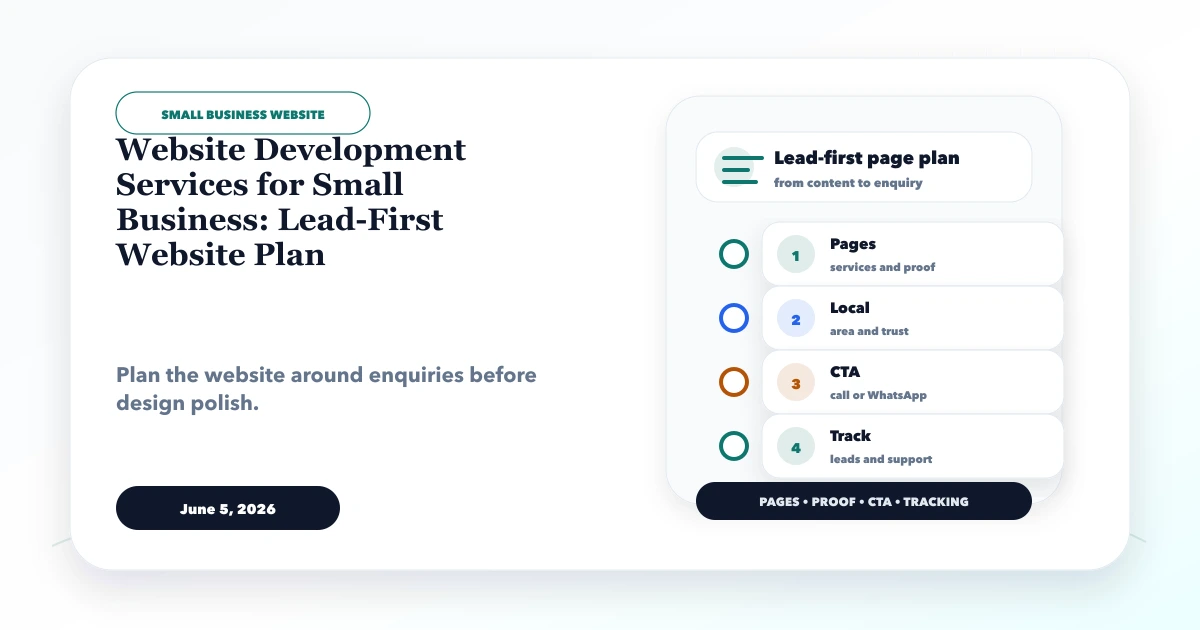
This guide explains website development services for small business for small business owners who want a website that generates calls, WhatsApp enquiries, and form leads instead of only looking presentable. It focuses on practical website planning, page structure, trust signals, SEO basics, lead capture, and a clean handover.
The goal is simple: build a website that helps visitors understand the business, trust the offer, and contact faster through call, form, or WhatsApp.
By Tushar C. (Founder, VASUYASHII). Reviewed by VASUYASHII Editorial for practical website planning, local SEO, lead generation, contact flow, and small business website delivery.
A small business website should start with the lead goal, then build the homepage, service pages, proof, contact flow, WhatsApp CTA, SEO basics, and tracking around that goal.
A local service provider may already have photos, a logo, and a phone number, but still lose enquiries because visitors do not see services, proof, pricing context, or a clear next step.
The practical target is not only a modern-looking page. The website should reduce buyer confusion, show proof, and make the contact path measurable.
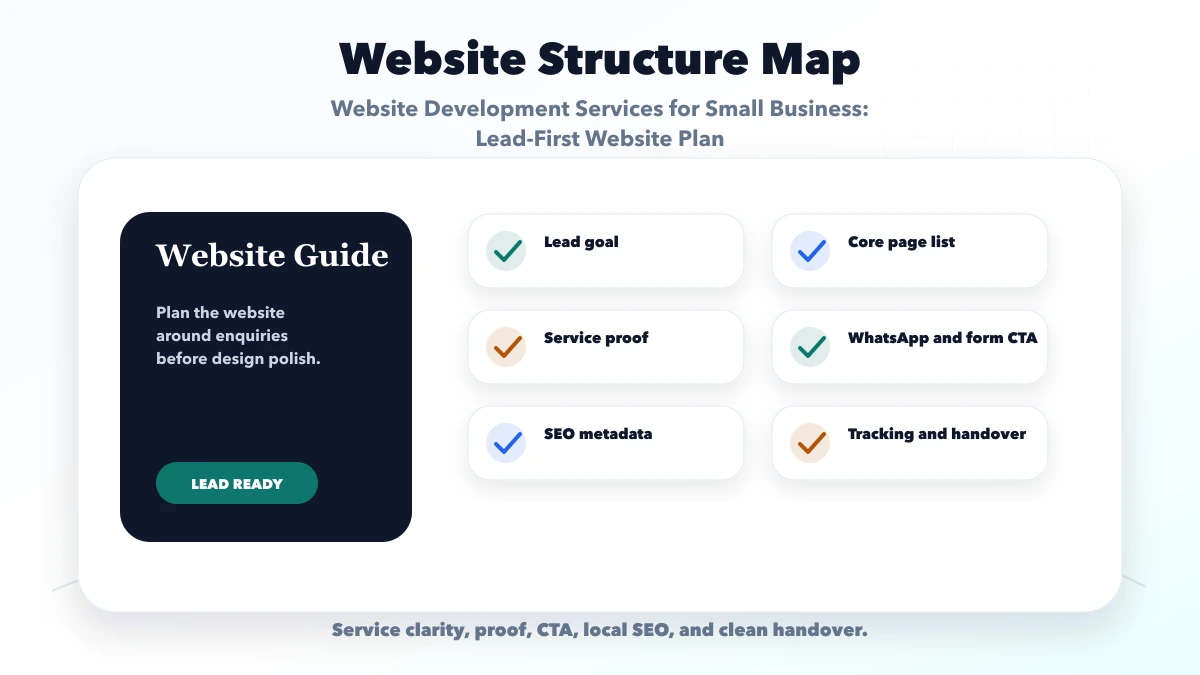
Each check should connect to a real buyer action. If a section does not support trust, search visibility, contact, or follow-up, it should be simplified or moved.
| Website area | What to include | Why it matters |
|---|---|---|
| Lead-first plan | Homepage, services, proof, CTA | Makes the next action clear |
| SEO foundation | Titles, meta, internal links | Helps Google understand pages |
| Lead system | Form, WhatsApp, call tracking | Turns visitors into enquiries |
The right structure depends on the business type. A shop, clinic, consultant, professional firm, and local service provider should not all use the same page plan.
Use this roadmap to build one useful launch version first. After launch, improve pages based on enquiries, search data, and customer questions.
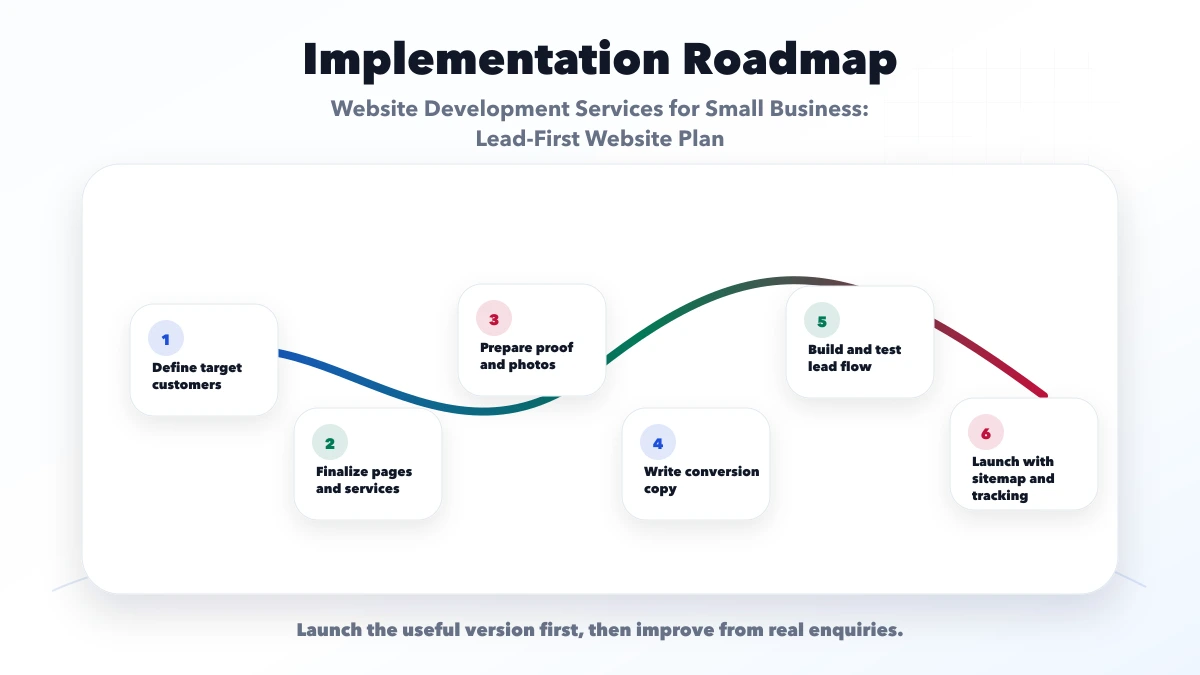
This checklist protects the project from looking complete but failing commercially. A good website should make the next step obvious and easy to measure.
VASUYASHII would first map services, target users, pages, proof, CTA, WhatsApp or form flow, SEO metadata, and handover needs. Then we would build the website in a focused phase instead of adding unnecessary complexity.
Useful links: web application services, software development, integrations, services, and contact.
Avoid judging a website only by design screenshots. Leads usually improve when service clarity, trust proof, speed, CTA, tracking, and follow-up work together.
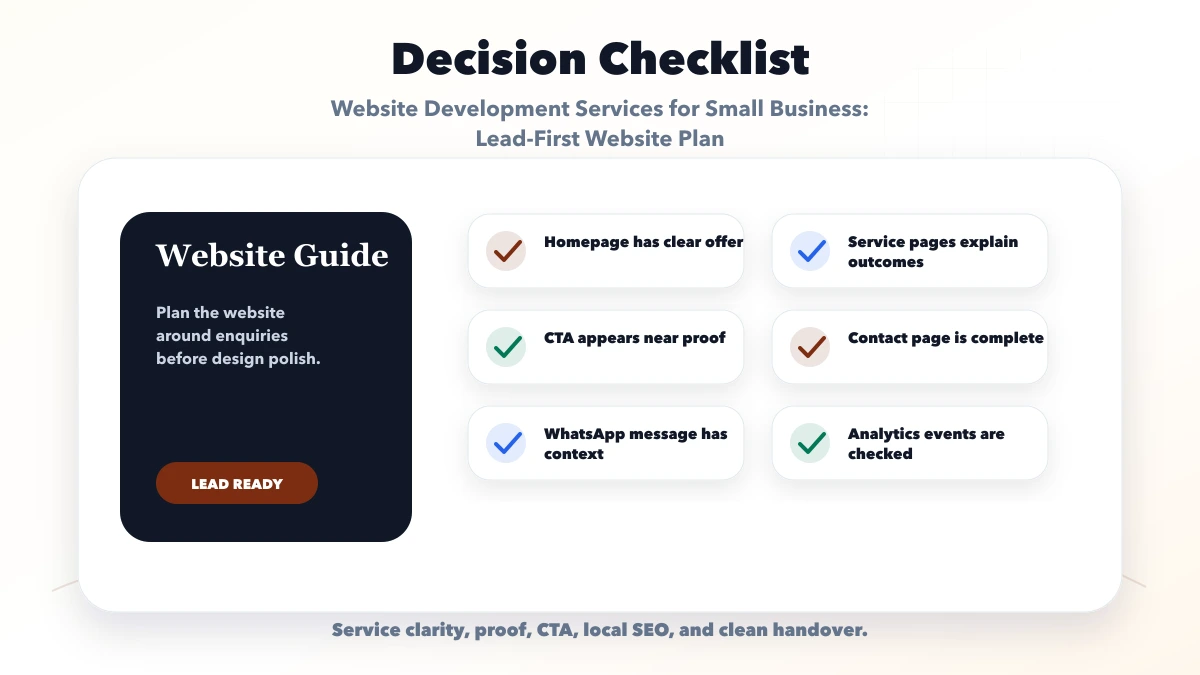
A website performs better when its main action matches how customers actually buy. A local repair service may prioritise phone and WhatsApp enquiries. A consultant may need a qualification form and scheduled call. A manufacturer may need an RFQ with product, quantity, location, and attachment fields. Trying to give every button equal priority makes the page harder to scan.
Choose one primary CTA for each page and one secondary option. Use clear labels such as “Request a Quote,” “Book a Consultation,” or “Send Product Requirement.” Track the action so you can measure whether visitors reach it from search, ads, social media, or referrals.
Use homepage, service detail pages, areas served, about, proof or reviews, FAQs, and contact. Each service page should explain the problem, process, deliverables, proof, common questions, and next step. Avoid creating dozens of city pages unless the business has genuine local proof and unique value for each area.
A CA, advocate, architect, or consultant needs expertise, service boundaries, process, team credibility, case examples, and a qualified enquiry flow. Avoid unsupported claims and stock testimonials. Explain who the service is for and what information a prospect should prepare.
Use product categories, capabilities, industries served, quality or compliance information, locations, enquiry requirements, and downloadable material where useful. A catalogue can support search and buyer evaluation without becoming full ecommerce.
The first screen should state what the business provides, who it serves, and the next action. Follow it with service choices, proof, process, differentiators, selected work, common questions, and contact. Visitors should not need to interpret abstract slogans before understanding the offer.
Keep navigation predictable. Important services should have direct links rather than being hidden behind a single generic page. The footer should include contact details, service links, company pages, privacy information, and the canonical business identity.
Review the broader structure through the website development Delhi NCR hub.
Useful proof includes real project screenshots, named deliverables, business outcomes, process artefacts, client reviews with context, company details, and clear support terms. If a project is confidential, explain the industry, problem, scope, and result without exposing private information.
Avoid decorative client-logo walls without permission or context. Show what was actually built and what role VASUYASHII played. Link to relevant services and live demos where they help a buyer understand quality.
Ask only for details needed for the next response. Name, phone, email, service, and short requirement are usually enough initially. Show what happens after submission and expected response time. Validate fields clearly and preserve the visitor’s input after an error.
A WhatsApp CTA should create a useful prefilled message containing the page or service context. Do not open a blank chat from every button. Track the click and ensure the phone number uses the correct country code. For CRM, email, WhatsApp, or analytics connections, use integration services.
Each important page needs a unique URL, descriptive title, useful meta description, one clear heading, crawlable text, image alt text, internal links, canonical URL, and sitemap entry. The content should answer real buyer questions rather than repeat the city or keyword unnaturally.
Technical setup cannot compensate for weak service information. Include process, deliverables, constraints, timelines, pricing factors, proof, and FAQs where they help. Link supporting blog guides back to the relevant service hub so search engines and users can understand the hierarchy.
Test the website on common Android and iPhone viewport sizes, not only a desktop browser. Buttons need adequate touch size, text must remain readable, forms should use correct input types, and sticky CTAs must not cover content. Images should have stable dimensions to reduce layout shift.
Use compressed modern formats, limit heavy animation, load only necessary scripts, and verify keyboard focus and colour contrast. Speed supports both conversion and search, but the practical goal is a stable page that lets visitors understand and contact the business quickly.
Website cost depends on unique pages, content work, visual design, custom functionality, CMS needs, forms, integrations, photography, migration, and support. Ask whether the proposal includes domain, hosting, SSL, analytics, Search Console, sitemap, redirects, content entry, testing, deployment, source code, and post-launch warranty.
Confirm who owns the domain, hosting account, analytics property, content, design files, and source repository. Request access and a handover document. A cheap package becomes risky when the vendor controls every account or charges separately for basic access.
Before launch, test forms, phone links, WhatsApp messages, emails, redirects, canonical tags, sitemap, robots rules, analytics events, and mobile layouts. Check legal and contact information. Keep a copy of the old URLs and add direct redirects where pages changed.
After launch, review Search Console coverage, lead events, top landing pages, form errors, call quality, and customer questions. Improve unclear copy based on real enquiries. Do not publish large volumes of near-duplicate location content as a shortcut.
For a focused quote, share your services, target locations, current website if any, proof assets, preferred CTA, and three competitor references through the contact page.
It should include page planning, responsive design, service content, contact flow, WhatsApp CTA, SEO basics, and launch support.
Most businesses can start with homepage, services, about, proof, contact, and one or more service detail pages.
Yes, for many Indian small businesses WhatsApp is a fast enquiry channel, but it should be placed with context.
Basic SEO should include titles, meta descriptions, headings, sitemap, image paths, and internal links.
Yes. VASUYASHII can plan, design, build, and launch lead-focused websites for small businesses.
If you want a practical plan for website development services for small business, VASUYASHII can help with scope, design, development, SEO setup, lead flow, launch, and maintenance.
Related Articles
June 8, 2026
Plan a travel agency website with controlled package data, clear inclusions, availability requests, itinerary leads, payment boundaries, and follow-up tracking.
Read article
June 5, 2026
Choose the right number of small business website pages using service intent, buyer questions, SEO value, content ownership, budget, and expansion plans.
Read article
June 2, 2026
Website for small business guide for 2026 with must-have pages, features, lead flow, WhatsApp CTA, SEO basics, and checklist.
Read article
June 5, 2026
Prepare a complete website development brief covering goals, audiences, pages, content, design, lead flow, SEO, access, ownership, and acceptance criteria.
Read article