
May 30, 2026
Landing Page Design Services in Delhi NCR
Landing page design services in Delhi NCR guide with conversion structure, WhatsApp CTA, forms, speed, pricing, testing, and launch checklist.
Read articlePublished Updated
Compare affordable landing-page providers by offer clarity, copy, responsive design, forms, speed, analytics, ownership, testing, and complete delivery scope.
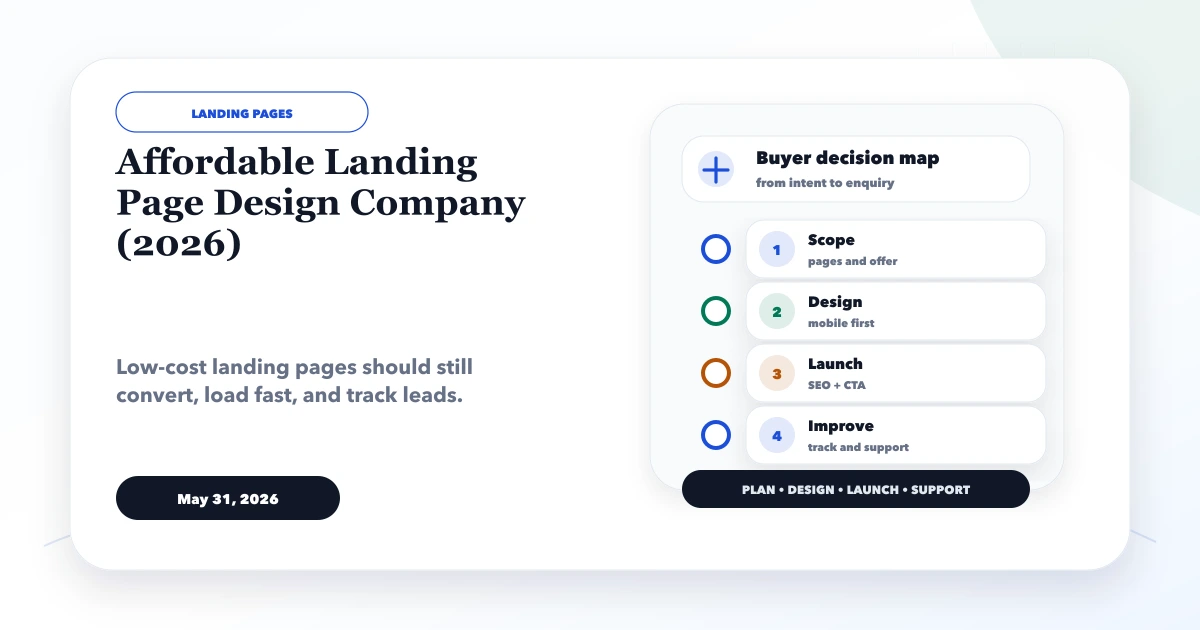
An affordable landing page design company should reduce cost by controlling scope, reusing stable components, and making decisions quickly - not by skipping copy clarity, mobile quality, form reliability, analytics, accessibility, or ownership handover.
The cheapest visible page may become expensive when campaign traffic reaches a slow page, leads are not tracked, the form sends nowhere, or every text change requires the original developer. This guide explains what a complete landing-page quote should contain and how a small business can prioritise the work.
Buy one focused page for one audience, one offer, one traffic source, and one primary action. The delivery should include message hierarchy, responsive design, working form/WhatsApp/call actions, performance basics, analytics events, SEO/share metadata where relevant, privacy handling, quality checks, deployment, and edit/ownership handover.
Review landing-page and web application services when the page needs custom lead flow or integration. A full multi-service website should be scoped separately.
| Scope choice | Cost-saving approach | Unsafe shortcut |
|---|---|---|
| Page count | One campaign page | Hiding required terms/contact details |
| Design | Reuse an approved component system | Copying another brand's page |
| Copy | Client provides evidence; specialist structures it | Publishing generic AI claims |
| Media | Optimise a small set of real assets | Heavy stock video above the fold |
| Form | Essential fields and one destination | Unverified email-only submission |
| Analytics | Track the primary conversion | Installing many marketing scripts |
| Testing | Focused device/browser matrix | Testing only the developer's laptop |
| Revisions | One structured review round | Unlimited undefined redesigns |
Affordability comes from a narrow, explicit contract.
Answer these questions:
A page for "all businesses" with five unrelated CTAs is difficult to write, test, and measure.
State the offer, audience, relevant outcome, and next action. Avoid headlines such as "Transforming Digital Excellence" that do not explain what is sold.
Include one primary CTA and supporting proof only when it is verifiable. The above-the-fold design guide provides a deeper layout checklist.
Show the situation the service handles and who it is not for. This prevents low-fit enquiries and signals expertise.
Explain what the buyer receives and how the work creates value. Use concrete items, not a long list of adjectives.
Use real screenshots, process artifacts, specific capability examples, genuine reviews, or approved case evidence. Never invent clients, metrics, ratings, or certifications.
Show the steps from enquiry to delivery and what the client must provide. This reduces uncertainty and revision delays.
Answer pricing boundary, ownership, timeline, support, content responsibility, integrations, and what happens after submission.
Repeat the same primary action with useful expectation-setting. Do not introduce a different offer at the end.
Clarify whether the provider will write final copy, edit a client draft, or only place supplied text. A design cannot compensate for an unclear offer.
The copy brief should include:
Use the service-page content guide for a broader content structure.
Choose the primary action based on sales operations. A form creates structured data; WhatsApp can start a quick conversation; phone suits urgent/high-intent services. Offering all three is acceptable when one remains visually primary.
For a form define:
The lead form versus WhatsApp guide helps match channel to workflow.
Track at least page view, primary CTA click, form start, valid form submission, call/WhatsApp click, and thank-you/confirmation where appropriate. Do not mark a button click as a qualified lead unless the business process supports that definition.
Capture campaign source in the lead record and test events in GA4 or the selected analytics tool. Avoid sending names, phone numbers, email addresses, or message text in analytics events.
An affordable page still needs:
Campaign-only pages may use a different indexing strategy, but that decision should be explicit rather than accidental.
| Workstream | Questions to ask |
|---|---|
| Discovery | Is offer/audience clarification included? |
| Copy | Drafting, editing, or placement only? |
| Design | Custom concept or approved component system? |
| Development | Static page, CMS, or custom integration? |
| Form/integration | Where does data go and how are failures handled? |
| Analytics | Which events and who verifies them? |
| Media | Who supplies and optimises images/video? |
| SEO metadata | Included for an indexable page? |
| QA | Which devices, browsers, and states? |
| Deployment | Domain/hosting access and rollback? |
| Handover | Source files, credentials, editing instructions? |
| Support | Warranty boundary and ongoing plan? |
Third-party hosting, domains, email, form tools, CRM, analytics, stock assets, payment, and messaging fees should be listed separately.
Our implementation process uses a pre-build conversion contract: the client approves one audience, one offer, one primary action, evidence, and lead owner. This first-party workflow reduces redesign caused by unresolved strategy; it does not promise a conversion rate.
Ask each company to respond to the same brief. Compare scope coverage, evidence, process, ownership, assumptions, exclusions, and post-launch support before comparing price.
Red flags include:
The amount depends on copy, custom design, integrations, media, analytics, compliance, and testing. Ask for a workstream breakdown; a fixed headline without scope is not comparable.
Yes, when its structure fits the offer and the copy, proof, mobile experience, form, and measurement are tailored. A template is a problem only when it dictates irrelevant content or remains visually generic.
No. A focused campaign page can launch independently, but it still needs real business identity, contact/privacy information, domain trust, and a follow-up process.
Show a fixed price, starting range, package, or quote criteria when the business can honour it. If scope varies, explain what changes cost rather than hiding every boundary.
The client should control the domain, production accounts, analytics property, lead destination, and approved source access. The contract should state reusable third-party assets and licences.
Contact VASUYASHII with the offer, audience, traffic source, CTA, evidence, deadline, and integration needs. The response can then focus on a complete lean scope rather than an arbitrary package.
Choose an affordable landing-page provider when the quote protects message clarity, lead reliability, mobile quality, measurement, and ownership while deliberately limiting non-essential custom work. Cheap omissions are not savings.
Related Articles
May 30, 2026
Landing page design services in Delhi NCR guide with conversion structure, WhatsApp CTA, forms, speed, pricing, testing, and launch checklist.
Read article
March 18, 2026
Design a lead-generation landing page with clear messaging, trust signals, focused CTAs, WhatsApp or forms, mobile speed, tracking, and testing.
Read article
June 4, 2026
Build a higher-converting service landing page with intent-matched sections, proof, offer clarity, CTA hierarchy, lead qualification, analytics, and mobile QA.
Read article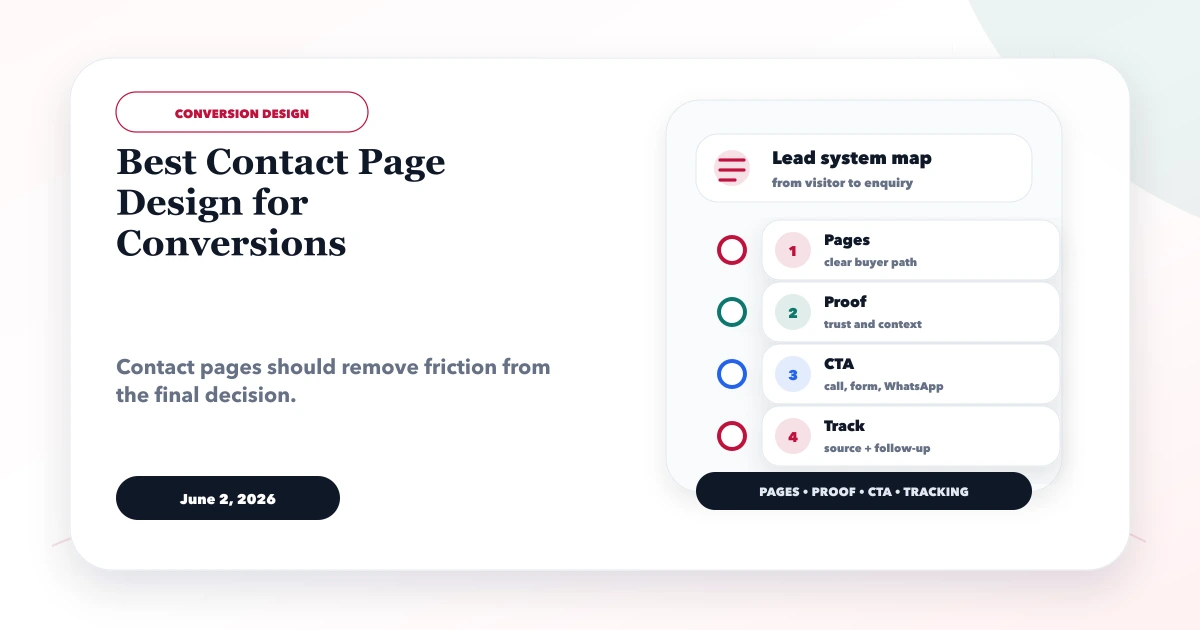
June 2, 2026
Design a contact page that routes qualified enquiries with clear actions, short forms, privacy cues, reliable delivery, mobile usability and useful analytics.
Read article