
June 5, 2026
Small Business Website Development: Lead-First Plan
Plan a small business website around service pages, trust proof, WhatsApp and form leads, local SEO, tracking, cost, and launch priorities.
Read articlePublished Updated
Plan a travel agency website with controlled package data, clear inclusions, availability requests, itinerary leads, payment boundaries, and follow-up tracking.
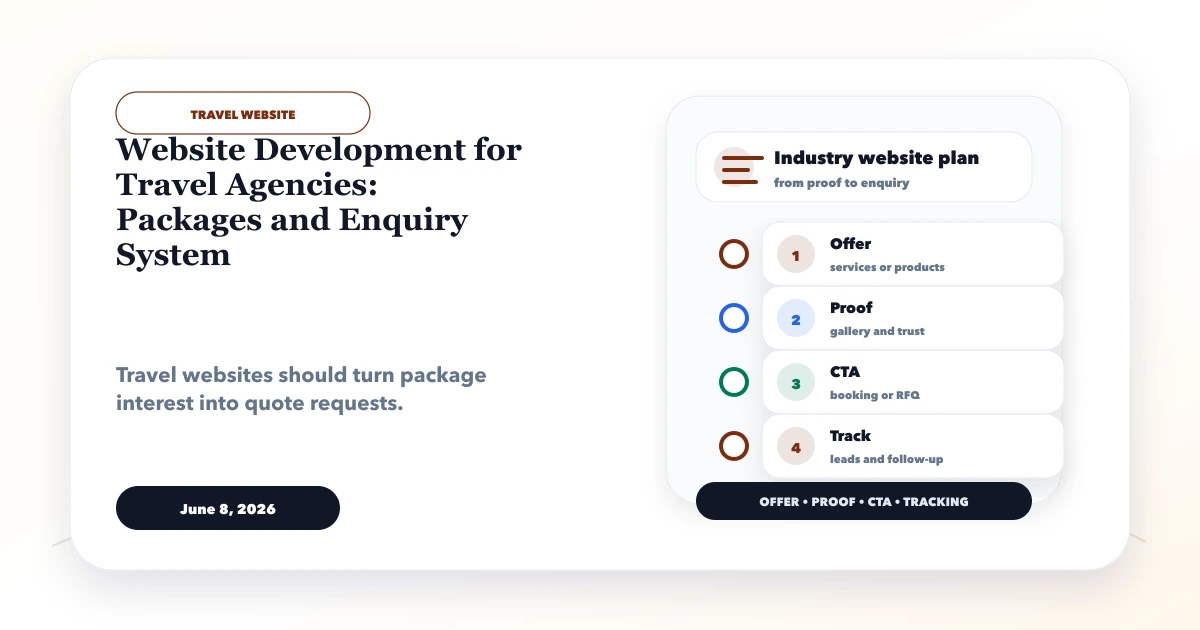
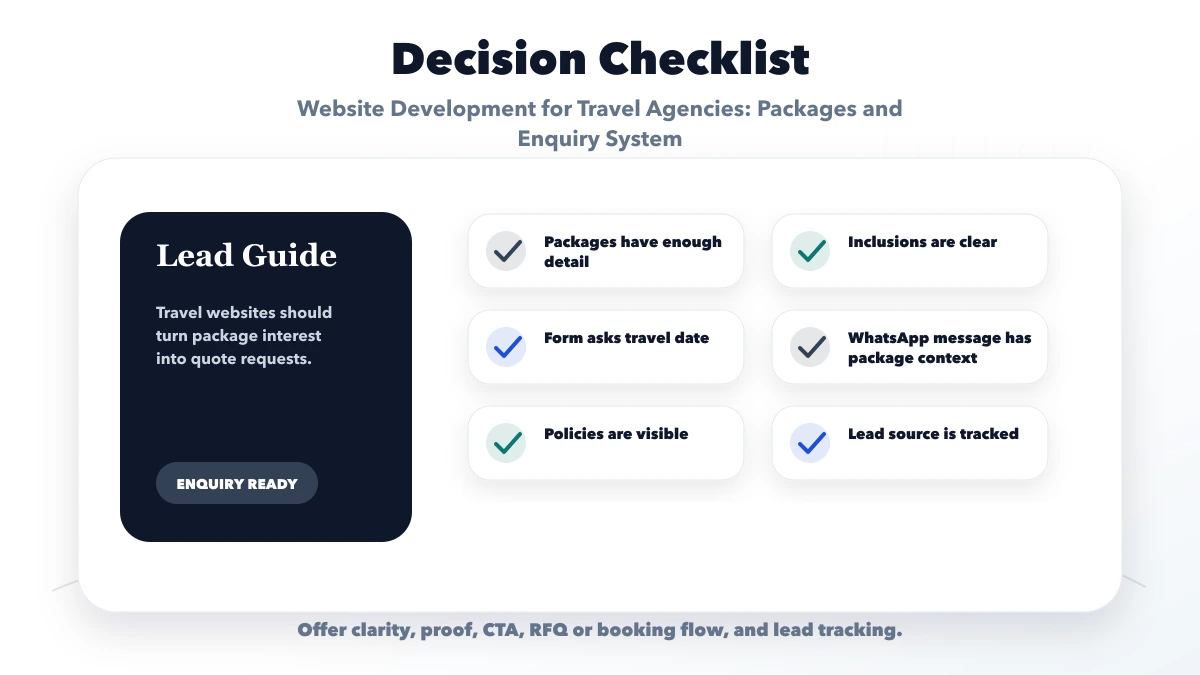
A travel agency website must inspire interest while keeping prices, availability, inclusions, visa notes, and booking states accurate. A destination gallery can generate clicks, but a visitor still needs to know whether the package fits the dates, travellers, departure city, budget, and support expectations.
This guide explains website development for travel agencies with controlled package data, itinerary pages, availability requests, lead qualification, payment and cancellation boundaries, WhatsApp handoff, search architecture, and operational ownership.
By Tushar C. (Founder, VASUYASHII). Travel availability, fares, visa requirements, taxes, supplier terms, safety notices, and cancellation rules can change. The agency must approve and maintain all commercial and destination information.
A useful travel agency website should include:
A package enquiry is not a confirmed booking. Confirmation should happen only after supplier availability, current price, traveller details, payment terms, and required documents are checked.
Travel packages change more often than normal service pages. Use a structured record for each package:
If the agency cannot maintain live price and availability, label values as starting or indicative and confirm them during enquiry. Never make an old promotional image the only source of package terms.
| Section | Visitor question | Required clarity |
|---|---|---|
| Summary | Is this trip relevant? | Destination, duration, trip type, departure, price basis |
| Itinerary | What happens each day? | Locations, activities, free time, transfers |
| Stay and transport | What category is assumed? | Hotel basis, room occupancy, flight/train/road scope |
| Inclusions | What is covered? | Meals, tickets, transfers, taxes, support |
| Exclusions | What may cost extra? | Visa, insurance, personal expense, optional activities |
| Dates and validity | Is the offer current? | Travel window, blackout, quote validity, availability note |
| Policies | What can change? | Payment milestones, cancellation/change reference |
| Enquiry | What information is needed? | Travellers, dates, city, budget, preferences, contact |
This structure helps search and conversion while giving staff one repeatable content standard.
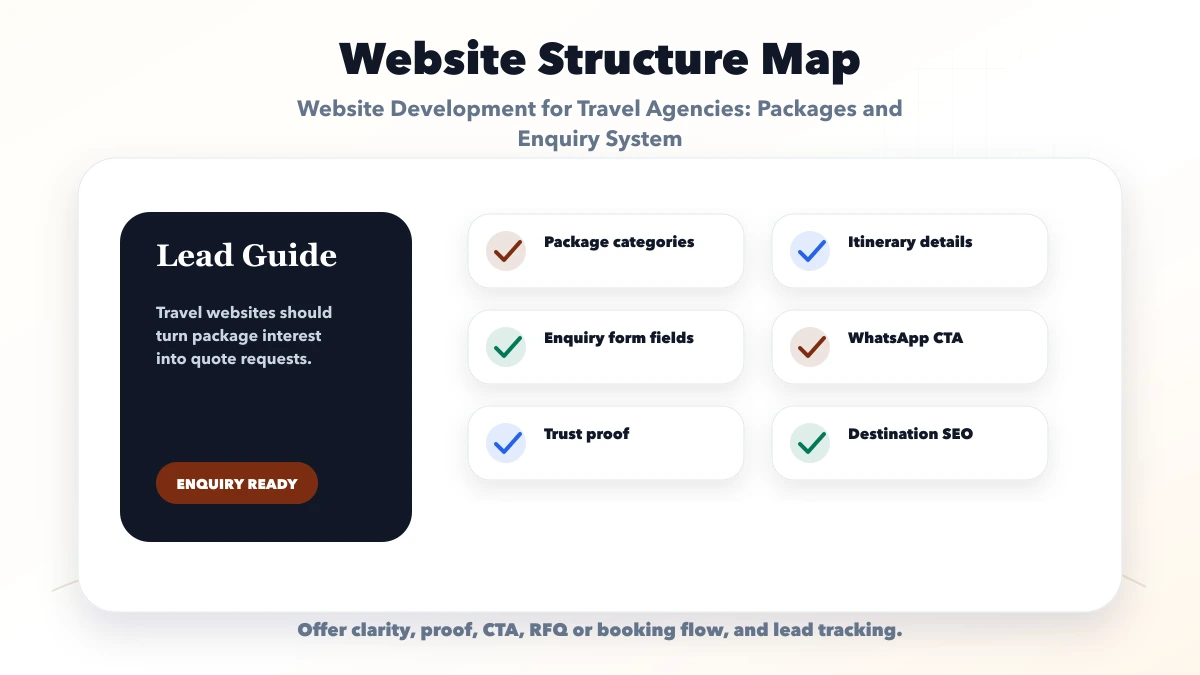
The first form should collect information that changes the package recommendation:
Do not ask for passport numbers or document uploads before the agency confirms that they are needed and provides an approved secure channel.
After submission, create a reference and explain the response process. Internally, assign an owner, verify supplier availability, update the current price, create or adjust the itinerary, record follow-up, send a proposal, and distinguish quote accepted from booking confirmed.
For higher volume, a custom web application can manage package records and enquiry status. Real-time inventory should be promised only when supplier APIs and failure handling are reliable.
WhatsApp works well for clarifying dates and coordinating a callback. Prefill the package ID or page title, travel month, and source context. Avoid a generic "Hi" link that forces staff to ask what the visitor viewed.
Use the structured form when multiple details are required. Phone support should display actual business hours and an alternative when staff are unavailable.
Track package enquiry start, valid submission, WhatsApp click, phone click, itinerary download, proposal sent, and booking confirmation in their appropriate systems. Do not place traveller names, phone numbers, dates of birth, passport information, or free-text requests in GA4.
Integration services can connect approved notifications or CRM workflows after data ownership and consent are defined.
An online payment button should not appear before the visitor understands what the amount reserves, refund/change rules, payment milestones, and confirmation conditions. A payment may represent an enquiry deposit, package hold, partial booking, or final payment; label it precisely.
The flow should show:
Use payment gateway webhooks and server-side verification rather than trusting a browser success screen. The agency owns supplier and consumer-policy compliance.
Build one useful destination hub and link packages, seasons, trip types, and practical guides from it. Avoid creating a separate thin page for every destination-keyword combination.
Original content can explain departure logistics, suitable trip duration, traveller type, package differences, and questions to ask before booking. Facts such as visa rules, entry requirements, safety notices, and taxes require authoritative sources and visible update dates.
Use only destination images the agency has the right to publish. Do not imply that a stock photograph represents the exact hotel, room, or package experience.
Useful proof includes real agency identity, current contact details, office/service model, verified registrations where relevant, clear support process, permission-approved customer reviews, real itinerary examples, and transparent terms.
Avoid invented traveller counts, fake destination partnerships, unverified hotel logos, guaranteed visa language, or reviews written by the agency. Explain whether the agency is the organiser, reseller, coordinator, or custom-itinerary provider when that distinction matters.
Consider a fictional Delhi NCR agency selling domestic family packages and customised international holidays. Its old site shows package posters with prices but no validity dates. Leads arrive on WhatsApp without traveller count, dates, or departure city.
A focused rebuild would create structured package pages, visible validity and occupancy assumptions, a custom-itinerary request, package-aware WhatsApp messages, and an owner dashboard. Old offers would automatically move to an expired state instead of remaining indexable as current deals.
Success would be measured by complete enquiries, response time, current quotes produced, proposal-to-booking progression, and fewer disputes about inclusions. This is an illustrative workflow, not claimed client performance.
Travel pages often contain many photographs. Use responsive formats, stable dimensions, lazy loading below the initial viewport, and restrained carousels. The first mobile screen should show destination, duration, price basis, validity, and enquiry action.
Forms need accessible labels, clear traveller controls, visible validation, and saved values after an error. Do not rely only on colour to show included/excluded items. PDFs should support the page, not replace crawlable and accessible itinerary information.
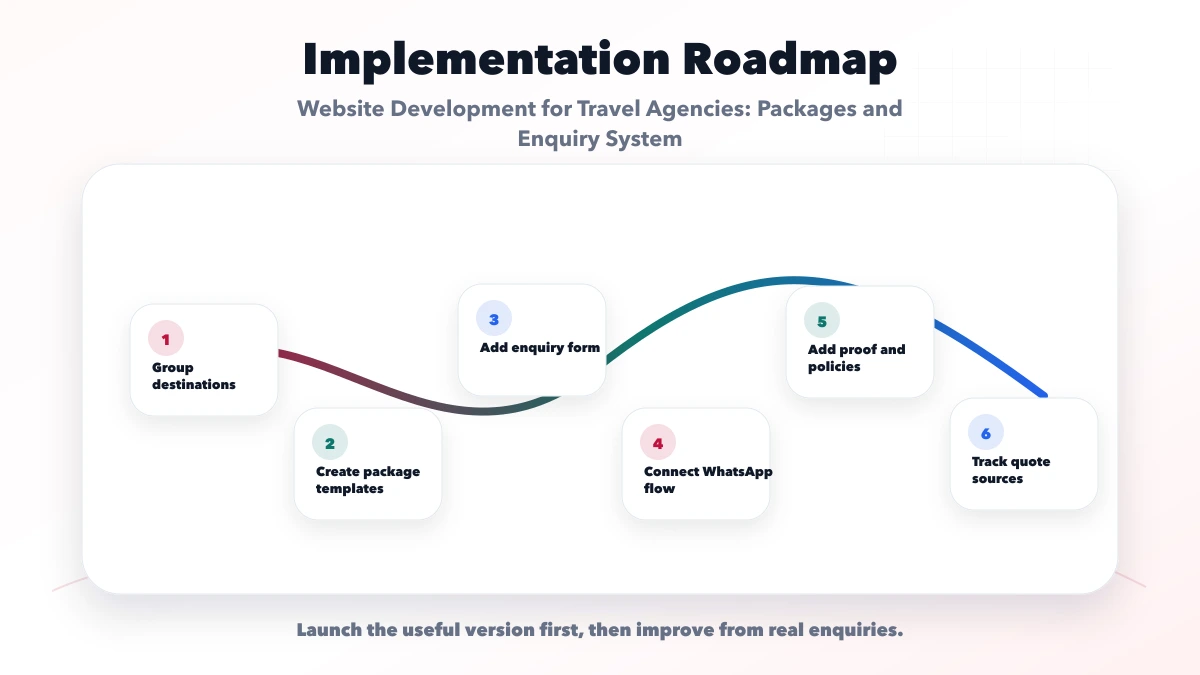
A static brochure site costs less than a structured package catalog, filters, custom itinerary builder, CRM routing, supplier API, payment workflow, document portal, and customer account.
Key effort drivers include package volume, update frequency, destination content, image preparation, search/filter complexity, currencies, multilingual content, payment and refund workflow, supplier integration, secure document handling, and ongoing maintenance.
Separate the public site, package CMS, lead workflow, booking engine, payment reconciliation, and customer portal in the quote. Review software development services and services for scope context.
Create an indexable page when the package has current, useful, distinct information. Expired or near-duplicate variants should be updated, consolidated, or handled according to their continuing value.
Yes, if a reliable authorised source or API exists. Define caching, failure, timestamp, manual override, and reconciliation before showing a price as live.
No. Qualify the trip first. Request sensitive documents later through an approved secure process when they are genuinely needed.
No. It is normally an enquiry or support conversation. Confirmation requires current availability, commercial terms, payment status, and the agency's formal booking record.
Remove outdated claims and decide whether the URL should show an updated alternative, an expired notice, or redirect to a relevant current hub. Do not leave stale prices as active offers.
Yes. VASUYASHII can scope the website, structured catalog, lead workflow, payments, and approved integrations. The agency remains responsible for supplier terms, package accuracy, travel rules, and customer commitments.
Start with controlled package records, transparent assumptions, a structured availability request, and a reliable staff follow-up process. Add live supplier inventory or customer accounts only when the data and operations are ready.
Review website development services, web applications, integrations, or contact VASUYASHII for a scoped plan.
Related Articles
June 5, 2026
Plan a small business website around service pages, trust proof, WhatsApp and form leads, local SEO, tracking, cost, and launch priorities.
Read article
June 10, 2026
Website development for builders with project pages, amenities, floor plans, enquiry strategy, WhatsApp CTA, trust proof, and SEO checklist.
Read article
June 7, 2026
Plan an architect website with approved project stories, clear role and scope, fast portfolios, consultation qualification, SEO, and lead ownership.
Read article
March 24, 2026
Compare website development packages in India by price, scope, deliverables, timelines, exclusions, ownership, acceptance checks, and maintenance needs.
Read article