
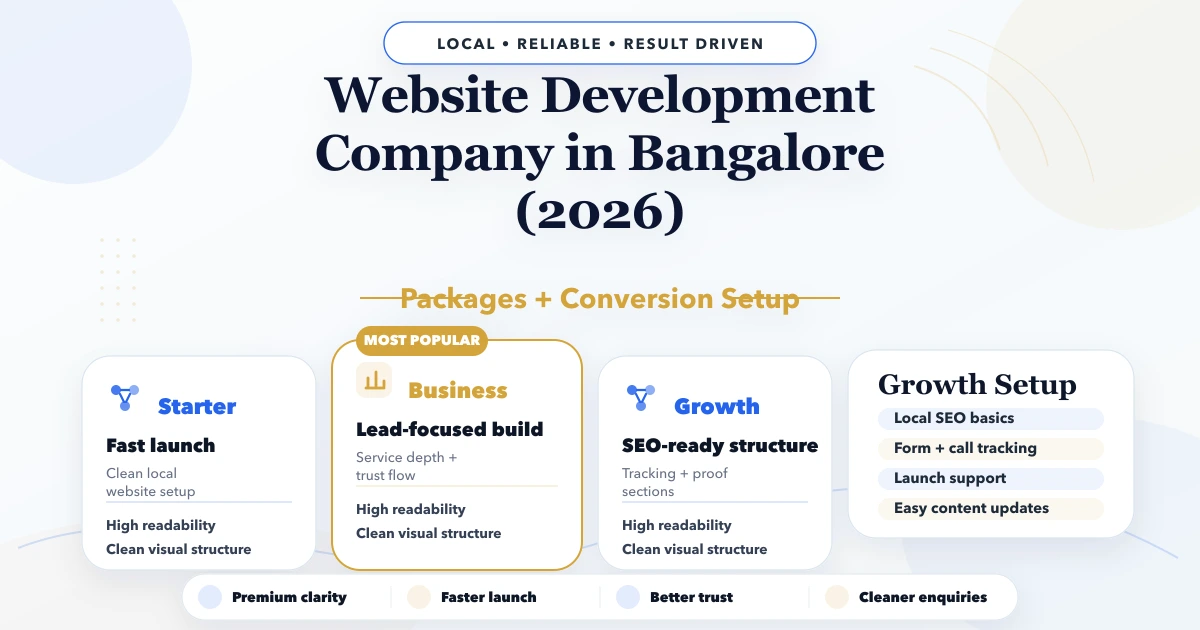
April 24, 2026
Bangalore Startup Website for Product Validation
Plan a Bangalore startup website for product validation with claim controls, waitlist or demo journeys, analytics, experiments, handover, and governance.
Read articlePublished Updated
Plan a startup website with the right pages, positioning, lead flow, technology, SEO, timeline, and cost decisions for an efficient 2026 launch.
A startup website must quickly explain the problem, target customer, offer, proof, and next action. A service startup may need qualified enquiries, while a SaaS startup may need demo bookings, trial sign-ups, or investor confidence. Those goals require different page structures and conversion flows.
This guide helps founders plan the first useful version without paying for pages or features that do not support the launch. It covers positioning, essential pages, lead capture, technology, SEO foundations, cost, and the handover details needed before development begins.
Most startups make one of these mistakes:
This guide gives you a complete website development blueprint for startups—pages, structure, tech choices, cost, timeline, and a conversion system that works in India (Delhi, Noida, Ghaziabad) and beyond.
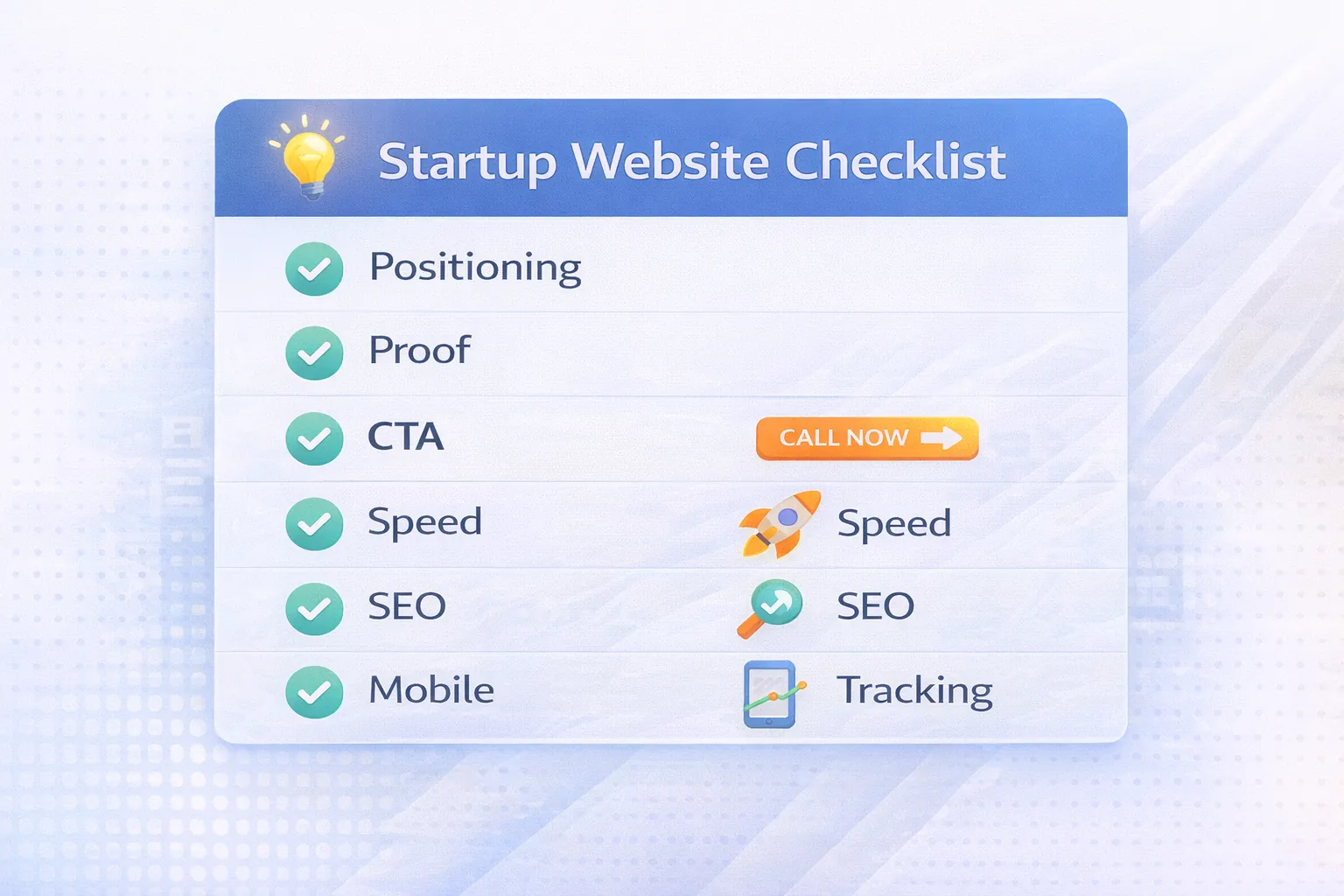
Big companies already have reputation and brand recall. Startups don’t. Your website must do extra work:
1) Trust building (proof, credibility, clarity) 2) Explaining your offer in simple language 3) Capturing leads quickly (WhatsApp / form / call) 4) Ranking on Google for long-tail keywords 5) Showing progress (case studies, demos, results)
If your startup builds web applications, portals, or dashboards, explore: Web Applications Services
Your startup site should answer three questions instantly:
1) What do you do? 2) Why should I trust you? 3) What should I do next? (CTA)
A visitor should not have to “search” your website to understand your offering.
Write a single sentence that a customer can understand.
Bad:
Good:
Pick one:
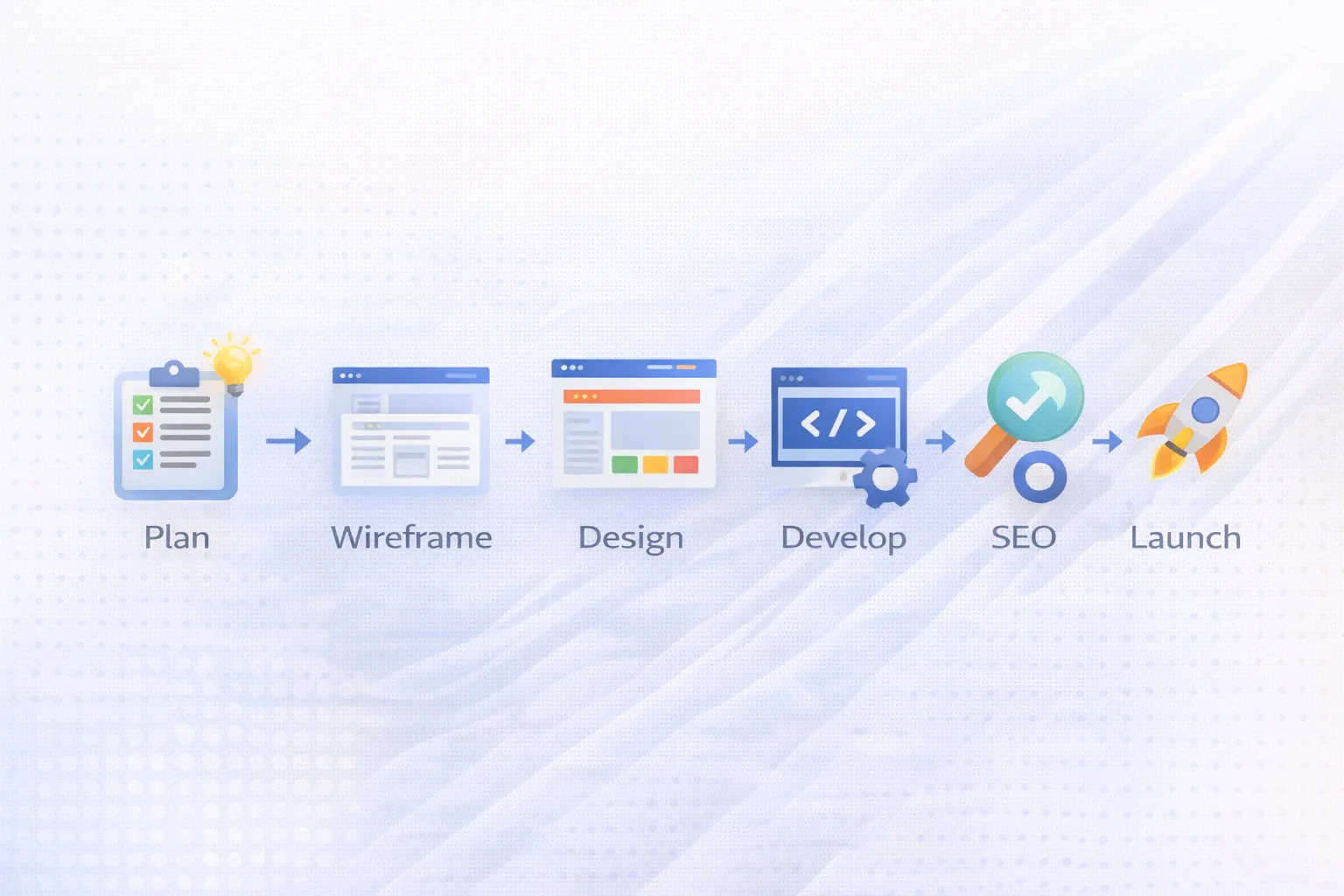
Start simple. Your first version should include only pages that help you sell.
Wireframes decide the section order (before design). This prevents rework.
Choose a clean system: spacing, typography, button styles.
Build responsive pages + forms + tracking + SEO basics.
Search Console submission + performance checks.
Startups don’t need 25 pages in the beginning. They need the right pages.
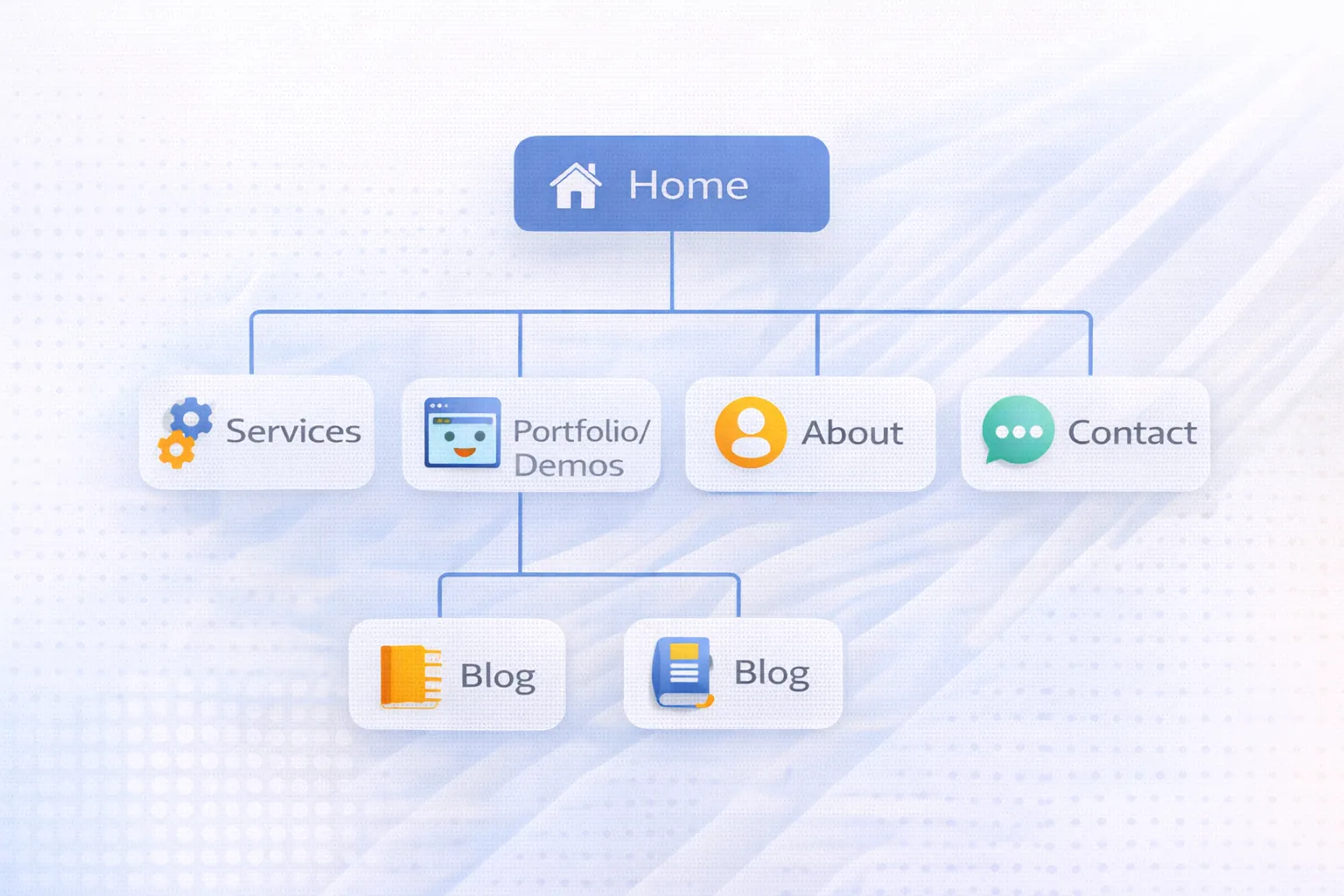
1) Home 2) Services / Product (or both) 3) Work / Case Studies (or demos) 4) About (trust page) 5) Contact 6) Blog (for SEO growth)
A startup homepage should follow a proven order:
Keep it simple: 3–6 services max.
Step 1 → Step 2 → Step 3 (customers love clarity)
Show real examples quickly.
Handle objections: cost, timeline, support, process.
End with a strong CTA and WhatsApp link.
Most startup websites fail because copy is generic. Use this:
Clarity + Proof + CTA
You can show working demos like:
And your work portfolio:
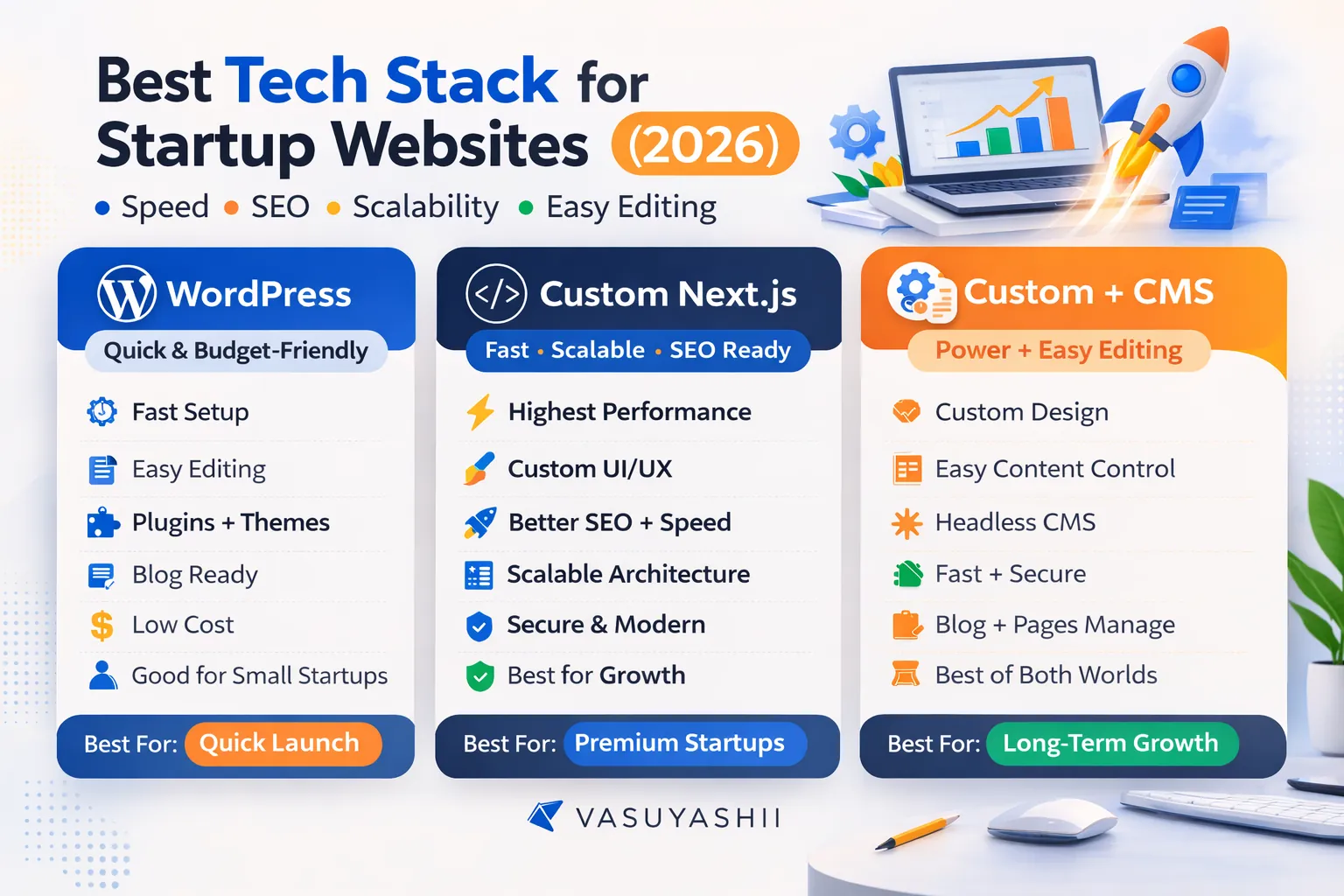
Good when:
Risk:
Best for:
Great if your startup wants a “product-like” website that feels modern.
Best when:
CMS options:
If your startup may need portals or dashboards later, document those future requirements before choosing the architecture. Custom code can preserve flexibility, but it also needs clear maintenance and ownership.
Startups don’t need advanced SEO tricks. They need fundamentals done perfectly.
/services/web-applications)Example internal links:
In India, WhatsApp converts best. But do it properly:
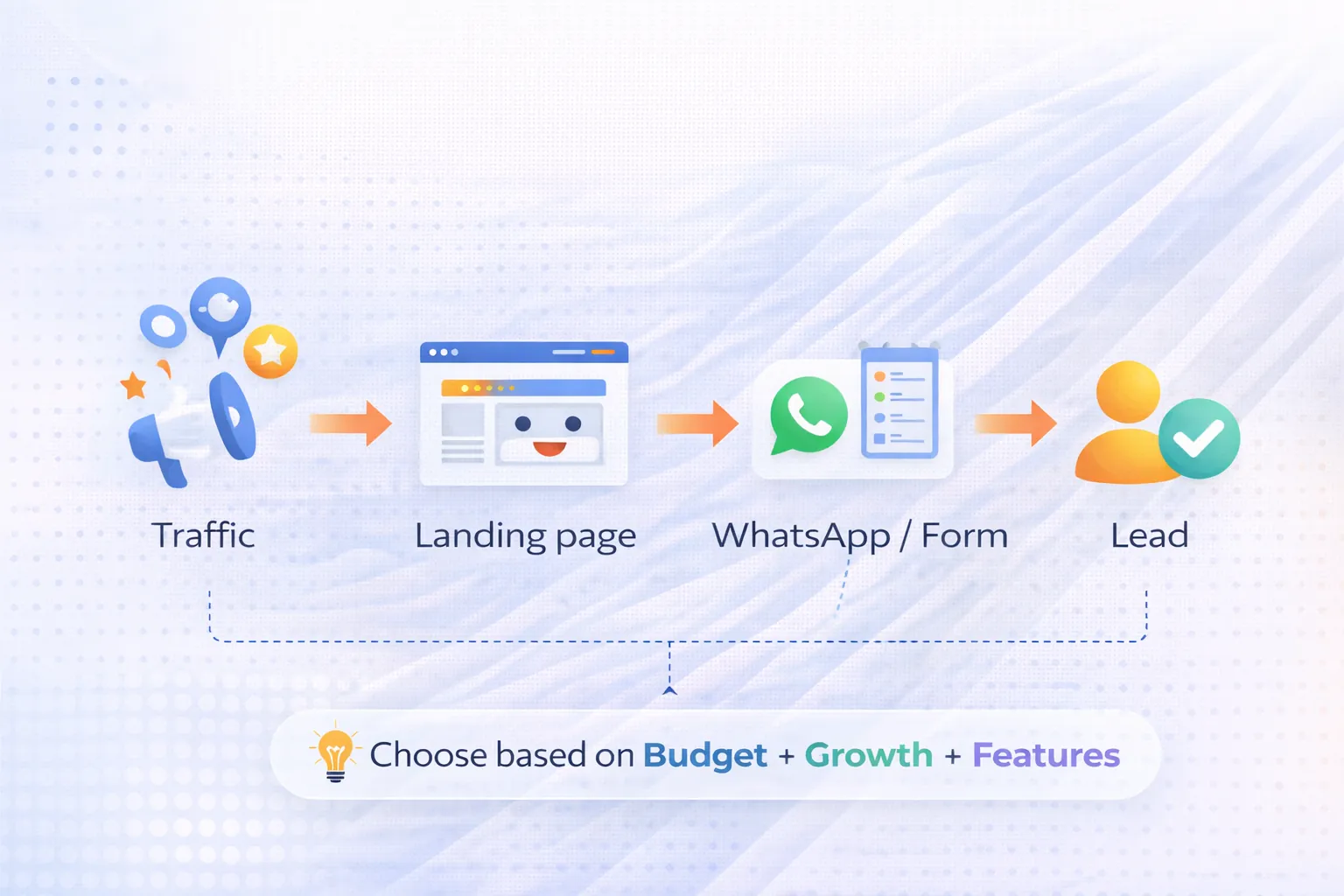
Example: 👉 WhatsApp: Chat on WhatsApp
Keep it short:
Startups typically choose one of these levels:
₹20,000 – ₹80,000 Good for: service startups, local lead generation
₹80,000 – ₹2,50,000 Good for: strong brand + better conversions
₹1,50,000 – ₹10,00,000+ Good for: platforms and automation systems
For detailed ranges, see: Cost of Website Development in India (2026)
A realistic timeline:
Fast launch tip: Launch with a strong base first (Home + Services + Portfolio + Contact). Then expand with blogs and case studies.
1) Launching without clear positioning 2) No proof (even demos count as proof) 3) Heavy animations that slow mobile performance 4) No SEO basics (meta, headings, sitemap) 5) No CTA or hidden CTA 6) Copying competitor content (duplicate content risk)
Use an evidence-led sequence:
1) State one audience, problem, offer, and next action. 2) Add a working contact route with confirmed delivery. 3) Publish only content that answers a real buyer question. 4) Add approved proof when it becomes available. 5) Improve pages using enquiries, analytics, and Search Console evidence.
The current VASUYASHII mobile homepage below is first-party evidence of a responsive startup-style service surface with positioning, supporting copy and contact actions.
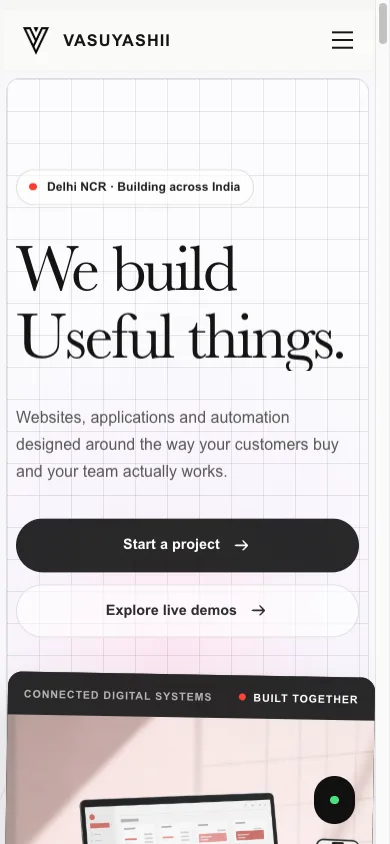
This screenshot proves the current interface exists. It is not a startup customer result and does not guarantee leads, funding, rankings or product-market fit. Those outcomes depend on the offer, audience, evidence, distribution and follow-up.
| Stage | Primary website job | Useful pages | Avoid initially |
|---|---|---|---|
| Problem discovery | Explain the problem and collect interviews | Landing page, founder context, contact | Large feature catalogue |
| MVP validation | Show one workflow and recruit users | Product, use case, FAQ, demo request | Unsupported customer claims |
| Early revenue | Qualify buyers and support sales | Service/product pages, proof, pricing logic, contact | Generic traffic-only blogs |
| Repeatable sales | Segment intent and build authority | Industry pages, case studies, resources | Duplicate city pages |
| Scale | Support product, partners and hiring | Documentation, integrations, security, careers | Unowned content expansion |
The website should change when the company learns something, not merely because a template includes more sections.
A new startup can publish founder experience, product screenshots, a clearly labelled interactive demo, methodology, security boundaries, public roadmap decisions, original research and waitlist or pilot terms. Do not invent customer logos, testimonials, user counts or revenue improvements.
Google's people-first content guidance recommends original information and clear first-hand expertise for an intended audience. Evidence should help a buyer make a decision even when the startup is new.
If you want a fast, SEO-ready startup website that generates WhatsApp leads and can scale into dashboards/portals later, we can help.
👉 WhatsApp: Chat on WhatsApp 👉 Services: Web Applications Services 👉 Services: View our services 👉 Contact: Contact page
A home page, services/product page, proof (portfolio/demos), about, contact, and a blog.
WordPress is quick; custom Next.js is faster and more scalable. If you can, choose custom + CMS for the best hybrid.
Use strong CTA (WhatsApp), proof sections, SEO blogs, and internal linking to service pages.
Indexing happens quickly, but meaningful rankings typically take 3–6 months with consistent content.
Blogs, case studies, performance improvements, and tracking events (WhatsApp clicks, form submits).
Related Articles
April 24, 2026
Plan a Bangalore startup website for product validation with claim controls, waitlist or demo journeys, analytics, experiments, handover, and governance.
Read article
March 16, 2026
Plan a corporate website around stakeholder journeys, governance, proof, security, performance, SEO migration, analytics, approvals, and ongoing ownership.
Read article
March 17, 2026
Responsive website development explained with mobile-first design, breakpoints, images, Core Web Vitals, SEO impact, mistakes, and best practices.
Read article
March 16, 2026
Understand frontend and backend responsibilities, data flow, security, costs, acceptance criteria, and architecture for websites and business apps.
Read article