
March 21, 2026
How to Choose a Web Development Company (2026)
Choose a web development company using portfolio proof, scope, pricing, timelines, SEO capability, ownership, support, and contract red flags.
Read articlePublished Updated
Website development cost in India for 2026 with pricing for business sites, ecommerce, web apps, portals, SaaS, timelines, and budget factors.

If you’re searching “cost of website development in India”, you’re not alone. In 2026, almost every business wants a website that looks modern, loads fast, ranks on Google, and generates leads on WhatsApp. But when you ask for quotes, you’ll see a massive range—₹5,000 to ₹5,00,000+ (and sometimes even higher).
So what’s the real cost? The honest answer is: website cost depends on what you’re building—a simple business website is very different from an ecommerce platform or a custom web portal.
In this guide, you’ll get realistic pricing ranges, what factors increase cost, what you should pay for (and what you should avoid), and how to pick a budget without getting stuck in a low-quality build.
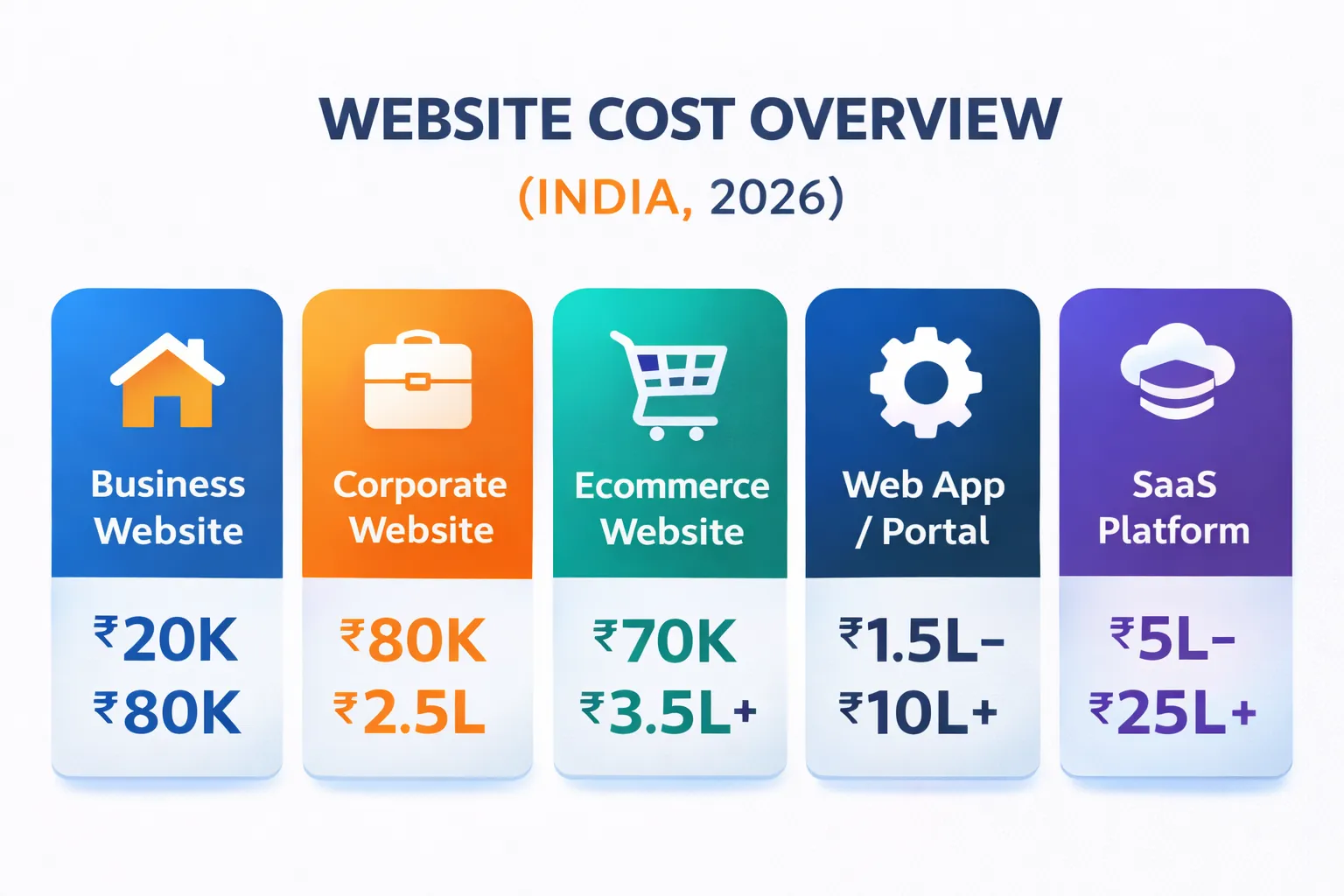
Here are realistic ranges you’ll see from most professional teams:
₹20,000 – ₹80,000 Best for: service businesses, small companies, local brands
₹80,000 – ₹2,50,000 Best for: companies needing a strong brand presence + credibility
₹70,000 – ₹3,50,000+ Best for: selling products online, integrating shipping/payment systems
₹1,50,000 – ₹10,00,000+ Best for: internal systems, client portals, automation, management dashboards
₹5,00,000 – ₹25,00,000+ (depends on scope) Best for: scalable products with login, billing, roles, analytics
If you’re building a system like dashboards/portal/apps, check our Web Applications Services.
Because people often compare different things:
A website isn’t just design—your cost includes:
A professional website typically has these cost components:
This decides what pages you need and how users move through them. Good sitemap = less confusion + higher conversion.
Custom UI/UX increases cost but improves trust and conversion a lot—especially for service businesses.
If you don’t have content ready, a team might help with copywriting.
This is where many cheap projects fail. If SEO and speed aren’t done properly, the website looks “fine” but doesn’t rank and doesn’t convert.
Testing on devices, fixing small issues, deployment, and basic support.
₹20,000 – ₹1,20,000
Includes:
Best for local businesses in India: Delhi / Noida / Ghaziabad, etc.
Tip: Create separate pages for key services (better SEO than one long page).
₹80,000 – ₹2,50,000+
Includes:
If you sell high-ticket services, corporate presence can double conversion.
₹70,000 – ₹3,50,000+
Cost depends on:
A simple ecommerce is cheaper; a custom ecommerce with advanced features costs more.
₹1,50,000 – ₹10,00,000+
Examples:
This is where businesses get the biggest ROI, because software saves time and increases efficiency.
If you want a portal/dashboard, start here: Web Applications Services.
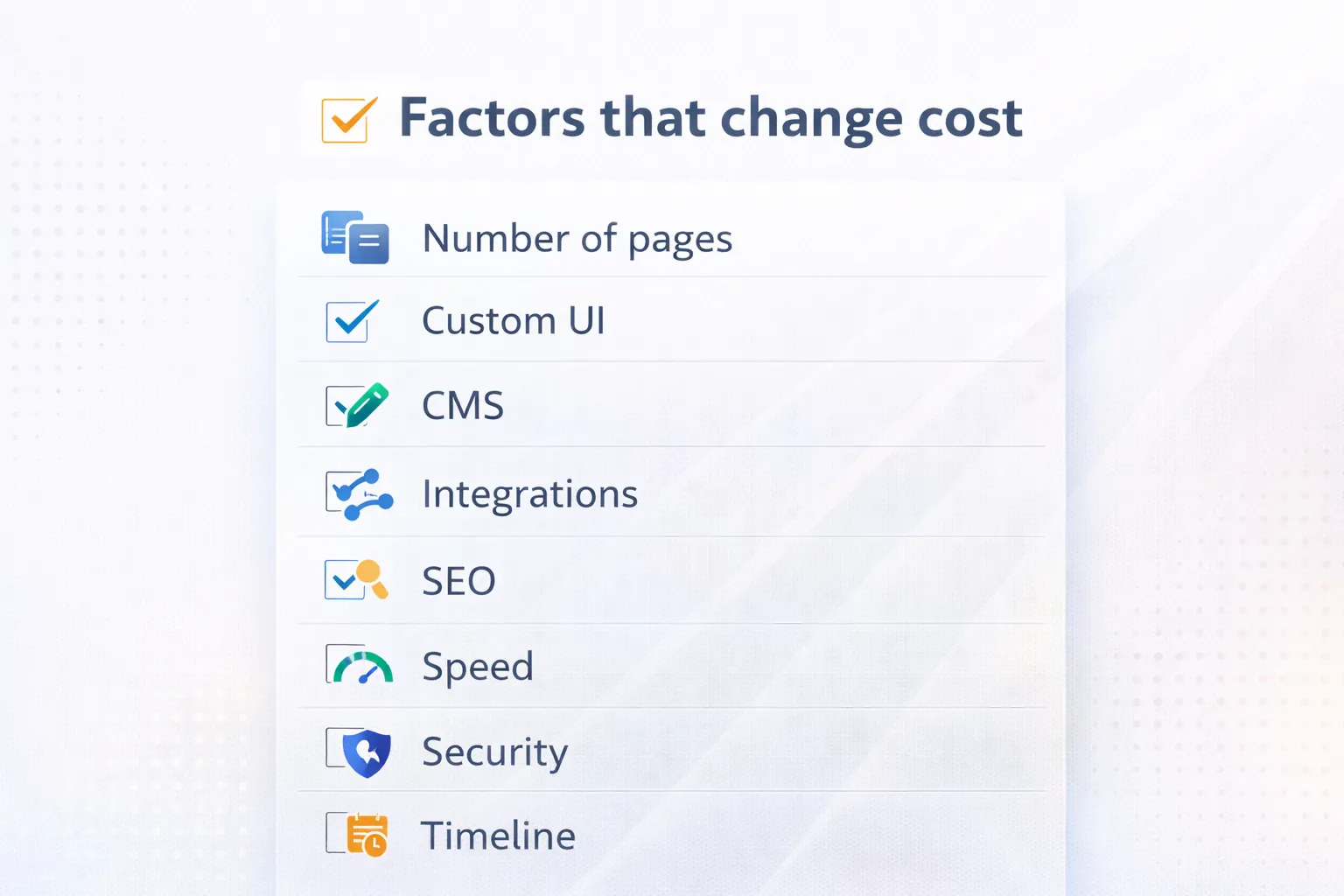
More pages = more UI + more QA.
Template is cheaper, custom design costs more but converts better.
Mobile is most traffic. Making it feel “premium” costs more but pays off.
If you need to update content easily (blog, pages), you may need CMS setup.
Light animations are okay; heavy animations increase dev time.
WhatsApp flows, email automation, CRM, analytics events, payment gateways.
Basic SEO = metadata + sitemap Advanced SEO = structured content + internal linking plan + speed optimization + schema
Fast websites need better engineering (image optimization, caching, lazy load, clean code).
Form spam protection, secure endpoints, rate limiting, backups.
If you need it “very fast”, cost increases due to rush work.
Pros: cheaper Cons: quality varies, support might be weak, SEO/performance often missing
Pros: structured process, reliable delivery, better design + QA Cons: slightly higher cost than freelancers
Pros: scalable architecture, best engineering Cons: highest cost, best for long-term products
Recommendation: If your goal is lead generation + brand trust, choose a team that focuses on speed + SEO + conversions (not just design).
These can increase cost later if ignored:
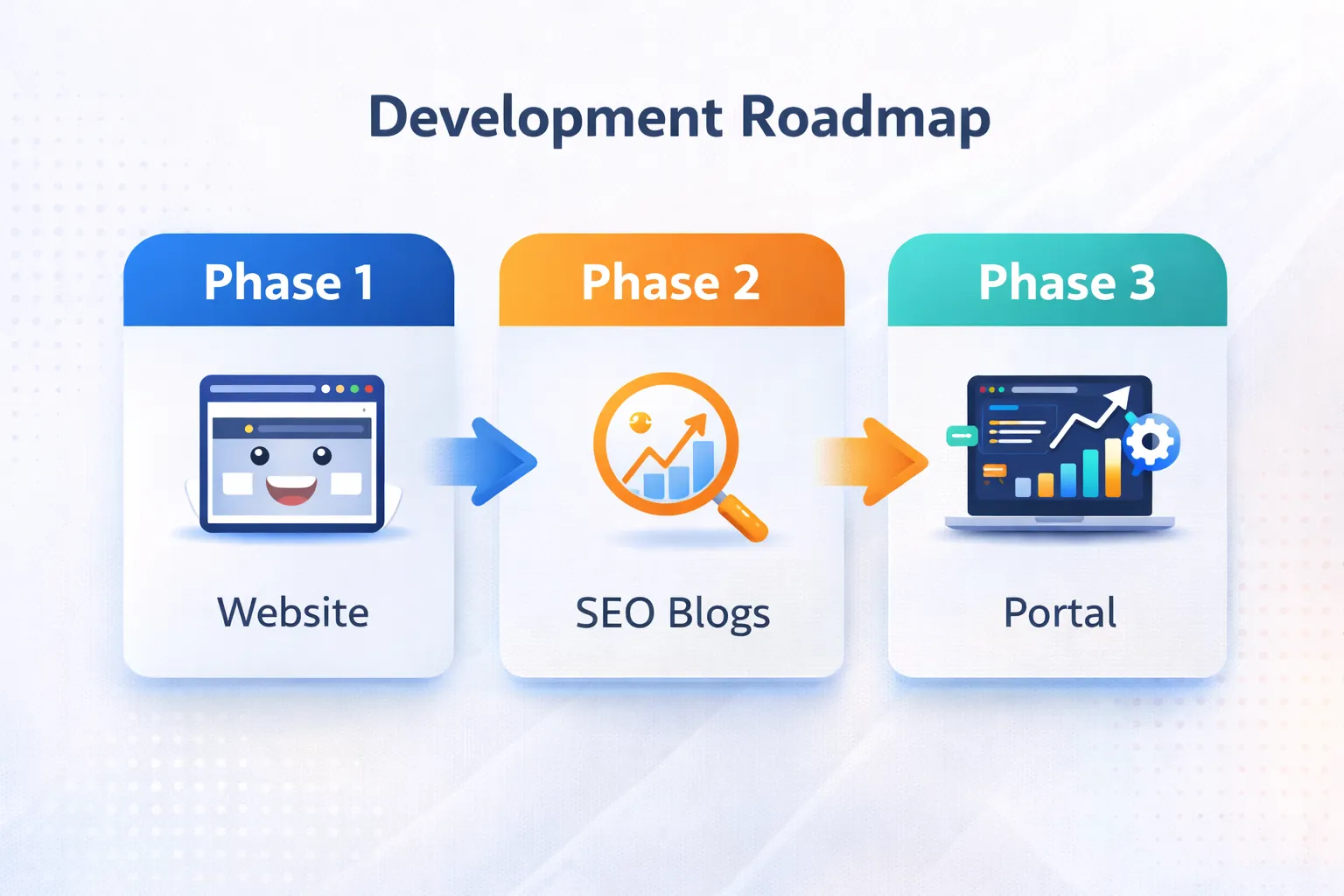
Best approach: Build a strong base, then grow monthly.
1) Start with a clear sitemap (don’t add unnecessary pages) 2) Use a clean design system (no random design changes) 3) Prepare content in advance (services, about, FAQs)
4) Use a phased approach:
If you are a service business that wants leads:
If you need automation / dashboards:
These are indicative planning ranges, not a public fixed-price offer. The final scope depends on pages, content readiness, design approval, integrations, migration, testing, ownership and post-launch support.
Page count is useful only after defining how many layouts, forms, integrations and content responsibilities are involved. A 20-page site built from four reusable templates can require less work than a five-page site with custom calculators, booking and CRM routing.
| Public page count | Common business use | Indicative planning range | Main variables |
|---|---|---|---|
| 1 page | Campaign or single-offer landing page | ₹10,000-₹50,000 | Copy, custom design, lead tracking and integrations |
| 5-7 pages | Focused small-business website | ₹20,000-₹80,000 | Unique service content, proof, SEO and forms |
| 10-20 pages | Multi-service or corporate website | ₹80,000-₹2,50,000 | Number of templates, approvals, migration and CMS |
| 20-50 pages | Established business, catalogue or resource-led site | ₹1,50,000-₹5,00,000+ | Structured content, filters, migration and editorial workflow |
| 50+ pages | Large catalogue, multi-location or publishing platform | Scope-based | Data quality, templates, search, permissions and maintenance |
These bands answer questions such as “how much does a five-page website cost?” only at a planning level. Ask for a page inventory that separates unique templates from repeated content. For a focused example, see the five-page website cost guide.
For a lead-focused Indian small business, ₹40,000-₹1,20,000 is a practical planning band when the scope includes original responsive design, useful service content, reliable lead capture, basic analytics, technical SEO, QA and handover. A lower budget can work when content is ready and a proven template fits; a higher budget may be justified by custom design, migration, multilingual content or integrations.
Do not compare only the launch amount. Add domain, hosting, maintenance, paid services and content ownership to the first-year total. The website maintenance cost guide explains recurring scope.
The current VASUYASHII website-development service hub below is first-party evidence of how the service is structured around planning, implementation, SEO foundations and lead flow.
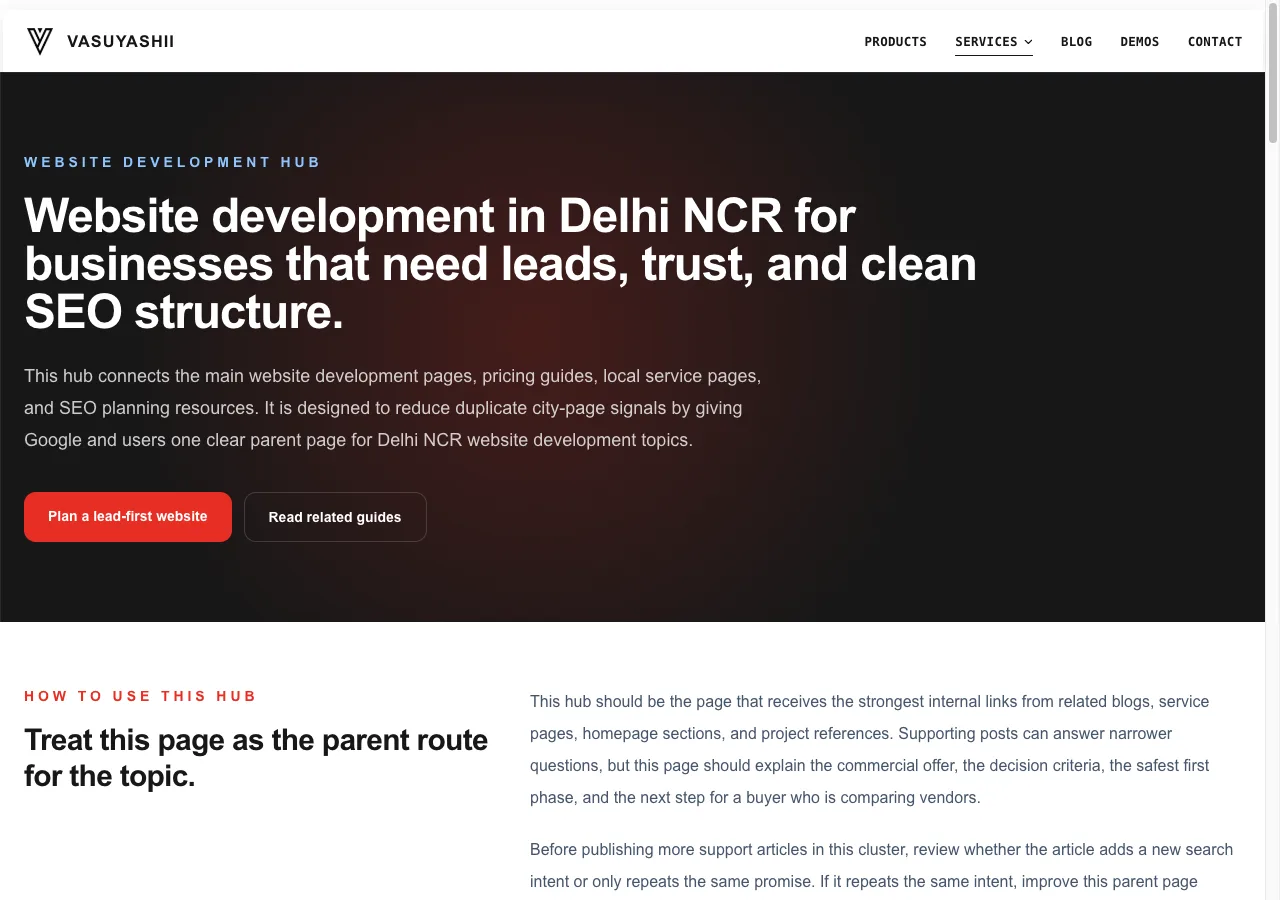
The screenshot is not a customer result and does not prove a universal price or ranking outcome. It shows the current service surface that should be translated into a project-specific scope.
Ask the developer to state assumptions beside the price.
| Scope area | Assumption that changes cost | Evidence at acceptance |
|---|---|---|
| Pages | Count, templates and language versions | Approved URL inventory |
| Content | Client-supplied or written by provider | Final copy in staging |
| Design | Template, customised system or original UI | Approved responsive screens |
| CMS | None, standard CMS or custom editing | Named editing workflow |
| Lead flow | Form, WhatsApp, phone, CRM routing | Successful test submissions |
| SEO | Metadata only or technical/content architecture | Crawl and rendered-page checks |
| Integrations | Provider, environment and failure handling | Sandbox/production test record |
| Handover | Domain, hosting, source and documentation | Signed access register |
Without these assumptions, a ₹30,000 quote and a ₹90,000 quote may describe different deliverables rather than different margins.
Budget separately for domain, hosting, email, paid fonts or assets, CMS licences, plugin subscriptions, analytics tools, maintenance, security monitoring and content updates. Ecommerce or app-like projects may also have payment-gateway, messaging, database, storage and third-party API charges.
Keep the domain, hosting/cloud account, analytics and Search Console under business-controlled accounts. The final payment checklist should include repository or CMS access, backups, deployment notes, design assets, open issues and licence records.
Review the website project agreement guide and delivery checklist before comparing only launch prices.
Link milestones to observable results:
Google's people-first content guidance and Core Web Vitals guidance are useful quality references. They do not guarantee ranking, and a quote should not promise a fixed Google position.
If you want to see working demos before building:
And you can view our work here:
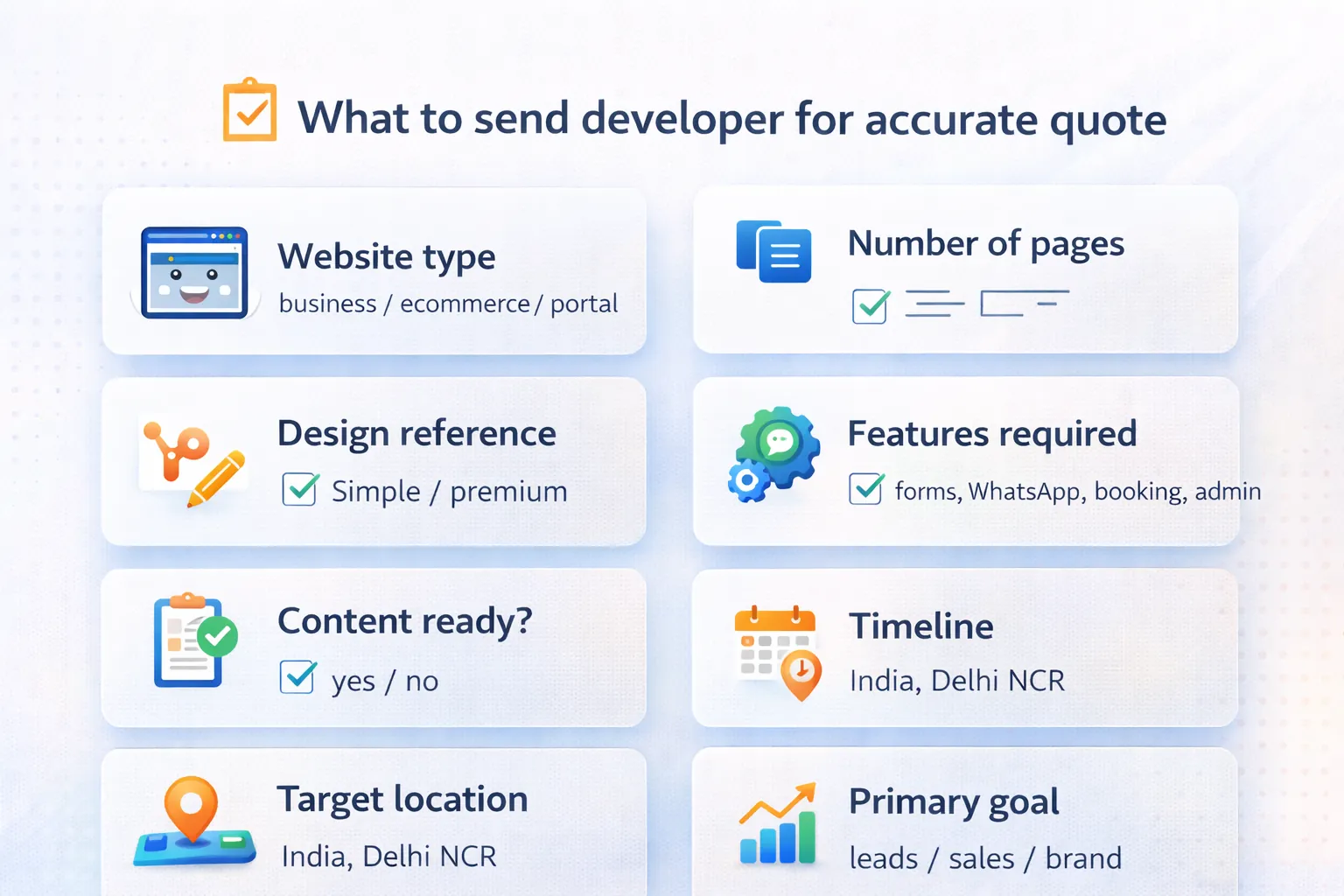
Send these 8 points and you’ll get accurate quotes:
1) Website type (business / ecommerce / portal) 2) Number of pages 3) Design reference (simple / premium) 4) Features required (forms, WhatsApp, booking, admin) 5) Content ready? (yes/no) 6) Timeline 7) Target location (India, Delhi NCR)
8) Primary goal (leads / sales / brand)
If you want a fast, SEO-ready business website or custom web application that generates leads, our team can build it for you.
👉 WhatsApp: Chat on WhatsApp 👉 Services: Web Applications Services 👉 Services: View our services 👉 Contact: Contact page
A basic template-style website can start low, but for professional quality and conversions, realistic range is ₹20,000+.
Usually it’s a basic template with minimal SEO, little customization, and limited support. It can look okay but often performs poorly.
In 2026, a well-built 5–7 page business website is typically ₹20,000 – ₹80,000, depending on design and SEO.
Most web apps start around ₹1,50,000+ and can go higher depending on modules, roles, and integrations.
Yes, but it’s worth it. Good SEO + speed setup can increase initial cost slightly, but improves rankings and leads long-term.
WordPress is quicker for budget projects; custom Next.js often wins on speed and premium UX when built properly. Choose based on needs.
Yes. Phase-based approach is one of the best ways to manage budget while keeping quality strong.
Related Articles
March 21, 2026
Choose a web development company using portfolio proof, scope, pricing, timelines, SEO capability, ownership, support, and contract red flags.
Read article
March 16, 2026
Plan a corporate website around stakeholder journeys, governance, proof, security, performance, SEO migration, analytics, approvals, and ongoing ownership.
Read article
March 24, 2026
Learn what increases website cost in 2026, including pages, CMS, integrations, speed, SEO, copy, and design choices that move pricing up or down clearly.
Read article
March 20, 2026
Compare WordPress and custom development by workflow, content ownership, integrations, security, performance, maintenance, cost, migration, and long-term fit.
Read article