
June 10, 2026
Property Dealer Website: Listings and WhatsApp Leads
Plan a property dealer website with verified listings, buyer and owner forms, WhatsApp qualification, CRM ownership, privacy, and listing expiry controls.
Read articlePublished Updated
Website development for shops in Ghaziabad with pages, product catalog, WhatsApp leads, local SEO, cost ranges, and checklist.
Service-area note: VASUYASHII is based in Delhi NCR and supports businesses remotely across India. A city-focused guide describes service and planning context; it does not claim a physical office in every location mentioned.
Explore the parent topic: Website Development Delhi NCR Hub →This guide explains website development for shops in Ghaziabad for Ghaziabad shop owners who want a website for product enquiries, catalog visibility, WhatsApp orders, or local SEO. It focuses on practical website planning, page structure, trust signals, SEO basics, lead capture, and a clean handover.
The goal is simple: build a website that helps visitors understand the business, trust the offer, and contact faster through call, form, or WhatsApp.
By Tushar C. (Founder, VASUYASHII). Reviewed by VASUYASHII Editorial for practical website planning, local SEO, lead generation, contact flow, and small business website delivery.
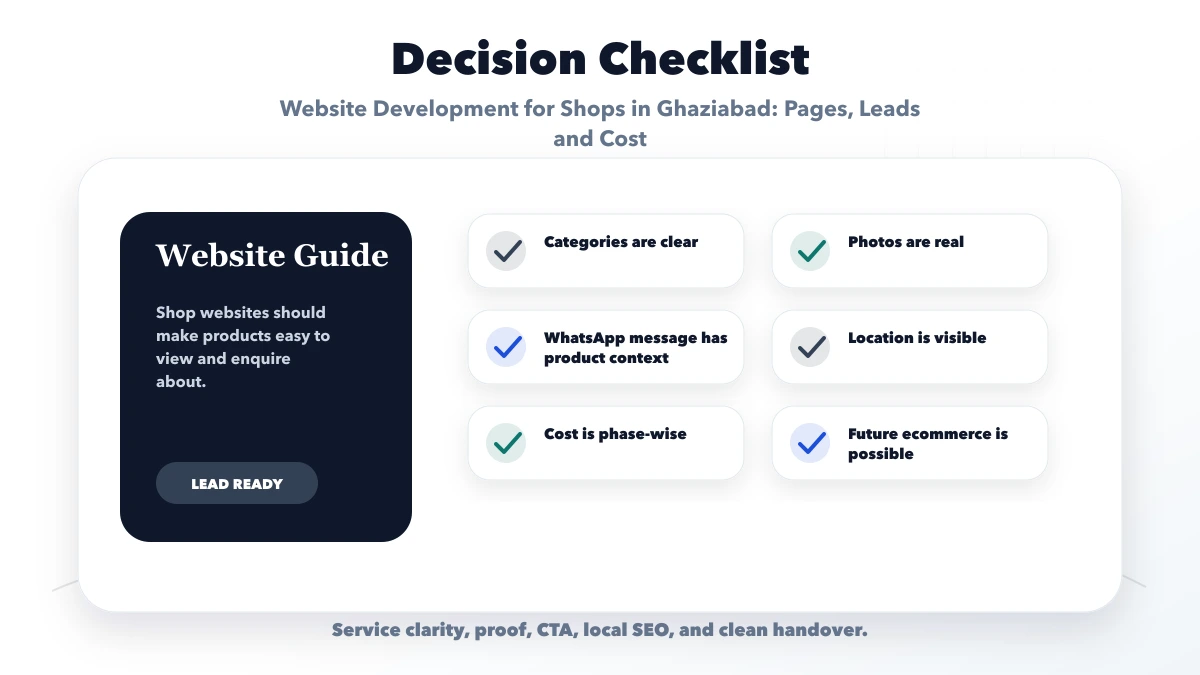
A Ghaziabad shop website should include product or category pages, store details, WhatsApp enquiry, call CTA, location, photos, offers, FAQs, and local SEO basics.
A shop may not need full ecommerce immediately. A catalog plus WhatsApp enquiry can be a practical first step before online payments and inventory sync.
The practical target is not only a modern-looking page. The website should reduce buyer confusion, show proof, and make the contact path measurable.
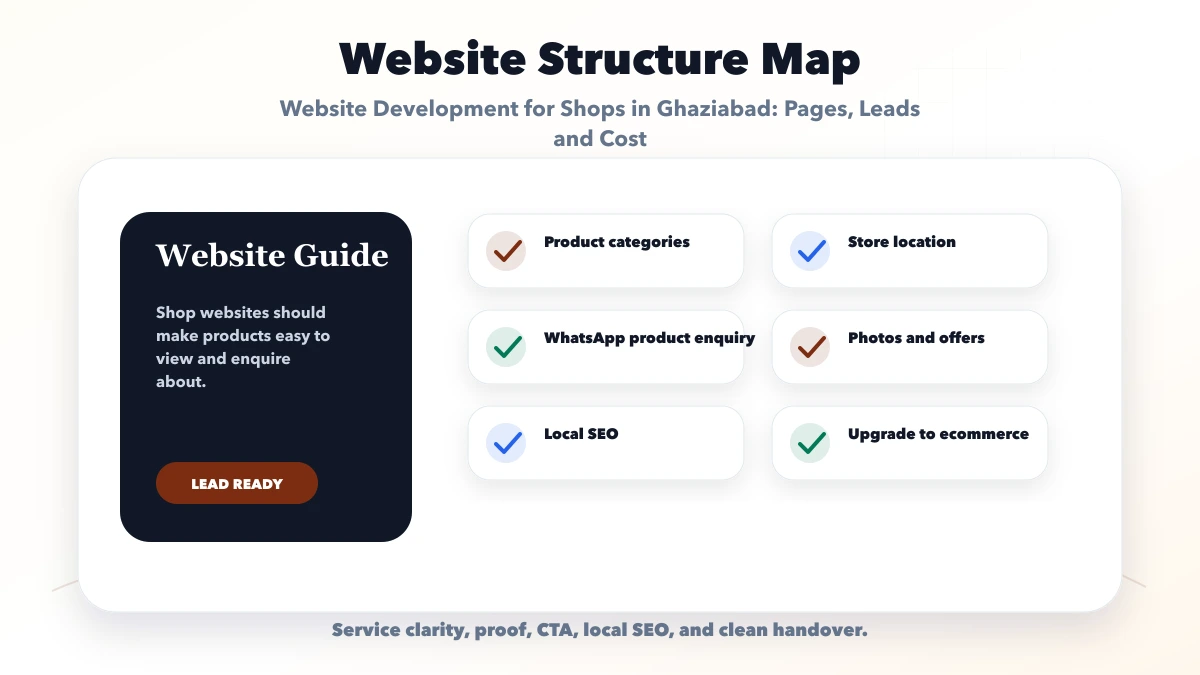
Each check should connect to a real buyer action. If a section does not support trust, search visibility, contact, or follow-up, it should be simplified or moved.
| Website area | What to include | Why it matters |
|---|---|---|
| Catalog website | Products, categories, WhatsApp | Good starter |
| Lead website | Offers, location, CTA | Gets enquiries |
| Ecommerce upgrade | Cart, payment, inventory | For online selling |
The right structure depends on the business type. A shop, clinic, consultant, professional firm, and local service provider should not all use the same page plan.
Use this roadmap to build one useful launch version first. After launch, improve pages based on enquiries, search data, and customer questions.
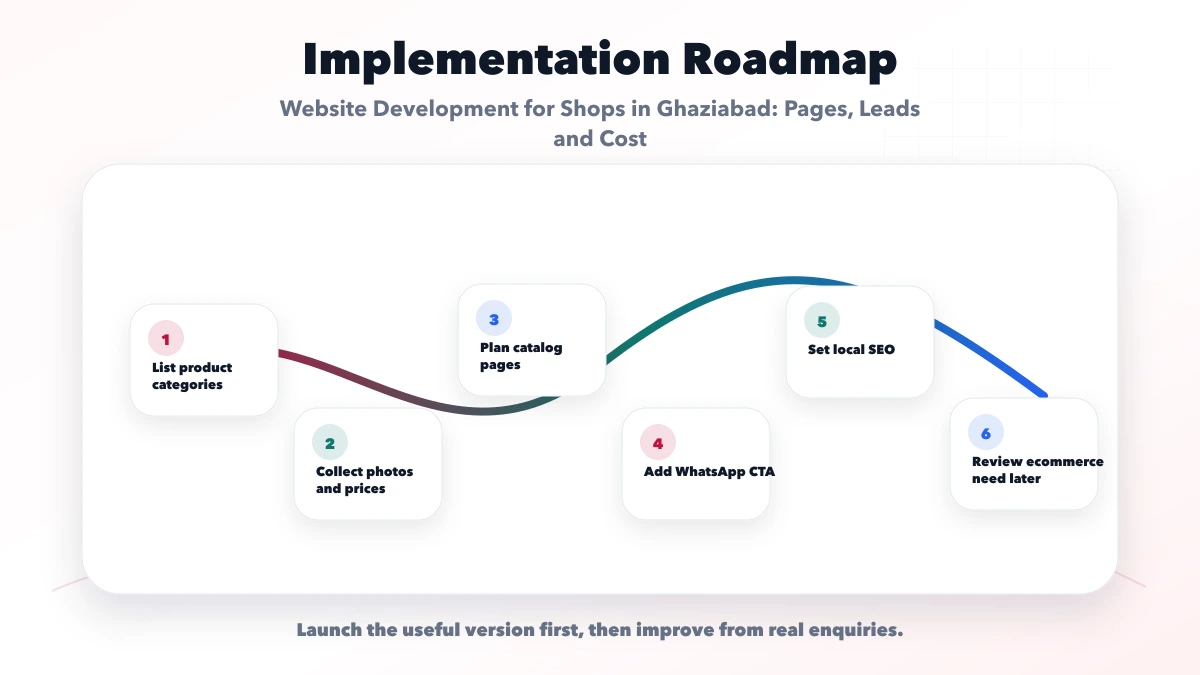
This checklist protects the project from looking complete but failing commercially. A good website should make the next step obvious and easy to measure.
VASUYASHII would first map services, target users, pages, proof, CTA, WhatsApp or form flow, SEO metadata, and handover needs. Then we would build the website in a focused phase instead of adding unnecessary complexity.
Useful links: web application services, software development, integrations, services, and contact.
Avoid judging a website only by design screenshots. Leads usually improve when service clarity, trust proof, speed, CTA, tracking, and follow-up work together.
A shop does not automatically need ecommerce. A product catalogue can help customers discover categories, check important details, ask about a model, and visit or contact the store. Ecommerce adds a much larger operating commitment: current prices, stock, taxes, payment status, delivery areas, cancellation, returns, support, and reconciliation.
Choose one launch model:
| Model | Best when | Required discipline |
|---|---|---|
| Store-information website | Customers mainly need trust, hours, directions, and contact | Accurate local details |
| Product catalogue | Range matters but price or stock needs confirmation | Product data ownership |
| Reserve or enquire | Customer chooses an item before store confirmation | Request status and response owner |
| Ecommerce | Price, stock, fulfilment, and returns are dependable | End-to-end order operations |
Do not present an enquiry button as “Buy now” if the business still needs to confirm stock or price.
Each listed product should have an approved name, category, brand where permitted, model or code, useful specification, image, availability wording, and next action. Add variants only when they help a customer choose; avoid creating a separate thin page for every colour or size.
Assign a product-data owner. If a price is public, record whether tax, delivery, installation, or minimum quantity affects it. If price changes frequently, explain the quote process instead of showing stale numbers.
Start with one complete category and difficult records before importing the full range. This exposes image, variant, specification, filter, and mobile-layout problems while the correction cost is still manageable.
A WhatsApp action should include enough context for the shop to understand the page or product the customer viewed. Avoid a generic “Hi” when a prefilled message can include the product name or category. The team still needs a response owner, business hours, duplicate handling, and a rule for confirming price or availability.
For store visits, publish a verified map destination, current hours, contact number, and any useful landmark or pickup guidance. Do not create fake branch or neighbourhood pages. One accurate store page is stronger than several unsupported local pages.
Use website forms for structured information when needed, but never request card details, passwords, identity records, or confidential documents in a general enquiry.
Track actions that indicate customer intent:
Do not treat every click as a sale. Review which products generate qualified questions, which pages cause repeated clarification, and whether the shop can respond within the stated time. Improve the catalogue from those patterns.
The lead-tracking guide explains how event data can support a practical review without claiming revenue that the website cannot verify.
The handover should include domain and hosting access, analytics, product export, image originals, update instructions, form destinations, and the list of third-party costs. Test how to add a product, change availability, retire an item, and update store hours.
Review public information on a schedule. Product availability may need frequent updates, while contact details and policies can use a periodic audit plus event-driven checks. If the catalogue grows beyond manual control, consider a managed web application or a defined integration with the actual stock source.
VASUYASHII can phase a Ghaziabad shop website from accurate store information to a structured catalogue and later automation. This is a capability statement, not a claim of a local office, shop client, ranking, or guaranteed sales.
Share the store count, representative products, price and stock update method, and customer action through contact. Those inputs determine whether a simple website or a larger commerce system is appropriate.
Retail information changes quickly. Define what the website displays when a listed item is unavailable, a public price has changed, a variant is no longer supplied, or a customer asks for an alternative. The page should not continue showing an active reserve or order action when the shop cannot fulfil it.
For enquiry-led catalogues, use wording such as “confirm current availability” only when the team actually checks and responds. For ecommerce, the stock and price source needs a documented update rule, and payment should not create an order the shop cannot identify or reconcile.
Keep correction authority limited. Staff should know who can change product facts, publish a price, approve an alternative, or remove an item. Record important changes so a customer conversation can be compared with the information that was public at that time.
Review store details, featured categories, campaign pages, product availability wording, policies, and contact ownership on different schedules. Hours and temporary closures need event-driven updates. Core service and policy pages can use periodic review. Short promotions need an expiry date and a rollback owner.
After each campaign, remove expired banners, disable invalid coupon or enquiry routes, and decide whether the URL still has lasting value. This prevents a growing archive of near-identical offer pages.
Review customer questions monthly. If many people ask the same thing about compatibility, size, delivery, installation, or pickup, improve the relevant page. Content maintenance should reduce avoidable uncertainty while leaving genuine price and stock confirmation to the authorised team.
A catalog website with categories, photos, location, and WhatsApp enquiry is a strong first version.
Not always. Start with catalog and WhatsApp if online payment and inventory are not ready.
Cost depends on pages, catalog size, photos, ecommerce features, and maintenance.
Yes. It helps nearby customers find products, location, and contact details.
Yes. We can build catalog, WhatsApp enquiry, and ecommerce-ready websites for shops.
If you want a practical plan for website development for shops in Ghaziabad, VASUYASHII can help with scope, design, development, SEO setup, lead flow, launch, and maintenance.
This guide owns the retail catalogue, store visit, assisted order, WhatsApp enquiry, stock-display boundary, and update-ownership intent. The main Ghaziabad website development service covers the commercial decision, while the Delhi NCR website development hub provides the regional parent. Shops comparing budget phases can also use the affordable Ghaziabad website guide.
VASUYASHII does not claim a shop, branch, or retail outcome in every Ghaziabad locality. The owner must decide whether prices and stock are live, indicative, or enquiry-only, and who maintains each product record. Share the catalogue size and intended customer action through the business website enquiry form.
Related Articles
June 10, 2026
Plan a property dealer website with verified listings, buyer and owner forms, WhatsApp qualification, CRM ownership, privacy, and listing expiry controls.
Read article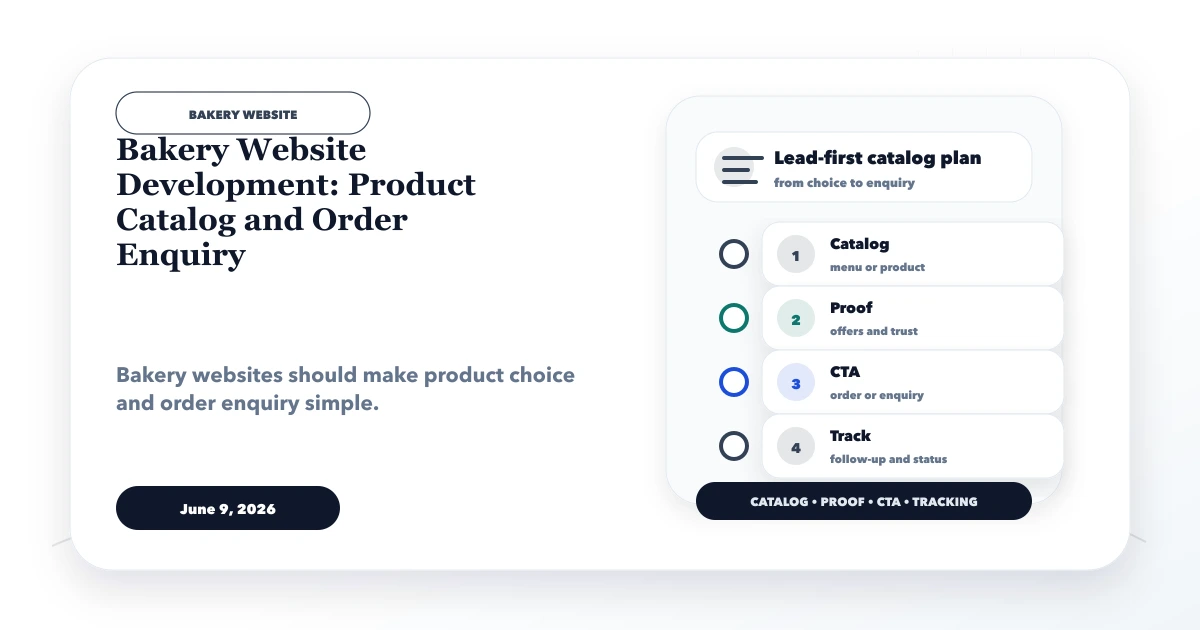
June 9, 2026
Bakery website development with product catalog, cake order enquiry, WhatsApp flow, custom order form, offers, local SEO, and checklist.
Read article
April 21, 2026
Plan a Karol Bagh retail website with a manageable product catalogue, store enquiries, WhatsApp qualification, stock boundaries, analytics, and ownership.
Read article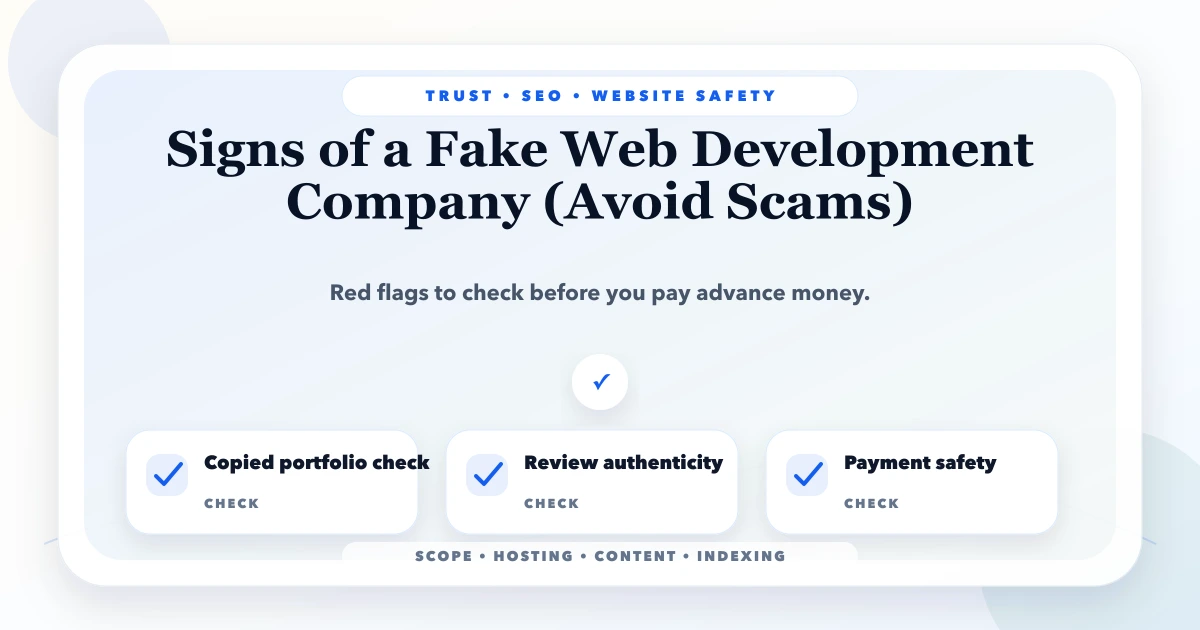
May 21, 2026
Verify a web development company through portfolio proof, domain ownership, contracts, payment milestones, source-code access, testing, and handover checks.
Read article