
April 7, 2026
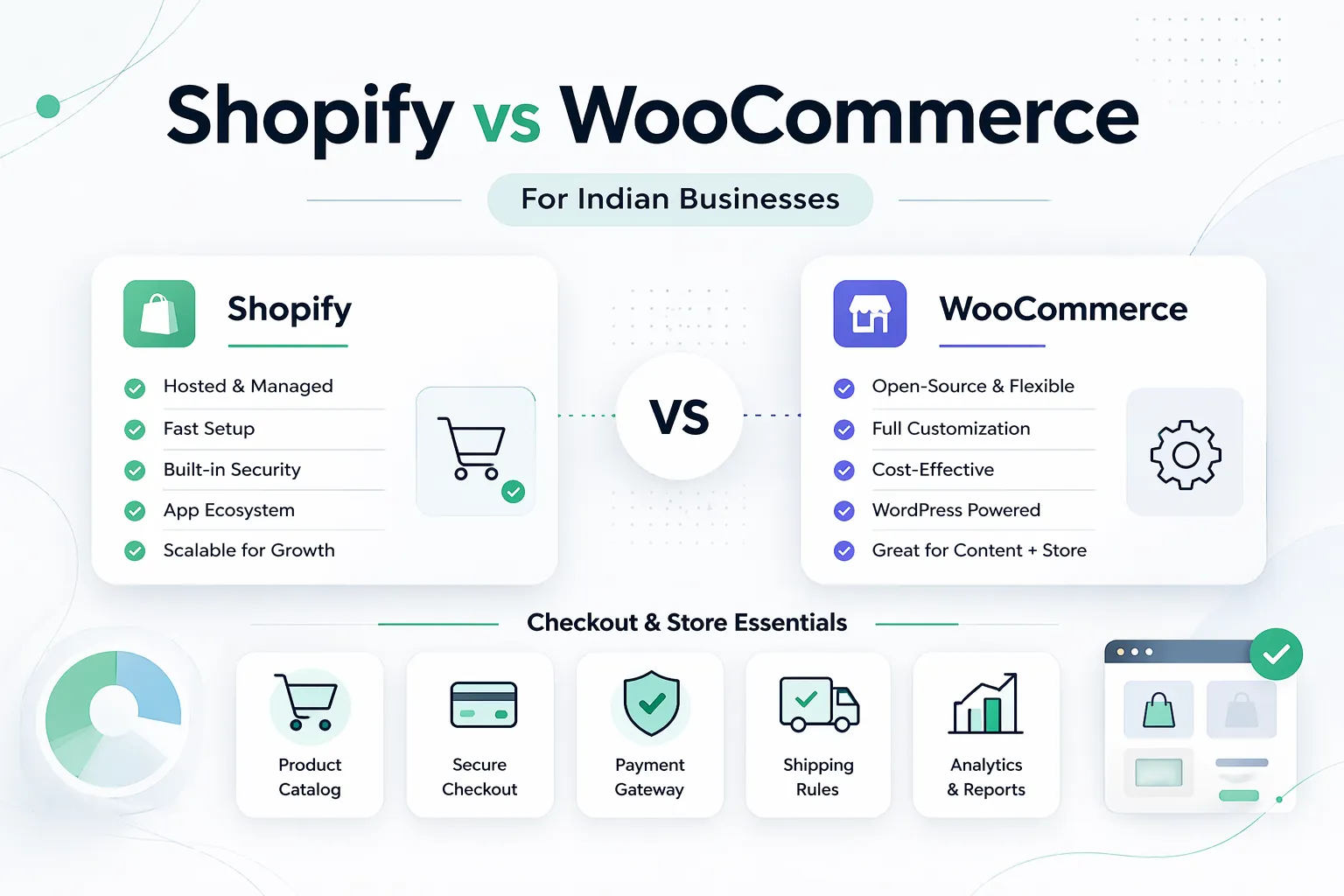
Shopify vs WooCommerce for Indian Businesses (2026)
Shopify vs WooCommerce for Indian businesses in 2026: pricing, control, costs, operations, and which platform fits your growth stage.
Read articlePublished Updated
Ecommerce website cost in India for 2026 with pricing ranges, packages, timelines, features, platform comparison, sales planning, and SEO.
If you want to start selling online in 2026, an ecommerce website is one of the best investments—but only if you build it correctly. In India, ecommerce website quotes can be confusing:
So what is the real ecommerce website cost in India, and what should you expect for that budget?
This guide covers:
Typical ecommerce store cost ranges:
₹35,000 – ₹80,000 Best for: small catalogs, 10–50 products, basic checkout.
₹80,000 – ₹2,00,000 Best for: 50–500 products, better UI/UX, improved speed and tracking.
₹2,00,000 – ₹8,00,000+ Best for: high competition, custom UI, advanced flows, integrations, performance.
₹5,00,000 – ₹30,00,000+ Best for: unique business model, marketplace, multi-vendor, custom logistics.
Your final cost depends on platform choice, number of products, custom design, integrations, and timeline.
In India, 90% of ecommerce websites are built using one of these:
Best for: quick launch, stable checkout, easy admin Cost style: monthly subscription + themes/apps + setup
Best for: flexibility, content + SEO blogs Cost style: one-time dev + hosting + plugin maintenance
Best for: performance + full customization Cost style: higher upfront + maintenance
Which is best depends on your business goals, budget, and team capability.
If your ecommerce later needs portal/dashboards: Web Applications Services
Below are realistic packages that match typical Indian business needs.
₹35,000 – ₹80,000
Best for
You get
Timeline 2–4 weeks
₹80,000 – ₹2,00,000
Best for
You get
Timeline 4–8 weeks
₹2,00,000 – ₹8,00,000+
Best for
You get
Timeline 8–16+ weeks
Here’s how ecommerce development timeline usually looks:
Even if development is one-time, ecommerce has ongoing costs:
Related: Website Maintenance Cost in India (Monthly Plans) Website AMC Explained + Pricing
Your ecommerce website must include:
Yes, ecommerce SEO works well when:
Many stores fail because they copy product descriptions from suppliers. Google sees it as duplicate content.
To rank, you need:
Related: SEO Friendly Website Development Website Speed Optimization Guide
A small D2C brand with 40 products and prepaid payment needs a very different budget from a wholesale store with 800 SKUs, GST invoices, role-based pricing, COD rules, and inventory sync. Both may ask for ecommerce website cost, but the second project is closer to a business system.
Use this cost checklist before finalizing a package:
For a first launch, focus on clean catalog, mobile product pages, payment testing, tracking, and support flow. Loyalty, subscriptions, advanced personalization, and custom dashboards can come after real orders start coming in.
Related help: web application services, integrations, and contact.
The figures above are planning examples, not binding quotations. Confirm current platform subscriptions, themes, apps, payment pricing, shipping fees and taxes on official provider pages before approving a budget.
An ecommerce storefront is only one part of the operating system. The current VASUYASHII Business Suite product screen illustrates product, price, GST and stock records that may need to connect with a custom storefront.
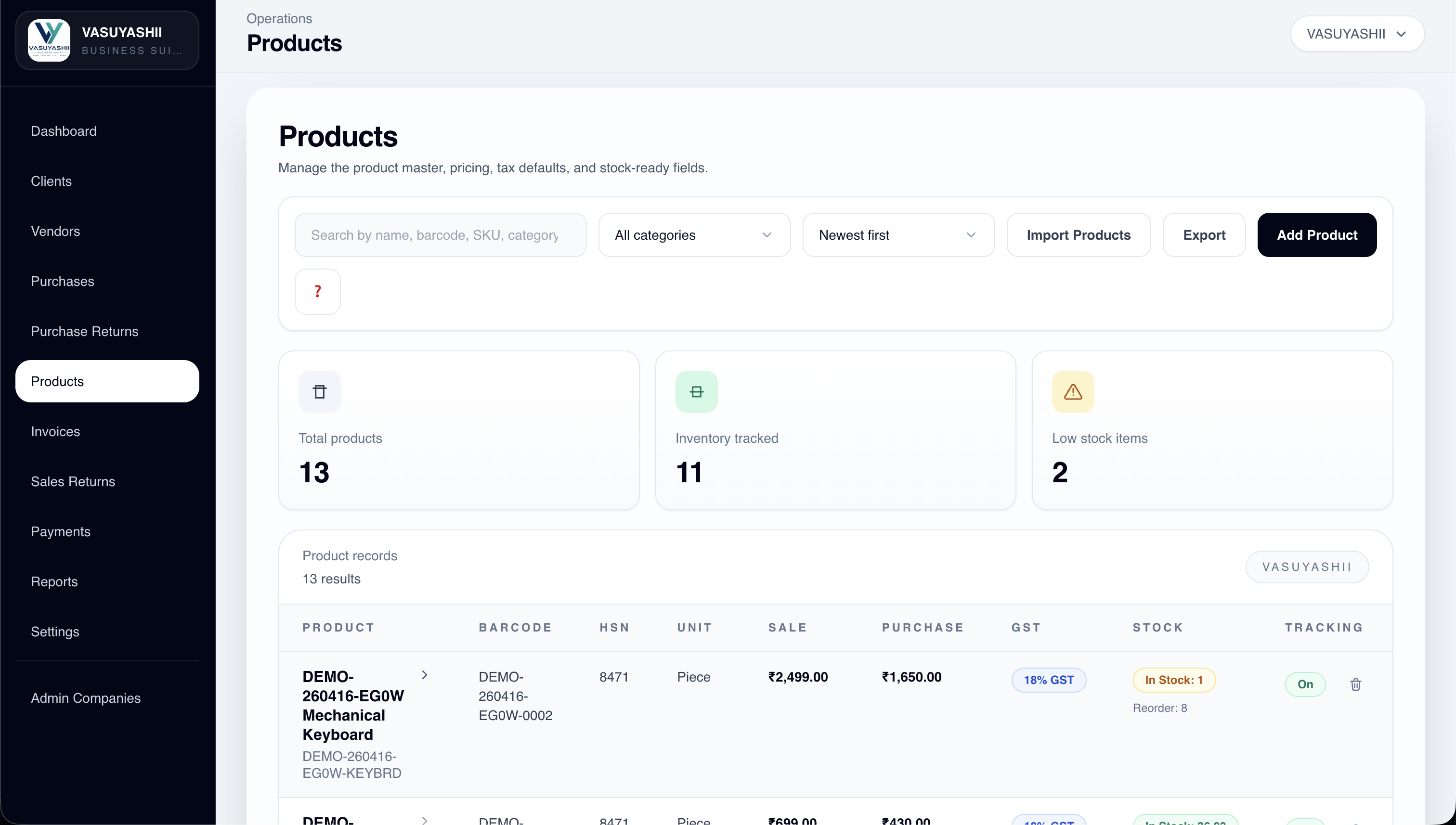
This is evidence of VASUYASHII's current ERP-lite product surface, not an ecommerce customer result or a claim that the Business Suite currently includes a public online store. A connected ecommerce build requires explicit sync, order, payment and failure rules.
| Responsibility | Low-complexity approach | Cost-increasing condition |
|---|---|---|
| Product catalogue | Manual small catalogue | Variants, bulk import, frequent updates |
| Inventory | Storefront quantity only | ERP, branch or warehouse synchronisation |
| Checkout | Hosted standard checkout | Custom UX, subscriptions or saved methods |
| Payments | One standard gateway | Multiple gateways, retries and reconciliation |
| Shipping | Flat or simple zones | Live rates, pincode rules, split shipments |
| Tax | Standard configured rules | Multi-state, B2B, export or specialist rules |
| Returns | Manual support process | Self-service portal and automated refund states |
| Content | Basic category copy | Large SEO catalogue and editorial workflow |
| Reporting | Platform dashboard | Unified finance and operations reporting |
Do not mark an order paid only because the browser returns to a success page. Create the payment on a trusted backend, verify the provider response or webhook, handle duplicate events idempotently, and reconcile orders with settlement reports.
Test success, user cancellation, failed payment, delayed webhook, duplicate webhook, refund, partial refund and order cancellation. Define when stock is reserved and released. Review the payment webhook guide and payment-gateway integration guide before estimating a custom checkout.
Shopify, WooCommerce and payment providers change subscriptions, features and policy terms. Use their current official pricing and documentation during quotation rather than copying an old comparison. Platform choice should consider editing, ownership, checkout, extensions, international needs and exit path, not only the first-year fee.
Google's ecommerce structured-data guidance explains product-result eligibility. Correct markup can support search understanding, but it does not guarantee rankings or rich results.
Want an ecommerce store that is fast, mobile-first, and built to convert?
👉 WhatsApp: Chat on WhatsApp 👉 Services: services
Basic ecommerce generally ₹35,000–₹80,000 se start hota hai.
Shopify fast and stable; WooCommerce more flexible but needs maintenance.
Depends on scope. Many packages include limited product upload.
Usually yes, but depends on gateway complexity and scope.
Yes, but unique content and speed is required.
Basic store 2–4 weeks, standard 4–8 weeks, premium 8–16 weeks.
Yes, especially WordPress/WooCommerce.
When you need unique flows, marketplace, or deep integrations.
Budget form states, payment reconciliation, inventory conflicts, mobile QA, analytics, and recovery using the checkout drop-off diagnosis guide. Then align buyer actions with the website CTA guide for Indian businesses.
If you want an ecommerce website that is fast, SEO-ready, mobile-first, and built for sales, we can help.
👉 WhatsApp: Chat on WhatsApp 👉 Services: web application development services 👉 Services: services 👉 Contact: contact page
Budget should also protect the journeys that generate revenue; audit discovery, product detail, cart, checkout, payment, and measurement with the ecommerce conversion checklist.
Related Articles
April 7, 2026
Shopify vs WooCommerce for Indian businesses in 2026: pricing, control, costs, operations, and which platform fits your growth stage.
Read article
March 28, 2026
Ecommerce website developer in Delhi NCR: packages, setup steps, pricing, timeline, and what online stores should launch first in 2026.
Read article
May 18, 2026
Improve WooCommerce speed with an India-focused audit of hosting, cache, database, plugins, themes, images, checkout safety, Core Web Vitals, and release QA.
Read article
May 18, 2026
Improve Shopify speed with a practical India-focused audit for themes, apps, images, scripts, Core Web Vitals, release testing, and conversion trade-offs.
Read article