

March 24, 2026
Ecommerce Website Cost in India: 2026 Guide
Ecommerce website cost in India for 2026 with pricing ranges, packages, timelines, features, platform comparison, sales planning, and SEO.
Read articlePublished
Shopify vs WooCommerce for Indian businesses in 2026: pricing, control, costs, operations, and which platform fits your growth stage.
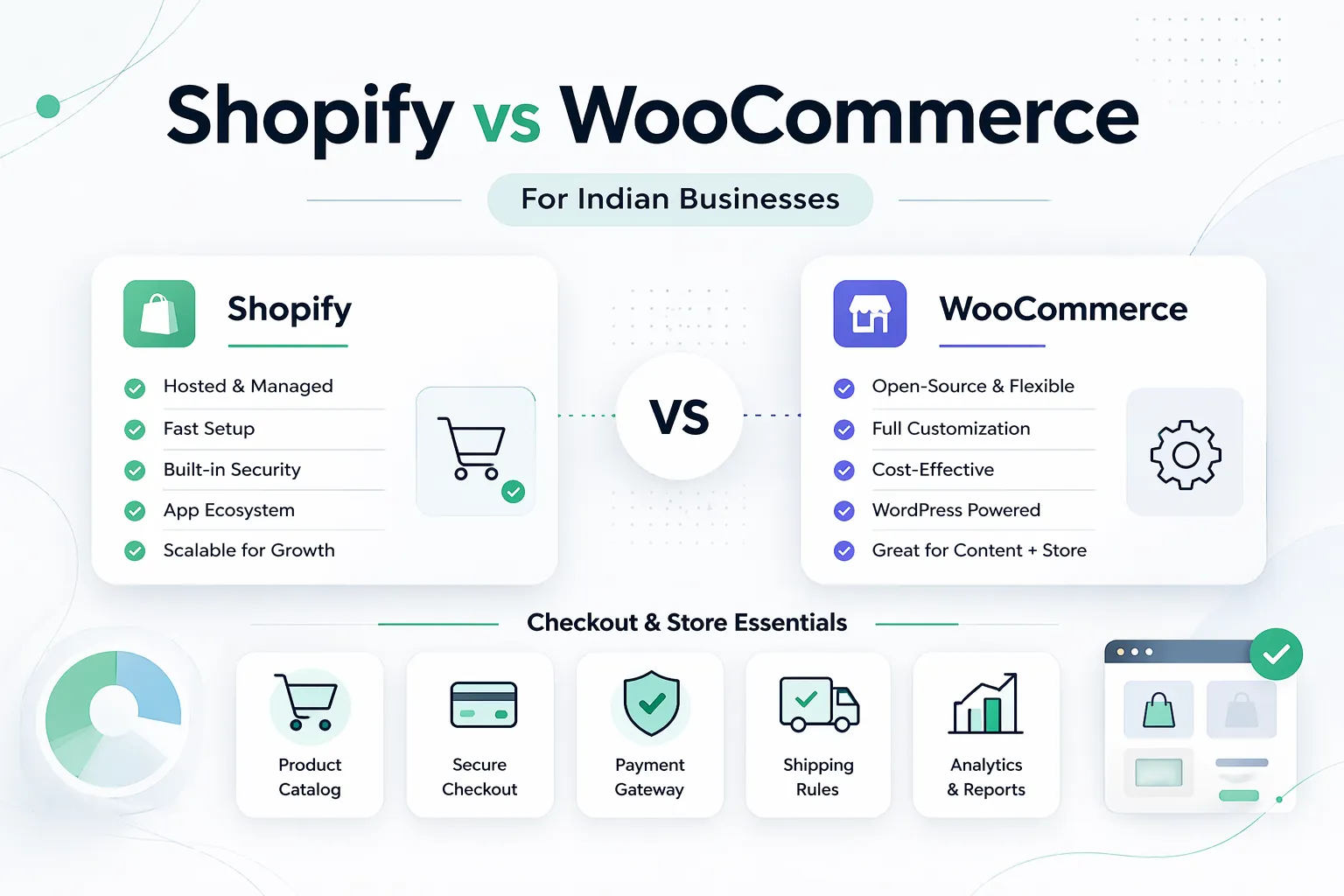
This comparison becomes confusing because both platforms can work well, but they solve different operational problems. Shopify gives a more controlled all-in-one system. WooCommerce gives more freedom, but it also puts more technical responsibility on the business.
For Indian businesses, the choice is rarely only about features. It is about payment flexibility, hosting responsibility, performance, maintenance, marketing needs, product complexity, and how much operational control the team actually wants.
This guide explains the real trade-offs in 2026 so you can choose based on business fit instead of platform hype.
In simple terms:
Shopify if you want faster launch, lower infrastructure responsibility, and a cleaner managed stackWooCommerce if you want more control, WordPress flexibility, and are comfortable managing hosting, plugins, and maintenanceAs an inference from the official pricing and documentation, Shopify is easier for teams that want platform simplicity, while WooCommerce usually suits teams that want customization flexibility and can handle variable total cost of ownership.
Based on the official Shopify India pricing page checked while drafting this comparison, the visible plans were:
₹399/month₹1,499/month billed yearly₹5,599/month billed yearly₹22,680/month billed yearlyShopify’s help center also states that Basic, Grow, and Advanced plans can include monthly price, credit card rates, and third-party transaction fees, and that annual billing lowers the effective monthly price.
WooCommerce is different. The core platform is open source, but the official WooCommerce cost guide explains that total cost of ownership depends on setup, hosting, infrastructure, security, maintenance, third-party tools, and continuous development. In other words, WooCommerce is not “free” in any serious production sense.
Shopify is usually the better fit when:
For a brand that wants to start quickly and keep the ops layer simpler, Shopify often reduces execution friction.
WooCommerce is usually the better fit when:
But the trade-off is operational responsibility. Hosting, performance, security, updates, and plugin compatibility are part of the real work.
This is where many decisions go wrong.
You are paying for:
The stack is more controlled, so the cost model is easier to estimate early.
You are paying for:
WooCommerce’s official cost guide explicitly treats hosting, security, maintenance, performance management, and third-party services as ongoing cost components. So the practical question is not “Is WooCommerce free?” It is “What operating model does the business prefer?”
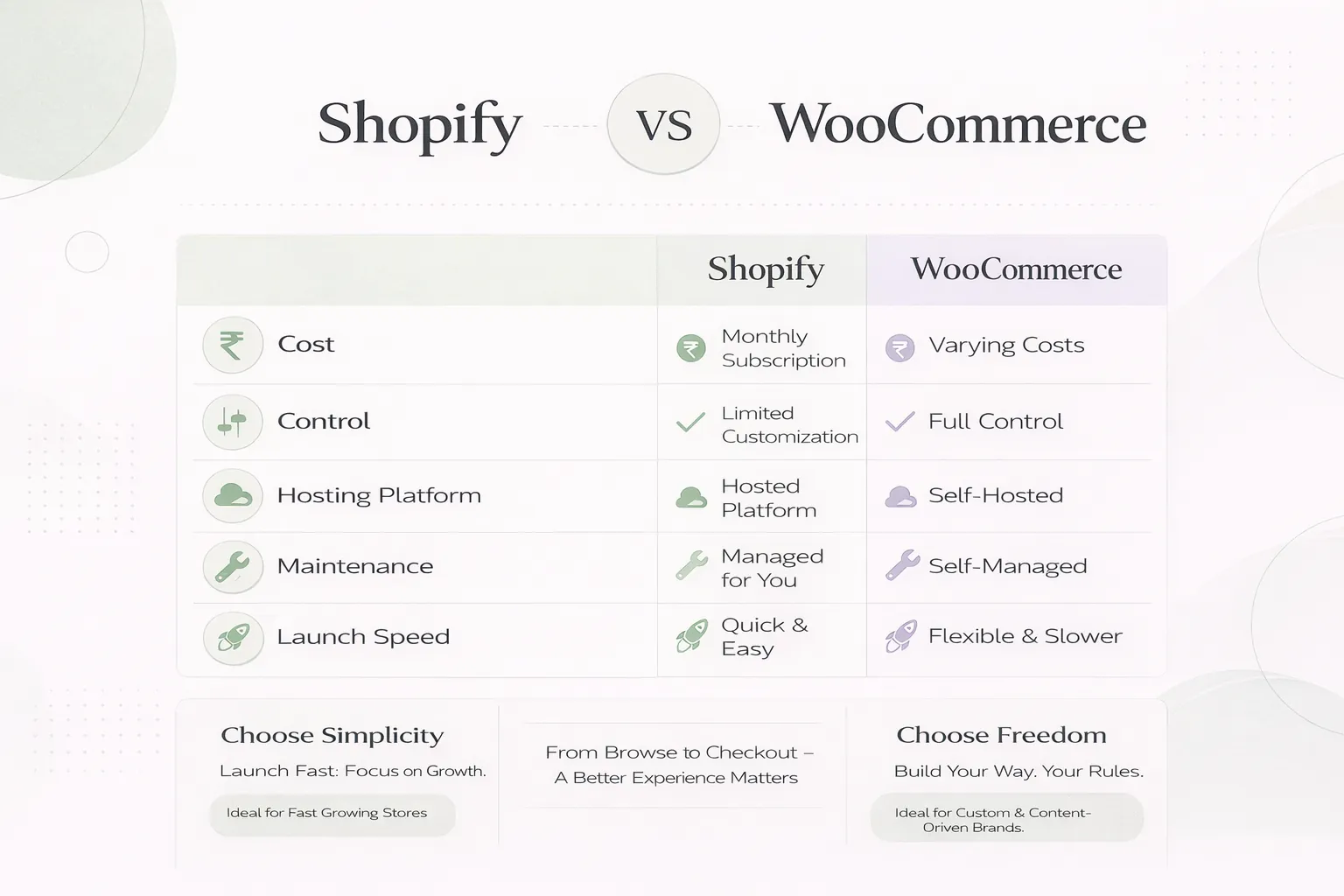
Shopify gives a more managed checkout environment. That is useful when the business wants speed and predictability.
WooCommerce gives more freedom, but checkout quality depends much more on theme, plugins, hosting, and implementation quality.
Shopify handles platform hosting by default.
WooCommerce performance depends on:
WooCommerce usually gives deeper control.
Shopify customization is strong, but the platform model still shapes what is easiest and what is not.
Shopify reduces infrastructure maintenance load.
WooCommerce increases responsibility for:
Typical launch or migration bands:
1 to 3 weeks for many standard stores2 to 6 weeks depending on content, design, and workflow depth3 to 8 weeksTypical custom build cost:
₹45,000 to ₹1.2 lakh₹1.2 lakh to ₹3 lakh₹3 lakh+If you are choosing between Shopify and WooCommerce, do not ask only which platform is “best.” Ask which one fits your team’s technical ownership, catalog complexity, marketing plan, and growth model.
Usually Shopify.
Usually WooCommerce, especially when content and custom behavior matter.
Not always. The real cost depends on hosting, maintenance, plugins, and development effort.
It can be very efficient for smaller teams, but the subscription and payment fee model should be evaluated against your store economics.
Both can work. Outcome depends more on implementation quality than platform branding.
WooCommerce often gives more flexibility, but that flexibility comes with technical responsibility.
Yes, but catalog mapping, redirects, SEO preservation, and order/customer data make migration a real project.
Shopify usually wins on launch speed and simplicity.
If you want to choose based on catalog complexity, operations, budget, integrations, and long-term maintenance reality, the scope should be mapped before the build starts.
If Shopify is selected, use the Shopify store speed optimization guide to set theme, app, media, QA, and post-launch performance rules before development expands.
Related Articles
March 24, 2026
Ecommerce website cost in India for 2026 with pricing ranges, packages, timelines, features, platform comparison, sales planning, and SEO.
Read article
May 18, 2026
Improve WooCommerce speed with an India-focused audit of hosting, cache, database, plugins, themes, images, checkout safety, Core Web Vitals, and release QA.
Read article
May 18, 2026
Improve Shopify speed with a practical India-focused audit for themes, apps, images, scripts, Core Web Vitals, release testing, and conversion trade-offs.
Read article
May 18, 2026
Use this ecommerce conversion checklist to improve measurement, product discovery, pricing clarity, mobile UX, checkout, payments, trust, and delivery.
Read article