
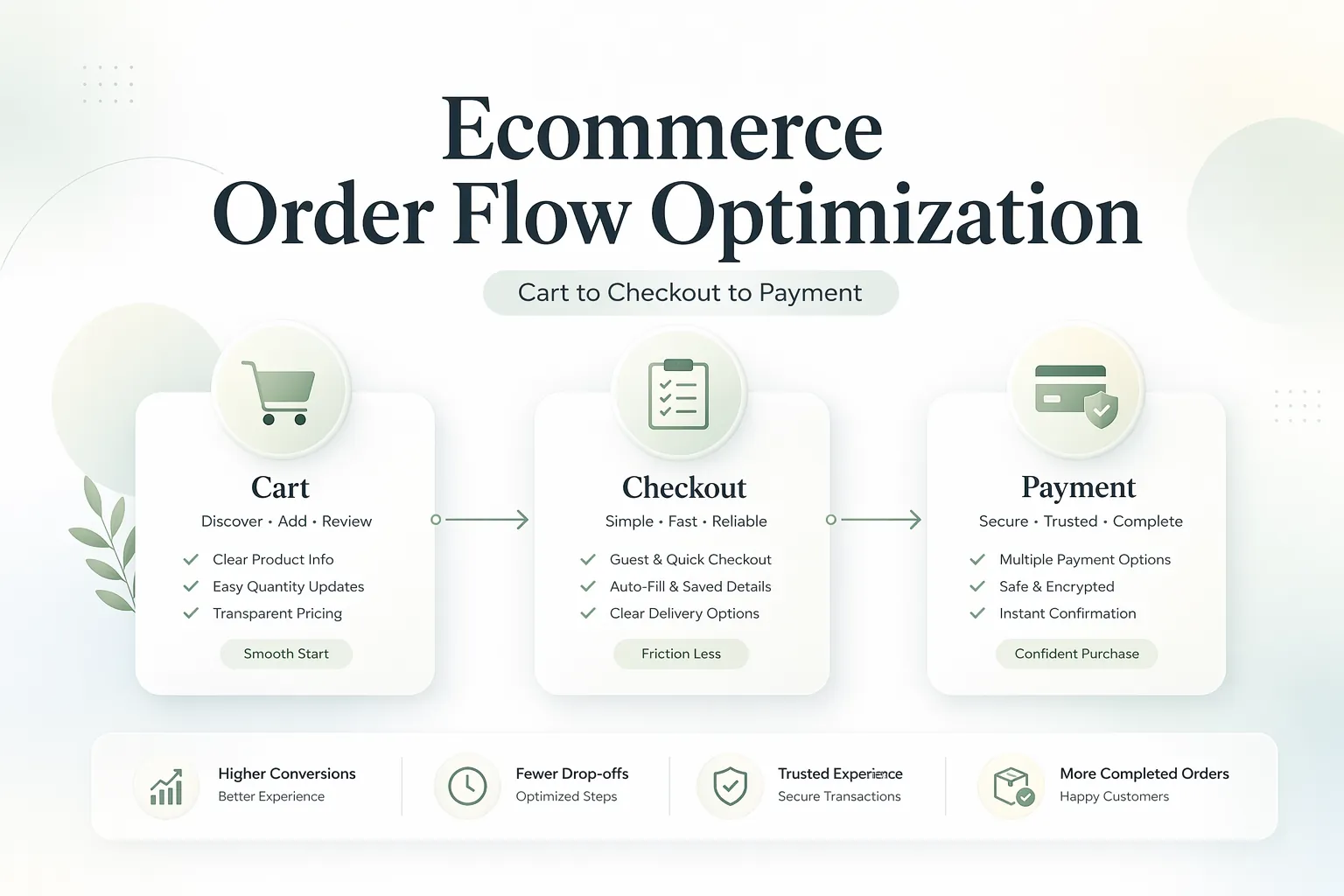
April 7, 2026
Ecommerce Cart, Checkout, and Payment Flow
Design a reliable ecommerce cart, checkout, and payment flow with server-side pricing, inventory checks, idempotent payments, webhooks, recovery, and analytics.
Read articlePublished Updated
Diagnose ecommerce checkout drop-off across cart, shipping, login, forms, trust, payment, mobile UX, failures, recovery, analytics, and experiment design.
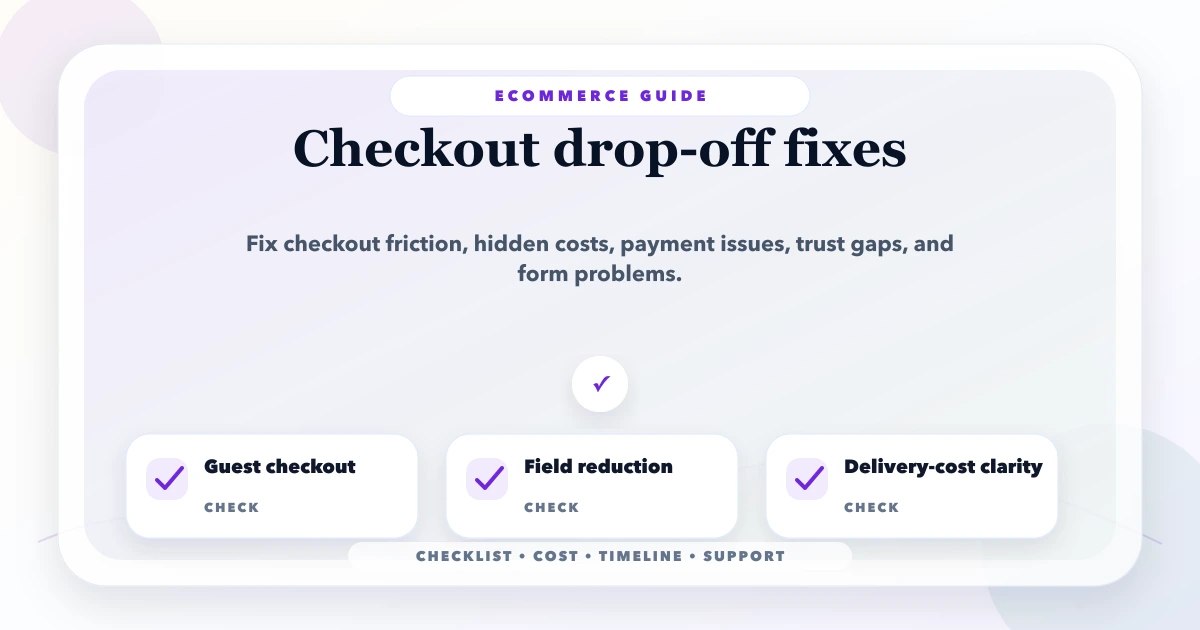
Checkout drop-off means a shopper started a buying journey but did not complete a valid order. The cause may be expected browsing behavior, unexpected total cost, account friction, delivery uncertainty, payment failure, poor mobile usability, missing trust, inventory conflict, or a technical error.
Do not treat every abandoned cart as one problem. First identify the exact stage, device, payment method, product type, customer segment, and error. The fix for users leaving at shipping cost is different from the fix for successful payment with a missing order record.
Research organisations such as Baymard Institute publish broad checkout usability findings, but your store needs first-party funnel and failure evidence before prioritising changes.
Use explicit events and server outcomes:
An analytics “purchase” event should reflect a verified order state, not only a button click or gateway redirect.
| Outcome | Meaning | Investigation |
|---|---|---|
| User leaves before payment | Choice or usability issue | Price, delivery, trust, form, distraction |
| Payment attempt fails | Gateway, bank, method, validation, or network issue | Error code and provider response |
| Payment succeeds, order missing | Critical reconciliation defect | Webhook, idempotency, order transaction |
| Order created, confirmation missing | Communication or UI problem | Redirect, email/SMS/WhatsApp, status page |
| Duplicate order/payment | Retry and deduplication defect | Idempotency, button state, webhook handling |
Server-side states are essential because browser analytics can be blocked or interrupted.
Unexpected shipping, taxes, convenience fees, COD charges, or minimum-order rules create avoidable surprise. Show what can be known before checkout and explain what depends on the address or payment method.
Useful practices:
Do not hide costs to improve checkout-start metrics. It usually moves the abandonment later.
Mandatory account creation can block buyers who want one transaction. Consider guest checkout when the business can fulfil, support, and meet legal requirements without an account.
An account can be offered after purchase using the verified order identity. If an account is required for subscriptions, regulated products, B2B credit, or member-only access, explain the reason and keep creation compact.
Every field should have a fulfilment, support, fraud, tax, or communication purpose. Remove duplicate and optional fields from the critical path.
Form design should include:
Do not assume one address format works for every Indian locality. Support apartment, landmark, locality, district, state, and postcode requirements appropriate to delivery operations.
“Fast delivery” is vague. Show a date range or dispatch expectation based on stock, location, cut-off, holidays, and carrier capability.
Clarify:
Do not promise a date the operations team cannot support. A conservative accurate promise builds more trust than an optimistic missed one.
Indian buyers may expect UPI, cards, net banking, wallets, COD, or other methods depending on order value and audience. More methods are not always better; each adds support, reconciliation, refund, and failure handling.
For every enabled method, define:
Review the payment gateway integration guide before treating a hosted checkout screen as complete integration.
When a payment fails:
The browser redirect is not authoritative. Verify signed provider callbacks or webhooks and query the provider when required.
Generic shield icons are weak if the business identity, delivery, return, and support information is unclear.
Useful trust signals include:
Do not fabricate reviews, countdowns, stock alerts, certifications, or “secure” claims.
Test checkout on real narrow screens and slower networks. Check:
Mobile testing should include low battery, interrupted network, back navigation, and resumed payment.
Checkout can fail when cart price or stock differs from the server. Define:
The server should calculate the final payable amount from trusted product and promotion records. Never accept totals from the browser as authoritative.
Recovery can include saved carts, email, SMS, WhatsApp, retargeting, or support assistance. Use only consented channels and respect frequency, suppression, and privacy rules.
A useful recovery message may include:
Do not expose cart contents in an insecure public URL. Avoid aggressive repeated messages or invented urgency.
| Event | Important properties |
|---|---|
view_cart | cart ID, item count, value, currency |
begin_checkout | device, customer state, source, value |
add_shipping_info | serviceability, method, fee |
add_payment_info | method category, not sensitive details |
payment_attempt | order intent ID, method, attempt count |
payment_result | approved error/status category |
purchase | verified order ID, value, item count |
Never send card data, OTP, full address, phone, email, or other unnecessary personal information to analytics.
Analyse conversion by:
Small samples can mislead. Include counts and confidence, not only percentages.
Prioritise changes using evidence, impact, effort, and risk. For each experiment define:
Do not test security, consent, tax, pricing accuracy, or accessibility as optional conversion features.
A robust sequence can be:
The order tracking page guide helps continue the post-purchase experience after conversion.
Before implementation, compare the wider commercial scope in the ecommerce website cost guide.
In our implementation work, VASUYASHII traces one order across browser events, backend records, gateway events, inventory, fulfilment, and customer communication. We classify exits separately from technical failures and reconcile successful gateway payments against created orders before recommending visual changes.
Our web application service can implement ecommerce workflows and integrations with explicit idempotency, webhook, status, and support boundaries. We do not promise a conversion increase without baseline, traffic quality, and controlled measurement.
There is no universal target. Product type, traffic intent, price, device, geography, payment mix, and repeat-customer share vary. Establish your own segmented baseline.
Either can work. Choose based on field count, dependencies, mobile usability, save/resume needs, and error handling. Test completion rather than assuming fewer screens are always better.
It can reduce friction for one-time purchases, but some businesses need verified accounts. Explain the requirement and minimise account setup when it is necessary.
Many systems create a pending order or payment intent before payment so retries and reconciliation have a stable reference. The exact design depends on inventory and fulfilment rules.
Keep the order in a pending state, verify authoritative provider status asynchronously, avoid duplicate payment prompts, and communicate a clear next step.
Yes, with lawful consent, secure links, frequency limits, suppression, accurate cart state, and clear preference controls. Automation should stop after purchase or invalidation.
Export the last 100 checkout attempts with stage, device, payment method, error category, order status, and final outcome. Fix the largest verified failure group first. Contact VASUYASHII for a checkout workflow and payment-integration review.
Related Articles
April 7, 2026
Design a reliable ecommerce cart, checkout, and payment flow with server-side pricing, inventory checks, idempotent payments, webhooks, recovery, and analytics.
Read article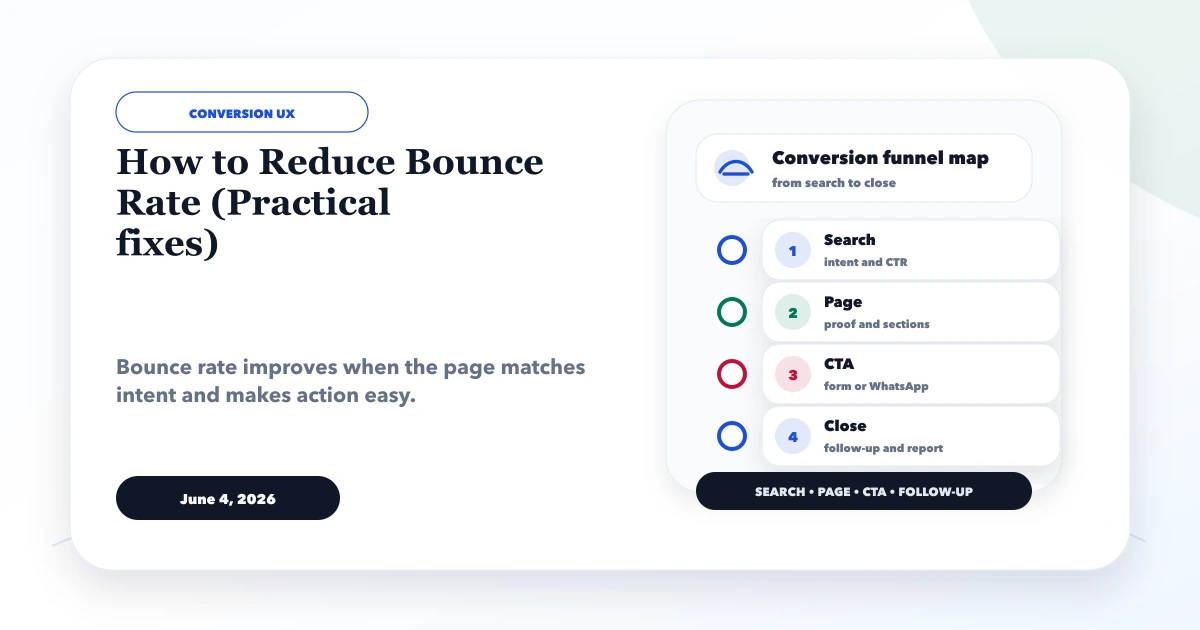
June 4, 2026
Reduce bounce rate by diagnosing search intent, mobile speed, content clarity, CTA friction, and tracking quality instead of chasing one sitewide number.
Read article
May 26, 2026
Plan gym membership software for plans, freezes, attendance, payments, trainer access, renewals, branch reporting, and secure member operations.
Read article
May 15, 2026
Plan distributor billing software with GST invoices, schemes, credit, stock, returns, purchases, payments, reports, controls, costs, and phased implementation.
Read article