
May 30, 2026
SEO Website Development Services in Delhi NCR
Scope SEO website development in Delhi NCR across architecture, rendering, metadata, structured data, performance, internal links and launch QA.
Read articlePublished Updated
Build local SEO for a web development company with clear service architecture, genuine area evidence, eligible profiles, reviews, citations and lead tracking.
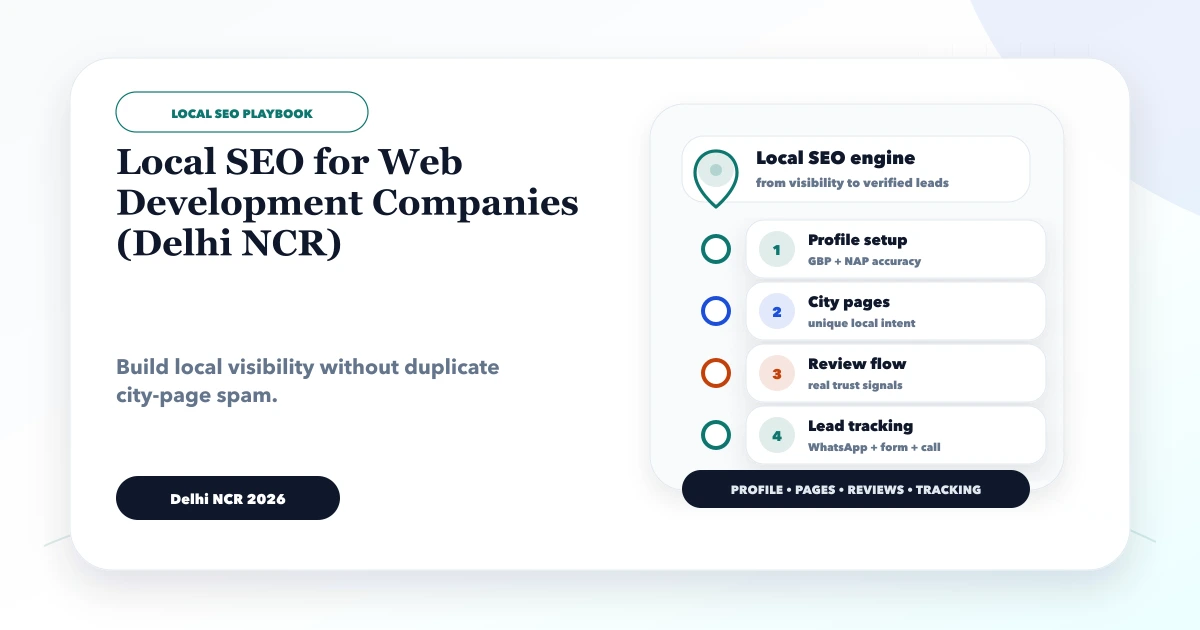
Service-area note: VASUYASHII is based in Delhi NCR and supports businesses remotely across India. A city-focused guide describes service and planning context; it does not claim a physical office in every location mentioned.
Explore the parent topic: Local SEO for Web Development Companies →Local SEO for a web development company should connect real service coverage, a clear website architecture, verifiable business identity and qualified lead measurement.
It should not begin with publishing a page for every city or creating a Google Business Profile at a location that does not meet eligibility rules. Web development can often be delivered remotely, so the company must be especially clear about physical location, service area and customer contact model.
This framework uses Delhi NCR as the planning context while keeping claims evidence-led.
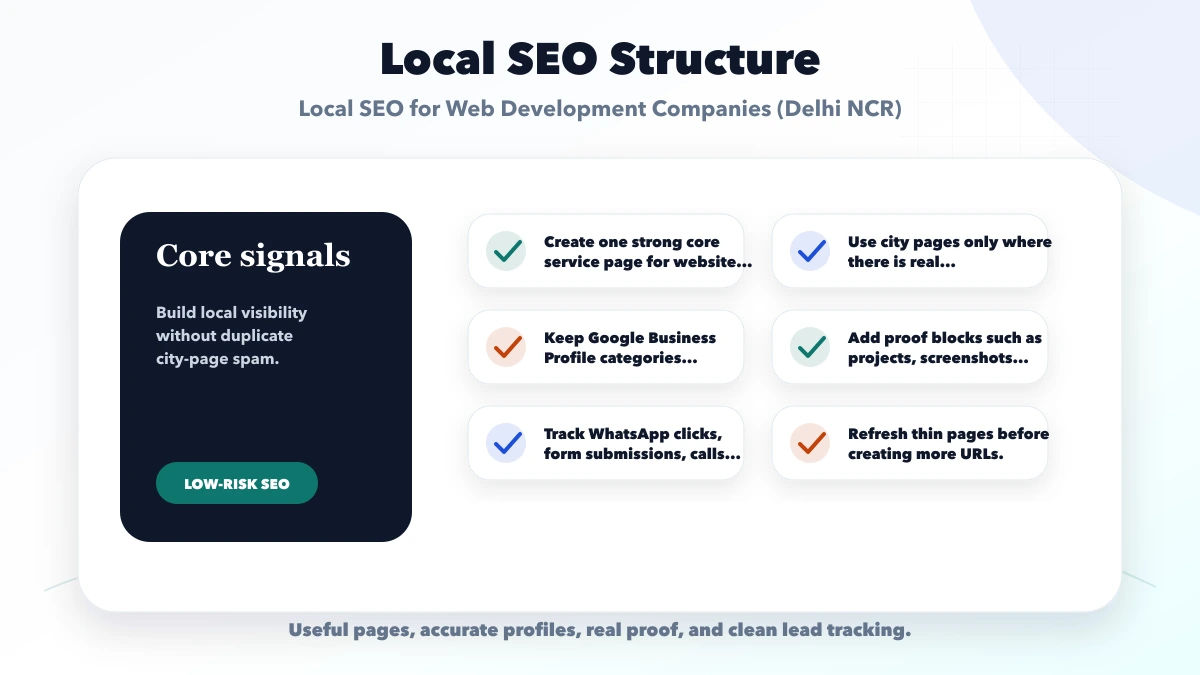
Build the system in this order:
Potential buyers may search:
These are not one intent. Service, location, cost, comparison and educational queries need different page owners.
| Intent | Page owner |
|---|---|
| Company and service overview | Main service page |
| Regional website-development service | Delhi NCR hub |
| Web app development | Web-app service/hub |
| Website pricing | Cost guide |
| Developer selection | Hiring guide |
| Local process in a genuinely served city | Evidence-backed city page |
| Educational question | Blog/support article |
Do not create three pages for “website developer Delhi NCR,” “web development company Delhi NCR” and “best website company Delhi NCR” if they answer the same buyer job.
Use the Delhi NCR keyword-mapping guide to group variants before assigning URLs.
Primary service pages should explain:
A location page cannot compensate for a vague service page. Build website development services, web application services and software development services around distinct buyer needs.
A regional hub can explain:
The hub should remain useful even if individual city pages are removed.
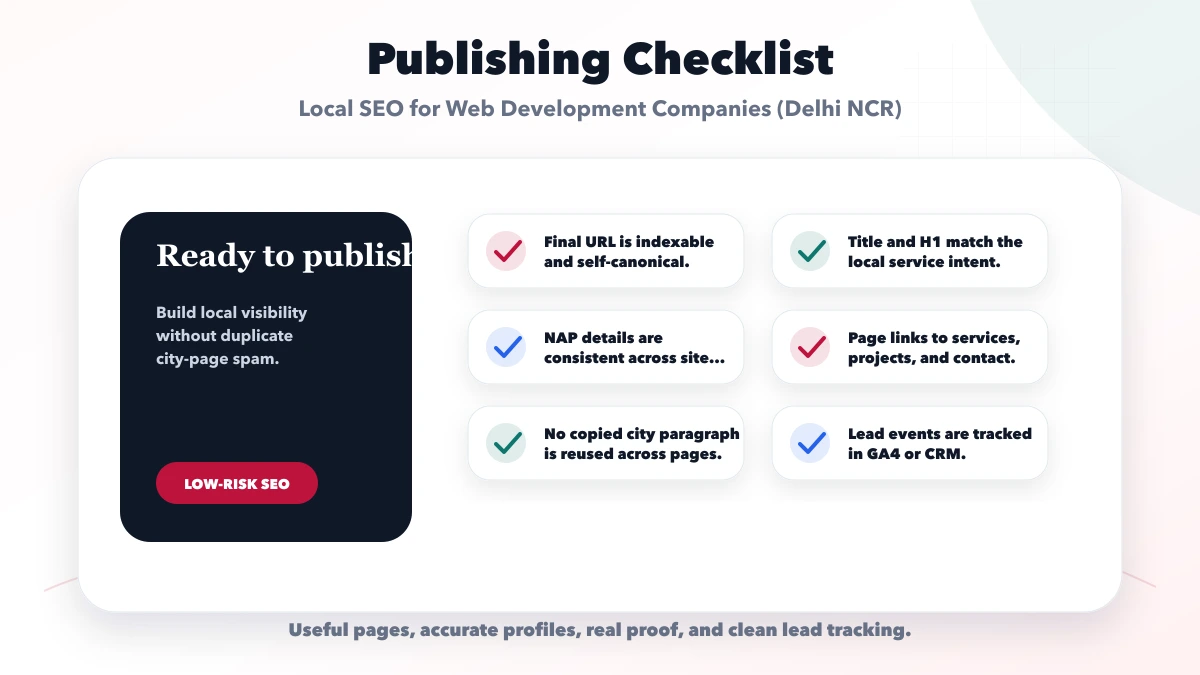
Publish or retain a city page only when:
The local landing-page evidence gate helps decide between publish, improve parent, consolidate or hold.
Google’s current spam policies identify substantially similar city pages that funnel users to the same destination as doorway abuse examples. The policies also cover keyword stuffing and scaled unoriginal content.
Risk patterns include:
The solution is not cosmetic rewriting. Reduce the URL set or give retained pages distinct purpose and evidence.
A Google Business Profile is not available to every online business. Google’s current eligibility guidance excludes online-only businesses and lead-generation agents. Eligible storefront and service-area businesses must follow real-world location and ownership rules.
Do not:
The Google Business Profile optimisation guide covers compliant profile operations after eligibility is established.
Useful proof can include:
Do not publish invented traffic, conversion or revenue outcomes. A technically valid website is not proof of business results unless measurement supports the claim.
Ask real customers for honest feedback after a meaningful delivery stage. Do not supply review text or offer an incentive for positive sentiment.
A review programme should define:
Reviews support buyer trust. They do not replace useful service content.
Maintain accurate business identity across sources customers use. Start with the website, eligible verified profile, major maps and relevant industry or professional profiles.
Use the Delhi NCR citation source guide and NAP consistency guide. Avoid bulk directory packages.
A practical hierarchy:
Home
└── Services
    ├── Website Development Delhi NCR
    │   ├── Selected evidence-backed city pages
    │   ├── Website cost guide
    │   └── Hiring guide
    ├── Web App Development
    └── Software Development
Blog posts should support these pages, not compete with them. Use descriptive anchors and final URLs.
Prioritise content that answers real sales questions:
Do not publish daily city variants while core commercial pages remain weak.
Local traffic is useful only when the business can qualify and respond.
Capture:
State response expectations. Track successful submissions rather than only button clicks.
| Metric | Question |
|---|---|
| Non-brand impressions | Is relevant discovery growing? |
| Page/query clicks | Which pages attract the intended search? |
| Qualified leads | Does traffic match service and area? |
| Lead source | Which page assisted contact? |
| Index status | Are priority pages eligible and indexed? |
| Duplicate queries | Are several URLs competing? |
| Review/profile actions | Do genuine profile users engage? |
| Response time | Can the business handle enquiries? |
Separate branded and non-branded data where possible. Average position alone does not explain business value.
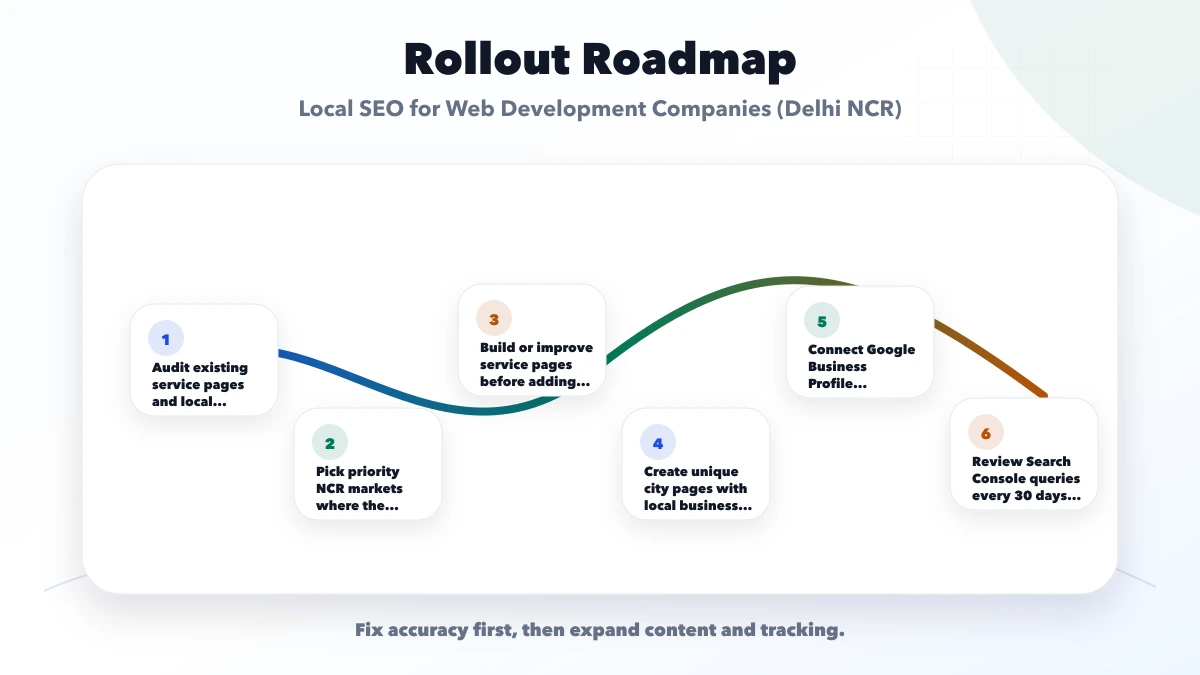
Confirm service area, business identity, page inventory, profile eligibility and analytics.
Strengthen services and regional hub. Fix canonical, sitemap and internal-link problems.
Add genuine proof and answer high-value buyer questions.
Review duplicate location pages, lead quality and GSC page/query ownership.
This sequence is not a ranking timeline.
The current VASUYASHII website has parent hubs for website development Delhi NCR, web apps, custom software/CRM/ERP and local SEO. It also has a large historical location-content cluster now under a publishing freeze.
VASUYASHII does not currently use this article to claim a verified Google Business Profile, a physical office in every Delhi NCR city or local rankings. The active work is to strengthen parent architecture and assess retained location pages with service, GSC, backlink and lead evidence.
That review also checks which page owns each buyer intent, whether the page has meaningful incoming links, and whether its enquiries match the service being offered. These controls matter more than increasing the raw city-page count.
VASUYASHII has replaced the repeated template in a focused set of retained URLs. Each page now owns a different planning intent:
Every page states that locality wording does not prove an office, client or result. This is the minimum editorial boundary for future cluster work.
Another retained group now covers separate business decisions instead of sharing one city template:
The links make the editorial hierarchy crawlable. They do not claim a physical office or prove that every URL has independent search demand.
The map helps crawlers and readers find the correct decision page. It is not evidence of a branch, customer, award or ranking in any named location.
These pages are linked for differentiated editorial ownership. Continued indexing should be reviewed against real service coverage and measurable usefulness, not preserved only because a city keyword exists.
This map improves discovery and clarifies intent. It does not provide evidence of a local branch, customer, ranking or completed project.
The map is an internal-link and editorial-ownership aid. It does not prove a branch, client, award, result, or ranking in any named market.
These pages should remain differentiated by user problem and operating model. A location term by itself is not evidence that a page deserves continued indexing.
Only if the business is eligible under current rules. An online-only company should not create a fake local presence.
Only pages with distinct service value, evidence and maintenance. A strong regional hub may cover several areas.
Use a separate cost guide when pricing factors are broadly the same. Add local detail only when it changes the decision.
Demos can show capability when clearly labelled. They do not prove a local client relationship or result.
There is no guaranteed timeline. Competition, relevance, distance, prominence, content, links and business evidence all affect outcomes.
Fix business identity, primary services, site architecture, tracking and duplicate pages before adding more local content.
Create the keyword-to-page map and service-area evidence sheet. Strengthen the parent pages before deciding which city URLs deserve continued investment.
Related Articles
May 30, 2026
Scope SEO website development in Delhi NCR across architecture, rendering, metadata, structured data, performance, internal links and launch QA.
Read article
May 14, 2026
local SEO content plan 30 days: practical 2026 SEO plan with cluster map, pricing, roadmap, mistakes, FAQs, proof, and next steps for Indian SMBs today.
Read article
May 21, 2026
verify web development company portfolio: practical 2026 guide with checklist, pricing, timeline, risks, tools, FAQs, and Indian business tips today safely.
Read article
May 9, 2026
how to create local pages without duplicate content: pricing, checklist, FAQs, trust signals, and practical SEO steps for Indian SMB owners.
Read article