
April 19, 2026
Dwarka Website for Home-Service Businesses
Plan a Dwarka home-service website with locality coverage, society-access notes, visit-charge rules, service requests, proof, and lead routing.
Read articlePublished Updated
Plan a Raj Nagar Extension service website with society-area coverage, visit eligibility, quote inputs, proof controls, lead routing, and ownership.
Service-area note: VASUYASHII is based in Delhi NCR and supports businesses remotely across India. A city-focused guide describes service and planning context; it does not claim a physical office in every location mentioned.
Explore the parent topic: Website Development Delhi NCR Hub →A business comparing a website development company in Raj Nagar Extension may need more than a locality page. Home-service, maintenance, interior, clinic, coaching, fitness, repair, and professional teams often serve several societies or nearby areas with different visit rules, timings, minimum order values, and enquiry owners.
This guide explains how to build a service website around honest coverage and useful qualification. It does not claim that VASUYASHII has an office, customer, project, ranking, or guaranteed result in Raj Nagar Extension.
Written by Tushar C. (Founder, VASUYASHII) using the current VASUYASHII website-planning process. Named societies, fees, availability, testimonials, response times, and service results must be supplied and approved by the business. Generic examples below are planning scenarios, not client evidence.
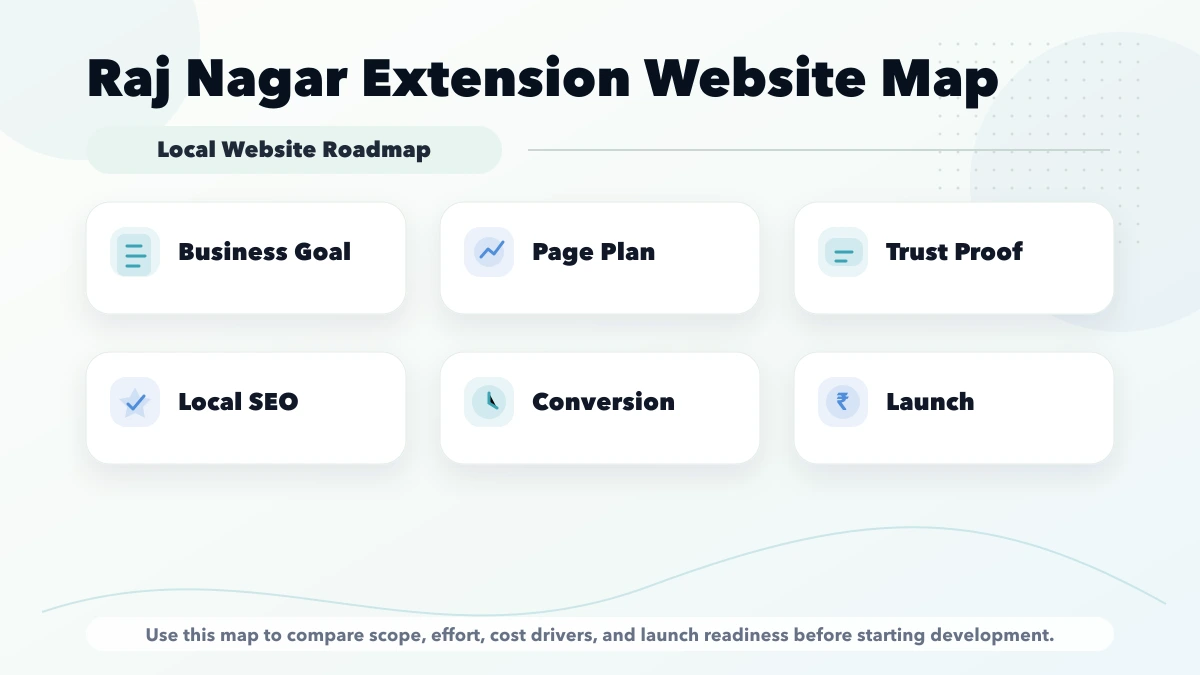
Before writing pages, define what “serving Raj Nagar Extension” means operationally. The website should not imply universal or immediate coverage if the team checks distance, technician availability, building access, minimum order, or appointment capacity first.
Create a coverage sheet with:
This sheet becomes the source for service pages, forms, WhatsApp replies, FAQs, and sales scripts. If the service boundary changes, all of those surfaces should be reviewed together.
Different businesses need different first actions. A repair visitor may need to share the item type and problem. An interior lead may need property status, approximate area, scope, and consultation preference. A clinic visitor needs appointment information, not a project quotation. One generic “Contact us” form makes routing harder.
| Visitor intent | Useful first action | Information to collect |
|---|---|---|
| Home or office service | Check visit eligibility | service, area, preferred date, contact |
| Repair request | Describe the issue | item, symptom, location, urgency |
| Consultation | Request a discussion | objective, property or business type, timeline |
| Class or membership | Check programme fit | age/group, preferred batch, start date |
| Clinic or professional service | Request an appointment | service category, preferred time, non-sensitive summary |
Collect only what is required for the first routing decision. Sensitive files, medical details, identity documents, and financial records need an approved secure process rather than an open form.
A focused first release can include:
If users need accounts, appointment inventory, job status, or role-based operations, evaluate web application development separately. Do not describe a public website as an operational platform unless those functions actually exist.
Every service page should answer:
Use precise language. “Subject to visit confirmation” is more useful than “available everywhere.” “Starting after approved inspection” is safer than an unsupported completion promise. The website should help unsuitable visitors self-select without making valid leads struggle.
Local wording is not proof. Use evidence the business can verify:
VASUYASHII provides sample website demos to show design and structure possibilities. A demo is not a local client project or business outcome. Keep that label visible wherever the demo appears.
The first form should improve the next conversation without becoming a long application. Useful fields may include service, locality or society, property/business type, broad scope, preferred date, and phone number. Use optional notes for context.
After submission:
For implementation help, review integration and automation services. A CRM or sheet connection should have clear field mapping, deduplication, failure handling, ownership, and consent rules.
Many local-service enquiries start on mobile. Test the page at small widths and on a slower connection. The phone or WhatsApp action should remain visible without covering content. The message can include the source service and area, but it should not expose personal or sensitive information in the URL.
Use one accountable WhatsApp number per defined workflow, not multiple numbers without routing rules. Decide who responds outside normal hours, what automatic acknowledgement says, and when a conversation becomes a tracked lead. Read the WhatsApp CTA placement guide before adding repeated buttons.
A useful local page needs genuine service relevance, unique visitor value, and ongoing ownership. Do not publish cloned society pages by swapping names. A stronger regional page may be better when services, proof, pricing factors, and processes are identical.
Connect this article to the parent Delhi NCR website development hub and follow the service-area page strategy. Keep business name, phone, service descriptions, and address claims consistent. Do not create or optimise a Google Business Profile unless the business is eligible and represented accurately.
Before approving launch, verify:
Submit harmless test enquiries for a covered service, uncertain area, missing information, and unsuitable request. Confirm the expected route and response for each.
No. Search visibility depends on relevance, quality, authority, competition, technical health, external signals, and genuine business evidence.
Usually not. Create a separate page only when it serves a distinct intent with truthful, maintainable value. Avoid doorway-style name swaps.
Only when the business can honour the stated scope and conditions. Otherwise explain price factors and use a qualified estimate process.
WhatsApp can start a conversation, but ownership, source, status, consent, and follow-up may need a CRM, controlled sheet, or web app.
Timeline depends on approved scope, content readiness, integrations, review speed, and acceptance. Request a written milestone plan rather than a generic promise.
Review service availability, coverage, proof, team details, forms, tracking, renewals, and outdated claims on a defined schedule.
Once a month, compare website enquiries with the coverage sheet. Record societies or areas that repeatedly require manual approval, services visitors assume are available but are not, and fields the team asks for again after submission. Use that evidence to clarify the coverage page, service prerequisites, and quote form.
The review should include the service owner, lead owner, and content owner. They should approve any new society name before it appears, remove outdated timing or visit language, and verify that photographs or reviews still have publication approval. If the business cannot maintain society-level details, publish a broader coverage explanation and confirm exact eligibility after enquiry.
Also test one mobile journey from a service page to WhatsApp and one to the form. Confirm the source, selected service, assignment, and successful response. This keeps the website aligned with the actual local-service operation rather than a growing list of locality keywords.
Build the Raj Nagar Extension website around honest society-area coverage and accountable service routing. Publish only verified proof, collect the minimum useful enquiry data, and connect every promise to an owner who can keep it current. For a scoped proposal, contact VASUYASHII.
Related Articles
April 19, 2026
Plan a Dwarka home-service website with locality coverage, society-access notes, visit-charge rules, service requests, proof, and lead routing.
Read article
April 19, 2026
Plan a Rohini website for clinics, institutes, and service teams with clear service routes, enquiry triage, proof governance, tracking, and ownership.
Read article
June 6, 2026
Plan an RDC Raj Nagar professional website with consultation routing, safe document-intake boundaries, verified credentials, tracking, and ownership.
Read article
April 21, 2026
Build a Laxmi Nagar website for coaching, professional, and service enquiries with course or service pages, qualification, tracking, and handover.
Read article