
June 6, 2026
Delhi NCR Local Business Website: Complete Page Plan
Website development for local businesses in Delhi NCR with complete page plan, local SEO, service pages, WhatsApp CTA, proof, and contact flow.
Read articlePublished Updated
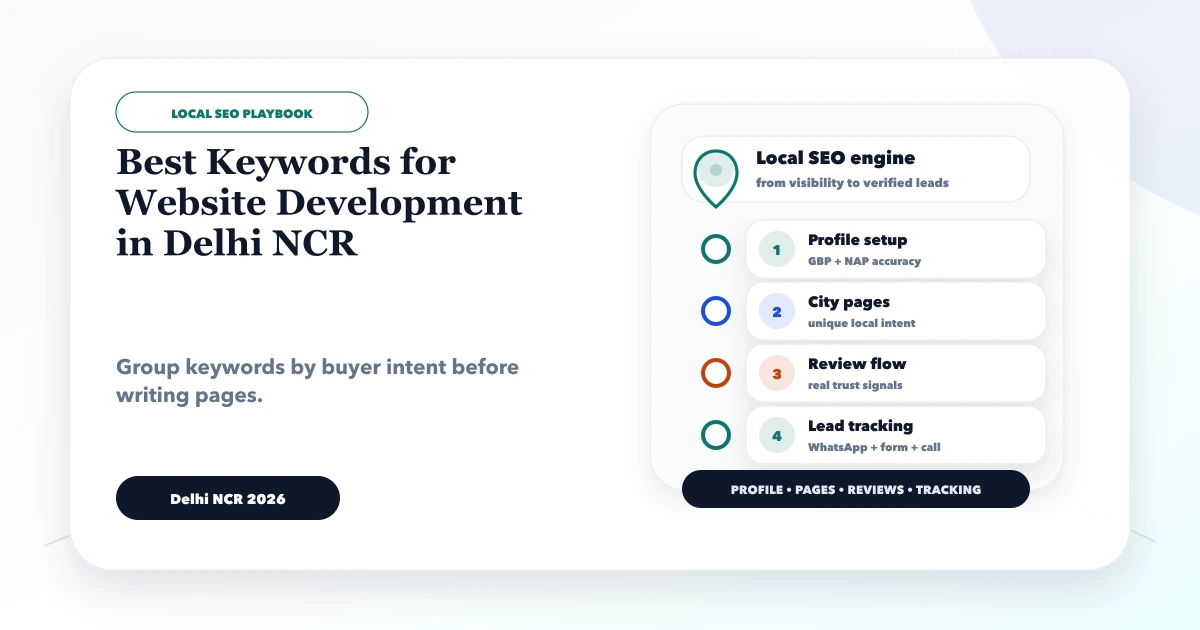
Build a Delhi NCR website-development keyword map by search intent, service, cost, industry and location, then assign one useful page to each buyer job.
Service-area note: VASUYASHII is based in Delhi NCR and supports businesses remotely across India. A city-focused guide describes service and planning context; it does not claim a physical office in every location mentioned.
Explore the parent topic: Website Development Delhi NCR Hub →The best keyword list is not the longest list. It is a map that groups related searches by buyer intent and assigns each group to one useful page.
For website-development services in Delhi NCR, users may search by service, city, cost, platform, industry, problem or provider-selection question. Publishing one page per phrase creates overlap. A better system decides which phrases belong together and which require distinct content.
This guide explains the mapping process without claiming exact search volume or ranking potential. Validate demand with current tools and first-party data.
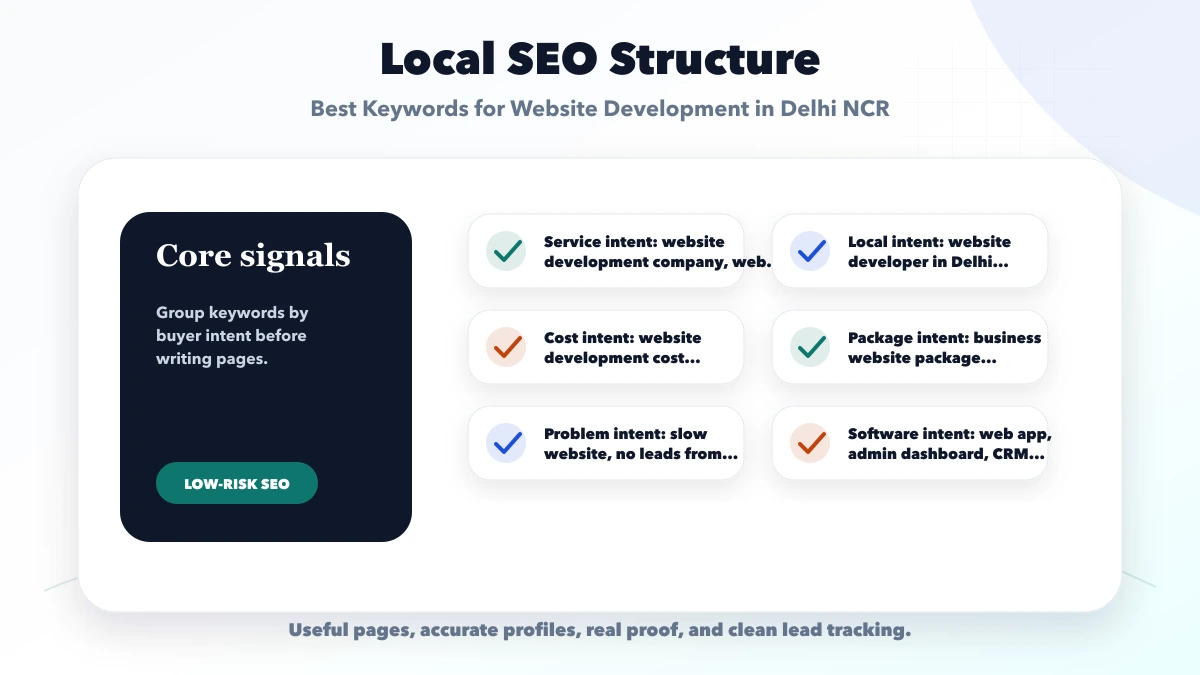
Start with these intent groups:
Assign one primary URL to each group. Use phrase variants naturally within that page instead of publishing duplicates.
| Intent | Example query pattern | User decision |
|---|---|---|
| Service | website development services | Can this provider deliver? |
| Local commercial | website developer Delhi NCR | Do they serve my area? |
| Cost | website development cost Delhi | Can I plan a budget? |
| Industry | website for coaching institute | Do they understand my business? |
| Platform | WordPress vs custom website | Which approach fits? |
| Problem | website loads slowly | How can I fix this? |
| Provider selection | how to choose a developer | How do I reduce hiring risk? |
Two phrases with different words may share the same intent. Two phrases with similar words may require different pages.
Possible variants:
These usually belong to one strong service page, not five articles. The page should explain audience, scope, process, proof, pricing factors, ownership and contact.
For the current site, website development Delhi NCR is the parent commercial URL.
Separate website and software intent:
Users searching for a web app often expect login, records, roles and workflows. Route them to web application development or software development, not a brochure-website page.
Possible clusters:
Platform comparisons, service offers and cost guides have different jobs. Do not combine every ecommerce phrase into one city page.
Examples:
Create industry content only when it includes distinct workflows, proof and buyer questions. A title change plus a generic feature list is not enough.
Common patterns:
Cost content should explain scope drivers, exclusions, third-party fees and ownership. It should not use a fake fixed price to attract every query.
Use the low-budget website package guide and five-page website cost guide as separate decision pages.
Examples:
These support existing website owners rather than first-time buyers. They should link to the relevant service or contact path.
Examples:
Avoid self-awarding “best” status. Build buyer guides that explain evaluation criteria and then present verifiable company evidence separately.
The web-developer hiring checklist owns the due-diligence intent.
Possible patterns:
Do not create a page for each permutation. Use:
The local SEO system for web development companies and service-area page strategy explain the architecture.
Examples:
These posts should answer a real question and guide users to the relevant service page naturally.
Use columns:
| Column | Purpose |
|---|---|
| Query | Raw search phrase |
| Intent | Service, cost, comparison, local, educational |
| Topic group | Shared buyer job |
| Existing URL | Current page owner |
| Page type | Service, hub, guide, industry, location |
| Business value | Qualified relevance |
| Evidence | GSC, research tool, sales question |
| Action | Keep, improve, merge-review, create |
| Parent page | Architecture |
| Notes | Differentiation and proof |
The action should not default to “create.”
Use several signals:
Search volumes are estimates and can vary by tool. First-party qualified-lead language can be more valuable than a high-volume broad phrase.
Export every indexable URL with:
For each keyword group, choose:
This prevents a new blog from competing with a commercial service page.
Use a title that describes the page’s actual job:
Service page
Website Development Services for Delhi NCR Businesses
Cost guide
Website Development Cost in Delhi: Scope and Pricing Factors
Hiring guide
Questions to Ask Before Hiring a Web Developer
Do not place several city and service variants in one title.
Use variants where they help language:
Google’s spam policies warn against unnatural keyword repetition and blocks of city names. Write for the buyer’s decision.
Link:
Avoid using the same exact-match anchor in every article.
Score 0–3:
| Factor | Question |
|---|---|
| Business relevance | Does the query match a service offered now? |
| Buyer readiness | Is the user near a commercial decision? |
| Evidence | Is there demand in GSC, research or sales? |
| Existing strength | Is there already a suitable page? |
| Proof readiness | Can the page be credible? |
| Competition | Can the business realistically differentiate? |
High score can mean “improve existing page,” not only “publish.”
Track by page and intent group:
Separate branded and non-branded queries. Review enough data before changing titles repeatedly.
The current VASUYASHII archive contains 616 blog posts and 119 location-intent posts. The site now uses parent hubs and a classifier to identify duplicate intent, thin content, weak linking and source metadata debt.
The active policy is to stop new city and near-me publishing while existing location clusters are assessed. This keyword map supports consolidation and page ownership; it does not claim that VASUYASHII ranks for every example phrase.
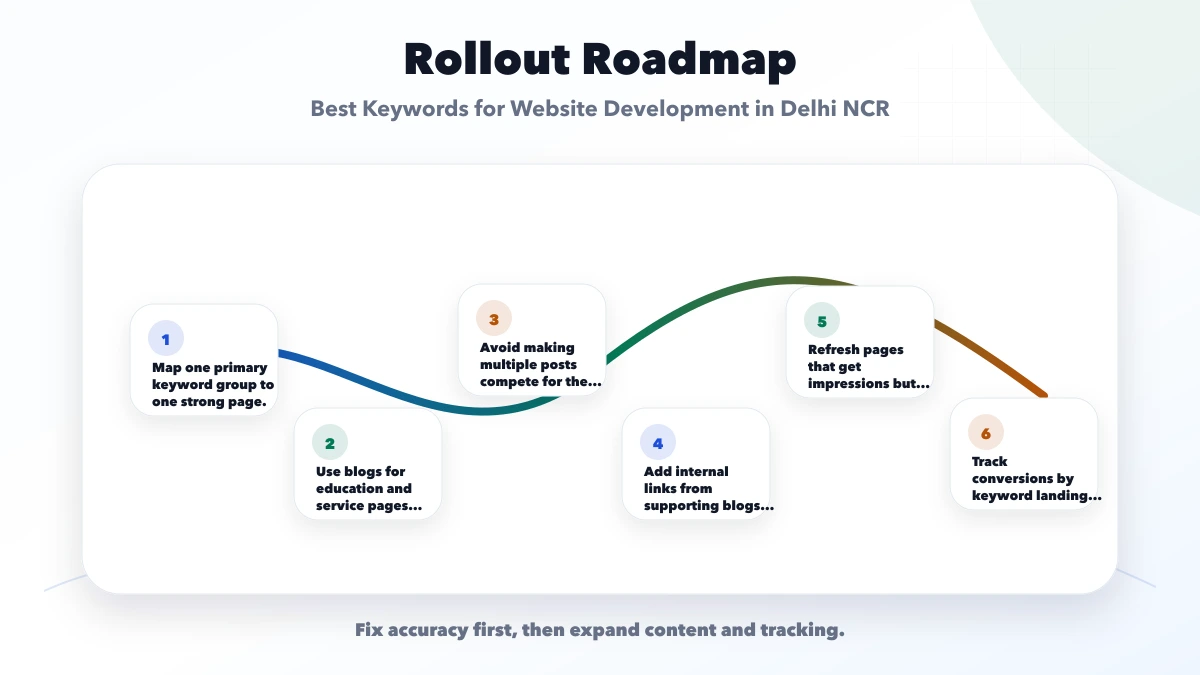
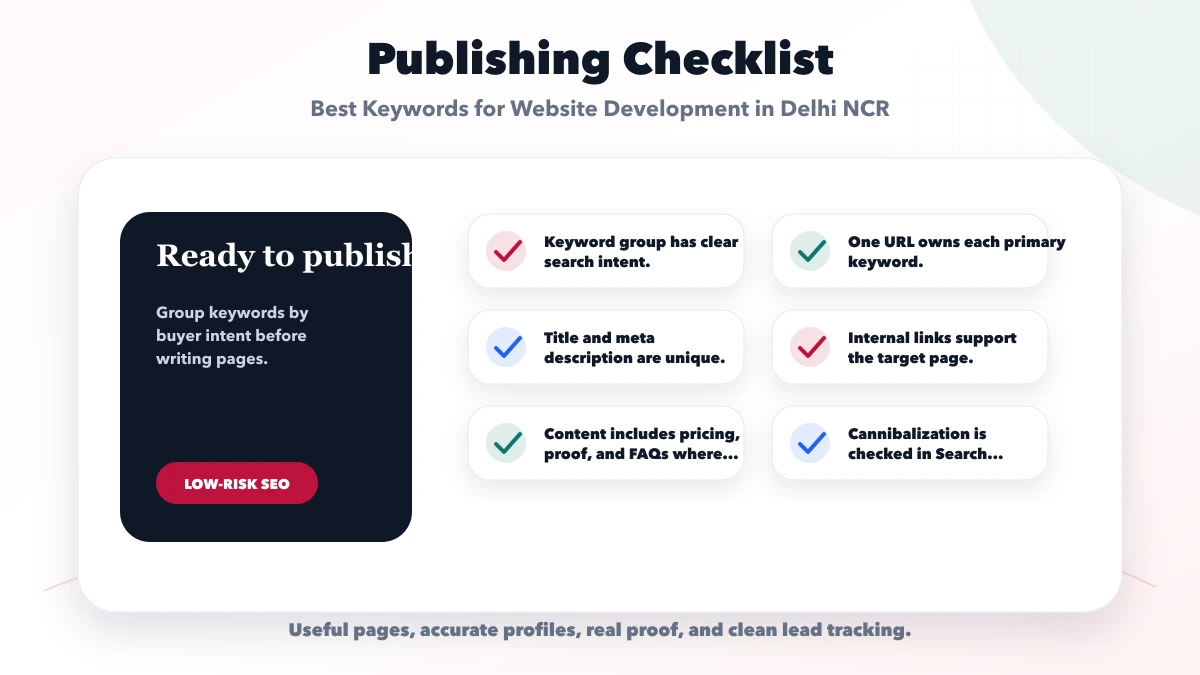
Target one coherent intent group. The number of phrases is less important than whether they share the same buyer job.
Only when the business genuinely serves them and each page can provide distinct useful value. Otherwise use a Delhi NCR regional hub.
Usually the website should explain location and service coverage naturally. Repeating “near me” is not necessary.
Use the service page as primary owner when the query seeks a provider. A blog can support related cost, process or comparison questions.
Review after major service changes and when enough GSC or lead data reveals new intent or overlap.
No. Tool data is estimated. Relevance, competition, content quality, authority and indexing all affect results.
Export existing URLs and assign one primary owner to each high-value intent group. Improve or consolidate current pages before adding more keyword variants.
Related Articles
June 6, 2026
Website development for local businesses in Delhi NCR with complete page plan, local SEO, service pages, WhatsApp CTA, proof, and contact flow.
Read article
May 9, 2026
website development company near me Delhi NCR: pricing, checklist, FAQs, trust signals, and practical SEO steps for Indian SMB owners.
Read article
April 20, 2026
Build software keyword clusters by buyer intent, service fit, page type, internal-link role, cannibalization risk, priority, and business value.
Read article
April 17, 2026
Build a Shahdara service website with mobile-first pages, bilingual content decisions, calls, WhatsApp routing, proof and ownership controls.
Read article