
May 28, 2026
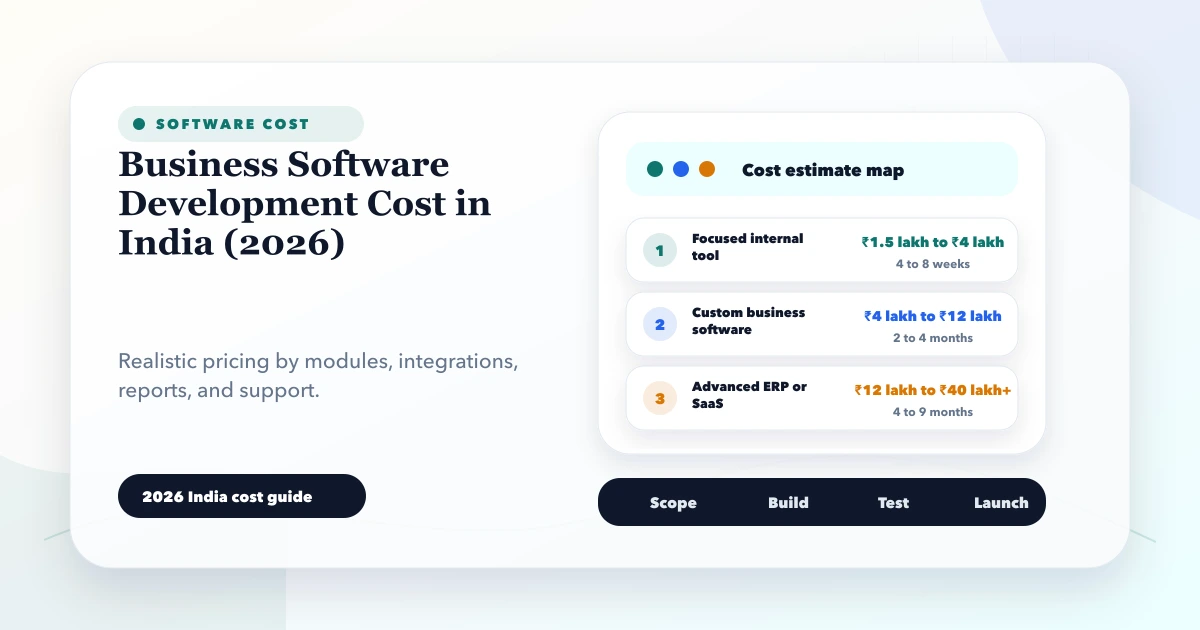
Business Software Development Cost in India
Estimate business software development cost in India using workflows, roles, data, integrations, migration, platforms, security, support, and ownership.
Read articlePublished Updated
Compare custom inventory software cost in India by stock workflow, migration, barcode and integrations. Includes a quote checklist and stock acceptance example.
Custom inventory software cost in India depends on the stock movements the system must control: receiving, sales, returns, transfers, adjustments and reporting. This guide helps retailers, warehouses, distributors and SMEs compare quotations against those workflows, including migration and ongoing costs.
Start with a representative item, a purchase document, a sale and a return. A useful estimate explains how each changes quantity, value and reports, who can approve corrections, and what support is available after launch.
By Tushar C. (Founder, VASUYASHII). The example below is an illustrative acceptance checklist for scoping a project, not a customer result or a claim that every module is included in our ready product.
VASUYASHII quotes custom inventory development after reviewing workflows, users, locations, data and integrations. There is no single fixed custom price on this page. Compare the first-year total: implementation or development, migration, hardware, hosting or subscription, integrations and support. A ready product subscription is a separate purchase from a custom build.
A retail shop may need stock, billing, and low-stock alerts. A warehouse may need barcode receiving, bin locations, dispatch, and audit logs. A distributor may need purchase, sales, returns, and customer-wise reporting.
The correct budget is the smallest complete version that solves the current business problem and keeps a clear upgrade path. Under-scoping creates rework. Over-scoping delays launch and blocks learning from real users.

Define what each module must do. For example, barcode support could mean finding an existing item, printing labels, receiving a batch, or picking a dispatch. These are different workflows with different hardware and testing needs.
Ask each supplier to quote the same written scope in INR and separate one-time work from recurring charges.
| Cost component | What the quote should identify | Common exclusion to check |
|---|---|---|
| Core system | Item fields, units, stock movements, roles and named reports | Transfers, reservations or approvals assumed to be included |
| Data migration | Source files, record counts, cleanup owner and trial reconciliation | Opening balances, duplicate SKUs and historical transactions |
| Barcode equipment | Scanner and printer models, labels and supported workflow | Hardware, consumables and testing on the actual devices |
| Integrations | Systems, data direction, sync frequency and error handling | Third-party fees, API limits and ongoing connector support |
| Deployment and ownership | Hosting, backups, restore procedure, exports and handover | Storage growth, source-code rights and exit assistance |
| Support | Coverage, response targets, fixes and change-request process | New reports, new locations and later workflow changes |
For comparison, calculate the first-year total using the same user count, locations and support scope. Confirm taxes and quote validity in the proposal. A cheaper first invoice may exclude migration or recurring services that another quotation includes.
Use this synthetic example in a test company for one SKU, one location and one base unit. It checks saleable quantity only; stock valuation, reserved stock and tax calculations need separate agreed cases.
| Step | Change in saleable stock | Expected quantity |
|---|---|---|
| Approved opening balance | +100 | 100 |
| Receive a purchase | +25 | 125 |
| Complete a sale | -12 | 113 |
| Accept a saleable customer return | +2 | 115 |
| Approve a damaged-stock adjustment | -3 | 112 |
The closing saleable quantity is 100 + 25 - 12 + 2 - 3 = 112 units. Damaged items may still be physically present; keep them outside saleable stock according to the agreed process. The movement report should explain every change with its source document, user and time. Reopening or retrying a saved transaction must not apply its stock movement twice.
Also test a denied adjustment by an unauthorized user, a cancelled transaction and a transfer between two locations if transfers are in scope. Agree whether insufficient stock blocks a sale or requires an approval. These checks turn a vague feature list into acceptance criteria.
For example, one warehouse with a single unit per SKU is a different scope from several warehouses with carton-to-piece conversion, reserved stock and partial dispatches. Document those rules before comparing prices.
Do not compare a ready ERP-lite subscription with a custom software quotation as if they are the same purchase. They solve different levels of workflow ownership.
This path fits a trader, retailer, wholesaler, hardware shop, or supplier that needs GST billing, products, stock, clients, vendors, purchases, payments, expenses, reports, PDF invoices, and company-wise access without special warehouse logic. The VASUYASHII Business Suite currently shows a founder early-access price of Rs. 2,500 per year for its stated scope. Buyers should test the live demo and confirm onboarding, migration, support, and optional rollout costs before purchase.
Even when the product fits, implementation may include cleaning item masters, mapping GST fields, importing clients and vendors, preparing opening stock, setting roles, configuring invoice templates, and training staff. Ask whether this work is included or separately quoted. A low software price does not remove the need for accurate business data.
Custom development may be appropriate when required transfers, bins, batches, serial numbers, expiry, picking, dispatch, manufacturing rules, approvals or integrations cannot be handled by the chosen product. Confirm the gap in a demo first, then request a scoped estimate and acceptance criteria for every stock movement.
For related decisions, compare the best inventory software guide, distributor billing workflow, and software development service. The correct choice is the least expensive option that controls the real workflow without hiding critical gaps.
Before go-live, reconcile opening stock for a sample of high-value and fast-moving items. Then run one purchase, one invoice, one payment, and one return in a test company. The expected and actual quantity, tax, due amount, and report totals must match. This acceptance test is more useful than approving software from screenshots alone.
Agree a delivery schedule after the data sample and stock rules are reviewed. Use checkpoints for scope approval, a working purchase-to-return flow, trial import, user acceptance and cutover. Do not migrate live balances until the agreed reports reconcile and a rollback or correction process is documented.

This checklist protects the project from hidden costs. A clear vendor should explain scope, exclusions, access, timeline, revision limits, testing, handover, and maintenance before development starts.
VASUYASHII would first review your locations, user roles, item units, sample stock movements, reports and existing data sources. We would separate a ready-product fit check from custom requirements, then quote the agreed first release, migration and support. Use the software requirement template to prepare a brief without sharing live customer data.
Start with Business Suite inventory for the ready product, or send your inventory requirements for a scope review. For a custom build, review our software development service.
Approve the first release against reconciled stock, usable reports and staff permissions. A feature ticked in a proposal is not enough if the purchase, sale and return totals disagree.

For apparel-specific variants, returns and transfers, use the garment shop inventory guide. For SKU, barcode, units, GST, price tiers, effective dates and import governance, use the ERP product master and price list guide.
It needs a scoped quotation. Share locations, users, item units, stock movements, migration volume, integrations and required reports. Compare development, setup and first-year recurring costs separately from a ready-product subscription.
Use barcode or QR support when manual stock entry is slow, error-prone, or hard to audit.
Billing can be part of the agreed scope. Confirm when an invoice affects stock, how returns affect dues, and which invoice fields or external tax integrations are required. A billing screen alone does not establish every integration is included.
Not always. Retail focuses on billing and stock, while warehouse systems need receiving, picking, dispatch, barcode, and location logic.
VASUYASHII offers custom software development and a ready Business Suite. Share the required stock, billing, warehouse and reporting workflows so we can assess product fit and separately quote custom work.
Send your number of locations, approximate SKU count, user roles, a description of stock movements and the reports you need. Use anonymized examples initially. We can review whether a ready product fits or a custom estimate is appropriate.
Related Articles
May 28, 2026
Estimate business software development cost in India using workflows, roles, data, integrations, migration, platforms, security, support, and ownership.
Read article
June 1, 2026
Custom CRM software cost in India with modules, pricing ranges, implementation timeline, integrations, reports, and quote checklist.
Read article
May 24, 2026
Plan a barcode inventory system for receiving, putaway, picking, stock counts, returns, and transfers using mobile cameras or dedicated scanners.
Read article
May 23, 2026
Plan a custom reports dashboard with metric definitions, source mapping, sales and stock views, role access, refresh rules, reconciliation, and alerts.
Read article