
March 26, 2026
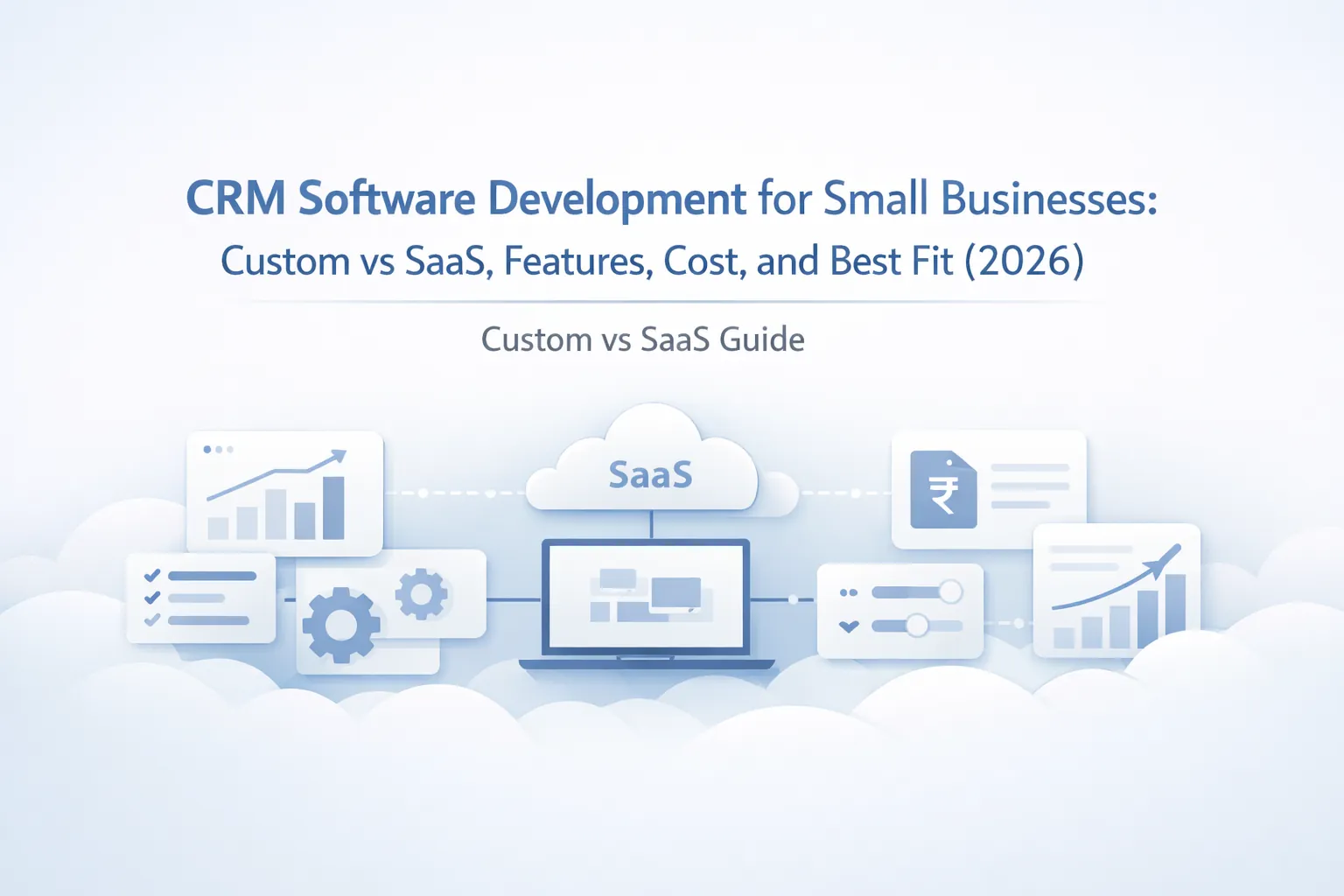
CRM Software for Small Businesses: Build vs SaaS
CRM software development for small businesses: compare custom CRM vs SaaS, features, pricing in India, timeline, tech stack, and rollout tips for lead tracking.
Read articlePublished Updated
Custom CRM software cost in India with modules, pricing ranges, implementation timeline, integrations, reports, and quote checklist.
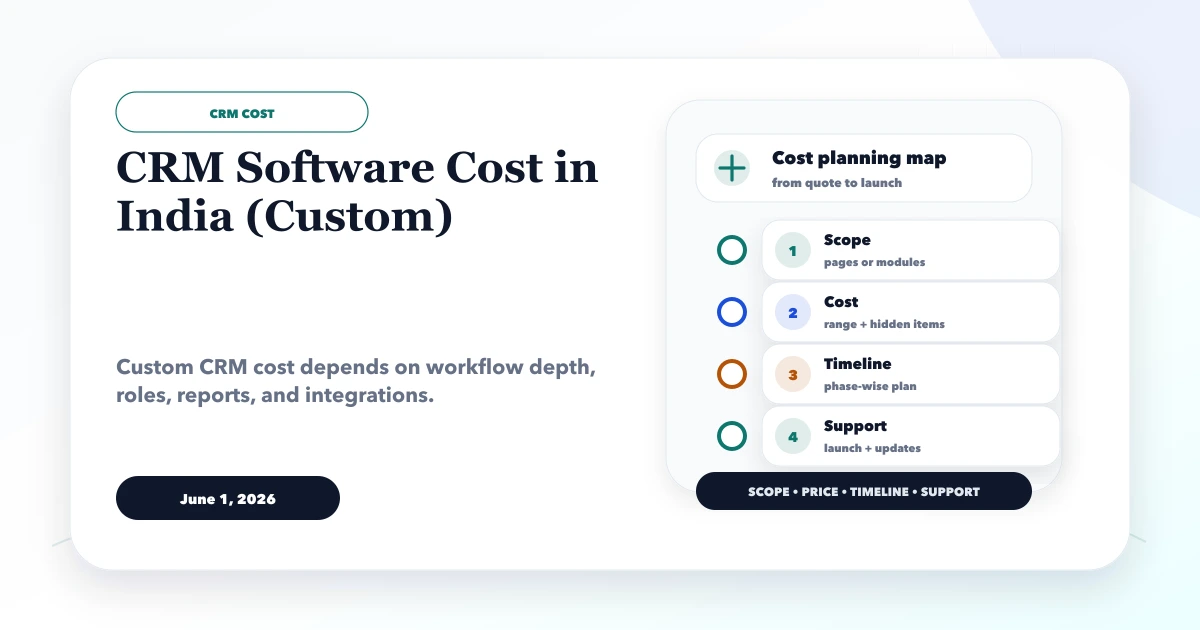
This guide explains CRM software cost in India custom for Indian SMEs comparing custom CRM development with SaaS CRM tools for sales, support, follow-ups, and reports. It focuses on practical cost planning, scope, deliverables, hidden costs, timeline, and what to check before approving a quote.
Custom CRM software cost in India can start around Rs. 2.5 lakh for a focused sales CRM and cross Rs. 15 lakh when lead capture, assignment, WhatsApp, email, reports, permissions, dashboards, and integrations are included.
A real estate team may need lead assignment and WhatsApp follow-up. A service company may need quote tracking. A distributor may need customer history and sales reports. Custom CRM cost follows these workflow rules.
| Scope | Practical price range | Timeline |
|---|---|---|
| Focused sales CRM | Rs. 2.5 lakh to Rs. 6 lakh | 6 to 12 weeks |
| Custom CRM with reports | Rs. 6 lakh to Rs. 15 lakh | 3 to 5 months |
| Advanced CRM with integrations | Rs. 15 lakh to Rs. 35 lakh+ | 5 to 9 months |
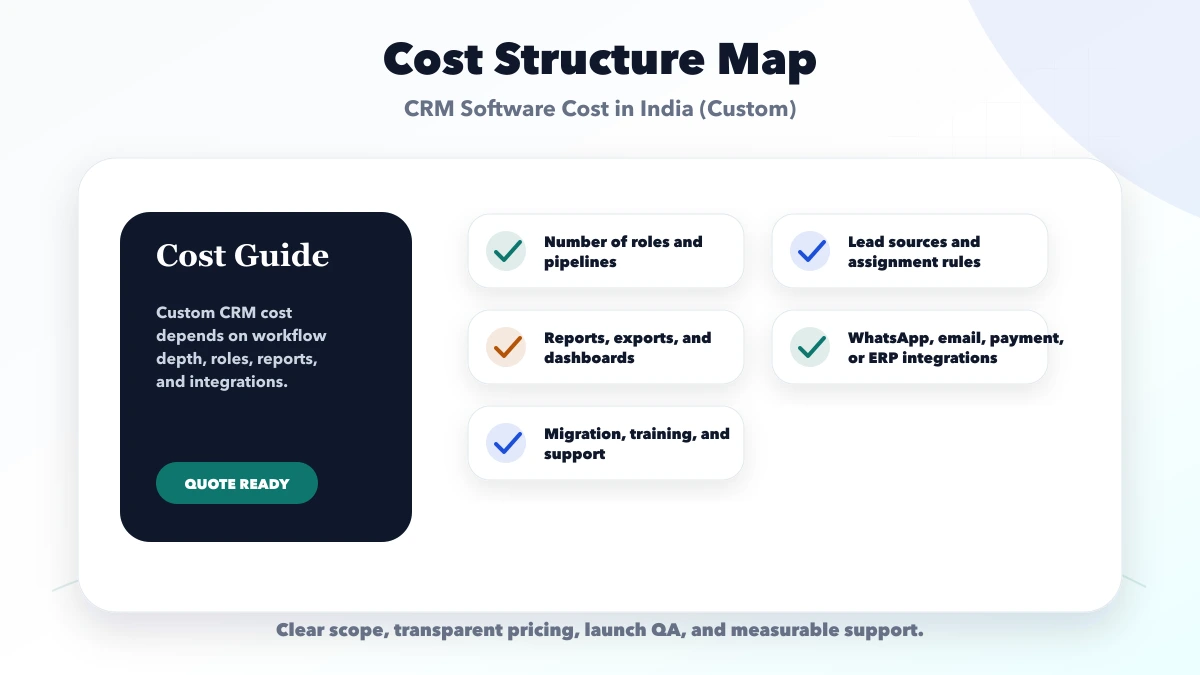
Two CRMs with the same visible modules can have very different effort. Cost increases when assignment rules, approvals, duplicate handling, permissions, reports, integrations, migration, and recovery must work across many teams.
Create a scope sheet for each workflow:
| Workflow | Questions that affect cost |
|---|---|
| Lead capture | Which forms, ads, imports, APIs, calls, or WhatsApp sources create leads? |
| Assignment | Round-robin, territory, product, workload, priority, or manual approval? |
| Pipeline | Which stages, mandatory fields, loss reasons, and reopen rules apply? |
| Follow-up | Tasks, reminders, templates, escalation, and missed-action reporting? |
| Quote/order hand-off | Does CRM stop at an opportunity or connect with billing and operations? |
| Reporting | Owner dashboard, team targets, ageing, source quality, and export rules? |
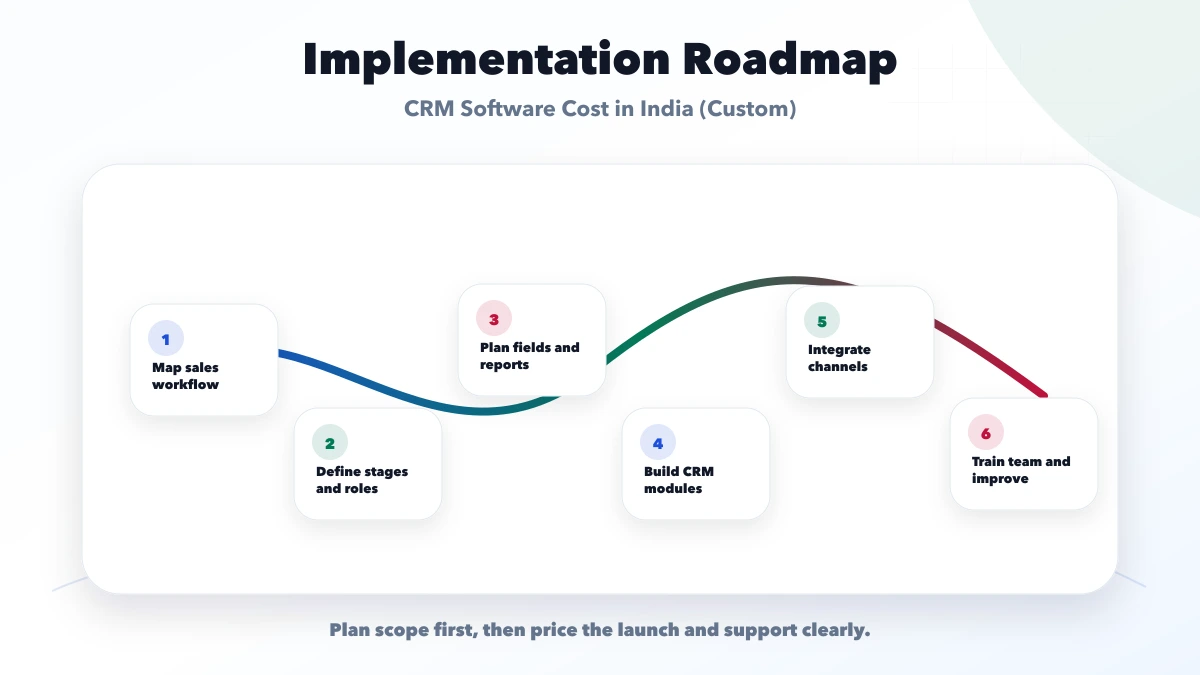
Estimate only after the first release has defined users, records, actions, reports, integrations, migration volume, and acceptance tests.
A focused phase may include leads, contacts, companies, opportunities, activities, tasks, notes, users, roles, basic reports, import, and export. Optional complexity includes multiple pipelines, territory logic, partner access, approval chains, configurable fields, document generation, telephony, WhatsApp templates, email sync, payment links, ERP hand-off, and offline/mobile use.
Do not add every field requested in a workshop. Each field needs an owner, purpose, validation rule, visibility rule, reporting use, and migration source. Excess fields reduce adoption and make reports less trustworthy.
Choose an established SaaS CRM when the sales process is standard, the available integrations are adequate, and configuration can meet the need. Include subscription growth, implementation, add-ons, API limits, storage, partner fees, and migration in the total cost.
Consider custom development when a differentiating workflow cannot be represented safely, company-specific permissions or reports are essential, several disconnected operations need one controlled system, or long-term product ownership justifies the build. Custom does not automatically mean better; it adds responsibility for security, hosting, testing, maintenance, support, and roadmap decisions.
Inventory every source: spreadsheets, email contacts, forms, old CRM exports, billing records, and team-owned files. Define one record owner and matching rules for phone, email, GSTIN, or company name. Decide how duplicates, inactive leads, missing owners, old notes, and attachments will be handled.
Run a rehearsal import. Compare counts by pipeline stage and owner, inspect a sample, verify date/time formats, and test rollback. Keep the original export immutable and obtain business approval before the final cut-over.
For WhatsApp, email, calling, payments, forms, or ERP connections, document the provider, API, authentication, message/template rules, rate limits, webhook retries, failure queue, consent, logging, and support owner. A line item called “WhatsApp integration” is too vague for a reliable quote.
Third-party provider charges, approvals, changing policies, and message fees should be shown separately from custom development cost. Integrations also need monitoring after launch; a successful one-time API test is not an operating system.
Define who can view, create, edit, assign, export, delete, merge, and report on records. Include team, territory, company, and record-level scope where needed. High-risk actions such as bulk export, permanent deletion, role changes, and automation edits should be restricted and logged.
Server-side authorization must protect every request. Hiding a menu item in the interface is not sufficient. Test that one user cannot retrieve another team’s restricted lead by changing an identifier or API request.
List reports before development: lead source, response time, stage conversion, ageing, follow-up compliance, win/loss reasons, pipeline value, owner performance, and data-quality exceptions. Define each formula and filter so users do not argue about totals after launch.
Acceptance testing should cover normal flows, duplicate leads, reassignment, lost/reopened deals, restricted records, imports, exports, integration failures, and backup/recovery. Budget for pilot training and two or more feedback cycles rather than declaring completion when screens are visible.
VASUYASHII offers custom software, CRM, and ERP services and integrations. The price bands above are planning ranges, not a quotation. A confirmed budget requires discovery, data samples, integration documentation, security needs, delivery responsibilities, and an approved phase-one scope.
Ask each vendor to separate discovery, UX, development, migration, integrations, hosting, third-party subscriptions, testing, training, warranty, ongoing support, and change requests. Record what the customer must supply and which assumptions can change the price.
Compare the same acceptance criteria, not only the headline total. One quote may include a rehearsal migration and permission testing while another includes only screen development. Also ask for source-code ownership, deployment access, documentation, backup responsibility, support hours, response process, and exit/export terms. These details explain the long-term cost more reliably than a module count.
For a first release, choose one measurable target such as faster lead assignment, fewer missed follow-ups, cleaner source reporting, or a shorter quote cycle. Defer low-use dashboards and speculative automation until the pilot proves the data is reliable.
Budget for hosting, monitoring, backups, security updates, provider fees, bug support, small workflow changes, data-quality review, user onboarding, and periodic permission audits. A CRM also needs an internal product owner who decides fields, stages, reports, and change priority.
Track adoption by active users, completed follow-ups, missing owners, stale opportunities, duplicate rate, and report accuracy. If teams keep parallel spreadsheets, investigate the missing workflow or trust problem before building more features. The sustainable cost is the combination of software operations and process ownership, not maintenance billing alone.
Useful links: web application services, software development, integrations, services, and contact.
Before treating CRM as a standalone quote, review the Custom Software, CRM and ERP hub. A CRM often touches lead capture, customer history, invoices, payments, reports, permissions, WhatsApp follow-ups, and owner dashboards.
For businesses that also need GST invoices, inventory, purchase tracking, due payments, expenses, PDF invoices, and multi-company operations, compare the custom CRM scope with VASUYASHII Business Suite. This avoids paying for custom modules that already fit a simpler ERP-lite workflow.
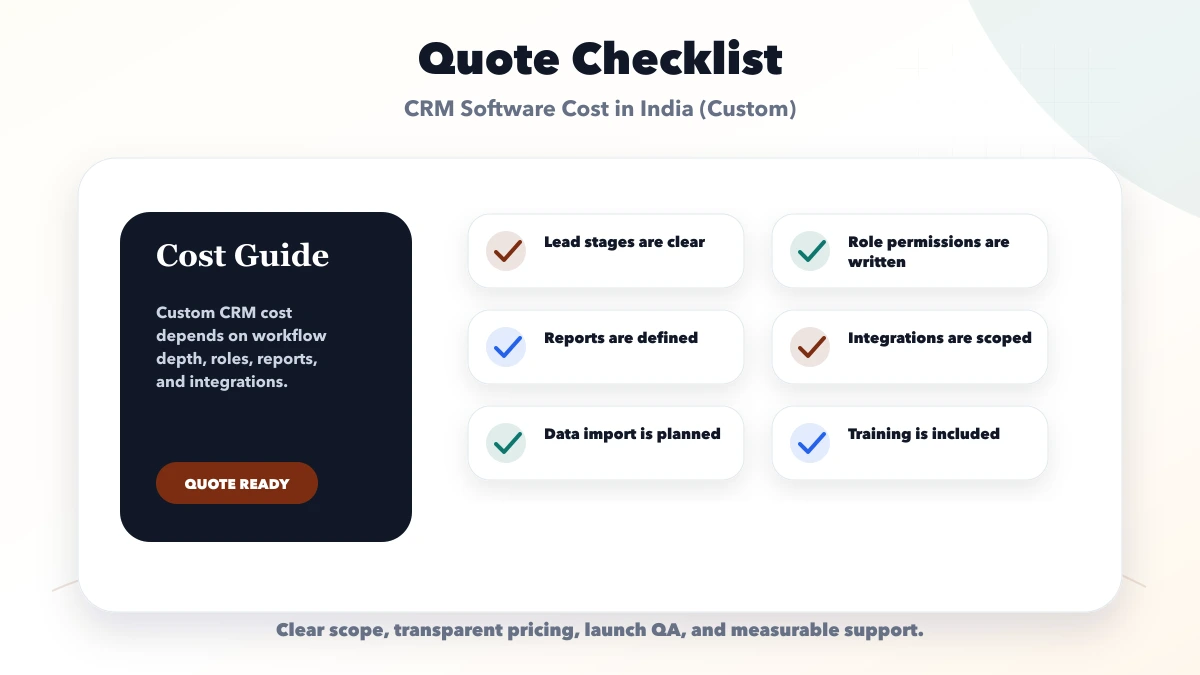
A focused custom CRM may cost Rs. 2.5 lakh to Rs. 6 lakh, while advanced systems can cross Rs. 15 lakh.
Choose SaaS CRM for standard workflows. Choose custom CRM when your process, reports, permissions, or integrations are unique.
Yes. WhatsApp lead alerts, templates, and follow-up tracking can be added depending on compliance and provider setup.
Common modules include leads, contacts, deals, follow-ups, tasks, users, reports, and integrations.
Yes. We build custom CRM systems, dashboards, automation, and integrations for Indian businesses.
If you want a practical quote for CRM software cost in India custom, VASUYASHII can help with scope, planning, design, development, integrations, tracking, launch, and maintenance.
Related Articles
March 26, 2026
CRM software development for small businesses: compare custom CRM vs SaaS, features, pricing in India, timeline, tech stack, and rollout tips for lead tracking.
Read article
June 1, 2026
Compare custom inventory software cost in India by stock workflow, migration, barcode and integrations. Includes a quote checklist and stock acceptance example.
Read article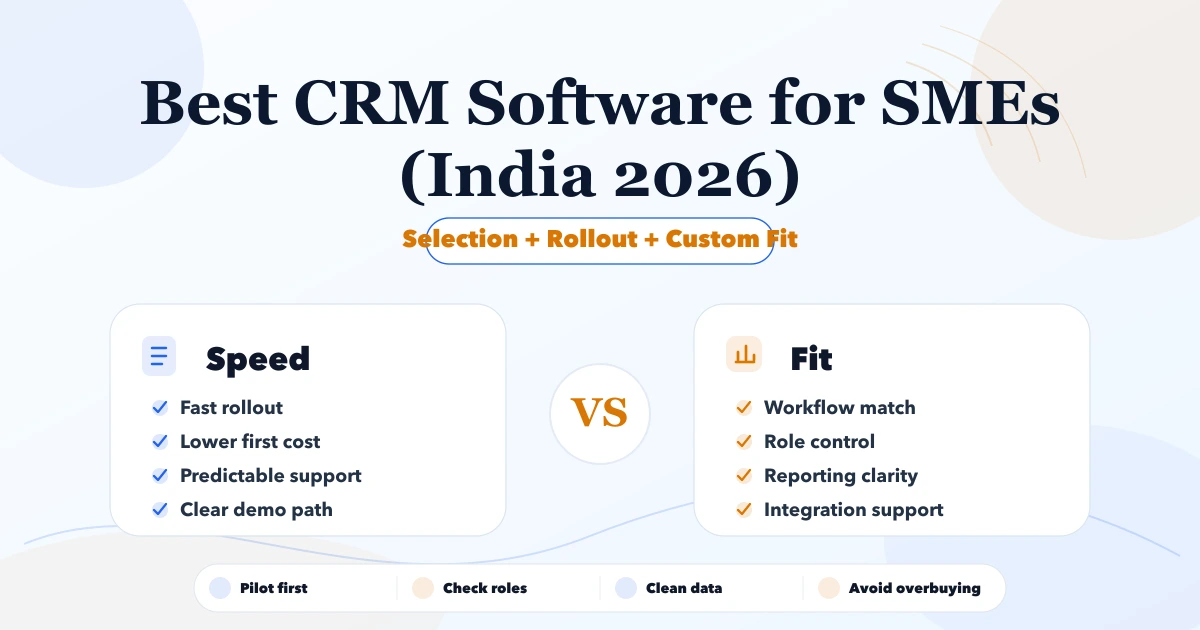
May 7, 2026
Best CRM Software for SMEs (India 2026) comparison guide with selection logic, pricing, rollout notes, and when custom software makes more sense in 2026.
Read article
May 19, 2026
Estimate custom software cost by module across workflows, roles, data, integrations, migration, testing, support and acceptance before comparing quotes.
Read article