
May 22, 2026
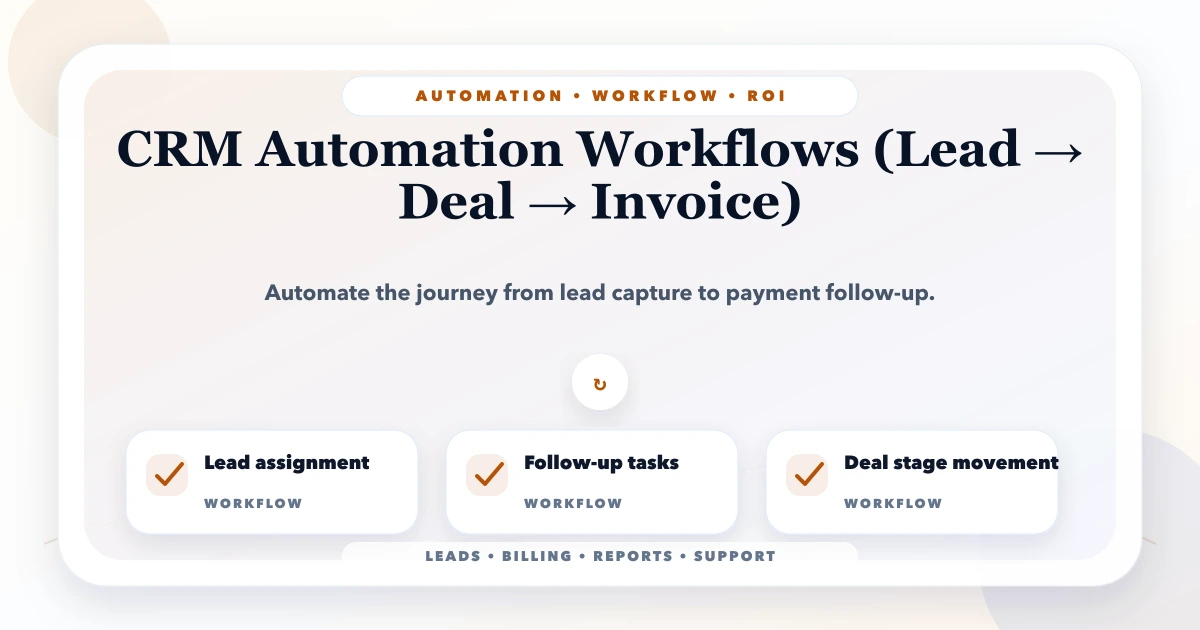
CRM Automation: Lead to Deal to Invoice
Design a reliable CRM workflow from lead capture to deal, quotation, invoice, payment, handoff, retries, approvals, and sales reporting.
Read articlePublished Updated
CRM development cost in India: 2026 India pricing guide with modules, timeline, cost drivers, mistakes, quote checklist, and practical planning ranges.
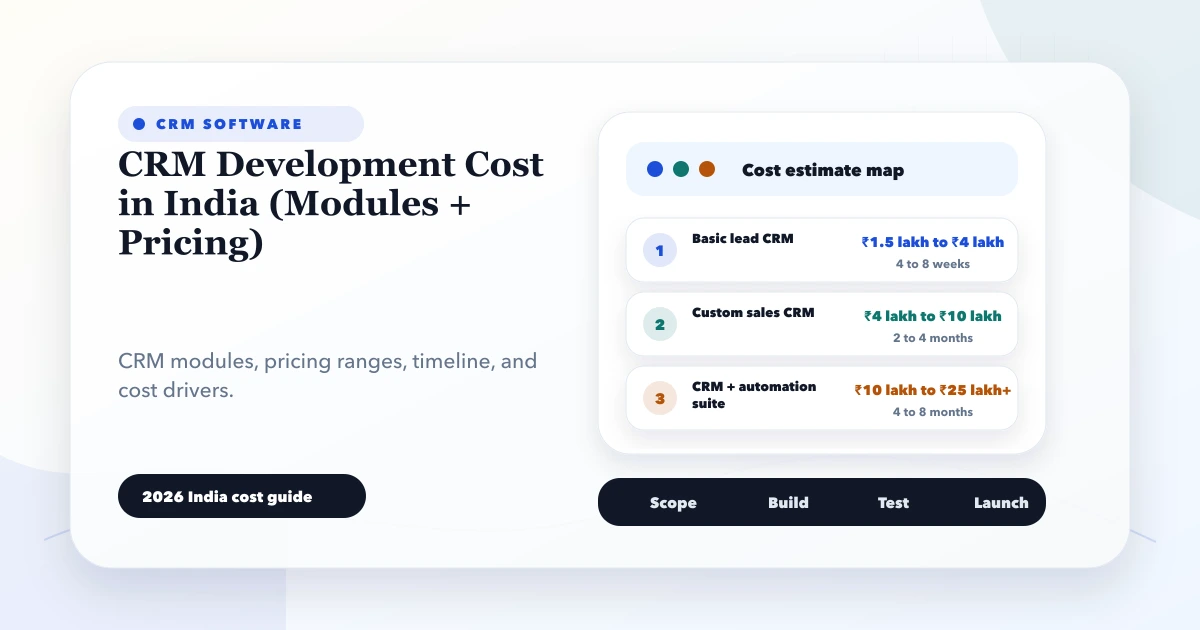
This guide on CRM development cost in India is for businesses planning a custom CRM for leads, follow-ups, sales pipeline, quotations, WhatsApp, reports, and team accountability. It explains practical 2026 India pricing in plain language so you can compare estimates, plan phases, and avoid unclear software scope.
Software cost is not decided by the project title alone. The real cost comes from modules, screens, user roles, reports, integrations, data cleanup, testing, deployment, and support. A small clean workflow can be affordable. A vague all-in-one system can become expensive because no one knows where the scope ends.
By Tushar C. (Founder, VASUYASHII). Reviewed by VASUYASHII Editorial for real-world custom software, CRM, ERP, admin dashboard, automation, booking, WhatsApp, SaaS, and payment implementation experience.
CRM development cost in India depends on lead stages, users, reports, automation, integrations, and data migration. A basic CRM may cost ₹1.5 lakh to ₹4 lakh, while a custom CRM with workflow automation can reach ₹5 lakh to ₹15 lakh+.
These ranges are planning ranges, not fixed quotations. Final pricing depends on the exact workflow, number of screens, user roles, integrations, reports, data migration, testing, and post-launch support.
In real projects, cost usually increases when the business process is unclear. If the team cannot explain what happens on success, failure, cancellation, edit, approval, retry, duplicate data, or report export, the developer has to discover that during development.
The cheapest useful version is usually a focused phase one. It should solve the main business workflow, give owners visibility, and create reliable data. Once that works, later phases can add automation, advanced reports, mobile views, integrations, and role depth.
Each item should be defined with input, output, user role, validation rule, and acceptance criteria. If one feature can be interpreted in many ways, the quote will either become vague or the project will face change requests later.
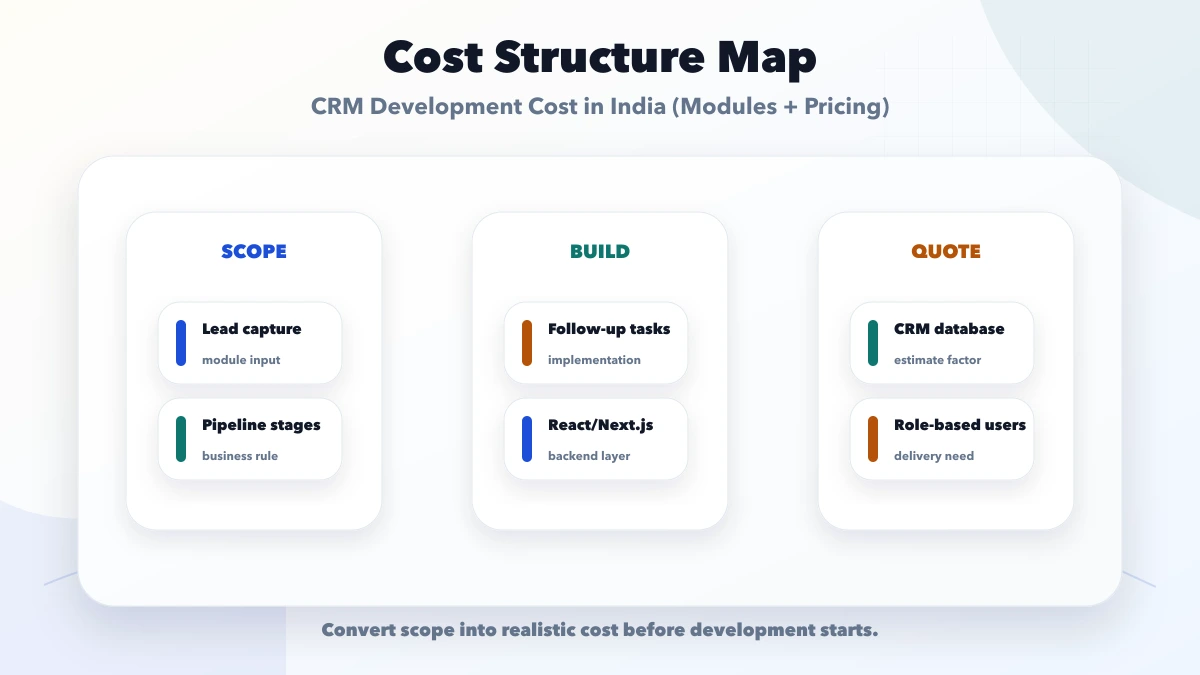
| Scope | Practical price range | Typical timeline |
|---|---|---|
| Basic lead CRM | ₹1.5 lakh to ₹4 lakh | 4 to 8 weeks |
| Custom sales CRM | ₹4 lakh to ₹10 lakh | 2 to 4 months |
| CRM + automation suite | ₹10 lakh to ₹25 lakh+ | 4 to 8 months |
These ranges assume a professional build with planning, UI, backend, database, testing, deployment, and basic handover. A cheaper quote may still work for a very small scope, but it becomes risky if it skips authentication, validation, reports, backups, logs, or support.
The best way to compare two quotes is to compare module-by-module scope, not only final price. One quote may include reports, testing, deployment, and support. Another quote may only include screens.
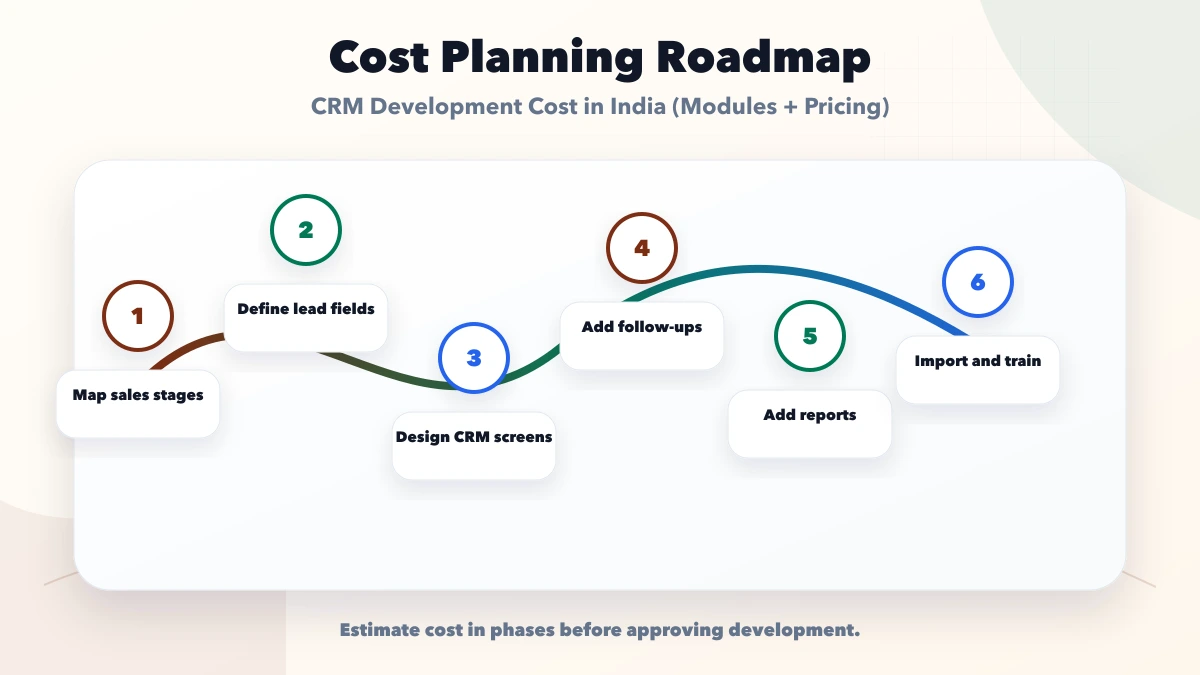
This roadmap keeps development practical. It avoids spending the full budget before the business has tested the main workflow with real users and real data.
The tech stack should match the workflow and support needs. A lightweight internal tool can use a managed backend. A data-heavy ERP or SaaS product may need a stronger backend, audit logs, queues, database indexing, backups, and monitoring.
The visible UI is only one part of cost. The hidden cost is usually in rules: who can edit, what happens when data is wrong, how reports are calculated, how duplicate records are handled, and how failures are tracked.
Before asking for a quote, prepare these details:
This turns the conversation from "how much will software cost" into a much clearer estimate based on scope.
Do not approve software only from screenshots. Ask how authentication, permissions, validation, database backups, logs, failed actions, deployment, and support will work. For payment, CRM, ERP, inventory, booking, WhatsApp, and SaaS systems, these details matter as much as the visible design.
Use separate test and production credentials where integrations are involved. Keep API keys out of frontend code. Define who can export data, delete records, change prices, approve actions, or retry failed automations.
VASUYASHII would start with module mapping, user roles, sample data, required reports, integration accounts, and phase-one priorities. Then we would turn the requirement into a practical build plan with estimated timeline and cost.
For most SMEs, we prefer a stable first release over a large fragile build. Once the team trusts the core workflow, the next phase can add automation, advanced analytics, customer portals, mobile flows, WhatsApp, payments, or ERP-style reporting.
If you are planning software and want a realistic estimate, prepare the module list, reports, roles, and sample data first. VASUYASHII can help convert that into a clear build plan before development starts.
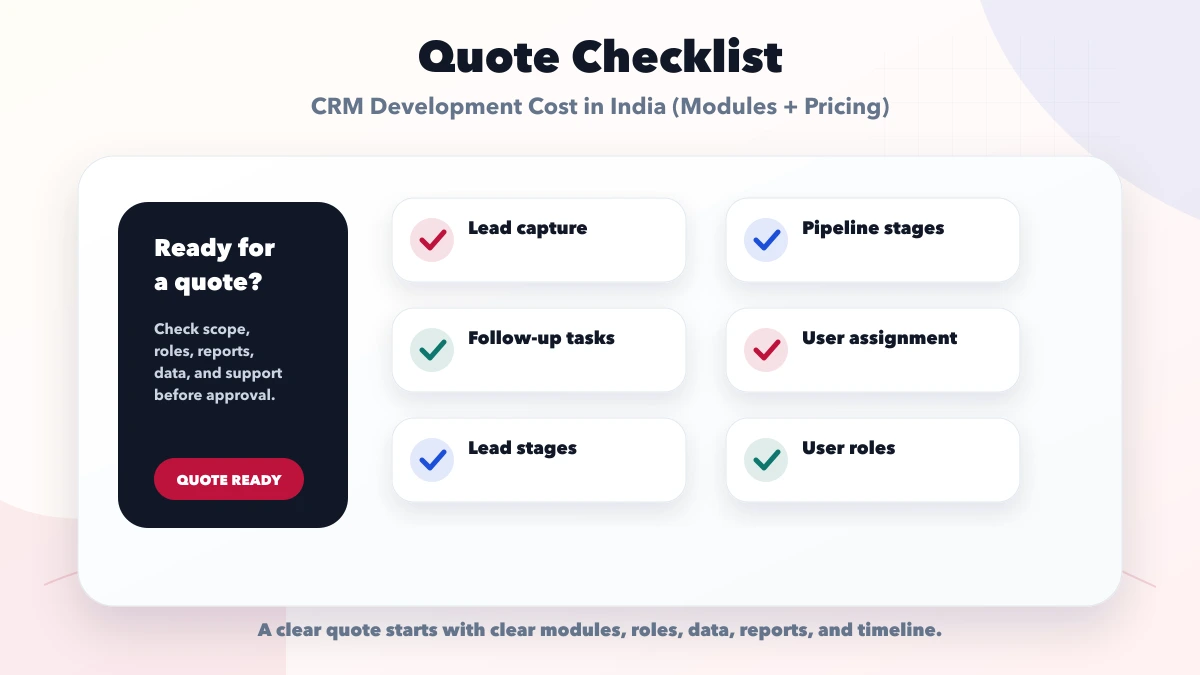
Avoid comparing quotations only by total amount. Compare what is included: modules, reports, user roles, integrations, testing, deployment, handover, support, and change-request policy.
Avoid starting development without a written scope. Even a short document with modules, roles, reports, and examples can prevent expensive confusion later.
It is for businesses planning a custom CRM for leads, follow-ups, sales pipeline, quotations, WhatsApp, reports, and team accountability. The goal is to understand realistic 2026 India pricing before approving custom software development.
Quotes vary because two projects with the same title can have different modules, roles, reports, data migration, integrations, testing depth, security needs, and support expectations.
Start with map sales stages. This keeps the first phase grounded in the real business workflow instead of guessing screens.
Yes. Most businesses should build the smallest reliable version first, then add reports, automation, integrations, mobile views, and advanced controls after real usage is clear.
The biggest cost risk is no lead source tracking. It creates unclear scope, rework, or wrong expectations after development begins.
Share module list, user roles, sample data, report examples, integrations, permissions, timeline, must-have features, and support expectations in writing.
Yes. VASUYASHII can help with project scoping, cost planning, UI planning, backend development, integrations, testing, launch, and support.
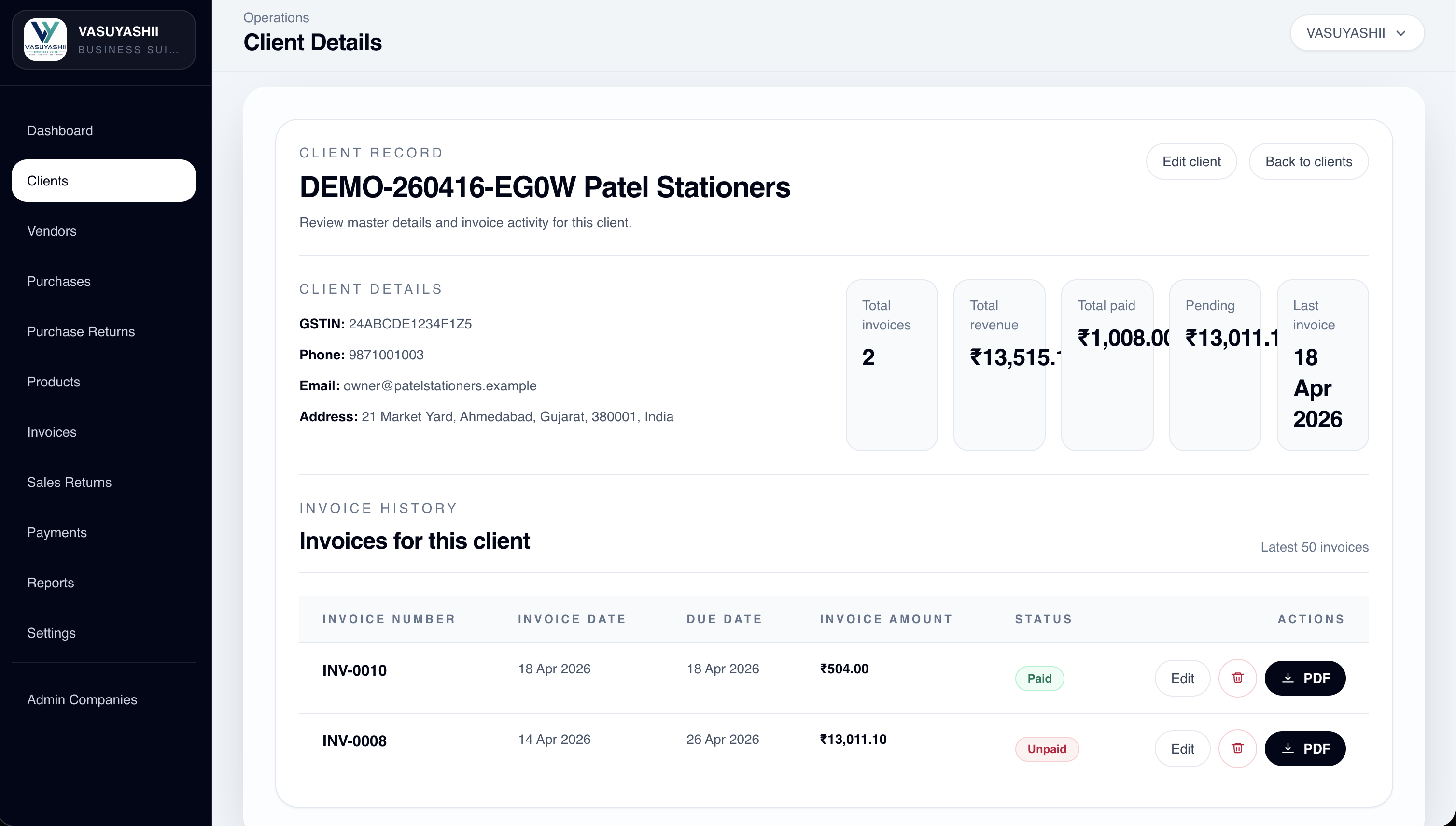
VASUYASHII Business Suite currently includes company-scoped clients, contact details, invoice/payment history and role-aware business records. The screenshot below is current first-party product evidence with demo data. A sales CRM would extend this foundation with pipeline stages, activities, source attribution and follow-up ownership.
| CRM module | Minimum acceptance test | Cost risk when undefined |
|---|---|---|
| lead capture | duplicate phone/email is handled | duplicate records and missed follow-up |
| pipeline | permitted user moves a lead with reason | unreliable forecast |
| activity | next action has owner and due date | “CRM” becomes a contact list |
| reporting | source and stage totals reconcile | management cannot trust reports |
| integration | failure/retry state is visible | silent data loss |
Decision example: a 5-user service team with standard stages can configure an existing CRM. A distributor requiring dealer hierarchy, credit limits, quotations and territory rules may justify custom development. Compare the process gap, not just licence versus build cost.
Limitations: current Business Suite is not presented as an advanced sales CRM. Telephony, marketing automation, lead scoring, omnichannel inbox and enterprise forecasting are separate scope. Prices in this guide are planning bands, not a binding quote.
Customer and lead records are personal data. Use the official Digital Personal Data Protection Act, 2023 as a compliance discussion source and obtain legal advice for notice, purpose, access and retention. Analytics should use non-PII event parameters; Google defines lead measurement in its GA4 event reference.
If you want a practical software estimate, VASUYASHII can help with scope, UI planning, backend development, integrations, testing, launch, and post-launch support.
Related Articles
May 22, 2026
Design a reliable CRM workflow from lead capture to deal, quotation, invoice, payment, handoff, retries, approvals, and sales reporting.
Read article
April 21, 2026
Plan a CRM-lite for Indian traders with customer history, follow-ups, quotations, WhatsApp, team roles, reports, realistic cost, and rollout steps.
Read article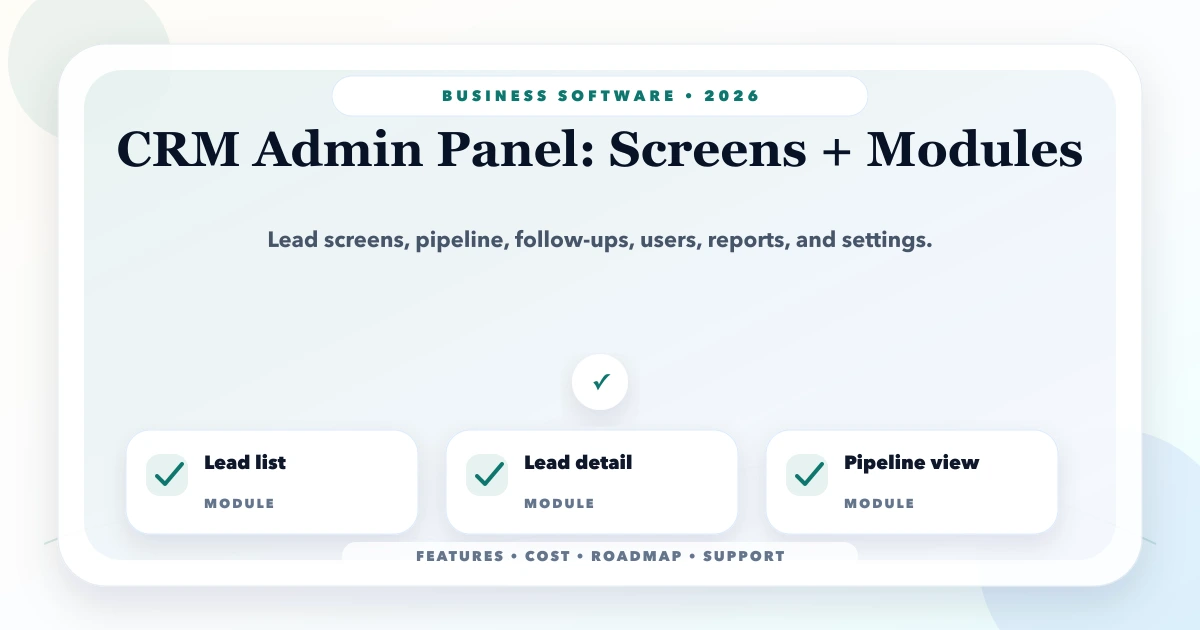
May 23, 2026
Plan CRM admin screens around sales jobs, queues, permissions, approvals, audit history, reports, bulk actions, and operational exception handling.
Read article
May 15, 2026
Compare real estate CRM features and cost in India, including lead sources, property matching, site visits, follow-ups, roles, reports and rollout phases.
Read article