
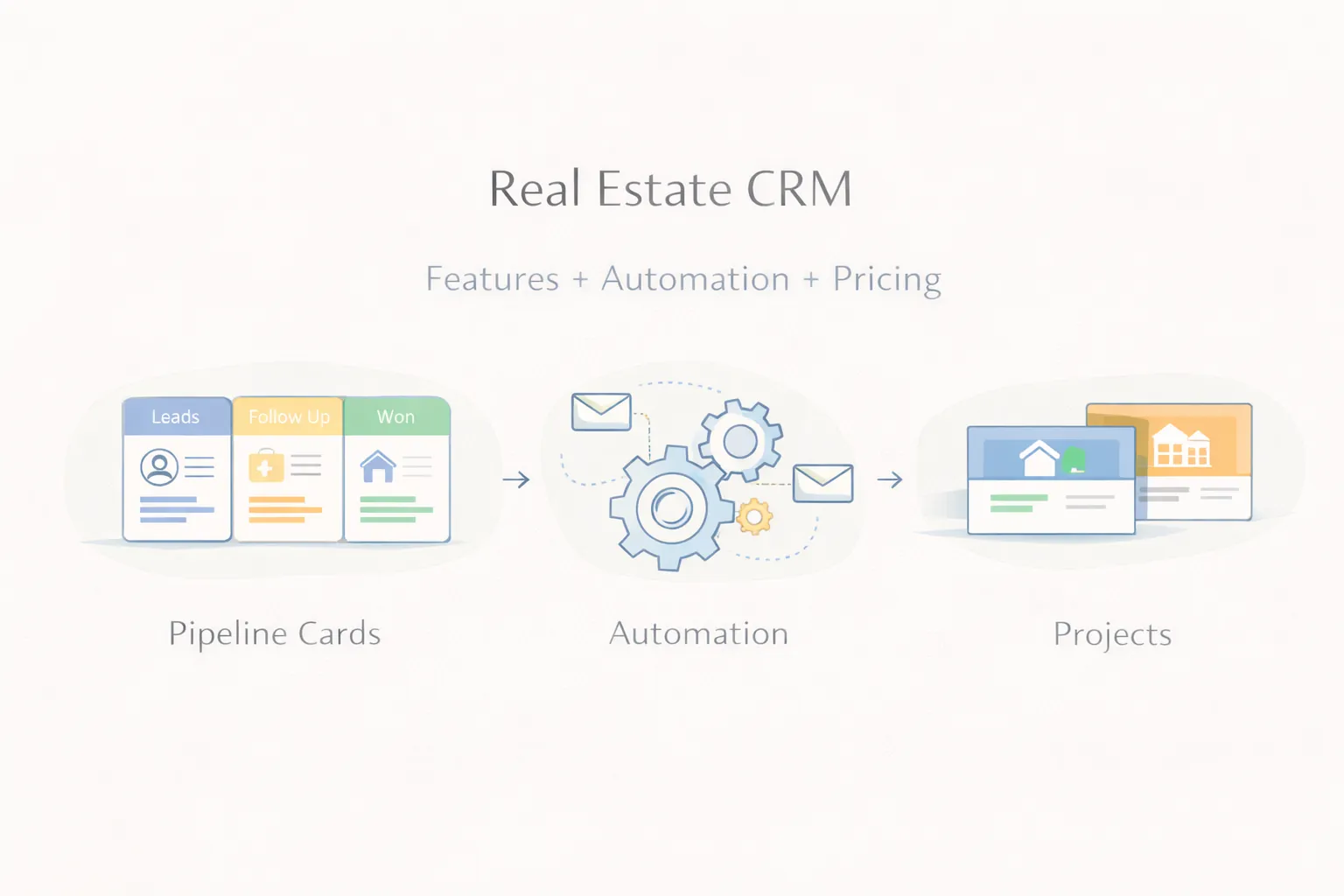
March 30, 2026
Real Estate CRM: Features, Automation and Pricing
Plan a real estate CRM with lead capture, project matching, site visits, follow-ups, automation, reports, pricing, and rollout guidance.
Read articlePublished Updated
Design a sales pipeline CRM with clear stages, ownership, follow-ups, reports, automation, cost ranges, and rollout guidance for SMEs.
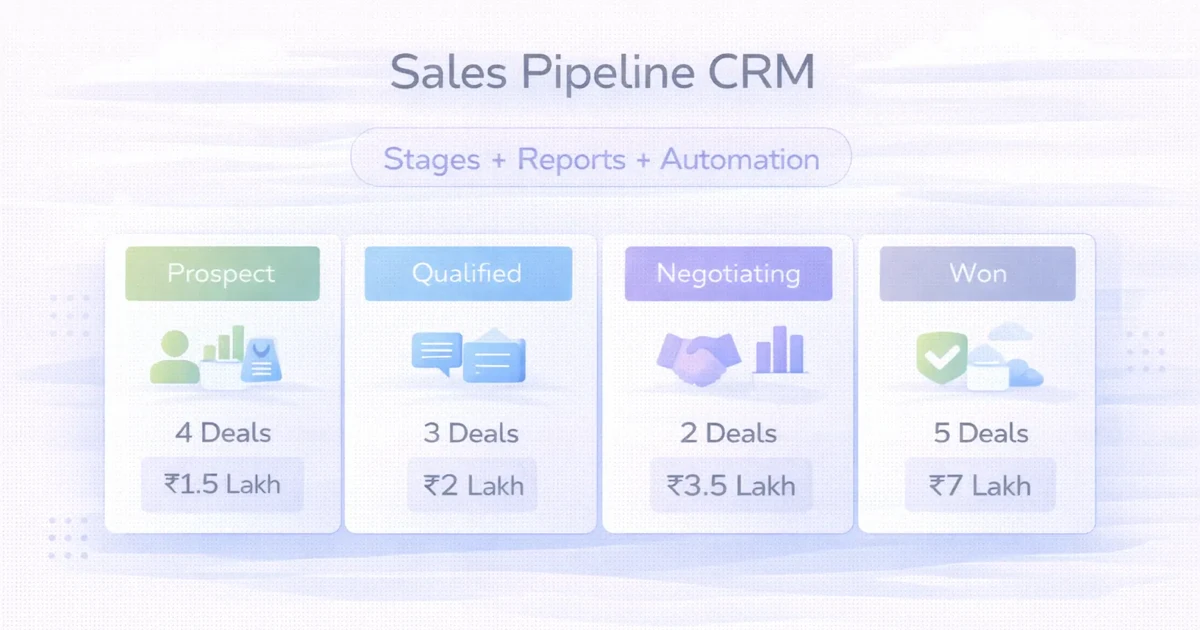
Many businesses say they have leads, but they do not really have pipeline visibility. Deals are floating across spreadsheets, personal notes, and memory. The team knows activity happened, but management cannot see stage movement, conversion gaps, or where deals are actually getting stuck.
A sales pipeline CRM solves that. It gives the team a clear deal flow from first contact to closure, with stage ownership, follow-up history, reports, and automation where it actually helps.
This guide explains what pipeline stages should look like, what reports matter, how automation should be used, and what a practical custom CRM costs for SMEs.
A useful sales pipeline CRM should help you:
Typical custom pricing:
₹60,000 to ₹1.25 lakh₹1.25 lakh to ₹3 lakh₹3 lakh to ₹6 lakh+The biggest win is usually not automation first. It is visibility first.
Too many businesses create a pipeline with 10 to 15 stages and then nobody uses it properly. The better approach is fewer, clearer stages.
This model is simple enough for daily use and clear enough for reporting.
For every stage, decide:
Without these rules, stages become decoration.
Related reading:
This shows how many deals sit in each stage and where the bottleneck is.
This shows how long deals stay inactive or pending in each stage.
This helps management see:
This shows whether website, ads, referrals, or campaigns are creating useful deals, not just raw lead count.
This helps improve offer quality, qualification, and sales process.
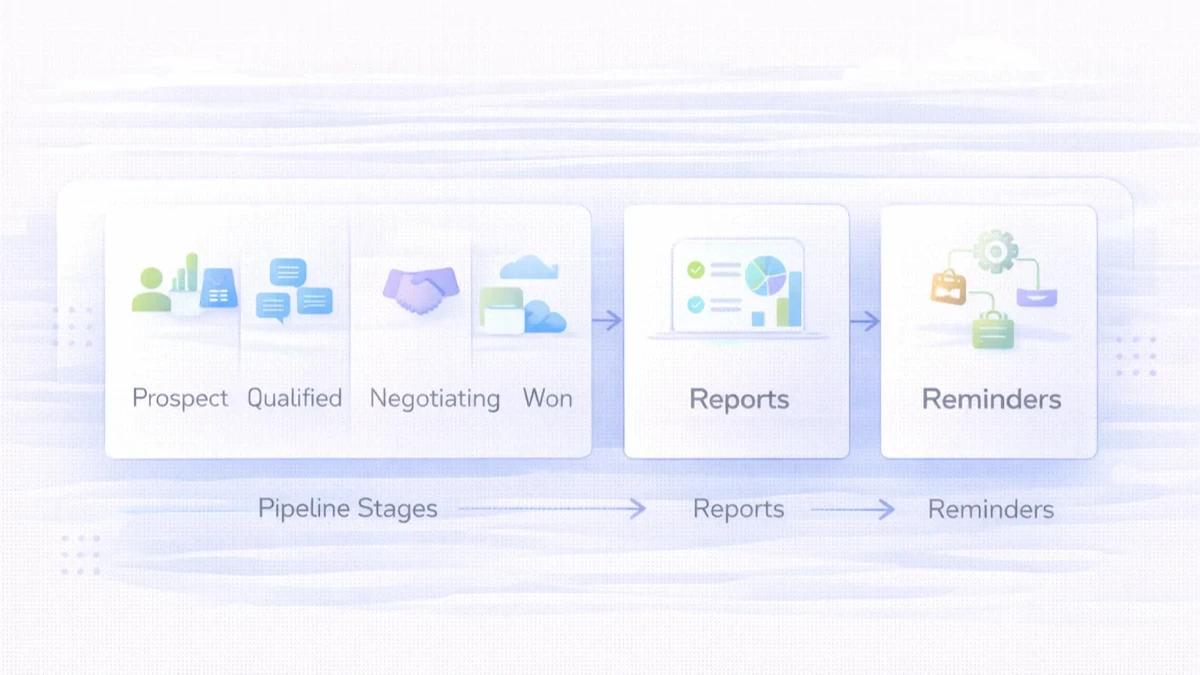
Automation should remove repetitive work, not create noise.
Practical examples:
Automation that usually becomes messy too early:
Start with reminders, routing, and stale-deal visibility. Those create value quickly.
₹60,000 to ₹1.25 lakhUsually includes:
₹1.25 lakh to ₹3 lakhUsually includes:
₹3 lakh to ₹6 lakh+Usually includes:
For many SMEs, the growth band is the best place to start.
Typical implementation timeline:
2 to 3 weeks: starter CRM4 to 6 weeks: growth CRM6 to 10 weeks: advanced CRM with integrationsTimeline depends on:
A practical pipeline CRM stack:
Next.js or React frontendNode.js backendPostgreSQL databaseThe real quality comes from workflow design and reporting clarity, not from a fancy stack diagram.
The biggest drivers are:
The most common mistake is trying to solve pipeline discipline only through software. The stage rules and sales habits also need to be defined.
If sales visibility is weak, do not jump straight to advanced automation. First make stages, ownership, and reporting clean. That alone improves management control a lot.
Pipeline stages should describe a meaningful change in the buying process, not every activity a salesperson performs. “Called” and “emailed” are activities; “qualified,” “proposal sent,” and “commercial approval” are stages because they reflect decision progress. Each stage needs entry criteria, required fields, expected next action, and an exit rule.
A practical service-business pipeline might be new enquiry, contacted, qualified, discovery scheduled, proposal sent, negotiation, won, lost, and nurture. If a deal can sit in “proposal sent” forever, add an expected decision date and ageing rule rather than creating more vague stages.
A Delhi NCR software company receives leads through SEO, referrals, WhatsApp, and paid campaigns. Salespeople keep notes on their phones, so management cannot see which service generates qualified opportunities or why proposals are lost. A phase-one CRM should capture source, requirement, estimated value, owner, stage, next action, and loss reason.
The system should not automate every message on day one. First make lead assignment and next-action discipline reliable. Once the team consistently updates records, add reminders, templates, and manager alerts.
Qualification should collect only information that changes prioritisation or solution fit. Useful fields may include business type, problem, users, location, urgency, budget range, decision maker, current system, and required integration. Make sensitive or uncertain answers optional; forcing fake data is worse than allowing “not known.”
Use a qualification checklist for repeatability, but allow notes for context. A high lead score should remain explainable. Do not hide the reason behind a black-box number that salespeople cannot challenge.
Every active opportunity needs one owner and one dated next action. Assignment may use region, service, campaign, workload, or round robin. Define what happens when a salesperson is absent, a lead is untouched, or ownership changes. Preserve the previous owner and reason.
Manager alerts should focus on exceptions: high-value leads without response, overdue next actions, proposals ageing beyond a threshold, or repeated reassignment. Too many reminders create notification fatigue.
Start with lead volume by source, qualification rate, stage conversion, average stage age, proposal value, won value, loss reasons, and response time. Forecasting should distinguish committed opportunities from early-stage pipeline.
Every chart must support drill-down. If management sees a low conversion rate, they should be able to inspect the actual records, source, owner, and period. Keep definitions stable so monthly comparisons remain meaningful.
Useful automations include acknowledgement after enquiry, owner assignment, next-action reminders, stale-deal alerts, proposal follow-up tasks, and nurture enrolment after explicit classification. Customer-facing messages should respect consent and allow a salesperson to pause inappropriate sequences.
For WhatsApp, email, forms, calendars, or ad lead sources, plan verified events, duplicate prevention, retries, and error queues through integration services. A lead should not disappear because one webhook failed.
Do not import years of unclean spreadsheets blindly. Deduplicate phone and email values, normalize owner and stage, archive obviously dead leads, and retain the source file for reference. Pilot with a small active dataset and one team.
Adoption should be measured through records with a next action, response-time compliance, stage freshness, and manager review usage. If the CRM demands excessive fields, salespeople will work around it. Adjust the process before adding more controls.
Choose an established CRM when your stages, reports, and integrations fit its model. Configure carefully before commissioning custom software. Consider a custom system when multiple companies, unique approvals, project inventory, pricing logic, service delivery, or proprietary reporting are central to the workflow.
Use the custom software, CRM and ERP hub to compare options, and review the web app development hub for role-based dashboard delivery.
Review relevant services or contact VASUYASHII with a sample pipeline for a scoped recommendation.
Yes. A pipeline CRM focuses more directly on deal stages, follow-ups, and sales visibility.
Usually 5 to 8 clear stages are better than too many detailed stages.
Stage-wise count, ageing, owner performance, and source-wise conversion are the most useful first reports.
No. Start with reminders, routing, and stale-deal tracking.
Yes. Website forms can push leads directly into the CRM.
Yes. It is very useful where follow-up quality affects closing rates.
A basic version can often launch in 2 to 3 weeks if scope is clear.
If your process is simple, SaaS may work. If reporting, roles, or workflows are specific, custom is often better.
If you want a CRM that helps sales teams act faster and management review pipeline quality clearly, start with the minimum stage system and report set that your team will use daily.
Related Articles
March 30, 2026
Plan a real estate CRM with lead capture, project matching, site visits, follow-ups, automation, reports, pricing, and rollout guidance.
Read article
March 26, 2026
CRM software development for small businesses: compare custom CRM vs SaaS, features, pricing in India, timeline, tech stack, and rollout tips for lead tracking.
Read article
March 28, 2026
Compare CRM pricing in India for small businesses, including SaaS plans, setup costs, custom build ranges, modules, integrations, and buy-vs-build checks.
Read article
May 23, 2026
Plan a custom reports dashboard with metric definitions, source mapping, sales and stock views, role access, refresh rules, reconciliation, and alerts.
Read article