
June 1, 2026
Inventory Software Cost in India (Custom)
Compare custom inventory software cost in India by stock workflow, migration, barcode and integrations. Includes a quote checklist and stock acceptance example.
Read articlePublished Updated
Estimate business software development cost in India using workflows, roles, data, integrations, migration, platforms, security, support, and ownership.
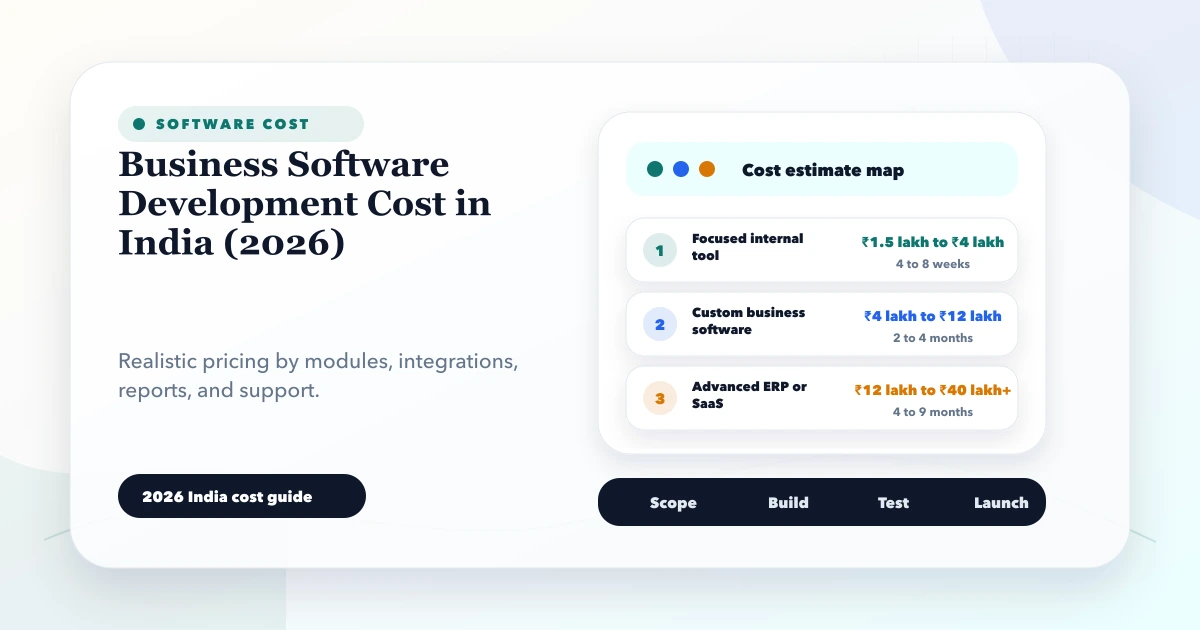
Business software development cost in India cannot be estimated accurately from a feature list such as “CRM, dashboard, reports, and mobile app.” Cost is driven by workflows, records, roles, exceptions, integrations, migration, platforms, security, acceptance testing, and long-term ownership.
A lead tracker for one five-person team may be a focused web application. A multi-company platform with customer portals, payments, documents, approvals, offline mobile work, and third-party APIs is a product programme. Both might be called “business software,” but they need different budgets and delivery plans.
This guide provides a scope-first way to compare quotes without treating the lowest number as the same deliverable.
Before commissioning custom development, evaluate:
| Direction | Use when | Watch for |
|---|---|---|
| Buy SaaS | Workflow is common and product fit is strong | Per-user cost, add-ons, export, vendor limits |
| Configure product | Most requirements fit existing software | Complex configuration, update conflicts |
| Integrate tools | Reliable systems exist but data handoffs are manual | API access, sync failures, duplicate source of truth |
| Build custom | Workflow is distinctive and strategically valuable | Build, maintenance, security, support, product ownership |
Custom software is easier to justify when the business has measured recurring coordination, control, or data problems that cannot be solved safely through configuration.
These are broad planning bands for discussion, not fixed market rates, quotations, or guarantees. A written scope can move a project above or below them.
| Project type | Illustrative band | Example boundary |
|---|---|---|
| Focused internal web tool | ₹2.5 lakh-₹6 lakh | One workflow, limited roles, basic reports |
| Multi-module business application | ₹6 lakh-₹15 lakh | Several workflows, roles, documents, integrations |
| SaaS or multi-company platform | ₹12 lakh-₹30 lakh+ | Tenant isolation, subscriptions, admin, onboarding, operations |
| Complex mobile/offline ecosystem | Scope-dependent | Web/API plus native apps, sync, devices, distribution |
Use the bands only to decide whether discovery is worthwhile. Request a quote against sample data, workflows, and acceptance rules.
A workflow has states, decisions, owners, and exceptions. For example, “quotation to payment” may include:
Each state requires data rules, UI, backend validation, permissions, tests, and support behavior.
Role-based software must enforce who can:
Backend authorization and tenant isolation add essential engineering work. Hidden navigation is not sufficient security.
Cost rises with the number and relationship of records:
Poorly defined data relationships create expensive rework later. The provider should explain the source of truth for each critical record.
An integration requires more than an API request. Budget for:
See the business API integration guide for scope questions.
Reports need exact definitions. “Monthly sales” could mean ordered, invoiced, delivered, paid, net of returns, or tax-exclusive value.
Specify:
A dashboard full of cards can be cheaper to draw than one reliable financial metric is to define.
Responsive web, native mobile, and desktop applications have different scope.
Usually the most efficient first platform for connected users. It can support role-based workflows, responsive layouts, updates without app-store distribution, and one main codebase.
Useful for camera, barcode, notifications, device integration, field use, or app-store distribution. Add authentication storage, permissions, offline behavior, sync, release, and device testing.
Useful when businesses need desktop installation, local device access, offline constraints, or a dedicated operating experience. Add installer, update, OS compatibility, signing, and local-data decisions.
Do not assume all three are included in one interface price. Start with the platform required for the highest-value workflow.
Migration effort depends on:
If the business cannot identify the source owner and validation total, the migration quote is provisional.
Production software needs:
Security scope should reflect data sensitivity and business impact, not just project size.
A standard internal admin interface costs less than a customer-facing product with research, multiple journeys, design system, responsive polish, accessibility, empty/error states, animations, and extensive usability testing.
Clarify whether the quote includes:
Testing should cover normal and failure paths:
If acceptance examples are not written, change disputes become more likely.
Records: leads, sources, tasks, notes, owners, stages, and follow-ups.
Hidden complexity: duplicate leads, reassignment, WhatsApp/call tracking, permissions, ageing, source attribution, and import.
Records: products, stock movements, customers, orders, delivery, returns, and payments.
Hidden complexity: units, locations, reservations, partial fulfilment, cancellations, price changes, and reconciliation.
Records: accounts, documents, orders, tickets, payments, and messages.
Hidden complexity: external authentication, row-level access, secure files, support impersonation, notifications, and audit logs. Compare the customer portal and admin dashboard guide.
Useful when requirements, acceptance, dependencies, and exclusions are stable. Changes need a controlled process.
Useful when discovery continues or priorities may change. The business needs backlog, budget, review cadence, and delivery visibility.
Useful for complex workflows, migration, and integrations. It can reduce uncertainty before committing to a full build.
Useful for an ongoing product roadmap, but requires product ownership, prioritisation, and enough work to justify continuing capacity.
The contract model does not replace scope clarity.
Plan phases rather than one launch date:
Customer decision delays, source-data quality, provider approvals, and acceptance availability all affect timeline.
Budget beyond development:
A cheap build with no maintenance owner can become expensive operational debt.
| Question | Provider A | Provider B |
|---|---|---|
| Exact included workflows | ||
| Roles and company/branch scope | ||
| Platforms included | ||
| Migration volume and validation | ||
| Integrations and third-party fees | ||
| Reports and PDFs | ||
| Testing and acceptance | ||
| Hosting and account ownership | ||
| Source code and documentation | ||
| Warranty and support | ||
| Exclusions and change process |
Use the software quote checklist to prepare comparable inputs.
In our implementation work, VASUYASHII estimates from representative records and workflows. We ask for actual forms, sheets, messages, reports, and exception examples, then define the smallest phase that reaches a usable business outcome.
Our software development service documents what is included, excluded, customer-supplied, third-party, and ongoing. We avoid quoting advanced accounting, statutory integrations, mobile apps, or automation as included unless the written scope says so.
A focused internal tool may begin in a few lakh rupees, while multi-module, multi-company, mobile, or SaaS platforms can require much larger budgets. Only a written scope produces a meaningful quote.
Providers may assume different workflows, quality controls, platforms, migration, integrations, testing, ownership, and support. Compare deliverables line by line.
Only when the workflow value and control needs justify product ownership. Evaluate existing products and integrations first.
Yes. A good phase delivers one complete usable outcome with necessary roles, reports, migration, and support, rather than disconnected screens.
It depends on the contract. Clarify warranty, incident support, updates, hosting, third-party changes, improvements, and response expectations separately.
The agreement should define ownership and usage rights. Production domain, hosting, provider, analytics, and business-data accounts should normally be controlled by the business with documented access.
Complete the software project requirement template with one representative workflow and sample report before asking providers for comparable estimates. Contact VASUYASHII for a phased scope review.
Related Articles
June 1, 2026
Compare custom inventory software cost in India by stock workflow, migration, barcode and integrations. Includes a quote checklist and stock acceptance example.
Read article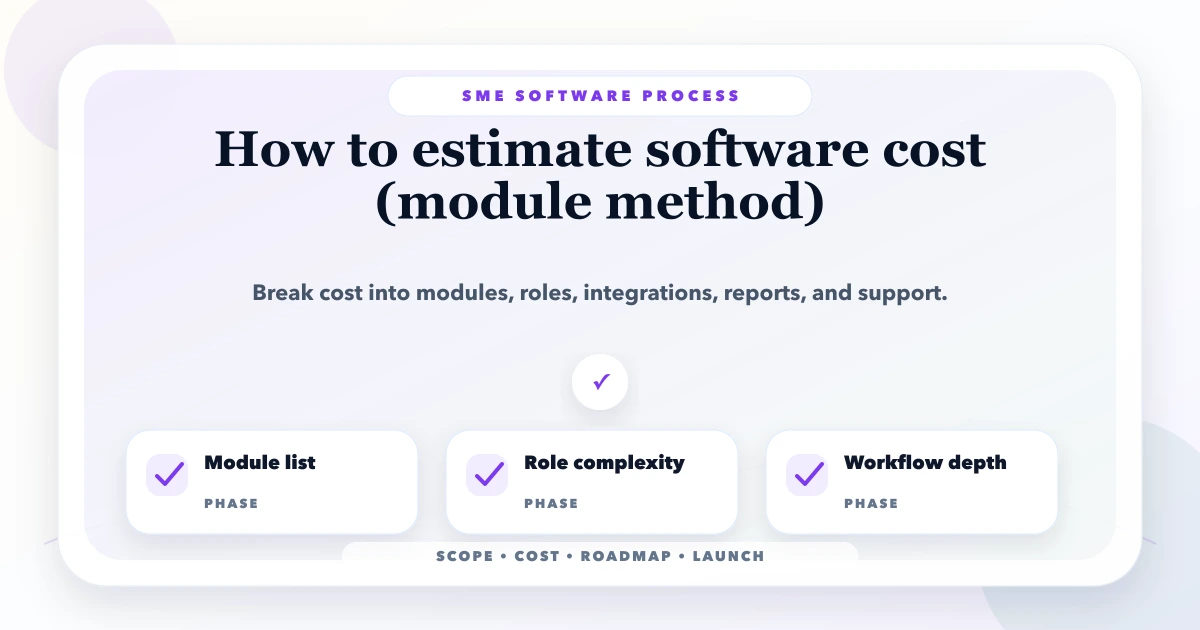
May 19, 2026
Estimate custom software cost by module across workflows, roles, data, integrations, migration, testing, support and acceptance before comparing quotes.
Read article
May 14, 2026
Build a Delhi NCR software-company SEO structure with one commercial parent, distinct module pages, approved proof, local relevance, internal links, and lead tracking.
Read article
May 19, 2026
how to write PRD for business software: practical 2026 guide with phases, INR pricing, checklist, roadmap, mistakes, FAQs, and SME implementation tips.
Read article