
May 28, 2026
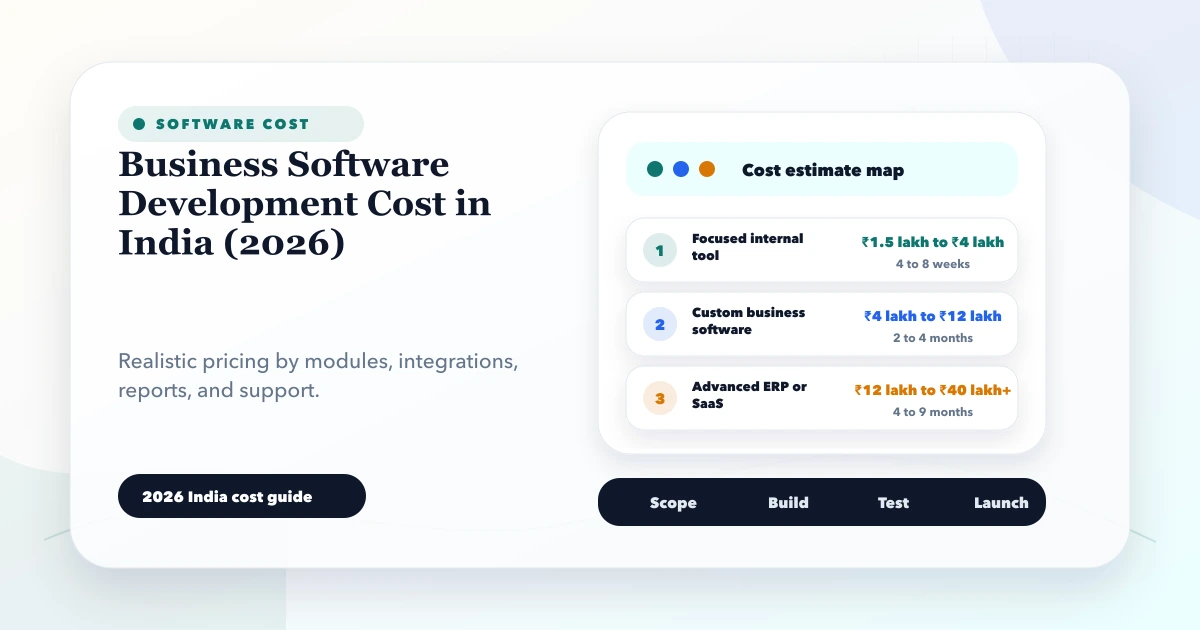
Business Software Development Cost in India
Estimate business software development cost in India using workflows, roles, data, integrations, migration, platforms, security, support, and ownership.
Read articlePublished Updated
how to write PRD for business software: practical 2026 guide with phases, INR pricing, checklist, roadmap, mistakes, FAQs, and SME implementation tips.
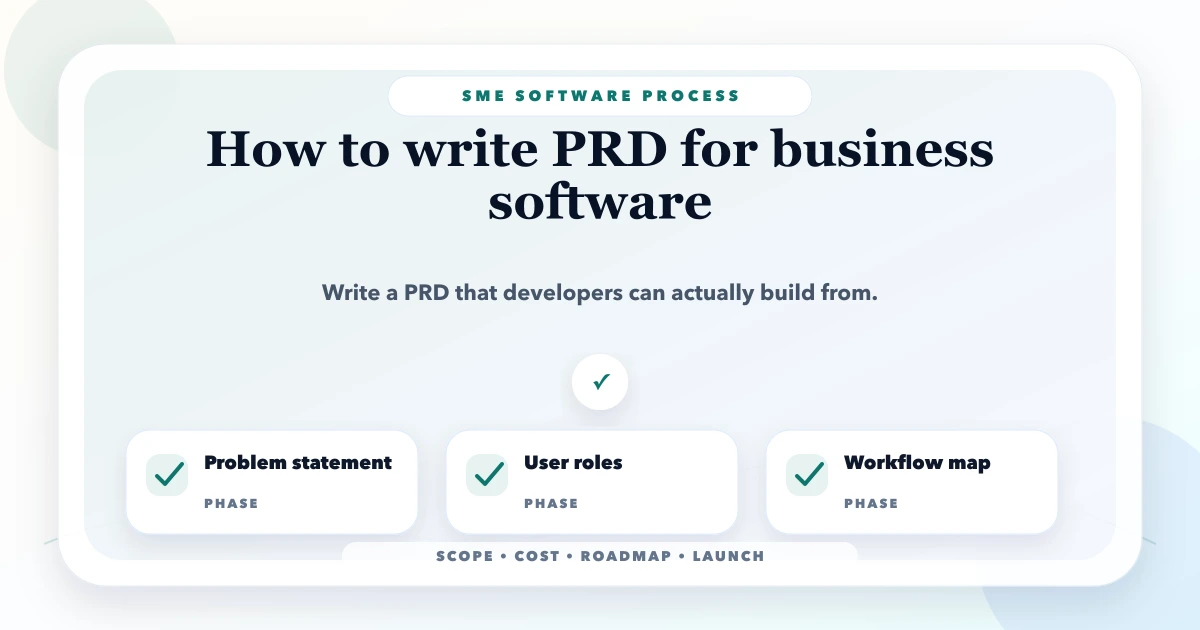
This guide on how to write PRD for business software is for SMB founders, managers, and teams preparing requirements for CRM, ERP, inventory, billing, portals, or internal tools. If you run an SME in Delhi NCR, Ghaziabad, Noida, Delhi, Gurugram, Faridabad, or anywhere in India, the aim is simple: plan software with less confusion, fewer surprises, and better business control.
Most software projects fail slowly, not suddenly. The team starts with a broad idea, adds features during development, delays testing, skips training, and then realizes after launch that staff adoption, data quality, or support ownership was not planned. A practical process fixes this before the project becomes expensive.
By Tushar C. (Founder, VASUYASHII). Reviewed by VASUYASHII Editorial for real-world SME implementation experience, pricing clarity, and practical usefulness.
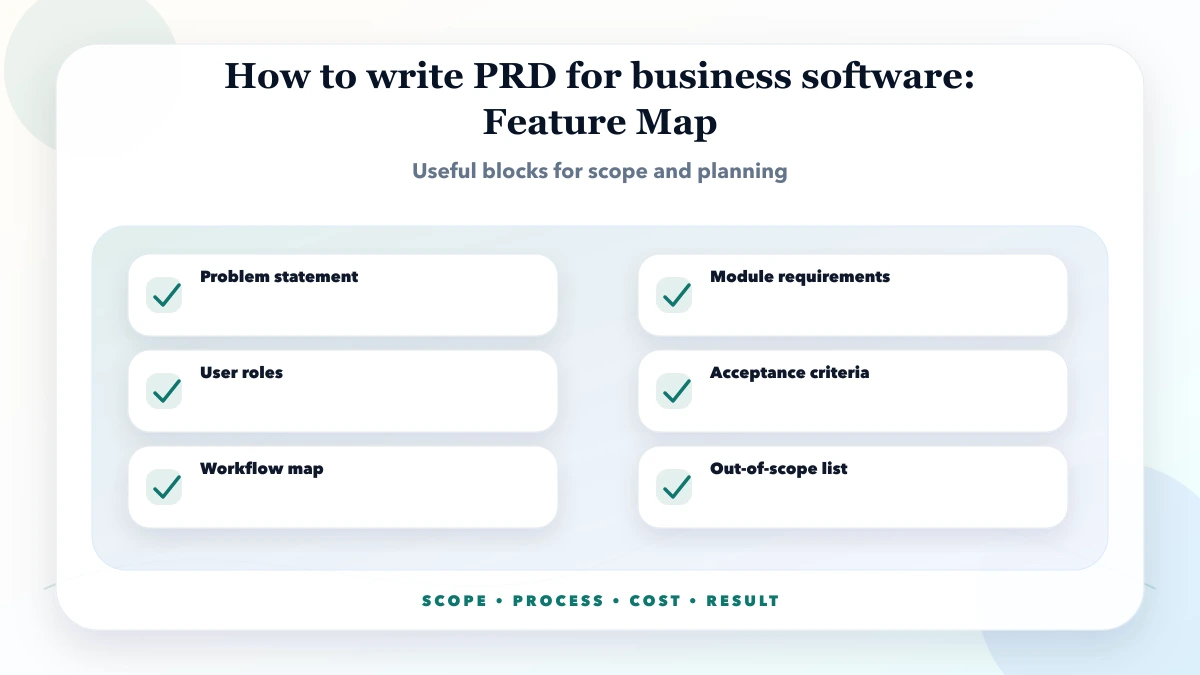
A business software PRD should define the problem, users, workflows, modules, roles, data fields, reports, integrations, acceptance criteria, timeline, and out-of-scope items.
For Indian SMEs, the best approach is rarely “build everything at once.” The better approach is to define the business problem, separate phase-one from later features, test with real users, train staff, and keep support ownership clear after launch.
In our work with business software planning, the biggest gap is usually not coding. It is unclear scope, incomplete data, late stakeholder decisions, and no training plan. Owners often know the business problem, but the requirement is still sitting in WhatsApp chats, Excel sheets, and verbal instructions.
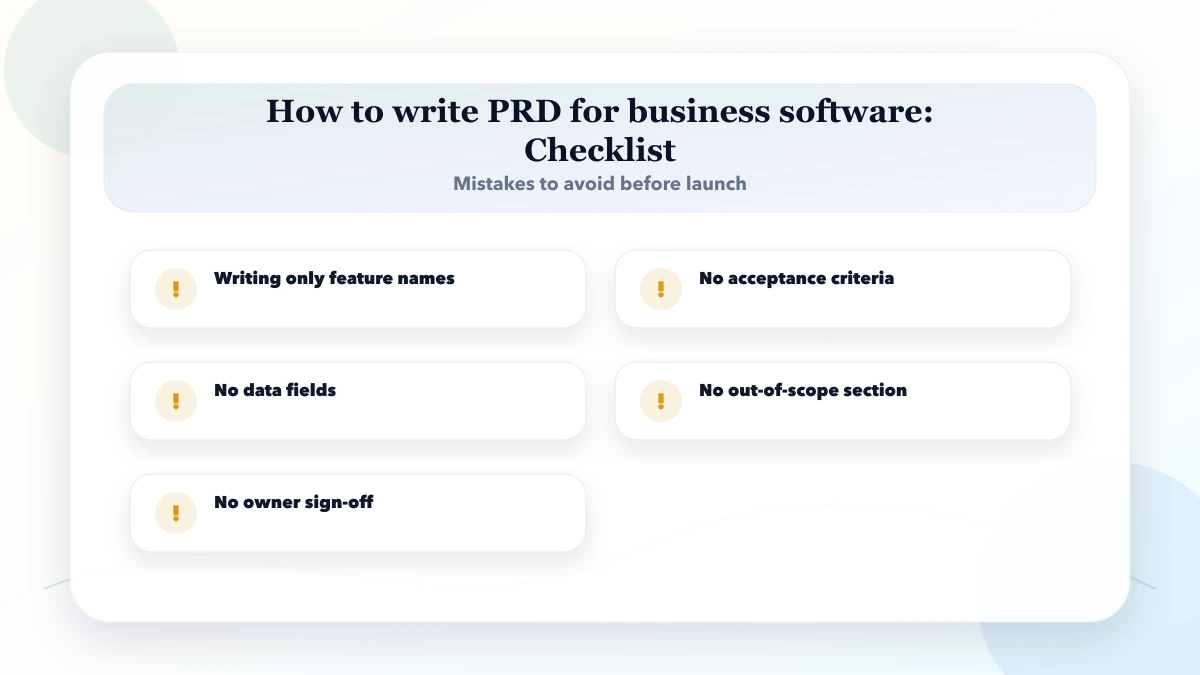
Each checklist item should have one owner and one acceptance rule. If nobody owns it, it will stay vague. If there is no acceptance rule, the team will argue later about whether the work is complete.
| Scope | Practical price range | Typical timeline |
|---|---|---|
| PRD review | ₹10,000 to ₹35,000 | 2 to 5 days |
| PRD writing workshop | ₹35,000 to ₹1 lakh | 1 to 2 weeks |
| PRD + wireframes | ₹75,000 to ₹2.5 lakh | 2 to 5 weeks |
These are practical planning ranges, not fixed quotes. Final pricing depends on workflow complexity, approval logic, number of users, custom reports, data migration, integrations, testing depth, and support needs.
Low-cost builds can work if the scope is tight and the workflow is simple. A cheap build becomes expensive when it skips documentation, backups, testing, or handover. For business-critical systems, clarity and stability matter more than adding many screens quickly.
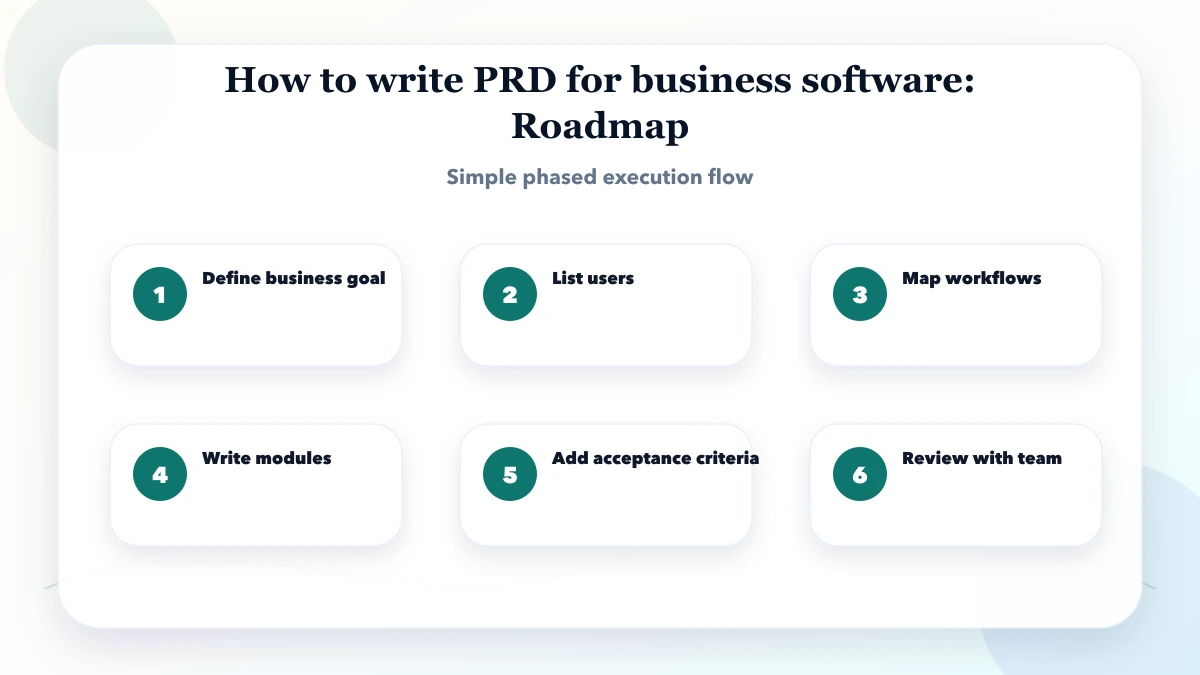
This sequence should be treated like a delivery rhythm. Do not jump to UI polish before workflow clarity. Do not migrate final data before import rules are tested. Do not train staff only after launch. A clean timeline saves both money and stress.
The stack should fit the business, not just the trend. A small SME tool may need a fast, stable admin panel with role-based access and good reports. A larger system may need APIs, audit logs, scheduled jobs, monitoring, backups, and a proper staging environment.
The biggest cost drivers are usually hidden in business rules. “Simple billing” can become complex when GST, discounts, returns, partial payments, credit notes, staff permissions, and PDF formats are included. “Simple CRM” can become complex when follow-ups, WhatsApp tracking, lead stages, reports, and role restrictions are added.
Use three buckets: must-have, should-have, and later. Must-have features are needed for launch, revenue, compliance, security, or daily operations. Should-have features improve convenience but should not block the first release. Later features should wait until users prove they need them.
For every feature, ask four questions: who will use it, what data is needed, what output is expected, and what happens if it fails. If these answers are unclear, the feature is not ready for development.
Keep phase one focused. If you are replacing Excel, do not try to replace every sheet on day one. Start with the sheet that creates the most errors or owner dependency. If you are building CRM, start with lead capture, follow-up, ownership, and reporting. If you are building inventory, start with product master, stock movement, low-stock alerts, and basic reports.
Staff adoption is also part of implementation. A technically correct system can still fail if staff do not understand why it exists or how it changes their daily routine. Plan a simple SOP, one training session per role, and a support contact for the first two weeks.
Use real workflows as PRD references: the small-business ERP roadmap for rollout gates, the secure data-entry guide for validation and approvals, and the repair center workflow for custody and exception states.
If you are planning a software project, start with a written scope and a phased roadmap. VASUYASHII can help convert your idea into PRD, wireframes, modules, timeline, and cost estimate before development starts.
Avoid treating software as a one-time delivery. Business software needs ownership, updates, monitoring, training, and support. The cleaner your process, the safer your launch.
It is for SMB founders, managers, and teams preparing requirements for CRM, ERP, inventory, billing, portals, or internal tools. The goal is to make decisions practical for Indian SMB budgets, staff, and timelines.
Start with define business goal. This keeps the project grounded in the real business problem instead of random feature requests.
Use the pricing table as a planning range. Final cost depends on modules, users, reports, data migration, integrations, testing, and post-launch support.
Yes. For most SMEs, phased execution is safer. Launch the useful first version, train the team, then improve based on real usage.
Document scope, users, roles, data fields, reports, acceptance criteria, credentials, change requests, and support ownership.
The biggest risk is writing only feature names. It creates delays, unclear ownership, and avoidable rework.
Yes. VASUYASHII can help with discovery, PRD/SRS, UI planning, development, migration, training, launch support, and maintenance.
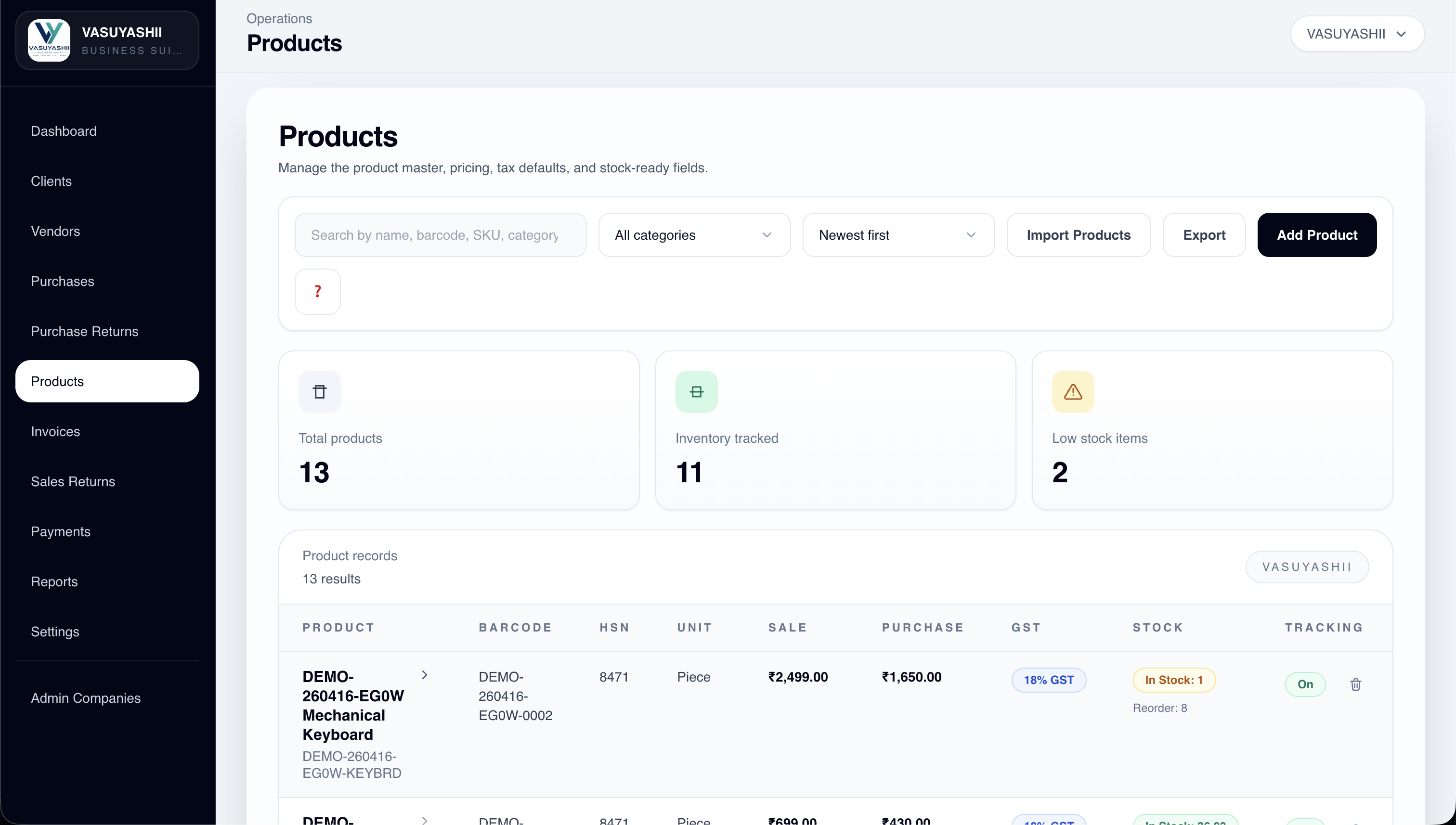
The current VASUYASHII Business Suite is a useful first-party example of why a PRD should describe decisions and states, not only screen names. Its product workflow includes SKU/barcode, HSN/SAC, tax rate, prices, stock tracking and reorder context. Those fields affect purchase entry, invoice calculation, reports and permissions, so they belong in one shared requirement model.
| PRD item | Concrete example | Acceptance evidence |
|---|---|---|
| actor | owner, billing operator, warehouse staff | permission matrix |
| trigger | purchase saved or invoice confirmed | event/state diagram |
| rule | stock cannot change without a recorded movement | test cases with opening stock |
| exception | duplicate SKU, cancelled invoice, failed import | expected error and recovery path |
| report | low stock and stock valuation | approved sample rows and totals |
Decision example: if a wholesaler says “add inventory”, the PRD is incomplete. The owner must decide whether draft invoices reserve stock, whether returns restore the same batch, who may adjust quantity, and which date drives valuation. Each answer changes engineering and testing.
Limitations: the screenshot demonstrates current product structure, not a generic promise that every ERP module is included. VASUYASHII Business Suite does not currently claim full accounting ledger, payroll, manufacturing BOM or statutory e-invoice integration as standard. A PRD must mark such needs as custom scope or roadmap.
For secure document requirements, use the OWASP File Upload Cheat Sheet. For mobile requirements, use the Android architecture guidance and Apple App Review Guidelines as implementation constraints rather than copying feature lists from competitors.
If you want a practical software plan for your SME, VASUYASHII can help with scope, PRD, roadmap, development, migration, training, and post-launch support.
Related Articles
May 28, 2026
Estimate business software development cost in India using workflows, roles, data, integrations, migration, platforms, security, support, and ownership.
Read article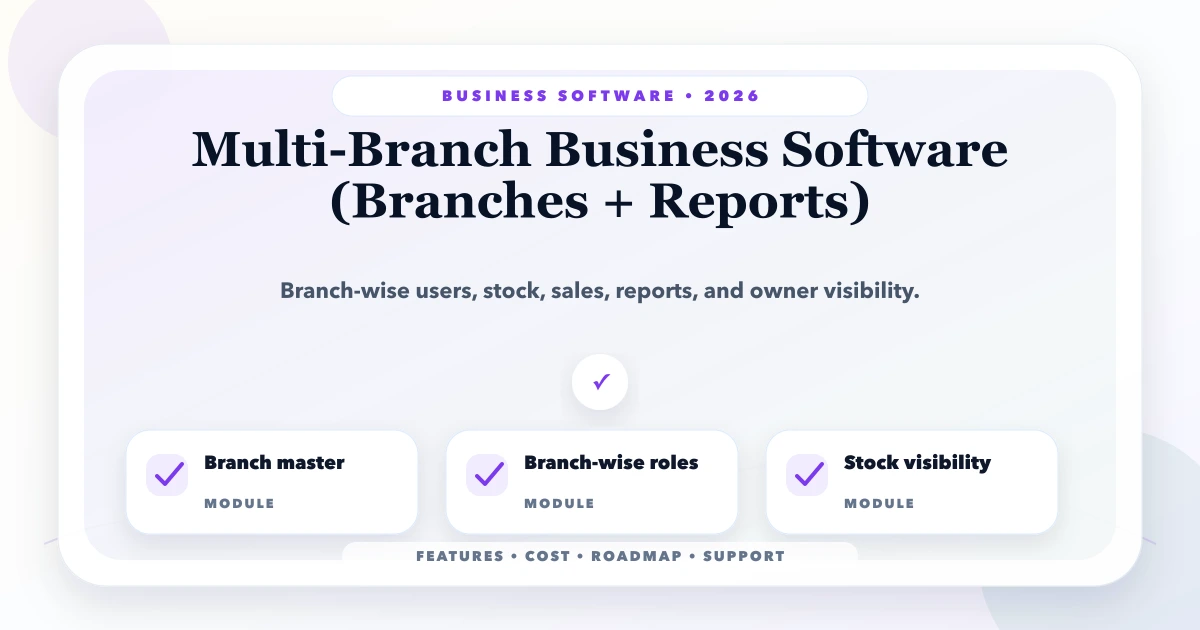
May 23, 2026
Plan multi-branch business software with company scope, branch permissions, stock transfers, shared masters, approvals, consolidation, and reliable reports.
Read article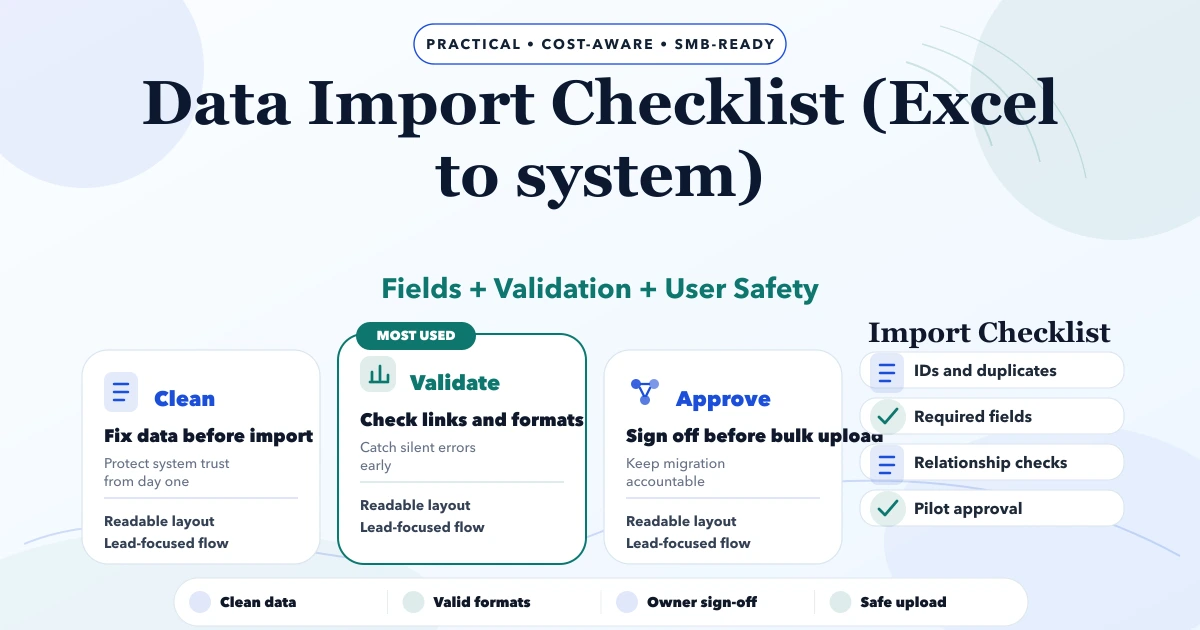
May 8, 2026
Use this Excel-to-software import checklist to map fields, clean duplicates, validate rows, run a dry import, reconcile totals, and plan rollback.
Read article
May 19, 2026
Use a 30-day plan to train staff on CRM, billing, inventory, or ERP software with role-based practice, safe data, adoption checks, and support ownership.
Read article