
June 8, 2026
Export Business Website: Catalog and RFQ Flow
Plan an export business website with controlled product specifications, MOQ and packaging details, credible trade proof, and a qualified international RFQ flow.
Read articlePublished Updated
Plan a distributor website with brand catalogs, territory rules, retailer enquiries, stock context, WhatsApp handoff, and B2B lead tracking.
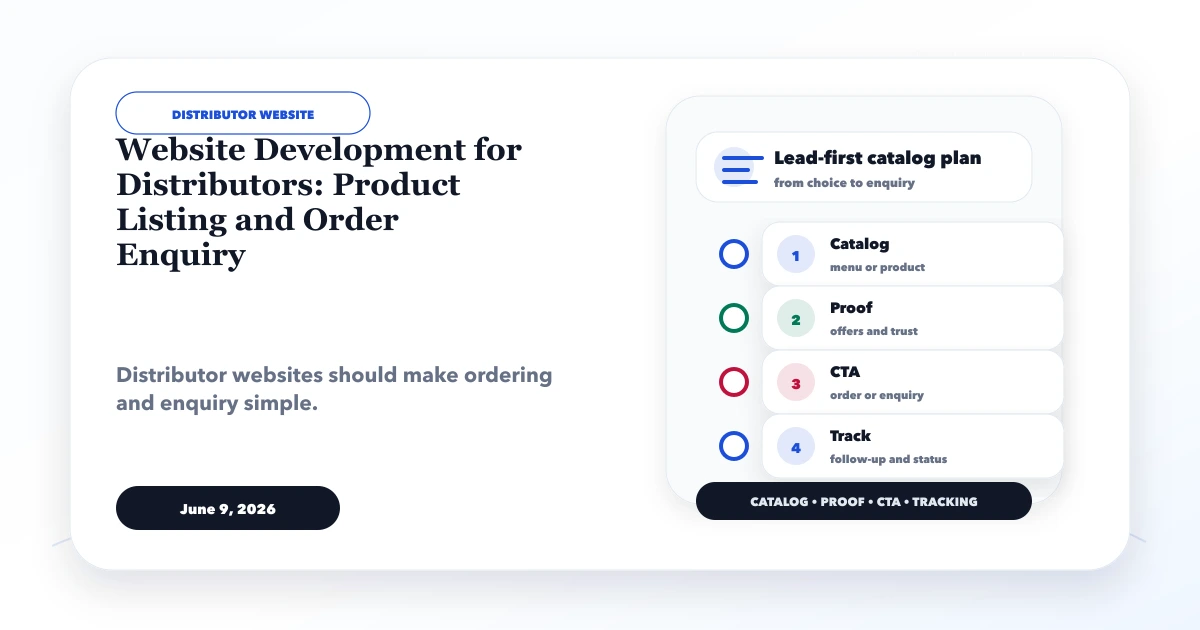
A distributor website should help a retailer answer four questions quickly: Do you supply this brand, do you serve my territory, can you meet my quantity, and who will confirm the order? A generic company profile rarely handles those questions. It may look professional but still sends incomplete WhatsApp messages to the sales team.
The useful version combines a controlled product catalog, territory guidance, retailer qualification, and a clear handoff to the person responsible for that brand or region. It does not need to expose confidential trade prices or promise live stock unless those systems are genuinely connected.
By Tushar C. (Founder, VASUYASHII). This guide covers distributor website and enquiry-system planning. It does not claim that every listed brand, stock figure, price, authorization, or delivery date can be published without approval from the distributor.
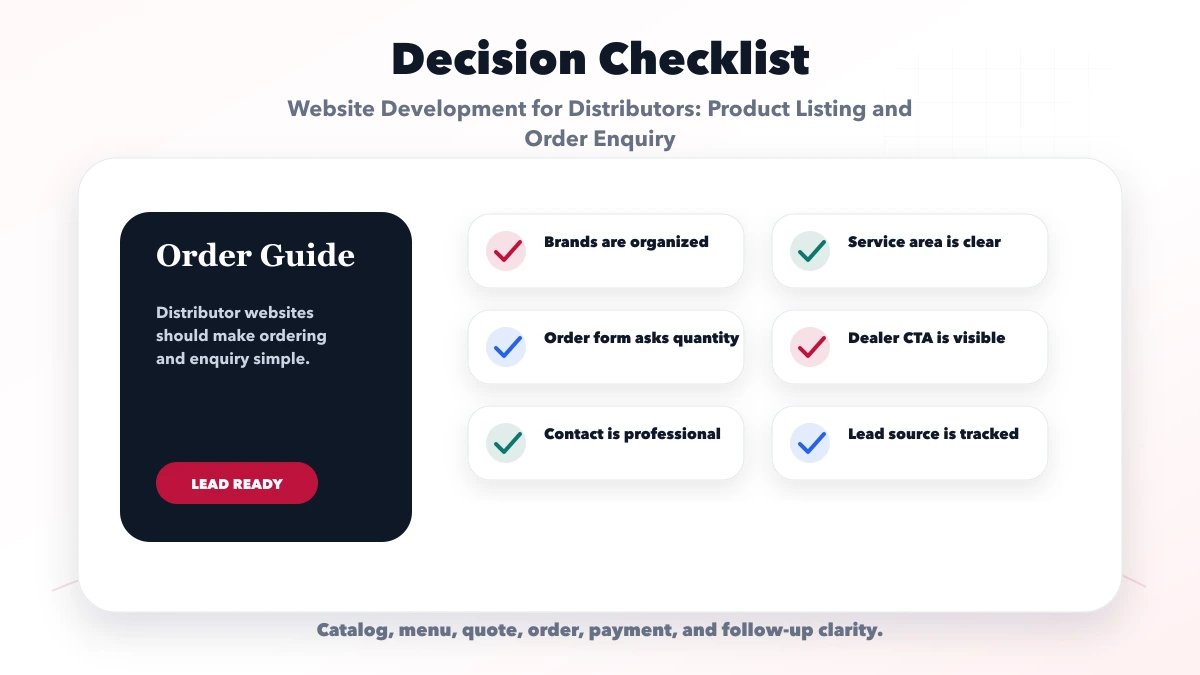
For most Indian distributors, the first release should include:
Build full ecommerce only when availability, trade pricing, credit limits, taxes, dispatch rules, and order approvals can be maintained reliably.
Consider an electrical-goods distributor serving retailers across Delhi NCR. The distributor handles several brands, but not every product is stocked at every warehouse. One retailer needs 40 units for a shop replenishment; another needs project pricing for 600 units. A single “Contact us for price” button treats both enquiries as identical.
A better flow lets the buyer choose a brand, product family, approximate quantity, delivery PIN code, and purchase timeline. The submission reaches the correct territory executive with the page and source attached. The executive still confirms stock and commercial terms, but no longer starts by asking what the buyer wanted.
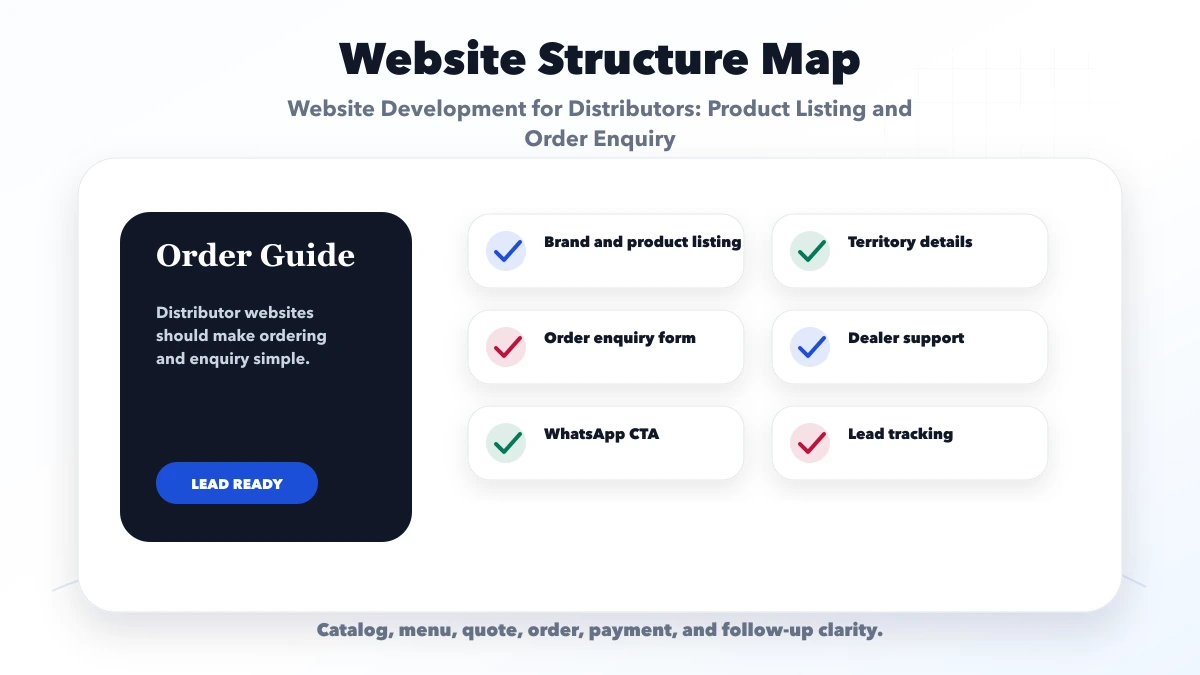
| Page or module | Information to control | Buyer action |
|---|---|---|
| Brand directory | Authorized brands, category scope, disclaimers | Open the correct brand range |
| Product categories | Model family, use case, specification, unit | Shortlist a relevant product |
| Territory page | Served districts, dispatch point, exclusions | Confirm whether enquiry is eligible |
| Retailer enquiry | Business name, GSTIN, location, category interest | Request supply discussion |
| Bulk order enquiry | Product, quantity, required date, delivery PIN | Ask for availability and quotation |
| Support page | Returns, damaged goods, warranty-routing boundary | Reach the right support path |
Brand authorization is a sensitive claim. Publish the exact legal or commercial scope approved by the principal, and remove expired logos or certificates promptly. A distributor for one product line should not imply authorization for the brand's entire portfolio.
Start with a product data sheet rather than manually designed pages. Useful fields include product name, internal SKU, brand, category, model, unit, key specifications, application, image, HSN where appropriate, downloadable document, and enquiry status.
Decide one source of truth. If product information lives in inventory software, an ERP-lite system, or a controlled spreadsheet, define who approves website changes. Duplicate manual entry eventually creates conflicting model names, discontinued items, and wrong pack sizes.
For a small catalog, curated static pages can work. For hundreds of SKUs, use a searchable catalog or product catalog web app. The public page can display approved information while the internal system keeps purchase price, trade margin, stock valuation, and supplier terms private.
Distributor pages often fail because they publish a broad “we serve all India” claim while operations are territory-specific. A useful territory section should state:
Do not create dozens of thin city pages just to repeat the same catalog. A location page needs genuine service detail, local contact ownership, and a distinct buyer purpose. Otherwise use one accurate coverage section and keep the main category pages strong.
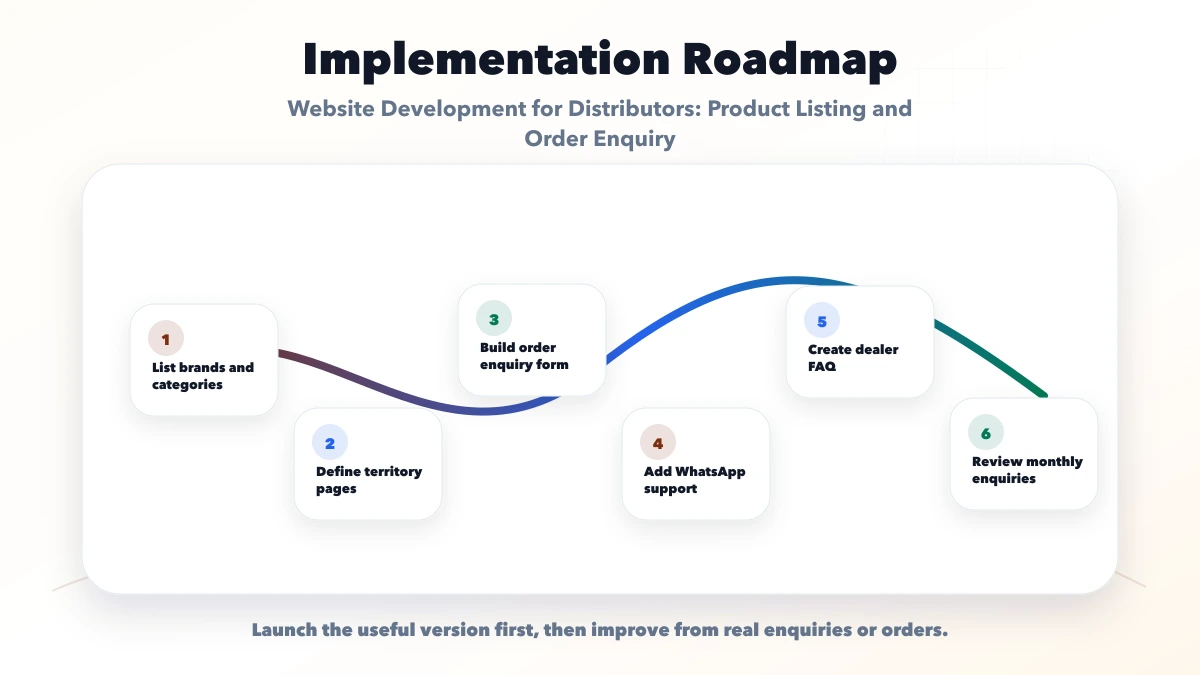
The form should collect enough context to route the lead without becoming a credit application. A practical first form can ask:
After submission, show a confirmation with a reference or clear response expectation. A WhatsApp CTA should prefill product and page context, not only “Hi.” For automation, connect forms and messages through an approved integration service, and avoid placing private buyer data in public URLs.
A distributor does not benefit from more enquiries if nobody owns the next action. Store source, product interest, territory, assigned executive, first-response time, status, quotation reference, and reason lost. Owners can then review which categories create qualified demand instead of counting raw form submissions.
Use privacy-safe events such as form start, valid enquiry submission, WhatsApp click, catalog download, and call click. Do not send phone numbers, GSTINs, names, or free-text messages to analytics tools. The operational database and analytics platform serve different purposes.
VASUYASHII Business Suite demonstrates how company-scoped products, clients, vendors, purchases, invoices, payments, and reports can live in one practical platform. That is relevant to distributors that want billing and stock control after an enquiry becomes an order.
The public website is not automatically live inventory. A direct connection needs explicit rules for stock reservation, price visibility, customer eligibility, taxes, payment, and failed syncs. For a custom retailer portal or approval workflow, start with web application development and document the system boundary before promising real-time data.
Before connecting both systems, assign ownership for product names, brand permissions, pack sizes, service areas, enquiry status, and customer records. Decide whether the website creates a new lead, updates an existing dealer, or only sends a notification. Duplicate dealer records and uncontrolled product copies can make a technically successful integration operationally unreliable. Test the handoff with a new retailer, an existing dealer, an out-of-territory request, an unavailable product, and a repeated enquiry before launch.
Compare catalog, RFQ, dealer login and pricing options in the wholesaler website buyer guide. If the requirement extends into GST invoices, stock, credit, returns and collections, use the distributor billing software guide.
Only when price ownership, validity, tax treatment, buyer eligibility, and update frequency are clear. Many distributors should use request-a-quote or login-based trade pricing instead.
No. An order requires availability, customer terms, address, tax, payment or credit approval, allocation, dispatch, and exception handling. A catalog can begin as a qualified enquiry system.
Yes, but restrict file types and size, scan uploads, define retention, and avoid exposing documents through public URLs. Structured line-item forms are easier to process when the range is limited.
No. Create a city or territory page only where the distributor genuinely serves buyers and can add distinct operational information. Repeated location copy creates more maintenance and indexing risk.
Yes, through a secured API or controlled sync. Define freshness, failed-sync behavior, reservation rules, and what happens when website availability differs from warehouse reality.
Track qualified enquiries by category and territory, first-response time, catalog searches with no result, quotation progression, and recurring buyer questions. These signals are more useful than page views alone.
Prepare one sample brand, ten representative products, actual territory rules, and the fields your sales executive needs before making a quotation. VASUYASHII can turn that material into a focused catalog and enquiry plan.
Related Articles
June 8, 2026
Plan an export business website with controlled product specifications, MOQ and packaging details, credible trade proof, and a qualified international RFQ flow.
Read article
June 9, 2026
Build a wholesaler website with searchable catalogs, MOQ and price rules, dealer qualification, repeat-order flow, WhatsApp, and lead tracking.
Read article
May 15, 2026
Plan a wholesaler website with a searchable B2B catalog, pack and MOQ data, RFQ and dealer enquiries, pricing controls, lead routing, costs, and launch checks.
Read article
June 9, 2026
Bakery website development with product catalog, cake order enquiry, WhatsApp flow, custom order form, offers, local SEO, and checklist.
Read article