
June 8, 2026
Garment Manufacturer Website: Catalog and Leads
Plan a garment manufacturer website with buyer categories, product specifications, MOQ context, qualified RFQs, verified export proof and catalog ownership.
Read articlePublished Updated
Plan an export business website with controlled product specifications, MOQ and packaging details, credible trade proof, and a qualified international RFQ flow.
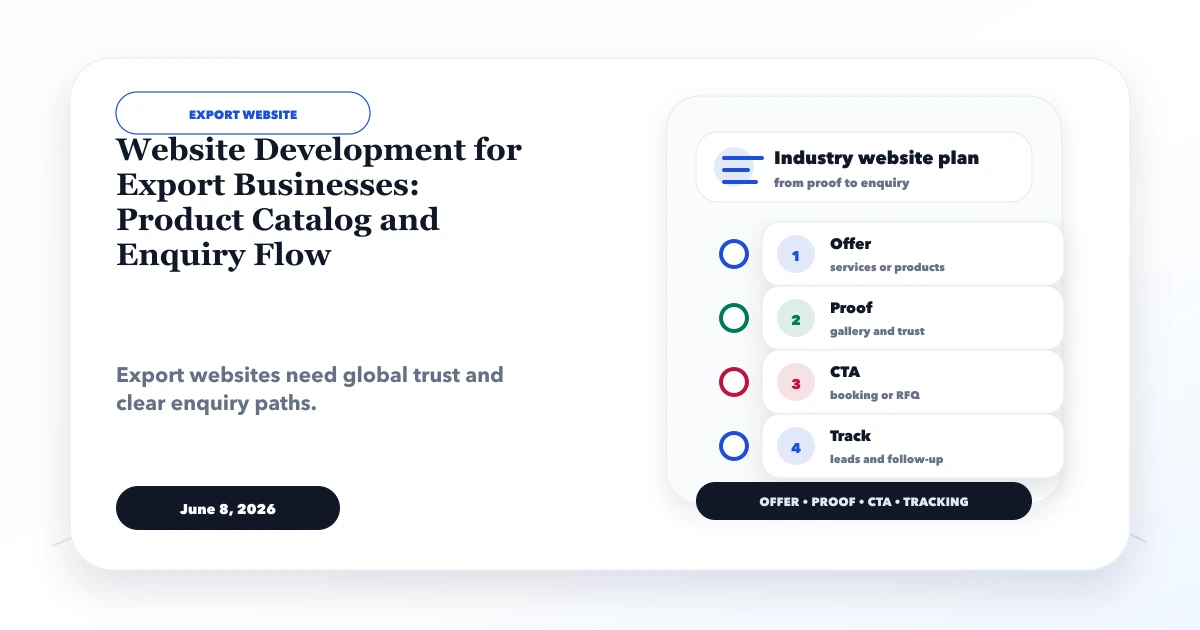
Strong website development for export businesses helps an overseas buyer assess product fit before sending a request for quotation. The website must communicate specifications, production or sourcing capability, minimum order context, packaging, documentation, and response process without making unsupported compliance or delivery promises.
An export site is not just a domestic catalog with “global” added to the headline. It should reduce time-zone friction, standardize technical enquiries, and give buyers a credible path from product research to RFQ.
By Tushar C. (Founder, VASUYASHII). Reviewed for B2B catalog architecture, product-data governance, enquiry qualification, international discovery, and claim safety. This is website-planning guidance, not export, customs, tax, or legal advice.
An export-ready website should provide:
The website should qualify interest. Final feasibility, pricing, compliance, and shipping commitments still require commercial review.
Consider a procurement manager looking for a repeat supply of a manufactured component. Before sharing company data, they may check:
A gallery and contact button cannot answer these questions. A structured catalog can.
Use a hierarchy that mirrors the commercial catalog.
| Layer | Purpose | Example content |
|---|---|---|
| Category | Helps buyer narrow the range | Industrial fasteners, packaging films, garments |
| Product family | Explains shared use and variants | Stainless steel bolts, laminated pouches |
| Product page | Supports technical evaluation | Specification table, options, MOQ, RFQ |
| Application page | Shows fit for a real use | Food processing, retail packaging, workwear |
| Capability page | Explains process and limits | Customization, quality checks, packaging |
Avoid publishing one near-identical page for every small size or color. Use tables and selectable variants when the core intent is the same.
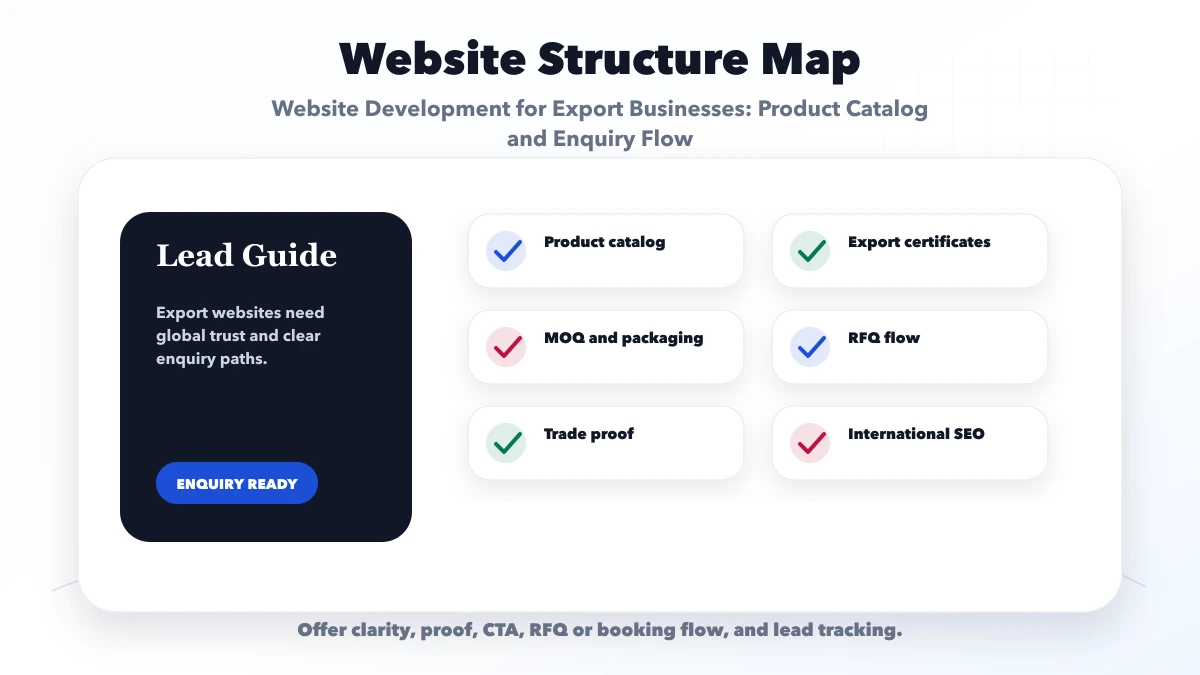
Each important product page can include:
Only publish values that the commercial and technical teams can maintain. If an attribute varies by order, label it “subject to approved specification” instead of showing a false fixed value.
Name each document accurately. A registration, management-system certificate, lab report, product certificate, declaration, membership, and customer approval are not interchangeable.
For each published certificate, verify:
Do not display marketplace badges, country flags, shipping logos, or customer logos as proof without authorization. “Export quality” is not a technical specification.
MOQ is often more useful than a hidden “contact for details” message. If it varies, explain the factors: material, print, tooling, color, production line, packing, or destination.
The sample section should clarify whether samples are free, paid, refundable against order, standard, or customized. For packaging, explain inner pack, master carton, pallet, labels, barcodes, moisture protection, and buyer-specific marking only when available.
Do not promise shipping cost or delivery date before destination, quantity, dimensions, weight, terms, and availability are confirmed.
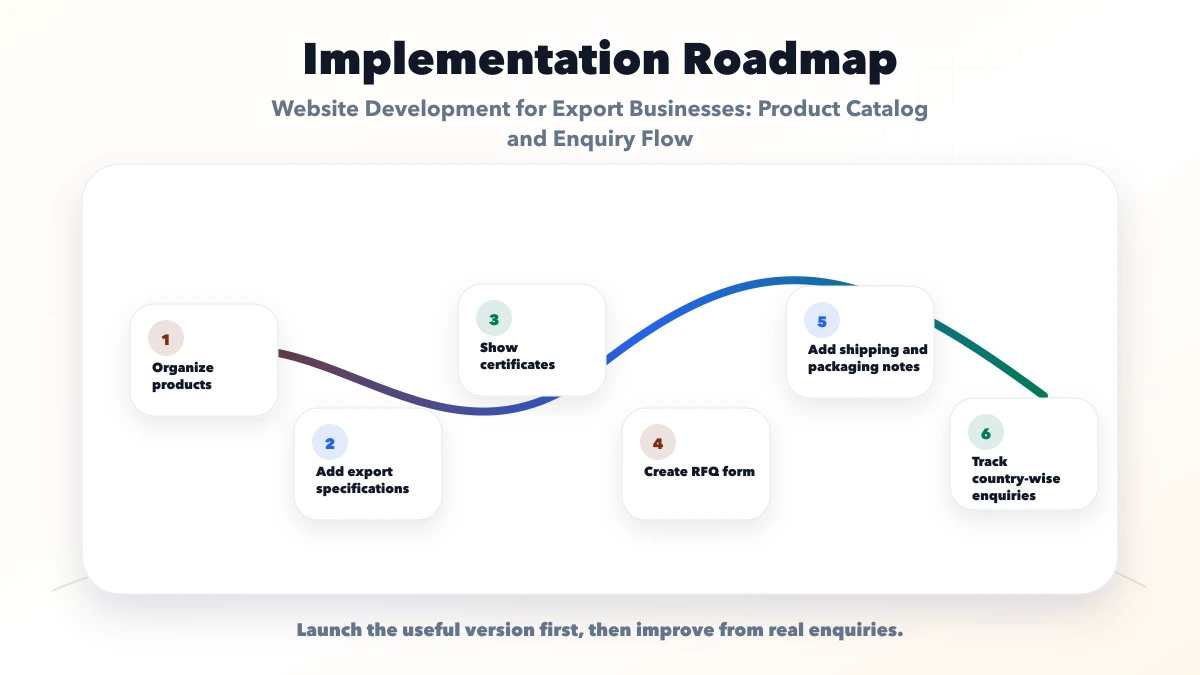
A useful RFQ can collect:
Use conditional fields to avoid overwhelming buyers. Confirm that submission is an RFQ, not order acceptance. State the expected response window in business hours and time zone.
A form-to-email setup may be sufficient initially. Growing teams may need a role-based web application or CRM connection so two people do not quote the same request differently.
Optimize product and application pages for the language buyers actually use. Add country pages only when market requirements, product range, documentation, delivery model, or local representation are genuinely different.
If the same language content serves several countries, one authoritative page is often better than copied country variants. A multilingual site requires proper translated content, navigation, and hreflang planning; automatic low-quality translation is not a market strategy.
Useful supporting content includes specification guides, material comparisons, application selection, packaging decisions, order-preparation checklists, and maintenance or storage guidance. Link each article back to the relevant product family and RFQ.
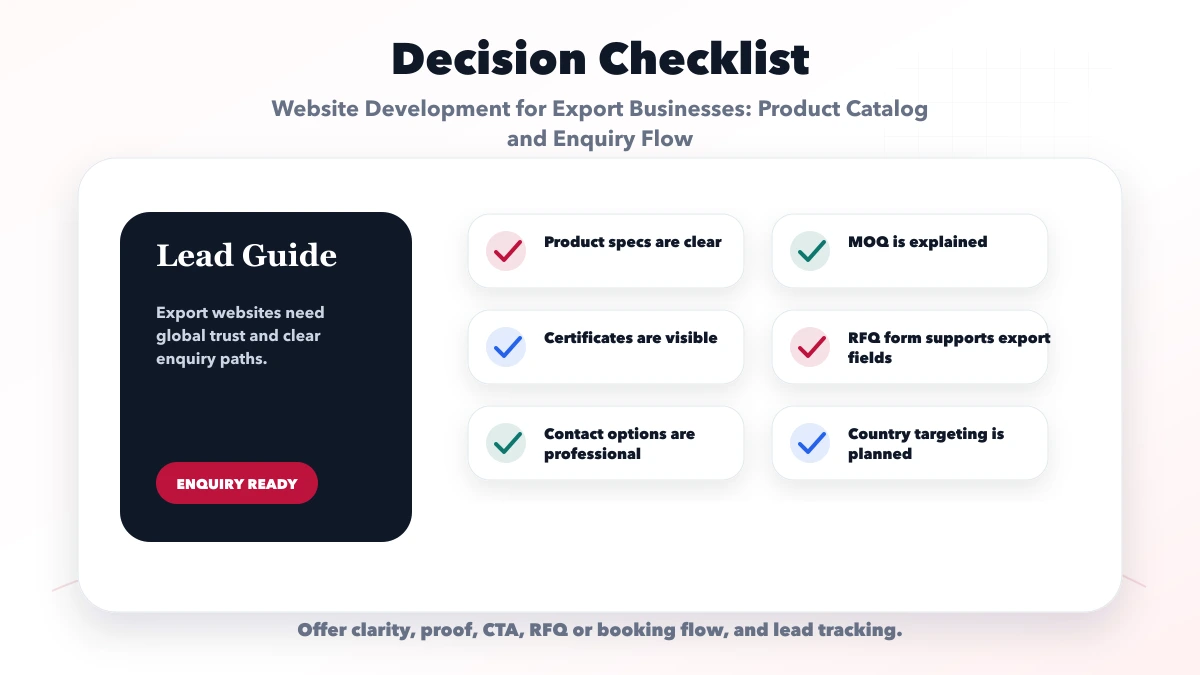
Buyers cannot confirm fit. Add controlled technical data and downloadable documents where appropriate.
Display only valid documents tied to the correct product, site, or process.
The sales team then asks every technical question manually. Preserve product, quantity, destination, and requirement context.
Country-name substitutions add little value and can divide authority. Publish market pages only with unique commercial relevance.
Buyer drawings and specifications require private storage and controlled access, not a predictable public link.
The public website supports discovery, product evaluation, and RFQ capture. Inventory, quotation approval, order processing, documentation, shipment tracking, and accounting are separate operational systems.
Current VASUYASHII service capabilities is kept separate from this export-site planning example. The guide does not imply that a fictional demo exported goods, passed a certification, or produced a buyer outcome.
VASUYASHII can scope custom software or integrations for controlled workflows, but those capabilities are not implied by a catalog website.
Yes, when approved. If MOQ varies, explain the product, material, customization, and packaging factors instead of publishing a misleading number.
Standard products may support indicative pricing. Most export quotes still depend on quantity, specification, packaging, destination, currency, validity, and commercial terms.
Yes, with private storage, restricted access, file validation, retention rules, and clear purpose. Do not expose buyer files through public URLs.
Only when the business can maintain accurate translations and serve those markets. One strong language version is better than several poor automated translations.
WhatsApp is helpful for quick communication, but structured RFQs are better for specifications, quantity, destination, attachments, and internal routing.
Yes. VASUYASHII can plan the catalog, product data, RFQ flow, analytics, and scoped integrations. Export compliance and commercial commitments remain with qualified business owners and advisers.
Gather approved product data, units, variants, MOQ rules, packaging options, certificates, RFQ fields, and response owners. This preparation determines whether the website becomes a useful sales tool or another image gallery.
Related Articles
June 8, 2026
Plan a garment manufacturer website with buyer categories, product specifications, MOQ context, qualified RFQs, verified export proof and catalog ownership.
Read article
June 8, 2026
Website development for furniture manufacturers with product catalog, quote system, material details, project gallery, B2B leads, and checklist.
Read article
June 8, 2026
Plan a manufacturer website with product data, capability proof, certificates, RFQ forms, catalog ownership, buyer journeys, lead routing, and B2B SEO.
Read article
June 9, 2026
Plan a distributor website with brand catalogs, territory rules, retailer enquiries, stock context, WhatsApp handoff, and B2B lead tracking.
Read article