
June 8, 2026
Export Business Website: Catalog and RFQ Flow
Plan an export business website with controlled product specifications, MOQ and packaging details, credible trade proof, and a qualified international RFQ flow.
Read articlePublished Updated
Website development for furniture manufacturers with product catalog, quote system, material details, project gallery, B2B leads, and checklist.
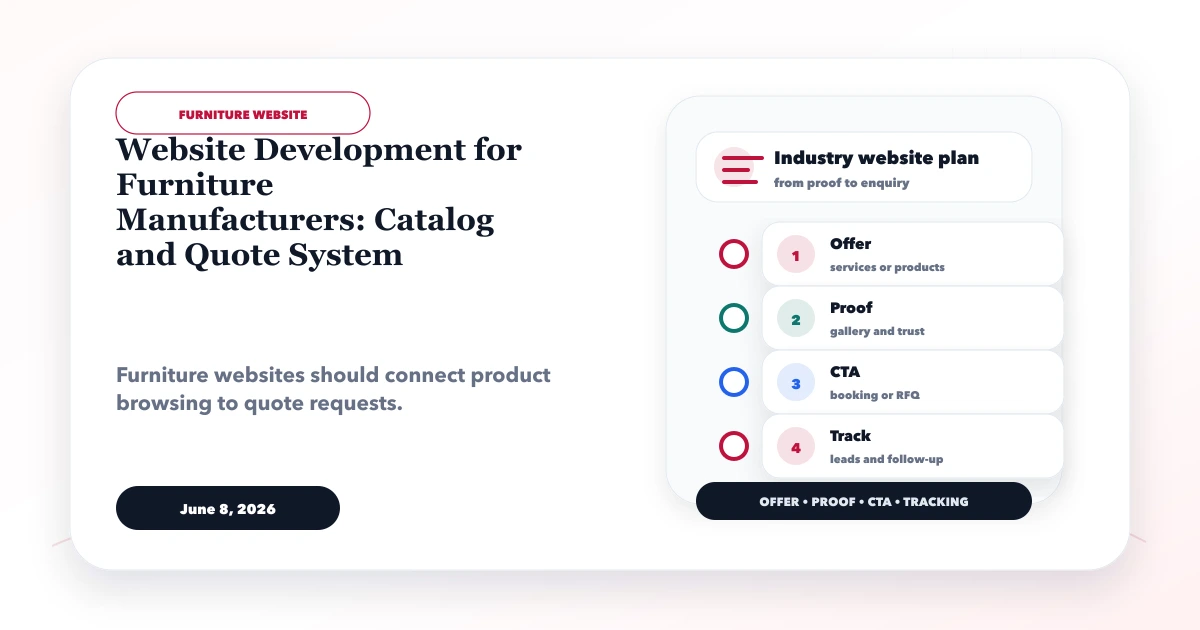
Website development for furniture manufacturers should reduce the work between "send catalogue" and a usable quotation. A modular-furniture buyer, dealer, architect, school, office, hotel, and homeowner do not ask the same questions. The website needs to show relevant ranges while collecting dimensions, materials, quantity, destination, and delivery expectations before the sales team prepares a quote.
This guide focuses on catalog structure, specification data, RFQ design, project proof, dealer and project-buyer journeys, search visibility, and handover. It is for Indian furniture factories, custom workshops, office-furniture suppliers, and modular-unit businesses that sell through enquiries rather than instant checkout.
By Tushar C. (Founder, VASUYASHII). Editorial review covers catalog information architecture, quote qualification, image performance, B2B buyer journeys, and realistic delivery boundaries.
A furniture manufacturer website should include product categories, material and size options, project gallery, custom quote form, B2B buyer information, delivery capability, and SEO pages.
A procurement manager comparing 150 workstations needs capacity, material, warranty, installation, and delivery information. An architect specifying a reception desk needs finishes, dimensions, drawings, and customization. A dealer may want price-list access and territory information. One generic gallery cannot serve all three.
The launch target is a catalog that helps each buyer shortlist a range and an RFQ that gives sales enough context to respond. It should not promise instant pricing when freight, site measurement, hardware, finish, and quantity can change the quote.
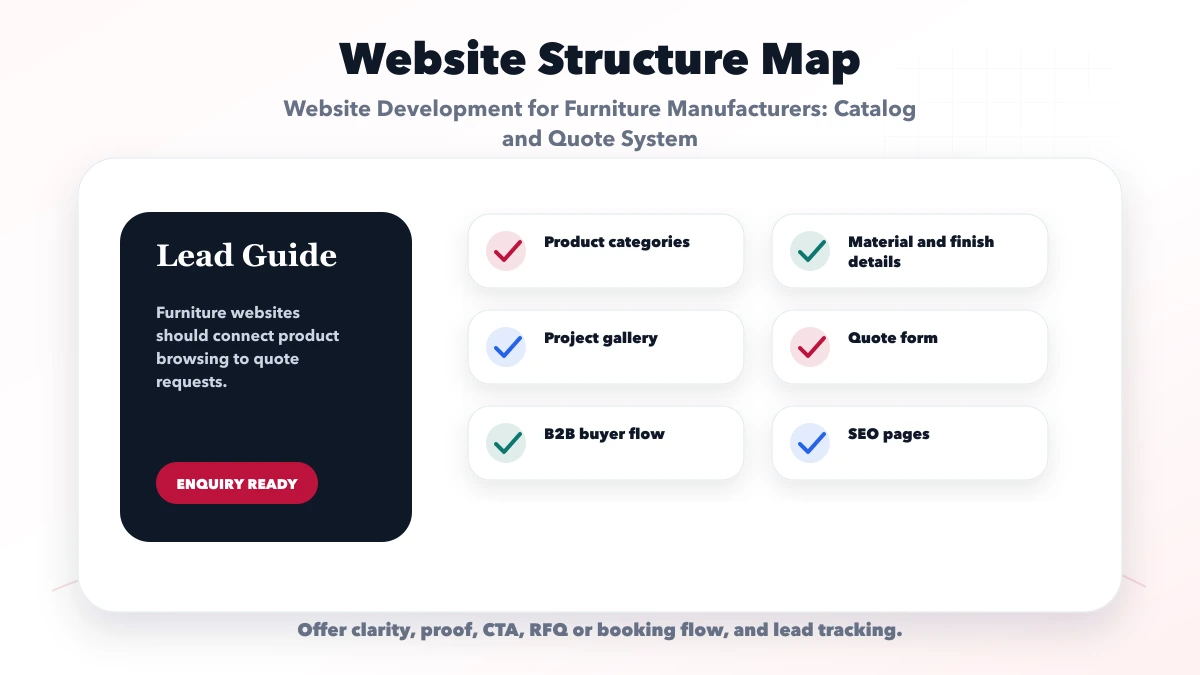
Map every check to a purchasing question. Product categories support discovery; specifications support comparison; factory and project proof reduce risk; RFQ fields improve quote quality; delivery notes prevent unsuitable enquiries.
| Website area | What to include | Why it matters |
|---|---|---|
| Catalog layer | Tables, chairs, modular, custom | Helps browsing |
| Spec layer | Material, size, finish, quantity | Supports quote |
| Lead layer | Quote form, WhatsApp, catalog | Captures enquiries |
Build the navigation around how furniture is bought. A contract manufacturer may lead with sectors and production capability. A modular brand may lead with rooms and systems. A dealer-focused business may separate retail enquiries from bulk or dealership requests.
Launch the highest-demand ranges first, but define the product-data template before uploading them. Adding hundreds of inconsistent cards creates a migration problem later. After launch, use RFQ quality, search terms, zero-result searches, and sales questions to decide which categories need deeper pages.
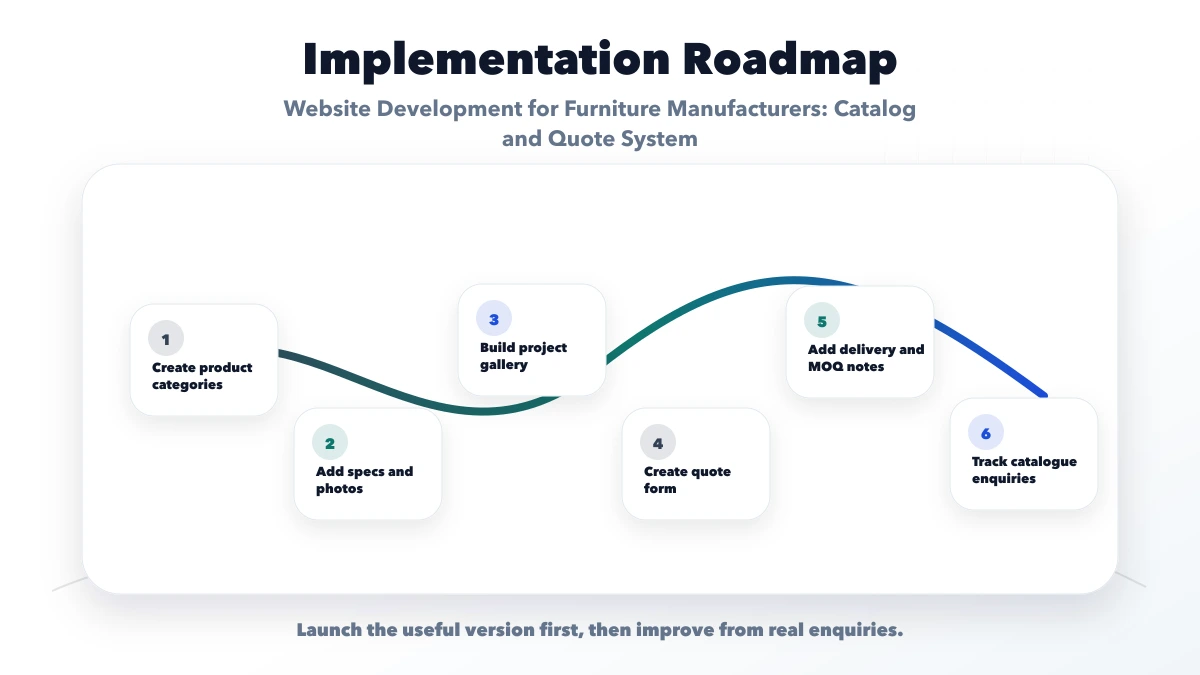
Before approval, ask a salesperson to prepare a quote using only one test RFQ and the linked product page. Missing information in that exercise should become a field, specification, help note, or follow-up step.
Start with a product-data sheet rather than card design. Each product family should use a consistent set of fields:
Do not publish fields that the factory cannot maintain. If exact stock or lead time changes daily, use "confirm availability" and collect the destination and required date. If a finish is made to order, explain the approval process instead of showing it like an always-available SKU.
Use category pages for broad search and comparison, then detail pages for ranges with enough unique specifications, photographs, and buyer questions. Thin pages that differ only by model name create maintenance and indexing problems. A structured product catalog web app becomes useful when filters, dealer access, downloadable selections, or frequent updates exceed a normal content-managed website.
The quote form should adapt to the buying context. A practical furniture RFQ can collect:
| Field | Why sales needs it |
|---|---|
| Product/range | Identifies the shortlisted item |
| Quantity | Separates a sample request from a bulk project |
| Dimensions or drawing | Reveals customization and measurement needs |
| Material/finish | Changes costing and production route |
| Delivery PIN code/city | Supports freight and installation planning |
| Required date | Exposes unrealistic timelines early |
| Buyer type | Routes dealer, architect, contractor, and direct enquiries |
| Attachment | Allows floor plan, BOQ, reference, or drawing upload |
Keep name, phone, and business email straightforward. Do not force a first-time visitor to complete an engineering questionnaire. Use conditional fields after they select "custom project" or "bulk requirement." The confirmation message should state what happens next and when the team normally reviews the request.
WhatsApp can remain a fast route, but prefill the product name and page URL. A message saying only "price?" creates more work than a short RFQ. For automatic routing or acknowledgement, review integrations and automation; do not claim that a WhatsApp click equals a qualified lead.
Furniture buyers need proof matched to the claim. Use original factory, material, process, installation, and completed-project photographs with permission. Add project type, approximate scope, city, and delivered items where disclosure is allowed. Do not present stock images or concept renders as completed work.
Useful trust material includes:
Case studies should explain the requirement, constraint, selected range, customization, and outcome without publishing confidential buyer data. If the business has no formal case study yet, start with one documented installation rather than writing broad claims such as "leading manufacturer."
Organize search pages by genuine demand: office workstations, school desks, hotel furniture, modular wardrobes, laboratory furniture, or custom reception counters. Do not create a page for every city unless the manufacturer has distinct delivery capability, proof, and service information there. A strong manufacturing guide plus clear delivery coverage is safer than dozens of near-identical location pages.
Furniture sites are image-heavy, so compress images, provide stable dimensions, use descriptive alt text, and show useful angles. Keep the primary product visible without loading a huge gallery first. A downloadable catalog must not be the only source of product information because search engines and mobile visitors need accessible page content.
Track category views, product-detail views, catalog downloads, RFQ starts, valid RFQ submissions, WhatsApp clicks, and source page. Compare enquiry quality, not just click count. Sales should tag whether the request had quantity, budget fit, destination, and a real buying timeline.
The VASUYASHII Business Suite provides current product context for records, stock-oriented workflows, company-scoped data, and operational reporting. It is not presented as a furniture-client case study and does not prove furniture-specific RFQ deployment.
For a furniture website, VASUYASHII would reuse the underlying discipline: define a product schema, separate public catalog data from internal cost and stock data, connect enquiries to a traceable follow-up route, and test exports and permissions. Website delivery can begin under website development services; a custom selector, dealer portal, or quote workflow belongs under web application services.
VASUYASHII would run a product-data workshop with sales and production, select priority ranges, define RFQ fields, prepare an image and specification checklist, and build one complete category before scaling. The handover would identify who updates products, where RFQs arrive, how consent and attachments are handled, and which outcomes are measured. Review software development when the requirement extends into internal quotation or dealer operations, then contact VASUYASHII with sample products and a real enquiry flow.
Review the site with a real BOQ, dealer request, and custom-size requirement. The design succeeds only when buyers can find the right range and the team can respond without restarting discovery over WhatsApp.
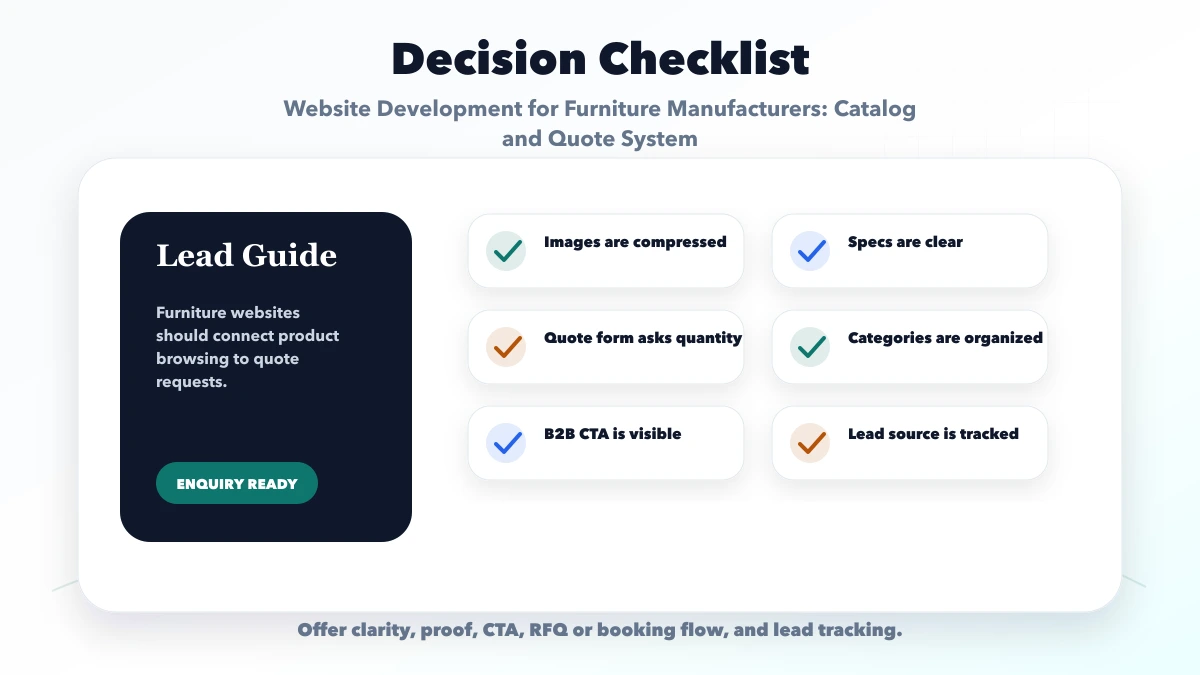
Include buyer-specific categories, consistent specifications, original project proof, delivery and warranty context, a quote-ready RFQ, and a clear sales contact route.
Create detail pages where a product has unique demand, specifications, images, or questions. Keep similar variants under a strong range page until they have enough useful information to stand alone.
Yes. Use conditional fields for product, quantity, size, finish, destination, date, buyer type, and drawings. Keep the initial form usable on mobile.
Yes. Use compressed responsive images, stable dimensions, meaningful alt text, and selective loading so product evidence does not make the page unusable on mobile data.
Yes. VASUYASHII can scope and build the public catalog and RFQ flow, and can separately quote a selector, dealer portal, or internal quotation system when justified.
If you want a practical plan for website development for furniture manufacturers, VASUYASHII can help with scope, design, development, SEO setup, lead flow, launch, and maintenance.
Related Articles
June 8, 2026
Plan an export business website with controlled product specifications, MOQ and packaging details, credible trade proof, and a qualified international RFQ flow.
Read article
June 8, 2026
Plan a garment manufacturer website with buyer categories, product specifications, MOQ context, qualified RFQs, verified export proof and catalog ownership.
Read article
June 8, 2026
Plan a manufacturer website with product data, capability proof, certificates, RFQ forms, catalog ownership, buyer journeys, lead routing, and B2B SEO.
Read article
June 8, 2026
Plan a packaging company website with material and print specifications, industry applications, MOQ context, proof, and a quote-ready RFQ form.
Read article