
June 8, 2026
Export Business Website: Catalog and RFQ Flow
Plan an export business website with controlled product specifications, MOQ and packaging details, credible trade proof, and a qualified international RFQ flow.
Read articlePublished Updated
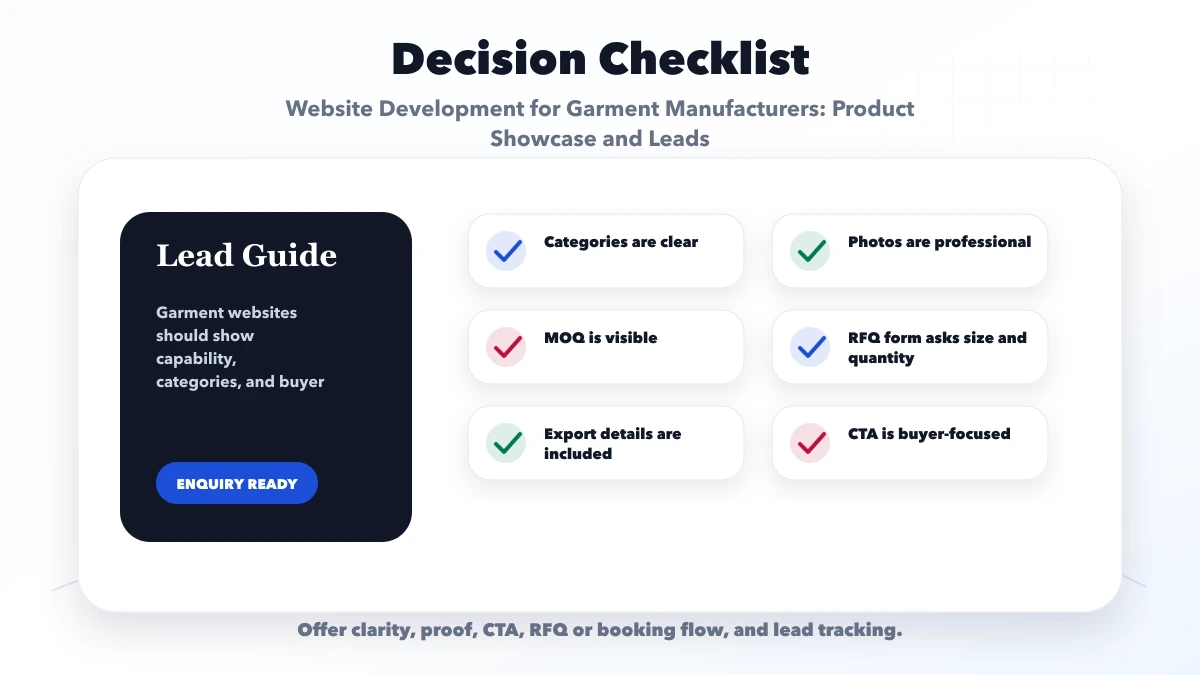
Plan a garment manufacturer website with buyer categories, product specifications, MOQ context, qualified RFQs, verified export proof and catalog ownership.
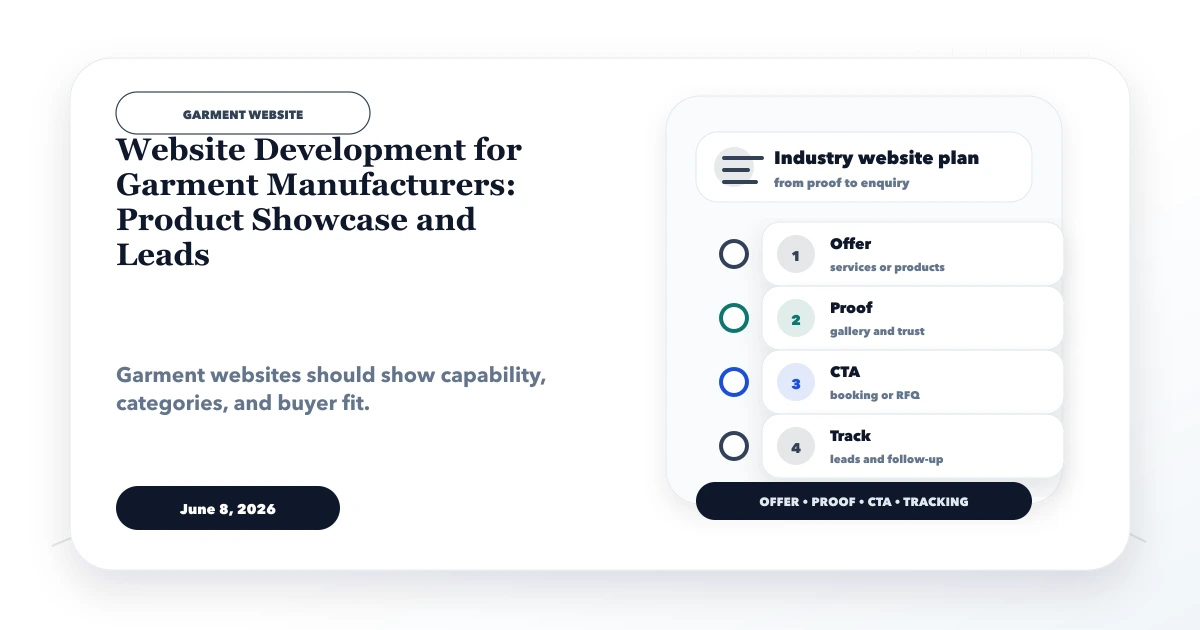
Website development for garment manufacturers should help a buyer evaluate capability before asking for samples or a quotation. The site must explain what the factory makes, materials and specifications it can handle, minimum-order context, customization boundaries, production and quality process, target markets, and how to submit a usable RFQ.
A page filled with fashion photographs may look attractive but still fail a wholesaler, private label, retailer, exporter, institutional buyer, or sourcing team. B2B buyers need structured facts and clear commercial next steps.
By Tushar C. (Founder, VASUYASHII). Reviewed by VASUYASHII Editorial for B2B website structure, catalog architecture, RFQ flow, media performance, technical SEO, and SME delivery. Factory capacity, certifications, export markets, clients, materials, lead times, and quality claims must be verified by the manufacturer before publication.
A useful garment manufacturing website needs capability-led navigation, product or range pages with specifications, an honest manufacturing profile, verified quality and compliance information, original factory and product media, MOQ and lead-time context, a qualified RFQ form, and ownership of follow-up. Keep important product information in crawlable HTML even when a PDF catalog is also available.
The website should not behave like a consumer ecommerce store unless the business actually sells fixed products at public prices. For make-to-order manufacturing, the primary conversion is a qualified sample or quotation request.
Before designing pages, document which commercial model the website represents:
Each model changes the information a buyer needs. A private-label buyer may care about fabric sourcing, sample development, labeling, packaging, and MOQ. A school-uniform distributor may care about size sets, colour consistency, repeat supply, and territory. A fashion retailer may need seasonal capacity and shorter replenishment cycles.
Do not describe the business as a manufacturer if it only trades finished goods. If both manufacturing and trading exist, label them accurately.
Suppose a regional retail chain wants 3,000 polo T-shirts under its own brand. It needs cotton-blend options, custom colours, embroidery, branded labels, size assortment, individual packaging, and delivery to two warehouses. A generic gallery forces the buyer to ask whether any of this is possible.
A useful website guides the buyer through:
The sales team receives a brief it can evaluate instead of a message saying "send price."
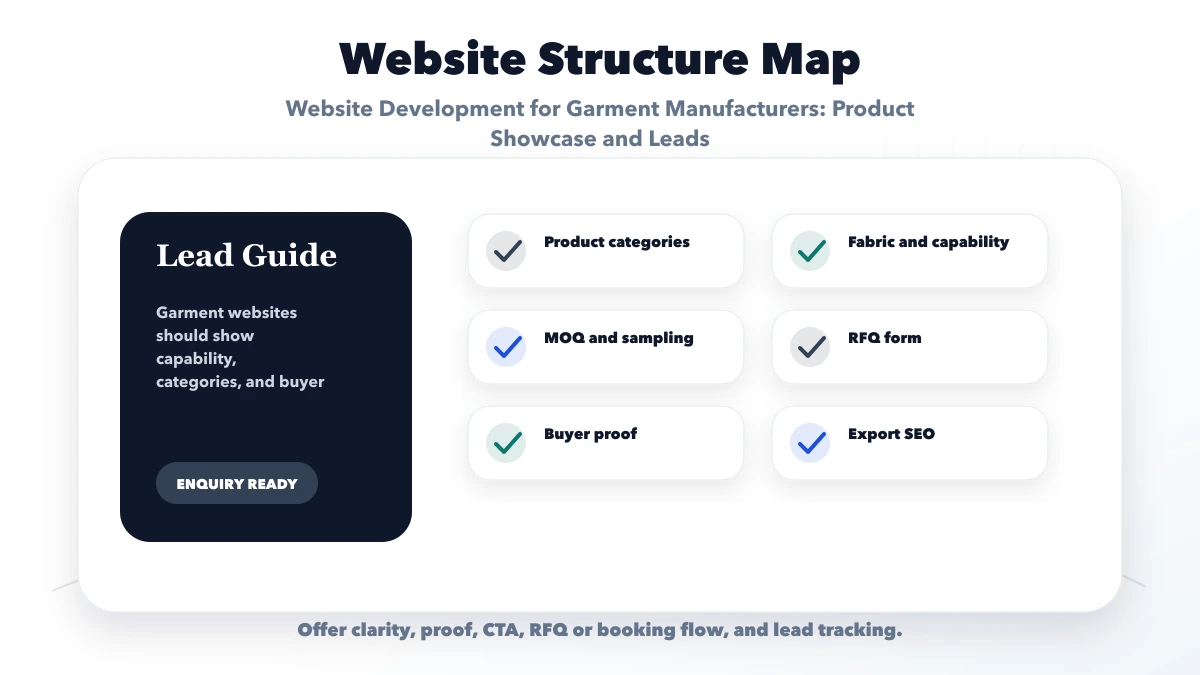
| Website area | Content to include | Buyer question answered |
|---|---|---|
| Homepage | Product families, manufacturing model, locations, proof, primary RFQ | Is this supplier relevant? |
| Product category | Use case, garment types, material options, customization, MOQ context | Can they make my range? |
| Product or capability detail | Specifications, size options, colours, branding, packing, enquiry CTA | What details can be supplied? |
| Manufacturing | Facility, process stages, machinery only where accurate, capacity context | How will the order be produced? |
| Quality | Inspection stages, tolerances or standards approved for publication | How is consistency controlled? |
| Sampling process | Brief, development, approval, revision, bulk production | What happens before bulk order? |
| Markets and logistics | Genuine domestic or export scope, dispatch model, documentation boundary | Can they serve my location? |
| RFQ | Structured requirement fields and attachment route | How do I request a quote? |
| Contact | Business identity, address, phone, email, hours | Can I verify and reach them? |
Avoid publishing a separate low-value page for every colour or minor variation. Use category and capability pages that remain useful even as specific designs change.
Each product or range page should use a consistent specification model. Depending on the garment, fields may include:
Do not publish a fixed specification unless production can support it consistently. Mark custom fields as "available after requirement review" where appropriate. If prices depend on fabric, quantity, design, branding, and delivery, explain those drivers instead of showing a misleading universal price.
Use original photos that represent actual capability. Keep records for:
For confidential private-label work, show material, process, stitch, finish, packaging, or anonymized capability details only when agreements allow it. Never copy catalog images from marketplaces or another manufacturer's site.
Optimize media for mobile. Use a consistent aspect ratio, descriptive alt text, modern image formats, and fixed dimensions. A 20 MB lookbook delivered on the homepage will harm usability. Keep downloadable high-resolution files separate from the initial page experience.
| RFQ field | Why it matters |
|---|---|
| Product category | Routes the request to the right team |
| Quantity and size mix | Supports material and production planning |
| Fabric or target specification | Clarifies sourcing and costing |
| Branding and finishing | Identifies print, embroidery, labels, wash, or packing |
| Sample requirement | Defines the development stage |
| Target date | Tests feasibility and urgency |
| Delivery city or country | Affects logistics and documentation |
| Buyer type and company | Helps qualification |
| Reference file | Communicates design only through an approved secure route |
| Contact preference | Supports follow-up |
Do not allow unlimited public uploads without file-type, size, malware, storage, and access controls. A simple first form can collect the brief and ask the buyer to share sensitive tech packs through an approved business channel after verification.
After submission, display a request number or clear confirmation, expected response time, and the next commercial step. Assign a sales owner and track whether the request was valid, feasible, quoted, sampled, won, or closed.
For team assignment, follow-up, quotation stages, or buyer dashboards, evaluate a focused business web application or custom software workflow.
A PDF is useful for sales sharing, but should not be the only source of product information. PDFs become outdated, are difficult to filter, and can be poor on mobile. Keep stable category and capability information in HTML, then offer a dated catalog download when needed.
Choose a catalog web app when the business needs frequent product updates, filters, dealer access, price visibility by role, saved enquiries, or structured export. Define which data is public and which requires authentication.
If prices, stock, or product masters already live in another system, an API integration may reduce duplicate updates. Integration should include source ownership, sync direction, failure handling, and reconciliation.
Useful evidence may include original facility photographs, process explanations, verified registration details, quality checks, packaging examples, and genuine market experience. Publish certification names, validity, issuing body, capacity, client names, export countries, or compliance claims only when current evidence exists and disclosure is permitted.
Avoid generic statements such as "world-class quality" or "unlimited production capacity." Explain the control instead: incoming material checks, size-set approval, inline inspection, final inspection, packing checks, or approved third-party testing where applicable.
Build pages around commercial categories and buyer questions. For example, a uniform manufacturer page can discuss fabric durability, size management, logo application, repeat ordering, and institutional procurement. A private-label page should focus on development, sampling, branding, MOQ, and confidentiality. These should be genuinely different pages, not keyword swaps.
Use internal links between categories, process, quality, RFQ, and relevant guides. Maintain one accurate location or facility page per real operation. Avoid mass-producing city pages unless the manufacturer has genuine local evidence and a distinct service model.
Related content can cover product catalog web apps, inventory software decisions, websites for export businesses, and manufacturer lead generation.
The budget depends on content depth, number of categories, product data, photography, languages, catalog management, RFQ logic, login requirements, integrations, and update ownership.
| Scope | Appropriate when | Main effort |
|---|---|---|
| Focused manufacturer website | Limited product families and manual RFQ follow-up | Pages, proof, media, form, SEO foundations |
| Structured catalog website | Many categories and regular updates | Product model, filters, admin, media workflow |
| Buyer or dealer portal | Role-specific catalog, prices, documents, enquiry status | Authentication, permissions, integration, support |
A focused website may take four to eight weeks once verified copy, media, and product information are available. Data cleanup and photography often take longer than expected. A catalog or portal needs discovery, migration, permissions, testing, training, and a longer rollout.
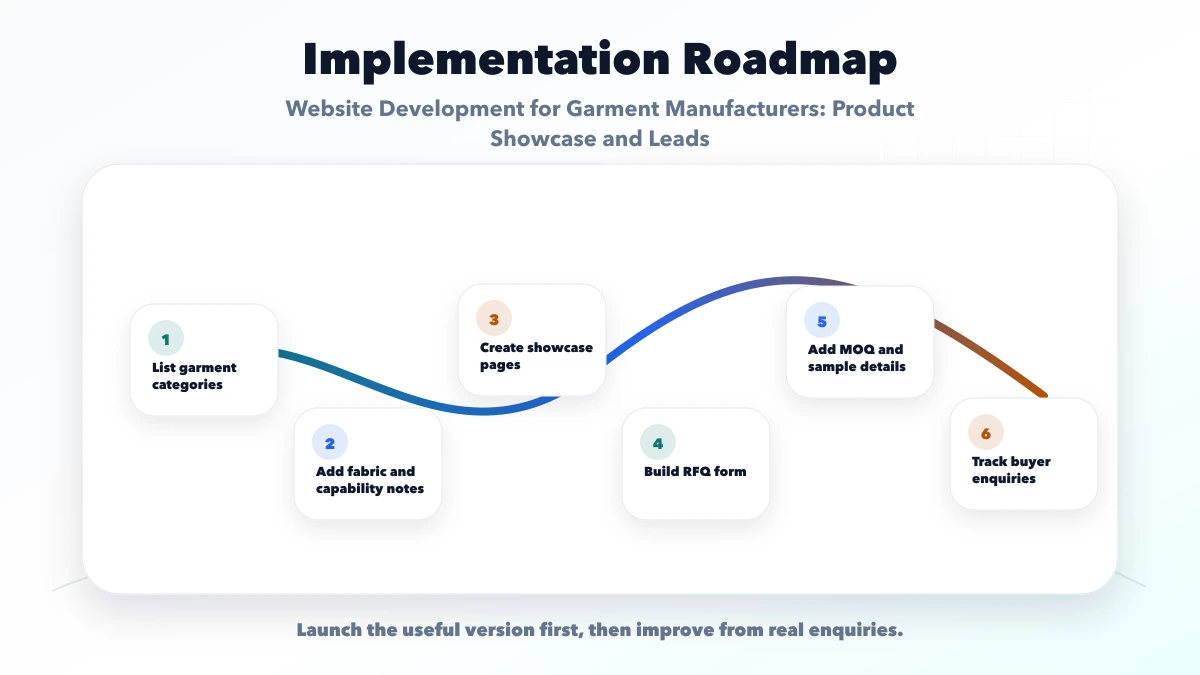
Current VASUYASHII service scoping starts with buyer segments, product taxonomy, specification fields, evidence ownership, RFQ qualification, and update responsibility. The first release would keep public product content clear and maintainable. Catalog administration, dealer access, pricing rules, quotation workflow, or system integrations would be proposed separately when the business process justifies them.
Review web application services, custom software development, integration services, and the complete services overview. A discovery discussion can be started through contact.
If the business also needs shop or warehouse control after enquiry, the garment inventory software guide explains style-colour-size variants, barcode billing, purchases, exchanges, transfers, stocktakes, permissions and reports.
Include buyer-focused product categories, specification context, manufacturing and quality information, original evidence, sampling process, MOQ and lead-time factors, RFQ qualification, and accurate contact details.
Display an MOQ when it is stable for a defined product and specification. If it varies by fabric, colour, size mix, printing, or packaging, explain the factors and ask for the requirement before confirming.
Public prices make sense for fixed ready-stock products. Make-to-order B2B pricing usually depends on specification, quantity, materials, branding, packing, logistics, and date. Use a structured RFQ rather than an inaccurate universal price.
Yes, but only through a controlled workflow with file limits, access rules, storage policy, and business ownership. Sensitive product files should not be exposed through public URLs or forwarded without controls.
No. A PDF supports sales sharing, but stable category and capability information should also be visible in crawlable, mobile-friendly HTML. Keep the PDF dated and retire old versions.
Yes. A portal can provide role-based catalogs, price lists, documents, saved orders, or enquiry status. Scope permissions, source data, and support before building it.
State only verified markets, documentation capability, certifications, logistics model, and incoterm or compliance experience approved by the business. Do not imply global reach from one unverified shipment.
Prepare the target buyer list, product families, specification template, current evidence, MOQ logic, and RFQ questions. VASUYASHII can then recommend a focused manufacturer website, structured catalog, or buyer portal.
Related Articles
June 8, 2026
Plan an export business website with controlled product specifications, MOQ and packaging details, credible trade proof, and a qualified international RFQ flow.
Read article
June 8, 2026
Website development for furniture manufacturers with product catalog, quote system, material details, project gallery, B2B leads, and checklist.
Read article
June 9, 2026
Plan a building material supplier website with a searchable catalog, contractor RFQs, dealer enquiries, WhatsApp context, local SEO, and lead tracking.
Read article
June 8, 2026
Plan a gym website with membership context, accurate class schedules, trial-booking requests, trainer trust, branch SEO, health-data privacy, and lead tracking.
Read article