
June 8, 2026
Salon Website Guide: Booking and WhatsApp Leads
Plan a salon website with services, price guidance, portfolios, appointment rules, local trust, WhatsApp qualification, reminders, analytics, and mobile QA.
Read articlePublished Updated
Plan a gym website with membership context, accurate class schedules, trial-booking requests, trainer trust, branch SEO, health-data privacy, and lead tracking.
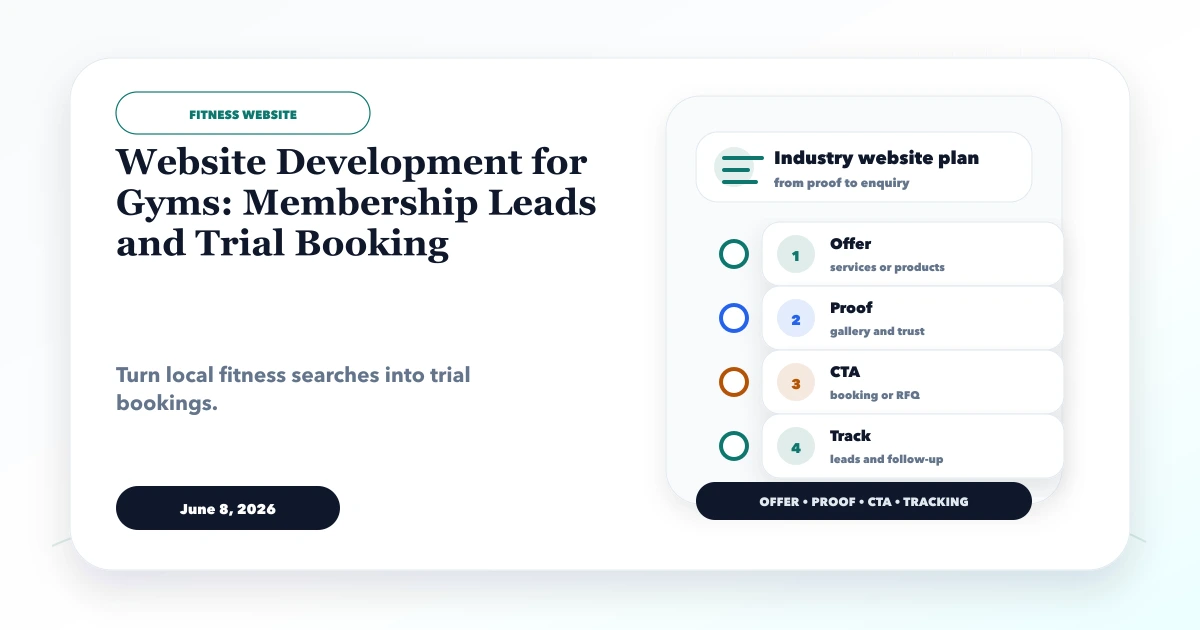
A gym website should help a visitor evaluate location, equipment, training format, class timings, membership context, and trial availability before staff begin a sales conversation. A gallery of machines and transformation slogans does not answer whether the gym fits the visitor's schedule, goals, comfort, or branch.
This guide explains website development for gyms with membership lead qualification, trial requests, schedule ownership, trainer trust, branch information, health-data boundaries, local SEO, mobile speed, and lead follow-up.
By Tushar C. (Founder, VASUYASHII). The website can describe facilities and booking processes but should not diagnose conditions, prescribe exercise, promise health outcomes, or collect unnecessary medical information. Qualified gym staff should approve training and safety content.
A useful gym website should include:
A visitor selecting a time is not guaranteed a trial until the branch confirms capacity, trainer availability, eligibility, and any applicable terms.
Visitors commonly ask:
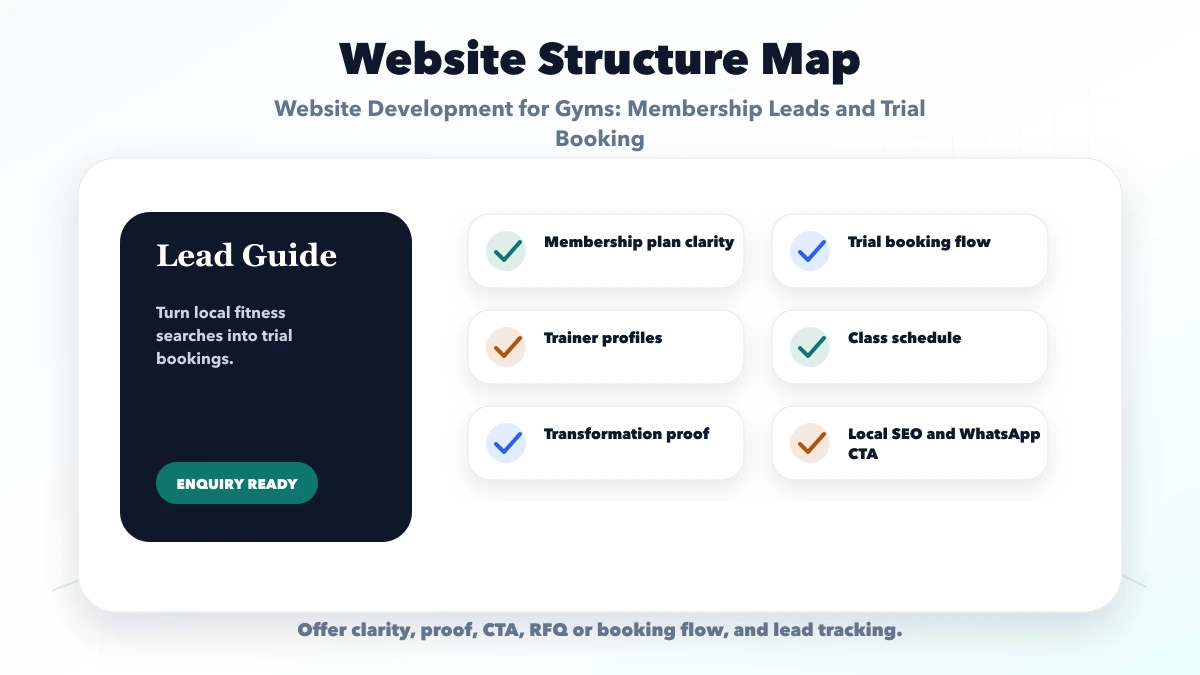
The homepage should answer location, format, key facilities, hours, and the next action. Deeper pages can explain memberships, classes, trainers, branch policies, and trial flow.
| Page | Main job | Content owner |
|---|---|---|
| Home | Introduce branch and offer | Branch manager/marketing |
| Memberships | Explain plans and assumptions | Sales/operations |
| Classes | Show real formats and schedule | Group-class manager |
| Trainers | Build accountable trust | Operations/HR |
| Facilities | Show actual equipment and amenities | Branch manager |
| Trial request | Capture qualified interest | Sales desk |
| Branch/contact | Route local visitors | Branch manager |
| Policies/privacy | Explain use, cancellation, data | Management |
For a multi-branch business, each branch page should show only the facilities, trainers, classes, timings, and offers available there.
If prices are published, state duration, taxes, joining fee, personal training, class access, freeze/cancellation rules, branch access, and validity date. Avoid a low headline price that depends on a long commitment not shown on the page.
When pricing varies, explain the plan types and quote factors. Useful categories may include monthly/quarterly/annual access, off-peak access, group classes, personal training, or multi-branch access where genuinely available.
Do not invent scarcity or countdown timers. Offers need a real start/end date, owner, redemption rule, and expiry process. Remove outdated posters from both the page and downloadable assets.
A schedule creates operational expectations. Store class name, branch, day, start/end time, trainer, capacity, level, booking requirement, effective date, and status. Assign one person to handle substitutions and cancellations.
If the schedule cannot update in real time, show when it was last confirmed and ask visitors to verify before travelling. Do not create a separate indexable page for every temporary timetable.
For a connected schedule, define what happens when the class is full, the trainer changes, the API fails, or a member cancels. A custom web application may be justified for capacity and membership access, but a static schedule is often enough for the first phase.
A practical trial form can ask:
Avoid collecting detailed health history in a marketing form. If the gym requires a health declaration, waiver, or assessment, use an approved process at the correct stage with clear purpose and access controls.
After submission, show that the request is pending confirmation. Internally, assign an owner, check branch capacity, contact the visitor, confirm the slot and instructions, record attendance, and follow up without excessive messaging.
Profiles should contain approved facts: name, role, current qualifications/certifications, training focus, languages, branch availability, and professional photo used with permission.
Avoid unsupported claims, fake transformations, stock-photo trainers, or outcome guarantees. Before-and-after images require explicit permission and careful context. They should never suggest that every person will get the same result.
Facility photographs should represent the actual branch and current condition. Date or update galleries when equipment or interiors change.
Gym leads do not require detailed medical information. Keep website analytics and lead systems free of diagnoses, injuries, body measurements, or free-text health details unless the business has a legitimate, approved process.
If a connected member system stores assessments, scope:
Do not include health or identity data in GA4 event parameters, URLs, or WhatsApp prefilled links.
Use "Request a trial" as the structured primary action when the branch needs date and interest details. WhatsApp can answer a quick question, and phone can support immediate branch availability during staffed hours.
Track trial start, valid request, WhatsApp click, phone click, confirmed trial, attendance, and membership conversion in the correct systems. A click is not a confirmed trial or sale.
Every lead needs branch, owner, response status, trial status, source, and opt-out handling. Integration services can help connect notifications or CRM records after responsibilities are defined.
Each branch page should include accurate name, address, phone, map, timings, parking/accessibility, facilities, trainers/classes, and trial action. Keep these details consistent across the website and verified profiles.
Do not create pages for every nearby sector if the gym has no branch or meaningful local service evidence. One strong branch page can serve multiple surrounding searches honestly.
Reviews should be genuine. Never offer health promises or write customer reviews on their behalf.
Consider a fictional single-branch gym in Noida offering gym-floor access, personal training, and four group-class formats. Its social pages produce messages, but staff do not know which class or time the visitor wants. The online timetable is also outdated.
A focused rebuild would create a branch page, current membership context, an owned class schedule, verified trainer profiles, and a trial request routed to the sales desk. Staff would mark confirmation, attendance, and follow-up status.
Success would be measured by qualified trial requests, response time, confirmed attendance, and memberships attributed to the source, not by page views alone. This scenario is illustrative.
Potential members often browse on mobile. Compress facility images, set stable dimensions, lazy-load below-the-fold media, and avoid auto-playing workout videos. Show branch, hours, membership context, and trial action quickly.
Forms need readable labels, clear errors, adequate tap size, keyboard support, and a confirmation state. Class schedules should remain understandable to screen readers and should not exist only as image posters.
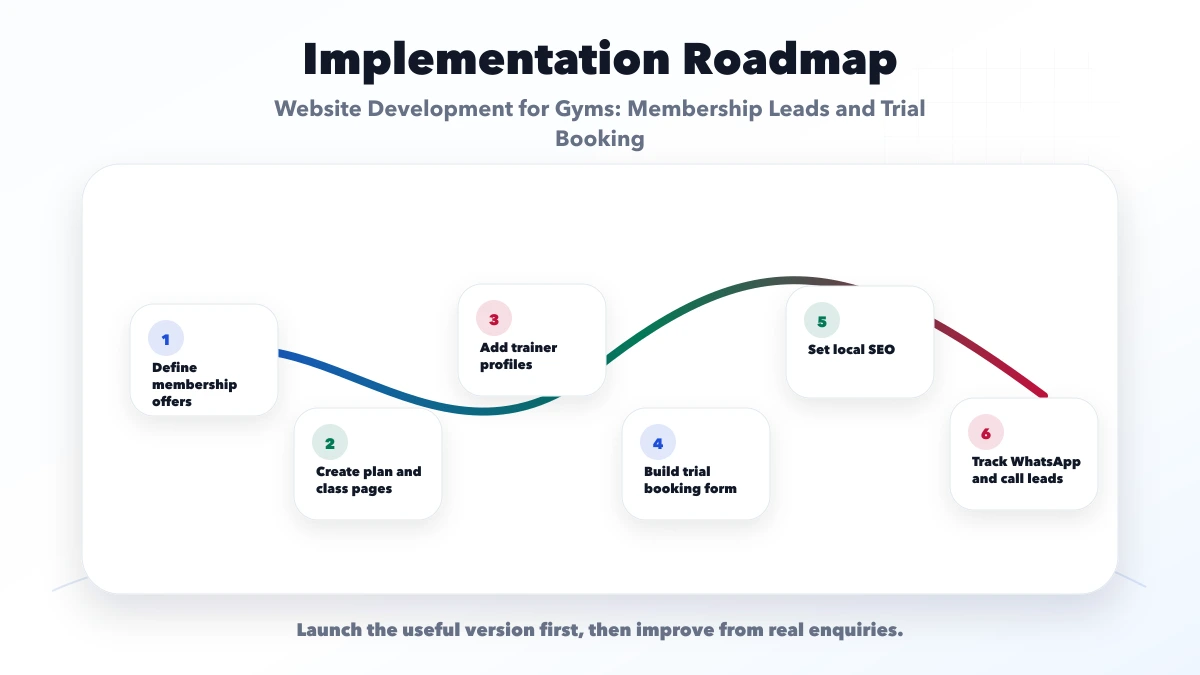
A simple branch website costs less than multi-branch memberships, live class capacity, trainer calendars, online payments, access control, member accounts, or fitness tracking.
Key effort drivers include branch count, membership complexity, schedule updates, trainer profiles, image/video preparation, trial routing, payment/refund policies, CRM, member-system API, privacy, and ongoing maintenance.
Separate public lead generation from member management. Review software development services and services before treating a membership portal as a small website add-on.
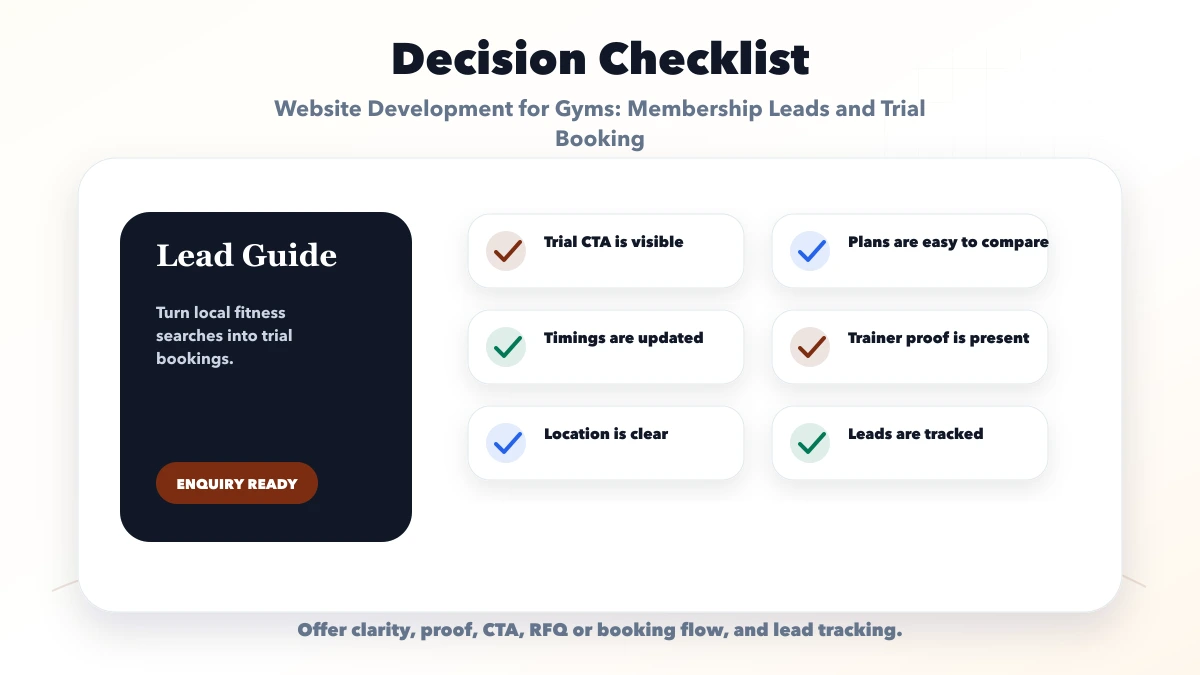
The public website can generate trials, while the gym membership software guide controls plans, check-ins, payments, freezes, renewals, and branch reporting after a lead becomes a member.
Yes when the plans and assumptions can remain accurate. Otherwise show plan types, inclusions, quote factors, and a transparent enquiry process.
They can request a preferred slot. Confirm only after the branch checks capacity, staff availability, eligibility, and applicable terms.
Use accessible web content as the primary schedule. An image can support promotion but is harder to search, update, and use with assistive technology.
Collect only what the first-stage lead process needs. Use a separate approved assessment or declaration process for health information.
Yes when each real branch has different address, timings, facilities, trainers, classes, and contact flow. Avoid fake or duplicate locality pages.
Yes, after scoping memberships, schedules, payments, roles, access, privacy, integrations, and support. It should be treated separately from the public website.
The current VASUYASHII enquiry implementation preserves the selected service from the CTA into the contact form and records a lead only after the backend confirms a new lead ID. A gym trial form should use the same principle: a click is not a booking until the branch confirms capacity and ownership.
The screenshot is a demonstrator of page structure, not a claim about a live gym customer's membership results. Production setup still needs the branch's real programme, schedule and booking rules.
| Trial stage | Required record | Branch action |
|---|---|---|
| request | preferred branch, slot, phone and consent context | check availability |
| qualification | goal and safe minimum context | assign counsellor |
| confirmation | accepted slot and responsible staff member | send confirmation |
| attendance | attended, rescheduled or missed | choose follow-up |
| membership decision | plan discussed and outcome | close or nurture |
Decision example: a single gym can launch with a lead form and manual slot confirmation. A multi-branch operator with class capacity, trainer rosters, recurring plans and access control needs a member system with company/branch permissions; that is separate from the public marketing website.
Limitations: do not collect diagnoses or detailed medical histories in the first marketing form. The page does not claim VASUYASHII has delivered a named gym client or that a trial request guarantees membership. Payment mandates, waivers, health declarations and access hardware need independent review.
The official Digital Personal Data Protection Act, 2023 should inform data-purpose and retention discussions, with professional legal advice for the actual gym. Use WCAG when building forms, schedules and controls that must remain usable on mobile and with assistive technology.
Launch with accurate branch information, current membership context, an owned schedule, verified trainers, and a trial request the sales desk can reliably confirm. Add member-system complexity only after the process is stable.
Review website development services, web applications, integrations, or contact VASUYASHII for a focused plan.
Related Articles
June 8, 2026
Plan a salon website with services, price guidance, portfolios, appointment rules, local trust, WhatsApp qualification, reminders, analytics, and mobile QA.
Read article
June 7, 2026
Plan a physiotherapy clinic website with treatment pages, therapist trust, safe appointment requests, home-visit details, local SEO, and lead tracking.
Read article
June 8, 2026
Plan a wedding photographer website with fast galleries, package context, date-availability requests, image rights, lead tracking, and booking handoff.
Read article
June 8, 2026
Plan a garment manufacturer website with buyer categories, product specifications, MOQ context, qualified RFQs, verified export proof and catalog ownership.
Read article