
June 7, 2026
Dental Clinic Website: Features, Cost and Booking
Plan a dental clinic website with treatment pages, verified dentist profiles, appointment requests, local SEO, privacy controls, cost and launch checks.
Read articlePublished Updated
Plan a physiotherapy clinic website with treatment pages, therapist trust, safe appointment requests, home-visit details, local SEO, and lead tracking.
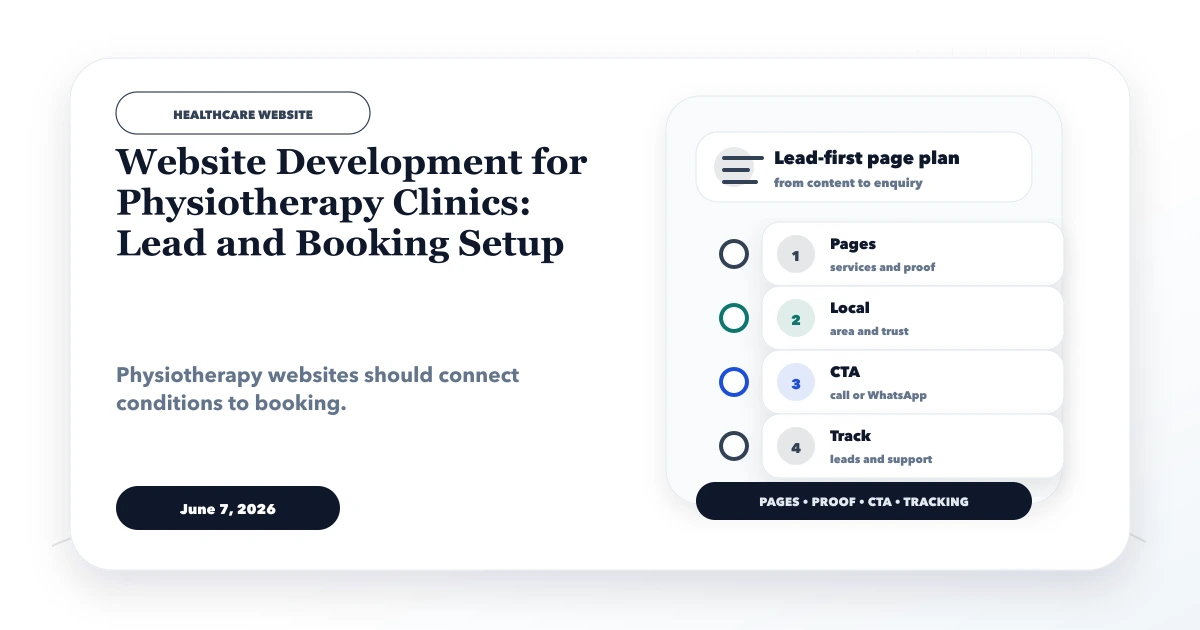
A physiotherapy clinic website has to answer a different set of questions from a general business website. A person with back pain may want an appointment today. A parent may be comparing rehabilitation options after an injury. An office worker may be checking whether the clinic offers evening sessions, while an older patient may need a home visit. The website must help each visitor understand the service without pretending to diagnose them online.
This guide explains website development for physiotherapy clinics from that practical perspective. It covers treatment and condition content, therapist credibility, appointment requests, home-visit boundaries, privacy, local discovery, lead tracking, implementation cost, and the checks required before launch.
By Tushar C. (Founder, VASUYASHII). This article is a website-planning guide, not medical advice. Treatment claims, therapist credentials, clinic policies, and patient-facing health information must be reviewed by the clinic before publication.
A useful physiotherapy website should make four things immediately clear:
The essential pages usually include Home, About the Clinic, Therapists, Treatments, Conditions or Patient Guides, Home Visits, Appointment Request, FAQs, Contact, and Privacy Policy. Clinics with multiple genuine branches may also need a distinct page for each location.
Patients do not always search using the name of a treatment. They may search for a problem, life situation, or desired outcome. Common intent groups include:
The website architecture should connect these questions to accurate service information. A treatment page can explain what the service involves, who may be referred for it, what happens during an initial assessment, where it is available, and how to request an appointment. It should not promise guaranteed recovery, give a diagnosis, or imply that every visitor is suitable for the same treatment.
Condition-oriented pages need even more care. Use them to explain the clinic's assessment process and the questions a patient may ask, not to create sensational health claims. Every medical statement should have an approved owner and review date.
| Page | Primary job | Important content |
|---|---|---|
| Home | Establish relevance and the next action | Clinic location, core services, therapist trust, call and appointment CTA |
| Treatments | Explain real services | Scope, process, session location, practical expectations |
| Patient guides | Answer condition-led questions | Plain-language education, assessment note, safety disclaimer |
| Therapists | Build accountable trust | Name, qualification, registration where applicable, experience, languages |
| Home visits | Qualify service availability | Areas, time windows, mobility/access notes, confirmation process |
| Appointment request | Collect a minimal enquiry | Contact details, preferred time, service/location, consent |
| Contact | Help urgent-intent visitors act | Click-to-call, map, timings, accessibility, WhatsApp and form |
| Privacy | Explain data handling | What is collected, why, retention, access, deletion/contact process |
This structure can start small. A single-clinic practice does not need dozens of thin pages. It needs a few accurate pages that answer real patient questions and lead to a reliable follow-up process.
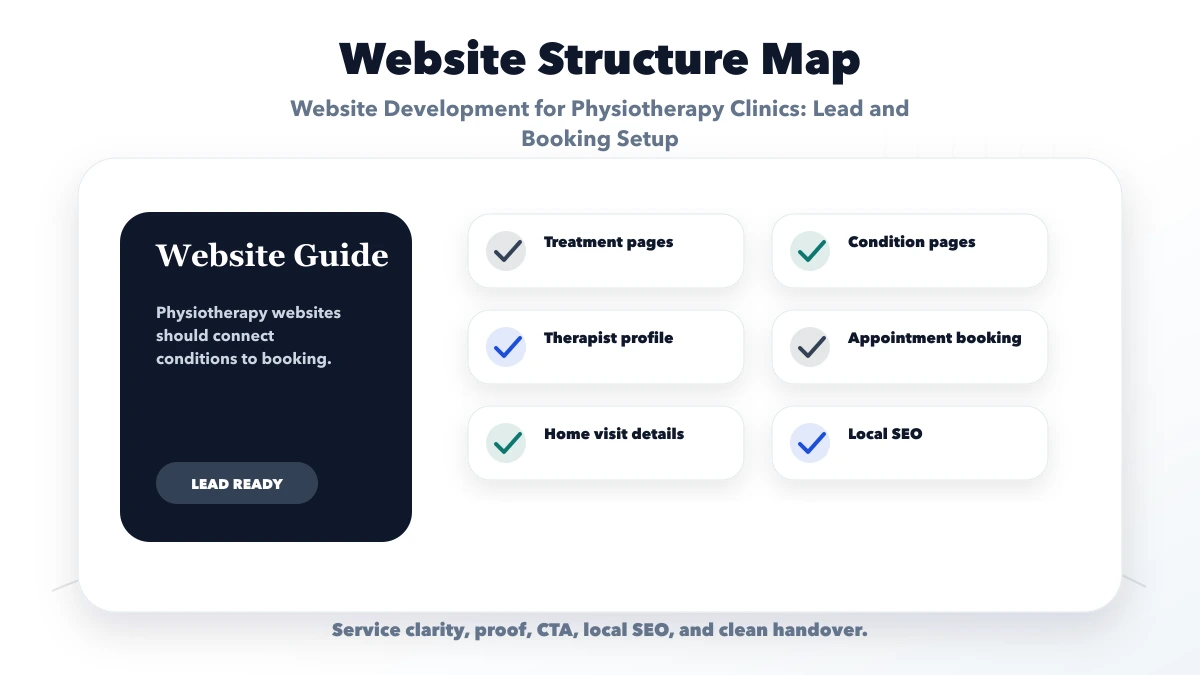
A therapist profile should contain information the clinic can support: full name, qualification, relevant registration or professional membership where applicable, treatment interests, languages, clinic availability, and a current professional photograph used with permission.
Avoid invented awards, vague claims such as "No. 1 physiotherapist," stock-photo team members, or patient outcome percentages without evidence. If a qualification is abbreviated, write its full form at least once. If a therapist works only on particular days or at one branch, state that clearly.
Real trust is built through consistency. The name on the profile, appointment confirmation, clinic signage, local listing, and follow-up communication should match.
One of the most common booking mistakes is showing a calendar slot as confirmed when the clinic has not checked therapist availability. A safer launch flow is:
The form and confirmation screen should use the words appointment request until a person or connected scheduling system confirms the slot. If the clinic later adopts real-time scheduling, the website can connect to a custom web application or an approved booking platform.
The initial form should not ask for a full medical history. Collect only what is necessary for routing the enquiry. Detailed clinical information belongs in the clinic's controlled intake process, not a general marketing form.
"Home physiotherapy available" is incomplete information. A usable page should explain:
Do not create city pages for places the clinic does not genuinely serve. A short, accurate service-area page is more useful than many near-duplicate location pages.
On mobile, the call button should be visible without searching through the footer. WhatsApp can be useful for requesting a callback, sharing a location, or asking about availability. It should not be presented as a secure clinical record system unless the clinic has an approved workflow for that purpose.
Use a short form for visitors who cannot call. A practical form may include:
Track call_click, whatsapp_click, appointment_start, and successful appointment-request submission separately. This shows which channel creates useful enquiries rather than counting every button click as a confirmed patient.
VASUYASHII can plan these flows through its integration and automation services, while the clinic remains responsible for consent, staff access, and patient-data policies.
Local visibility depends on accurate business information, not repeated city names. Keep the clinic name, address, phone number, timings, map pin, and service details consistent across the website and the clinic's verified profiles.
Each genuine branch page should include:
Use local structured data only for real locations. Reviews should be genuine and shown according to the source platform's rules. Never write fabricated patient testimonials for SEO.
Many visitors will reach the site on mobile data while travelling or dealing with discomfort. Large sliders, auto-playing videos, multiple chat widgets, and heavy animation can delay the information they need.
Prioritise:
The mobile page should make sense even if an animation does not load. A practical website development service should treat performance and accessibility as part of delivery, not optional polish.
Consider a fictional physiotherapy clinic in Noida with two therapists and a limited home-visit radius. Its existing one-page site receives calls, but staff repeatedly answer the same questions about sports rehabilitation, evening appointments, and home visits.
A better first phase would create:
The success measure is not "more traffic" alone. It is fewer unqualified enquiries, faster response, fewer missed requests, and more confirmed appointments from the right service area. This is an illustrative planning example, not a claimed VASUYASHII client result.
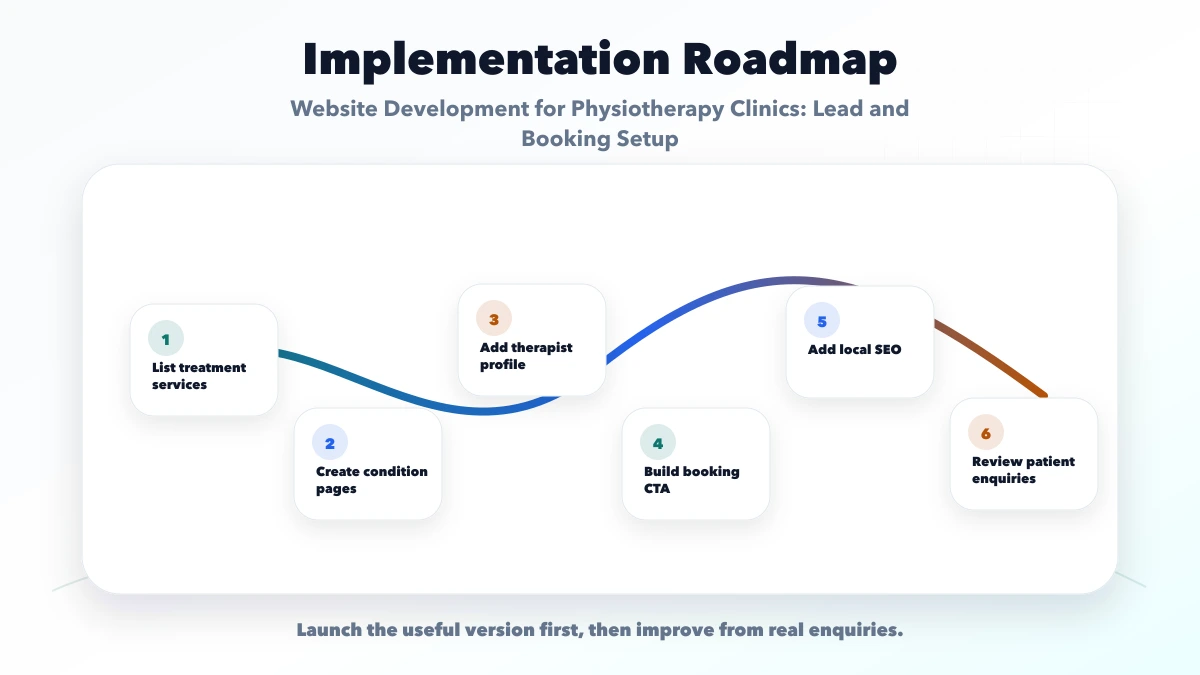
List services, therapists, locations, hours, booking rules, home-visit areas, approved claims, privacy requirements, and the staff member responsible for updates. Gather proof only from authorised sources.
Map the shortest path for clinic appointment, home visit, therapist comparison, and contact. Confirm which action is a request and which is a final booking.
Develop responsive pages, forms, analytics events, notification routing, maps, and any approved scheduling integration. Add spam protection without making the form difficult to complete.
Ask the clinic to verify every credential, treatment statement, branch detail, price reference, disclaimer, and booking message. Test with staff who will actually receive the enquiries.
Monitor enquiry source, response time, invalid submissions, missed calls, booking confirmation rate, and the questions visitors still ask. Improve the page that causes confusion instead of publishing unrelated content.
A focused informational clinic website costs less than a system with multiple branches, therapist calendars, payments, reminders, patient accounts, or an existing practice-management integration. The main effort drivers are:
Request a written scope that separates the marketing website from booking software and clinical systems. Our services page shows how VASUYASHII presents practical digital work, and the contact page is the right place to request a scope based on the clinic's real workflow.
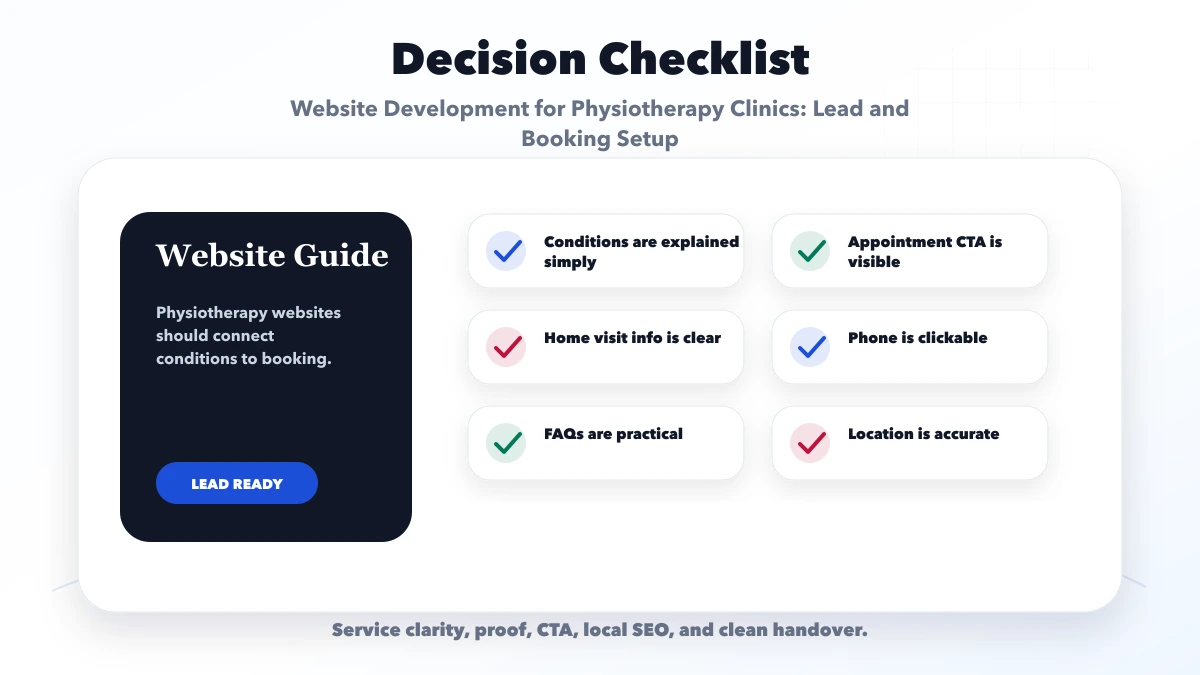
For the internal side of practitioner availability, service duration, patient identity, check-in, queues, reminders, and role controls, use the clinic appointment system guide.
No. Create a separate page when the treatment has distinct patient intent and enough approved information to be useful. Closely related services can be grouped to avoid thin, repetitive pages.
WhatsApp can start an enquiry, but the clinic should define how staff confirm identity, availability, consent, and the final appointment. Avoid requesting detailed health records in an uncontrolled chat flow.
Yes, if the slots come from a reliable scheduling source. Otherwise, show preferred time windows and clearly label the submission as a request pending confirmation.
Collect contact details, broad locality, preferred time, and practical access information needed to evaluate the request. Collect detailed clinical information later through the clinic's approved intake process.
Track qualified appointment requests, response time, confirmed appointments, service-area fit, missed calls, and source. Traffic and button clicks alone do not show whether the website improves clinic operations.
Yes. VASUYASHII can scope a lead-focused website, appointment-request flow, notifications, and suitable integrations. Clinical decisions, patient-record compliance, and final operational approval remain with the clinic.
The current VASUYASHII contact implementation preserves service context, validates required fields and records a GA4 lead only after the backend confirms a saved enquiry with a new lead ID. A clinic appointment request should follow the same reliable pattern while keeping clinical intake separate.
This screenshot demonstrates an appointment-oriented interface only. It is not a clinical system certification or evidence of a live physiotherapy patient's outcome.
| Appointment stage | Website record | Clinic responsibility |
|---|---|---|
| request | contact, service, preferred slot, broad locality | check service and capacity |
| confirmation | accepted time and responsible staff member | contact patient and confirm |
| intake | approved health/history fields in controlled process | consent and clinical governance |
| attendance | attended, rescheduled or missed | operational follow-up |
| outcome measurement | qualified request and confirmed appointment | do not treat clicks as patients |
Decision example: a single physiotherapy clinic can launch with appointment requests and staff confirmation. Live calendar booking is justified only when therapist schedules and rescheduling rules are maintained reliably. A patient portal with records, documents and treatment plans is a separate authenticated application.
Limitations: the website must not diagnose, promise treatment outcomes or replace clinical judgement. VASUYASHII does not claim a named clinic result in this article. Medical-data collection, consent, retention, access, payment and telehealth obligations require the clinic's legal and professional review.
Use the official Digital Personal Data Protection Act, 2023 as one source for data-governance discussion and WCAG for accessible forms and content. Google documents confirmed lead measurement in the GA4 event reference.
Build the first version around accurate services, real therapist trust, a clearly labelled appointment request, fast mobile contact, and a dependable staff follow-up process. Add real-time calendars or patient portals only when the clinic has the operations and data controls to support them.
For a focused implementation plan, review web application services, software development services, integrations, and VASUYASHII services, or contact VASUYASHII.
Related Articles
June 7, 2026
Plan a dental clinic website with treatment pages, verified dentist profiles, appointment requests, local SEO, privacy controls, cost and launch checks.
Read article
May 15, 2026
Plan a clinic website with doctor and treatment pages, appointment requests, patient trust, local SEO, privacy safeguards, costs, and launch checks.
Read article
June 8, 2026
Plan a salon website with services, price guidance, portfolios, appointment rules, local trust, WhatsApp qualification, reminders, analytics, and mobile QA.
Read article
June 8, 2026
Plan a gym website with membership context, accurate class schedules, trial-booking requests, trainer trust, branch SEO, health-data privacy, and lead tracking.
Read article