
June 7, 2026
Physiotherapy Clinic Website: Booking and Leads
Plan a physiotherapy clinic website with treatment pages, therapist trust, safe appointment requests, home-visit details, local SEO, and lead tracking.
Read articlePublished Updated
Plan a dental clinic website with treatment pages, verified dentist profiles, appointment requests, local SEO, privacy controls, cost and launch checks.
Website development for dental clinics should make three patient decisions easier: which treatment may be relevant, why the clinic appears trustworthy, and how to request an appointment. A useful clinic website is not a medical diagnosis tool. It is a clear, mobile-friendly information and enquiry system that keeps treatment claims, dentist credentials, patient privacy, and appointment follow-up under the clinic's control.
This guide is for independent dentists, multi-chair clinics, specialist practices, and small dental groups in India. It explains the pages, booking flow, evidence rules, local SEO setup, cost drivers, and launch checks that matter before design polish.
By Tushar C. (Founder, VASUYASHII). Reviewed by VASUYASHII Editorial for website planning, lead flow, technical SEO, privacy-aware forms, and small-business delivery. Clinical claims, treatment descriptions, credentials, and patient communication must be reviewed by the clinic's qualified dental professional before publication.
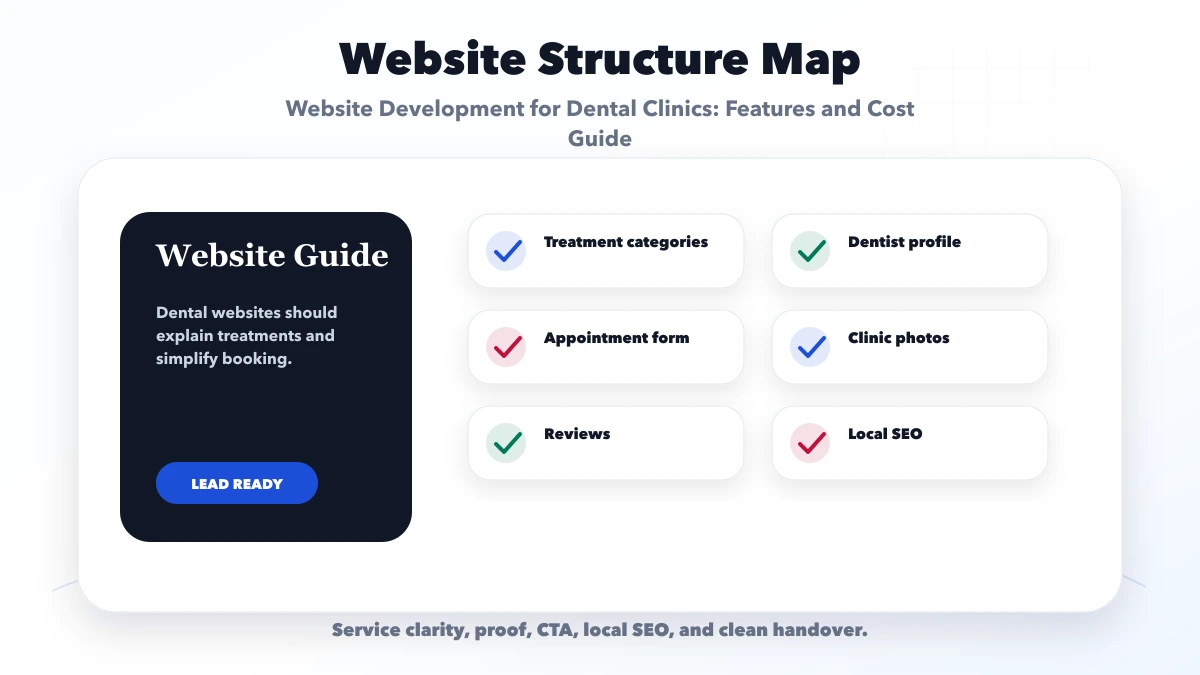
A practical dental clinic website normally needs a homepage, dentist profiles, individual treatment pages, clinic and equipment photos, location and timings, an appointment-request flow, FAQs, contact options, privacy information, and local search foundations. Add online payment or a patient portal only when the clinic has a defined operational need and someone responsible for handling it.
The safest launch is often a request system rather than instant appointment confirmation. The patient submits a preferred date, time window, treatment interest, and contact number. Clinic staff then confirm availability. This prevents the website from promising a slot that the reception desk has already assigned.
Consider a two-dentist clinic offering general dentistry, root canal treatment, implants, braces, and emergency consultations. Its current enquiries arrive through calls and WhatsApp. Patients repeatedly ask the same questions: Is the dentist available today? What does the treatment involve? Is an X-ray required? What is the expected cost range? Where is parking available?
The website should not answer personal medical questions without an examination. It should instead:
That scope is more valuable than adding a complex portal that nobody maintains.
| Page | Essential content | Patient decision supported |
|---|---|---|
| Homepage | Main treatments, clinic location, timings, dentist summary, primary CTA | Is this clinic relevant and accessible? |
| Dentist profile | Verified qualifications, registration details where appropriate, experience areas, languages | Who may handle my consultation? |
| Treatment page | What the treatment addresses, typical process, limitations, aftercare context, consultation CTA | Should I request an assessment? |
| Clinic page | Real photos, facilities, accessibility, hygiene process described accurately | What will the visit environment be like? |
| Appointment page | Preferred date, time window, treatment interest, consent, confirmation expectation | How do I request a visit? |
| Location page | Exact address, map, landmarks, parking or metro guidance, hours | Can I reach the clinic easily? |
| FAQ page | Questions actually asked by patients, reviewed by the clinic | What should I know before contacting? |
| Contact and privacy | Phone, WhatsApp, email, data-use notice | How will my details be handled? |
Create separate treatment pages only for services the clinic genuinely provides. Do not publish dozens of city-treatment combinations with nearly identical copy. One strong treatment page plus accurate location signals is safer than a large set of weak doorway pages.
Dental content affects health decisions, so the clinic should own the final review. A developer can structure pages and improve readability, but should not invent diagnosis, success rates, recovery timelines, credentials, or patient outcomes.
Each treatment page should clearly separate:
Before-and-after images need documented patient permission and accurate context. Avoid filters, misleading crops, guaranteed-result language, or anonymous photos copied from the internet. If approval records are not available, use clinic facilities, equipment, team, or process visuals instead.
A booking flow should match reception operations. Define these states before development:
| State | Website or staff action | Owner |
|---|---|---|
| Request received | Show confirmation and expected response time | Website |
| Availability check | Compare preferred window with clinic schedule | Reception |
| Appointment proposed | Send confirmed date and instructions | Reception |
| Patient confirmed | Mark the appointment accepted | Reception or booking system |
| Rescheduled or cancelled | Record the change and notify the patient | Reception |
| No response | Follow the clinic's approved follow-up rule | Reception |
Keep the form short. Name, phone number, preferred time window, treatment interest, and optional message are usually enough for an initial request. Do not ask patients to upload sensitive medical documents through a standard contact form. If document exchange is required, use a secure, access-controlled workflow designed for that purpose.
For a clinic that needs staff dashboards, schedule rules, reminders, or patient status tracking, evaluate a focused web application rather than forcing those workflows into a brochure website.
Useful trust comes from facts the visitor can check:
Do not use invented awards, unverified associations, stock photos presented as the clinic, or review counters that cannot be traced to real feedback. Trust content should be easy for the clinic to update when a dentist, timing, phone number, or treatment changes.
For a local dental clinic, consistency matters more than repeating the city name in every paragraph. The website, Google Business Profile, directory listings, and contact pages should use the same clinic name, address, and phone number. The site should also provide:
Track calls, appointment submissions, WhatsApp clicks, and map clicks as separate actions. A page with traffic but no appointment action may need clearer treatment content or a better CTA, not more keywords.
Cost depends on scope, content readiness, booking logic, integrations, and ongoing ownership. The following are planning bands, not a fixed VASUYASHII quotation:
| Scope | Typical contents | Planning complexity |
|---|---|---|
| Focused clinic website | 5-8 pages, core treatments, profiles, contact and map | Low to medium |
| Lead-focused treatment website | Individual treatment pages, local SEO, request flow, analytics | Medium |
| Clinic operations web app | Staff login, schedule rules, status tracking, reminders, reporting | High |
A focused website may take roughly three to six weeks after approved content and photos are available. A custom appointment or operations system needs discovery, workflow mapping, testing, staff training, and a longer rollout. The main cost drivers are usually the number of treatment pages, copy and clinical review effort, photography, booking complexity, multilingual content, integrations, and maintenance expectations.
Do not select a proposal only by page count. Ask who prepares content, who verifies clinical claims, who owns the domain and analytics, what counts as appointment confirmation, and what support is included after launch.
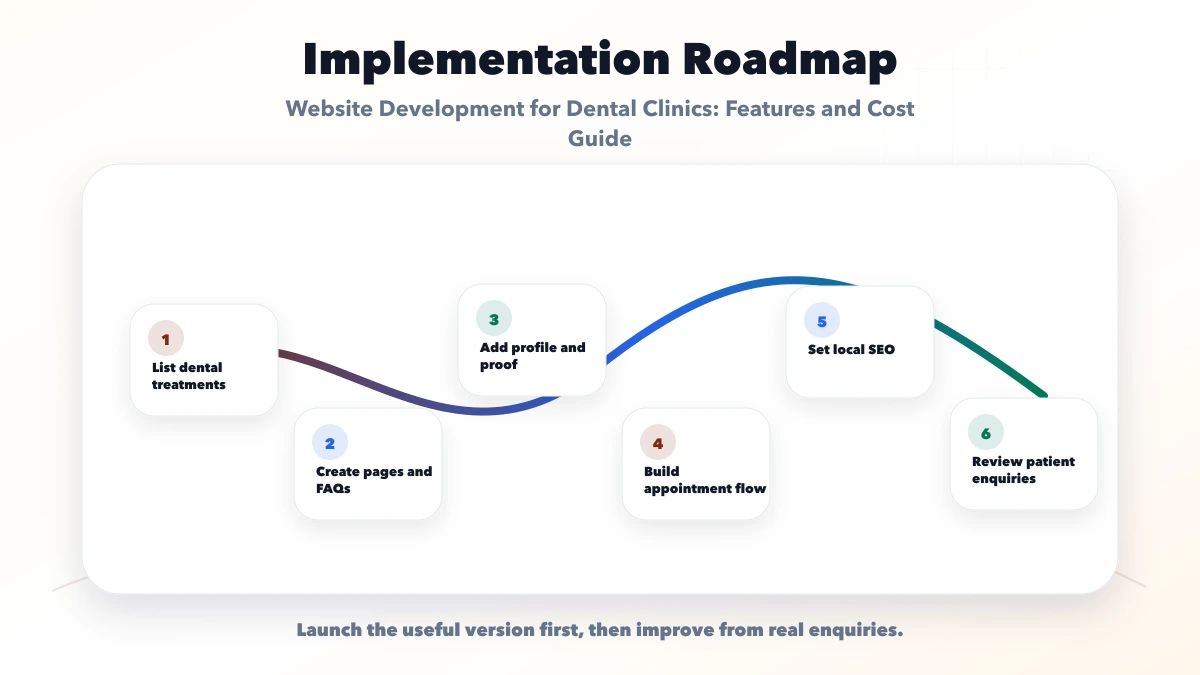
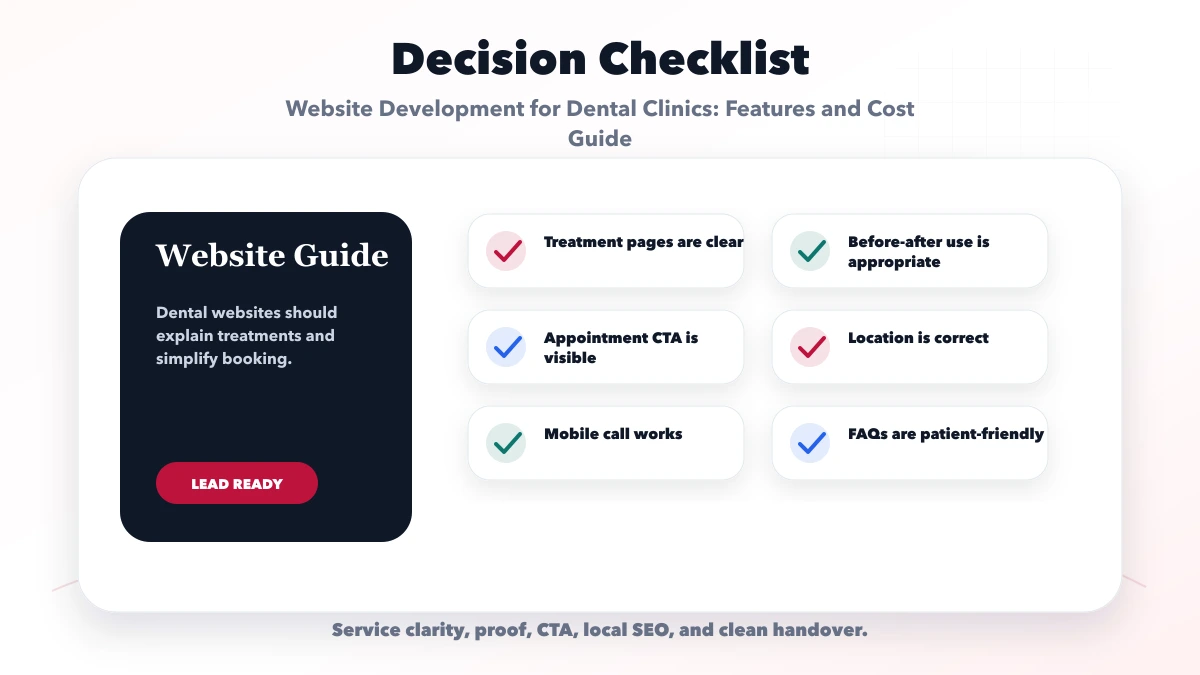
Current VASUYASHII service scoping begins with treatment scope, clinic ownership, appointment states, content review, and measurable enquiry actions. The first release would stay focused: accurate service pages, verified profiles, original proof, mobile contact, local SEO foundations, and a tested handover. Advanced reminders, dashboards, or integrations would be scoped separately after the clinic confirms the real workflow.
Relevant capabilities include website and web application development, custom software development, integrations and automation, and ongoing business website maintenance. Review current service options on the services page or discuss the clinic workflow through contact.
Dental pages still share core requirements with other practices. Review the clinic website features, booking and cost guide for doctor evidence, treatment-content ownership, appointment confirmation, branch consistency, privacy safeguards, and maintenance.
A focused site can launch with a homepage, dentist profile, core treatment pages, clinic and location information, appointment request, contact options, FAQs, and privacy information. The exact page count should follow real services and patient questions.
Show a fixed price only when the clinic can honour it under clearly stated conditions. Otherwise explain cost factors or an indicative range approved by the clinic, and state that the final treatment plan follows consultation.
No. An appointment-request form is often safer for a small clinic because staff can check chair, dentist, and procedure availability before confirming. Instant booking makes sense only when the scheduling system and reception process stay synchronized.
A normal contact form should not collect or expose sensitive records. If the clinic needs document exchange, it should use an authenticated, access-controlled system with defined retention and staff permissions.
Use only original media with documented patient consent, honest context, and no guarantee that another patient will receive the same result. The clinic should approve both the image and accompanying explanation.
Yes. Each real branch can have accurate address, timings, contact route, team, and service availability. Avoid creating branch pages for locations where the clinic does not operate.
Measure appointment submissions, calls, WhatsApp clicks, map actions, treatment-page engagement, response time, confirmed appointments, and invalid enquiries. Do not send patient-sensitive message content into analytics.
Write down the clinic's treatments, dentists, location, appointment process, and content owner before requesting a quotation. VASUYASHII can then recommend whether the requirement is a focused website, a lead-focused treatment site, or a custom appointment workflow.
Related Articles
June 7, 2026
Plan a physiotherapy clinic website with treatment pages, therapist trust, safe appointment requests, home-visit details, local SEO, and lead tracking.
Read article
May 15, 2026
Plan a clinic website with doctor and treatment pages, appointment requests, patient trust, local SEO, privacy safeguards, costs, and launch checks.
Read article
June 7, 2026
Plan a doctor website with clear profiles, services, appointment requests, patient-safe content, local discovery, privacy controls, and measurable enquiries.
Read article
June 7, 2026
Plan a pathology lab website with an accurate test catalog, home collection requests, secure report access, local SEO, privacy, and booking QA.
Read article