
June 8, 2026
Export Business Website: Catalog and RFQ Flow
Plan an export business website with controlled product specifications, MOQ and packaging details, credible trade proof, and a qualified international RFQ flow.
Read articlePublished Updated
Plan a manufacturer website with product data, capability proof, certificates, RFQ forms, catalog ownership, buyer journeys, lead routing, and B2B SEO.
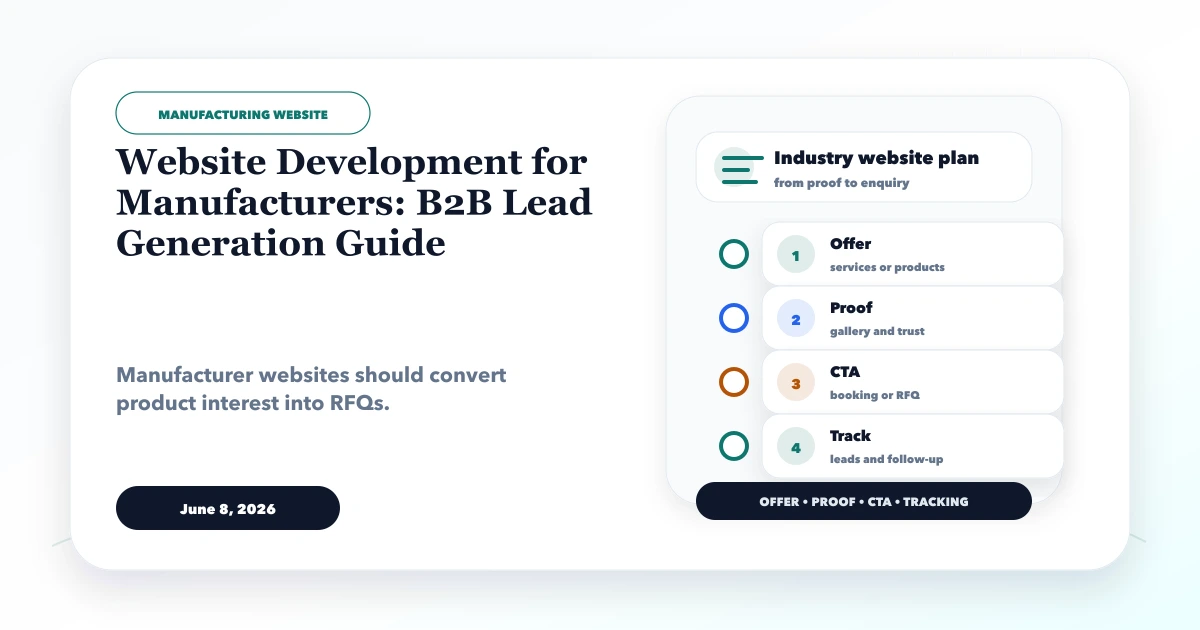
Website development for manufacturers should help procurement, engineering, quality, distributor or export buyers verify product fit and send a useful RFQ. That requires structured product data, approved capability proof, current certificates, clear document ownership and an enquiry route that preserves product context.
This guide covers the website structure, product-information model, RFQ fields, catalog strategy, lead routing, handover and acceptance checks needed for a credible B2B manufacturing website.
By Tushar C. (Founder, VASUYASHII). Reviewed by VASUYASHII Editorial for practical website planning, lead generation, product/service pages, WhatsApp flow, RFQ forms, local SEO, and business website delivery.
A manufacturer website should include product categories, capability pages, industry applications, certifications, plant or process proof, RFQ form, downloadable catalog, WhatsApp or email enquiry, and SEO pages.
A B2B buyer may compare capacity, materials, quality, certifications, MOQ, delivery area, and response speed before sending an enquiry.
The practical target is a website that reduces repeated questions and captures better enquiries through form, call, WhatsApp, or RFQ.
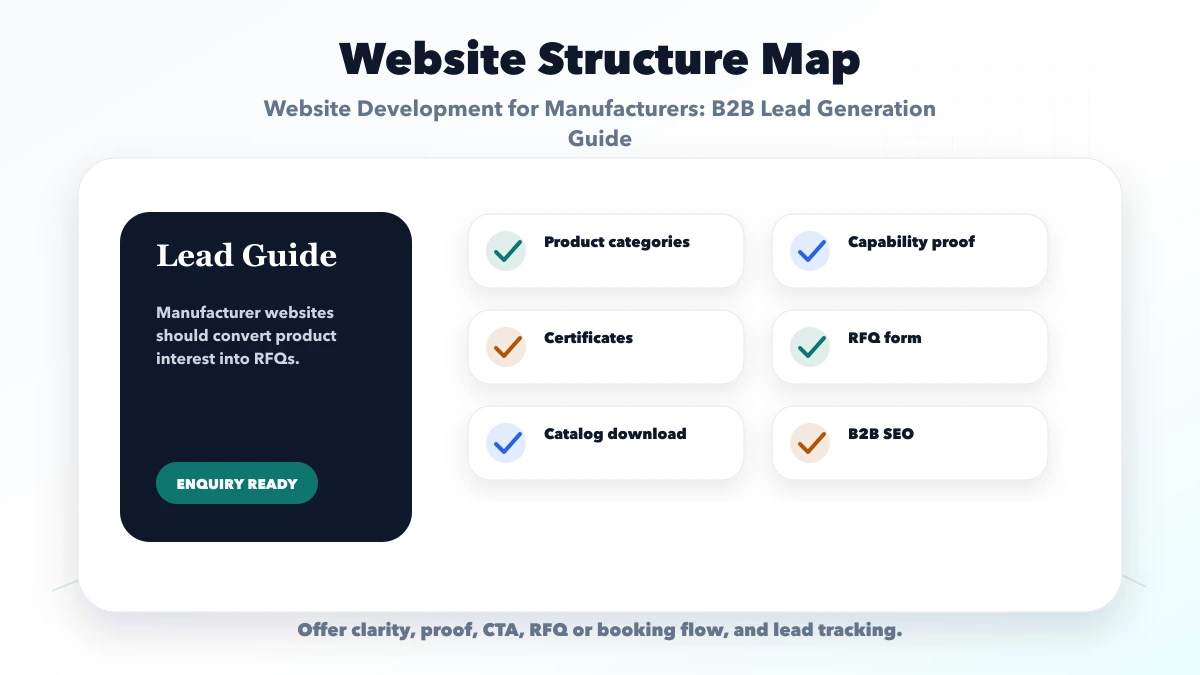
| Website area | What to include | Why it matters |
|---|---|---|
| Product layer | Categories, specs, applications | Matches buyer research |
| Trust layer | Plant, process, certificates | Builds confidence |
| RFQ layer | Form, catalog, sales contact | Captures B2B leads |
The right structure depends on the business model. A gym, salon, travel agency, photographer, manufacturer, exporter, and packaging company should not all use the same page plan.
A manufacturing website can serve several decision-makers:
Build page paths for the buyers the company actually serves. Do not create generic “industries” pages with only a changed heading. Each path should answer a different evaluation question and lead to the relevant product, capability, document, or RFQ.
Product pages should use a consistent set of approved fields. Depending on the category, this may include material, dimensions, tolerance, finish, variants, standards, applications, MOQ, packaging, lead-time range, downloadable drawing, and enquiry code. Only publish technical values that an authorised product owner has verified.
Group products by how buyers search and compare, not by an internal stock code alone. Use filters only when the range is large enough to justify them. A clear category page with six well-documented products is stronger than hundreds of nearly empty auto-generated URLs.
Useful proof can include original factory photographs, machinery with accurate capability notes, process stages, quality-control workflow, team expertise, dispatch coverage, approved certifications, and anonymised project examples. Every certificate should show the correct entity, scope, and validity where appropriate.
Avoid invented customer logos, stock photographs presented as a plant, unsupported capacity numbers, and certifications that belong to a supplier rather than the company. If evidence is confidential, explain the process and offer the document after a qualified enquiry instead of making an unverifiable claim.
| Field | Why it helps sales | UX rule |
|---|---|---|
| Product or drawing reference | Routes the requirement correctly | Allow text plus optional file |
| Quantity and frequency | Distinguishes sample, batch, and recurring demand | Accept an estimate |
| Material/specification | Identifies technical fit | Do not force unknown fields |
| Delivery location | Supports logistics and serviceability review | City/state is often enough initially |
| Required date | Reveals urgency | Label it as expected, not guaranteed |
| Company and contact | Enables B2B qualification | Explain how data will be used |
| Notes | Captures special process or compliance needs | Keep a reasonable character limit |
After submission, show a clear confirmation, send the lead to the responsible sales owner, and record the source page. File uploads need size/type controls, malware handling, private storage, and restricted access. Do not send confidential drawings through a public URL.
A PDF catalog can help buyers share information internally, but it should not replace crawlable product and capability pages. Give important products a stable web page, then offer versioned PDFs for detailed tables, certifications, or drawings.
Record who owns each document and its review date. Remove or redirect outdated versions so searchers do not quote discontinued specifications.
Use a controlled hierarchy:
Link product pages to the processes that make them, applications they support, and the RFQ route. Keep titles and descriptions specific. Avoid publishing hundreds of location or application combinations with repeated content.
Track RFQ submission, phone, email, WhatsApp, catalog download, and important product-page journeys. Capture the landing page and product context in the lead record. Define response owners and service-level targets internally; do not promise a public response time unless operations can meet it.
Review qualified RFQs rather than form count alone. Spam, job applications, vendor pitches, and unsuitable quantities should be classified separately so marketing decisions use genuine buyer demand.
VASUYASHII can scope and build product catalogs, technical pages, RFQ workflows, integrations, analytics, and custom portals through its web application and integration services. A final proposal depends on approved products, content, data, integrations, and evidence. This page does not claim manufacturing capacity, certifications, customers, or lead results for a specific factory.
Assign one technical approver for specifications, one commercial approver for MOQ and lead-time wording, and one marketing owner for pages and enquiries. The development team should not guess product tolerances, standards, export markets, or certification status.
At handover, the business should receive page and form ownership, analytics access, redirect notes, document-version rules, image guidance, backup information, and a process for updating products. Train the team to edit approved fields without breaking URLs or removing technical context.
Review high-value pages quarterly and whenever a product, standard, machine, certificate, or contact process changes. Use Search Console queries and qualified RFQ notes to identify missing information. Do not publish new application pages solely because a keyword tool suggests them; require a genuine product fit and approved evidence.
Run the acceptance check with a salesperson and someone who did not help write the site. Give them a product requirement and ask them to find the matching specification, supporting capability, document, and RFQ route on mobile. Their questions expose internal terminology and missing context that the project team may no longer notice.
Use this roadmap to build one useful launch version first. After launch, improve pages based on enquiries, search data, sales questions, and customer feedback.
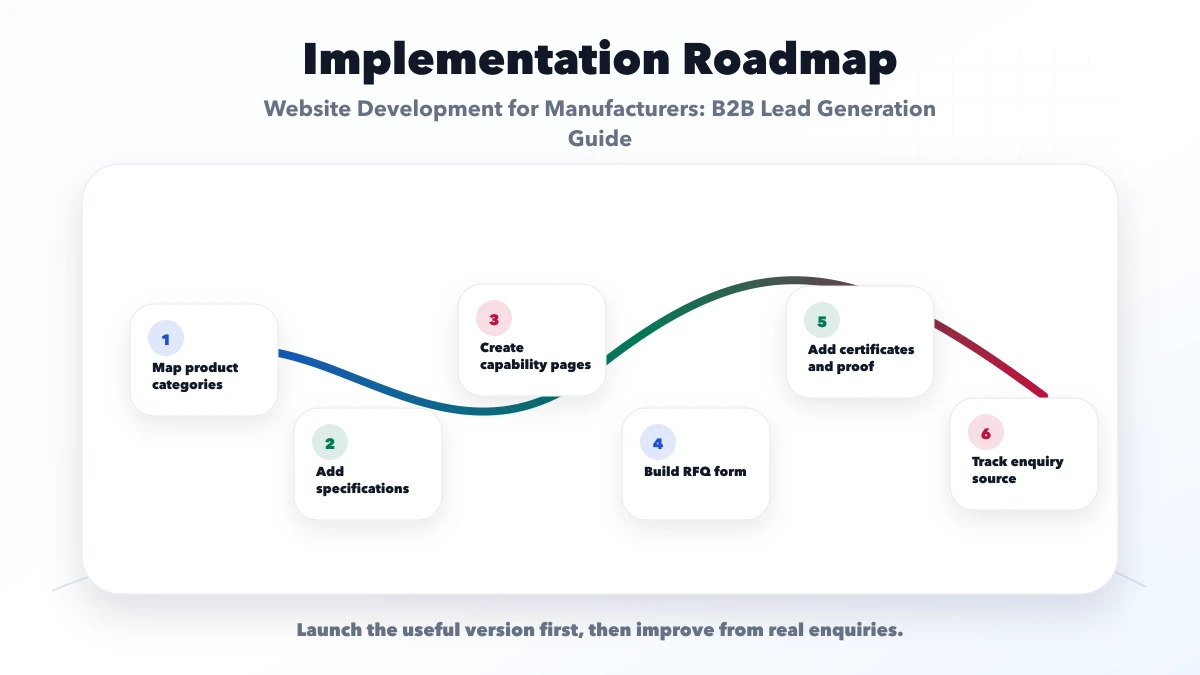
VASUYASHII would first map services or products, target users, pages, proof, CTA, WhatsApp or RFQ flow, SEO metadata, and handover needs. Then we would build the website in a focused phase instead of adding unnecessary complexity.
Useful links: web application services, software development, integrations, services, and contact.
Avoid judging a website only by design screenshots. Leads usually improve when service clarity, product detail, trust proof, CTA, tracking, and follow-up work together.
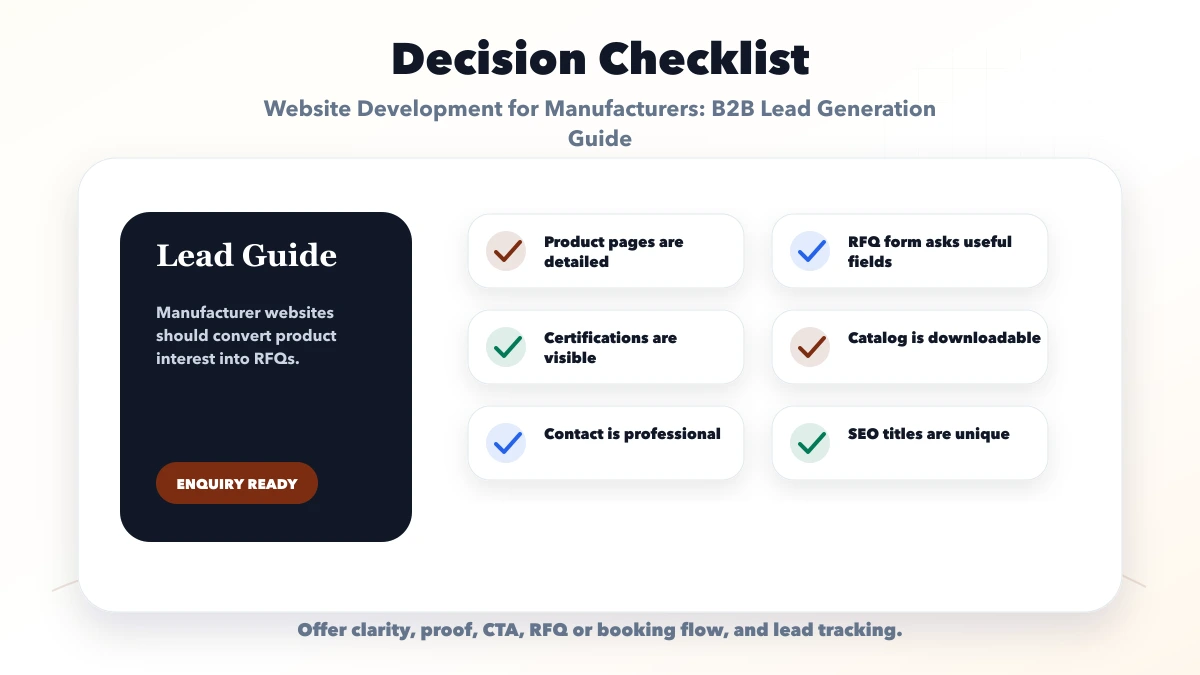
Include product pages, capability details, certificates, process proof, RFQ form, catalog, and contact details.
Yes. RFQ forms help collect quantity, specification, material, location, and buyer details.
Yes. Add downloadable catalogs and product pages so buyers can browse quickly.
Yes. Product, application, and industry pages can bring B2B search leads.
Yes. We can build B2B websites with product pages and RFQ systems.
Start with approved product families, buyer roles, technical fields, capability evidence, catalog ownership and RFQ routing. VASUYASHII can turn that information into a phased website or portal scope without inventing factory claims.
Related Articles
June 8, 2026
Plan an export business website with controlled product specifications, MOQ and packaging details, credible trade proof, and a qualified international RFQ flow.
Read article
June 8, 2026
Plan a packaging company website with material and print specifications, industry applications, MOQ context, proof, and a quote-ready RFQ form.
Read article
June 8, 2026
Website development for furniture manufacturers with product catalog, quote system, material details, project gallery, B2B leads, and checklist.
Read article
May 18, 2026
Diagnose whether ecommerce conversion needs better product photography, product-page UI, offer clarity, trust, performance, or checkout before investing.
Read article