
April 5, 2026
Sonipat Food Supplier Website Guide
Plan a Sonipat food-supplier website with product data, label and allergen governance, quality documents, bulk enquiries, distributor routes, and ownership.
Read articlePublished Updated
Plan a building material supplier website with a searchable catalog, contractor RFQs, dealer enquiries, WhatsApp context, local SEO, and lead tracking.
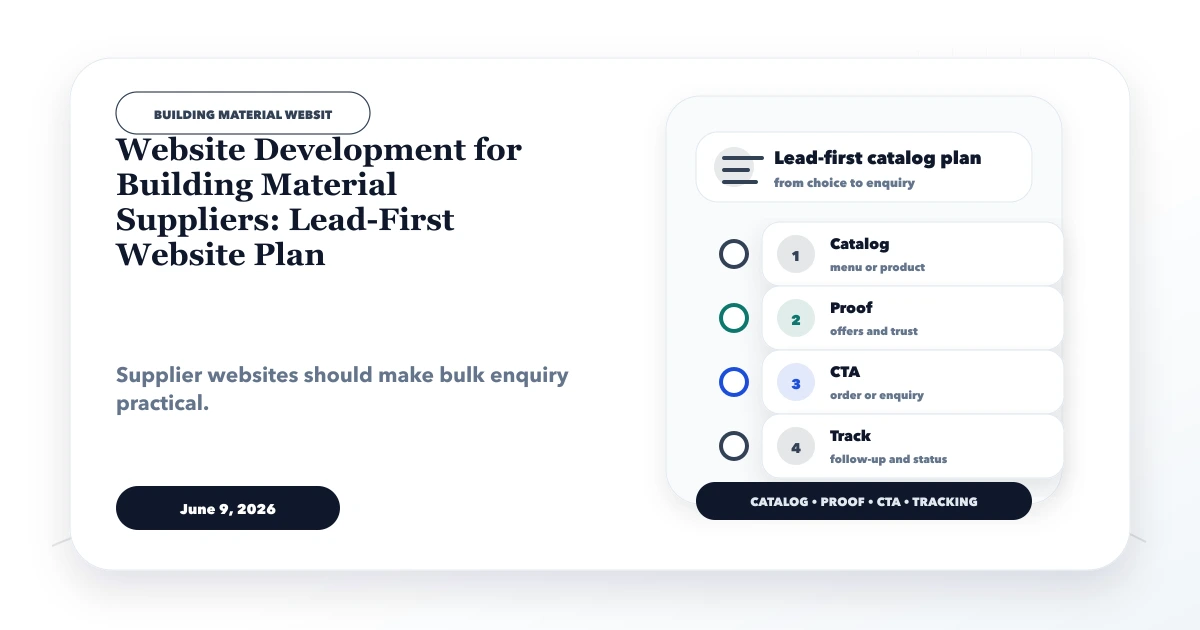
A building material supplier website should help a contractor, dealer, architect, or homeowner identify the right material and send a usable requirement. It should not behave like a decorative brochure or an online shop with prices that become outdated every week.
The practical goal is a shorter path from product discovery to a qualified RFQ. That requires a structured catalog, service-area clarity, specification fields, stock or availability language, and enquiry tracking. This guide explains how to plan that system for an Indian supplier without turning phase one into a large ecommerce project.
Start with a catalog-led website rather than a checkout-led store. Publish product categories, brands, applications, technical specifications, units, delivery areas, and project types. Give every category or product page a contextual RFQ and WhatsApp action that carries the product name into the enquiry.
The first release should prove that visitors can find a material and send enough information for the sales desk to prepare a quote. Real-time stock, dealer logins, negotiated prices, and online payments can follow only when the underlying product and pricing data is reliable.
Consider a Ghaziabad supplier selling cement, tile adhesive, waterproofing products, sanitaryware, pipes, and electrical material. One visitor is a contractor who needs 300 bags delivered over two weeks. Another is a homeowner comparing tile brands. A third is a dealer asking about territory, margin, and minimum order quantity.
All three visitors need different information. Sending everyone to one generic contact form creates incomplete leads such as “send price” or “call me.” A useful website identifies the visitor, product, quantity, destination, timeline, and preferred response channel before the sales team starts follow-up.
Use a hierarchy that reflects how customers search and how the sales team quotes:
A product record should have consistent fields instead of a free-form paragraph. Useful fields include SKU, brand, HSN when appropriate, unit, pack size, grade, dimensions, colour or finish, application, minimum order quantity, indicative availability, warranty, technical sheet, and related accessories.
Do not create hundreds of empty product pages only to increase URL count. Publish a page when it helps a buyer compare, select, or enquire. If a range has identical variants, use one strong page with a readable table.
Each product page should answer six buyer questions before displaying the primary action:
| Buyer question | Page element |
|---|---|
| Is this the right material? | Application, grade, dimensions, and compatibility |
| Can you supply my quantity? | MOQ and availability language |
| Where can you deliver? | Service area and delivery conditions |
| What information is needed for a quote? | Quantity, unit, location, and required date |
| Can I compare options? | Related ranges or specification table |
| How do I contact sales? | Product-aware RFQ and WhatsApp CTA |
Price display is optional. Show a fixed price only when it is operationally maintained and genuinely applies to most buyers. Otherwise use “request current trade price” and explain which factors affect the quote: quantity, brand, tax, freight, unloading, site location, and credit terms.
A good RFQ form is shorter than a tender document but more useful than a phone-number box. Capture:
The form should record the page and campaign that produced the lead. A thank-you state must show the next step and expected response channel. For repeatable follow-up, connect the form to a CRM or a focused lead dashboard through integration and automation services.
A floating WhatsApp button is useful for general questions, but it is not enough for a large catalog. The product CTA should prefill a message such as:
I need a quote for [product]. Quantity: [quantity/unit]. Delivery location: [PIN code]. Required by: [date].
Keep the message editable. Do not insert sensitive information into the URL. Record a whatsapp_click event with the product/category and page path so the business can compare WhatsApp enquiries with form submissions.
If the team later needs automated acknowledgement, lead routing, or quote reminders, scope it as a separate workflow. The website should not promise instant stock or pricing unless the inventory and rate source is connected.
One navigation structure can serve different buyers when the paths are explicit:
Prioritise BOQ upload, technical specifications, bulk quantity, delivery schedule, project location, credit-policy boundaries, and a named sales follow-up process.
Explain eligible territories, product range, expected business profile, onboarding documents, and how the company evaluates an enquiry. Avoid publishing guaranteed margins or rights that depend on approval.
Use application-led categories, simple comparisons, pack-size guidance, store or pickup details, and a quick WhatsApp path. The copy should help selection without pretending to replace technical advice.
Location visibility should come from genuine operating information, not dozens of swapped city-name pages. The core website can include:
Use the local SEO hub for web development companies as a broader framework for NAP consistency, local proof, and non-spam location content. A page should exist because the service differs or local evidence exists, not because a city keyword is available.
Suppliers often have useful evidence that never reaches the website. Collect it in a controlled content sheet:
Do not invent completed-project counts, customer logos, inventory levels, or “lowest price” claims. A smaller verified proof section is stronger than an impressive but unsubstantiated one.
Current VASUYASHII service scope can deliver a structured catalogue, RFQ workflow, analytics, and integrations after discovery. Live stock, customer-specific pricing, dealer credit, and order promises remain separate modules until a reliable source system and acceptance rules are confirmed.
A focused first release usually includes:
Businesses with frequently changing products should consider a custom web application rather than editing every page manually. The important decision is not the framework name; it is who owns product data, how changes are reviewed, and how quickly the public catalog can be corrected.
There is no responsible fixed quote without knowing the catalog and workflow. Cost rises with the number of unique templates, product-data cleanup, filters, document uploads, integrations, role-based admin access, multilingual content, and custom quote logic.
The largest hidden task is usually data readiness. If 600 product rows have inconsistent names, missing units, and duplicate SKUs, development cannot make them trustworthy automatically. Plan a sample import first, approve the field structure, and only then migrate the complete catalog.
A simple catalog-and-RFQ site may be delivered in phases. A connected portal with live stock, customer-specific rates, orders, payments, and account statements is business software and needs discovery, security controls, and acceptance testing. Review custom software development services when that is the actual requirement.
Manufacturer specifications may be necessary, but a copied page does not explain your availability, delivery, customer type, or quote process. Add supplier-specific value and use technical documents lawfully.
Launch the categories and products that sales can support. Expand after the template and ownership process work.
WhatsApp is a contact channel, not a complete source-of-truth. Important lead fields and status should be available to the team in a shared system.
Freight, quantity breaks, tax, unloading, and credit terms make many material orders unsuitable for immediate checkout. Solve quotation accuracy before payment automation.
An enquiry from an unsupported area wastes time for both parties. State service areas and exceptions clearly.
Show prices only when they can be maintained and apply consistently. For trade or bulk orders, an RFQ with clear price factors is often more accurate.
No. A structured catalog and qualified RFQ flow can create value before checkout, payment, and live inventory are justified.
Yes. Use controlled file types and sizes, secure storage, a clear consent notice, and an internal owner for every uploaded request.
Start with categories and products that represent real demand and have complete data. There is no SEO benefit in publishing hundreds of thin or unavailable items.
Yes, if stable IDs and field ownership are planned from the start. Integration should follow a documented source of truth and failure-handling process.
Prepare the category list, sample product sheet, buyer types, service areas, RFQ fields, update owner, required integrations, and examples of current sales follow-up.
VASUYASHII can convert a product sheet and current enquiry process into a focused website scope. Review our website and web application services, see the broader services overview, or send the catalog and RFQ requirement for a practical phase-one plan.
Retail counters selling hardware and electrical categories can also use the hardware-shop website guide for public product fields, local evidence, availability language, and enquiry acceptance checks.
Related Articles
April 5, 2026
Plan a Sonipat food-supplier website with product data, label and allergen governance, quality documents, bulk enquiries, distributor routes, and ownership.
Read article
June 9, 2026
Build a wholesaler website with searchable catalogs, MOQ and price rules, dealer qualification, repeat-order flow, WhatsApp, and lead tracking.
Read article
June 8, 2026
Plan a garment manufacturer website with buyer categories, product specifications, MOQ context, qualified RFQs, verified export proof and catalog ownership.
Read article
March 23, 2026
Plan a Hapur supplier website with product categories, trade enquiries, dispatch coverage, quotation inputs, verified documents, tracking, and ownership.
Read article