
June 9, 2026
Electronics Shop Website: Catalog and Service Flow
Website development for electronics shops with catalog pages, service pages, warranty notes, WhatsApp enquiry, local SEO, and checklist.
Read articlePublished Updated
Website development for hardware shops with local SEO, product pages, WhatsApp enquiry, service area, category catalog, and checklist.
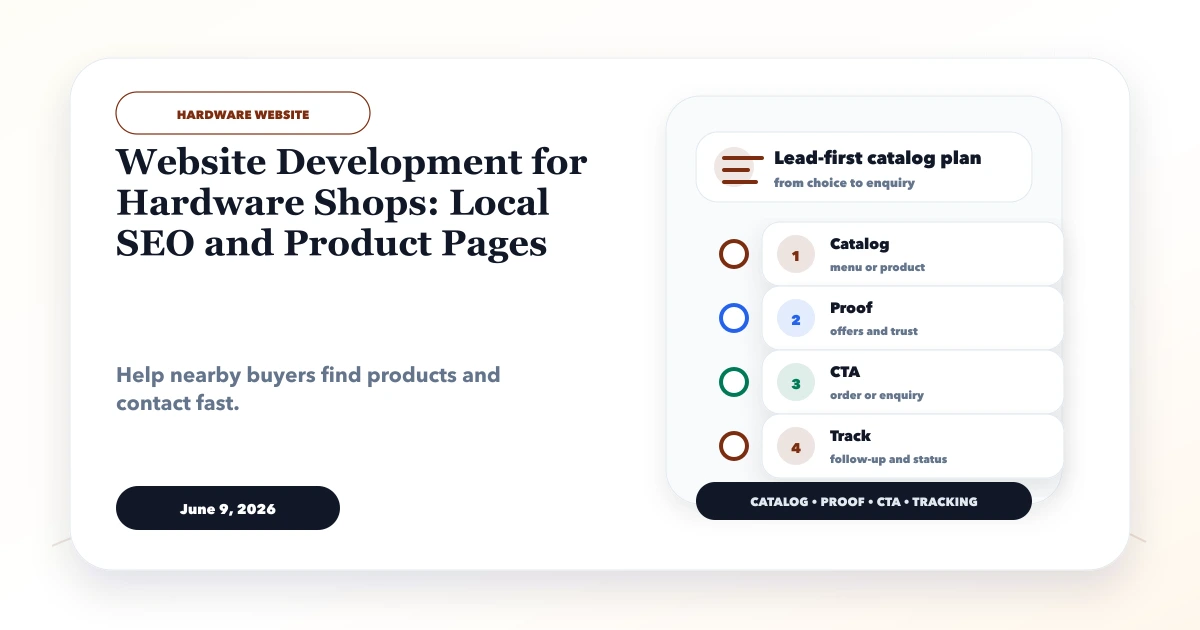
Website development for hardware shops should help a buyer confirm whether the shop handles the required category, brand, size, unit, quantity, and delivery area before calling or visiting. Hardware demand is often urgent and specification-heavy; a generic photo gallery does not answer those questions.
This guide is for local hardware stores, sanitary and plumbing dealers, tool suppliers, building-material shops, and mixed electrical-hardware businesses. It covers catalog structure, quotation enquiries, local SEO, store evidence, inventory boundaries, WhatsApp context, and content ownership.
By Tushar C. (Founder, VASUYASHII). Editorial review covers product taxonomy, units and variants, quote qualification, local business evidence, and practical catalog maintenance.
A hardware shop website should include product categories, local SEO details, store location, WhatsApp enquiry, call CTA, store timings, delivery or pickup notes, and high-demand product pages.
A contractor may send a list containing pipe diameters, fitting types, quantities, and brands. A homeowner may need one replacement part but not know its name. A workshop may ask for recurring tool or consumable supply. The website should support category discovery and let each buyer share a usable requirement.
The target is not real-time ecommerce unless stock, pricing, fulfilment, and returns are ready. A maintained category catalog plus a quote or availability request is often the safer first phase.
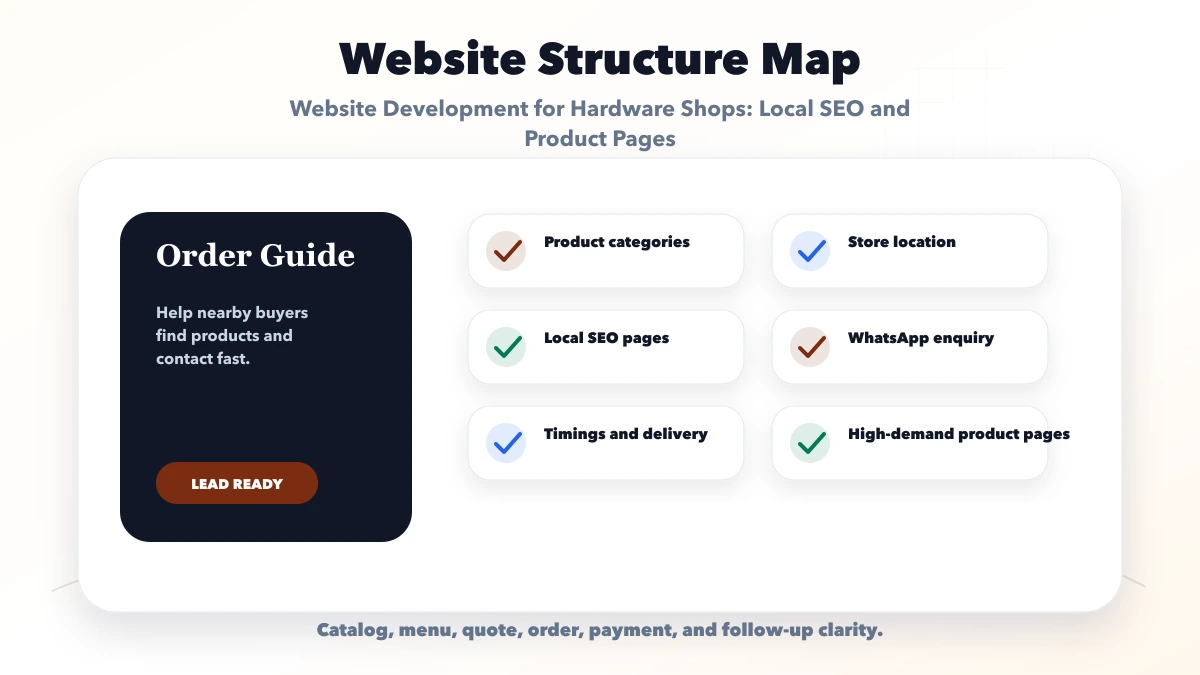
Connect every check to a local buying action. Category pages answer "do you stock this type?" Store information answers "can I visit now?" Delivery notes answer "can this reach my site?" Enquiry fields answer "what must I send for a quote?"
| Website area | What to include | Why it matters |
|---|---|---|
| Local layer | Area, address, timings | Helps nearby buyers |
| Product layer | Categories and product pages | Matches searches |
| Enquiry layer | WhatsApp, call, form | Captures demand |
A neighborhood retail store may organize by customer problem and top categories. A project supplier may organize by brand, specification, application, and RFQ. A hybrid business should clearly separate single-item availability from bulk quotation.
Launch the categories the team can maintain, then use internal search terms, WhatsApp questions, quote quality, and store-call reasons to improve detail. Do not upload a supplier spreadsheet without normalizing names, units, and variants.
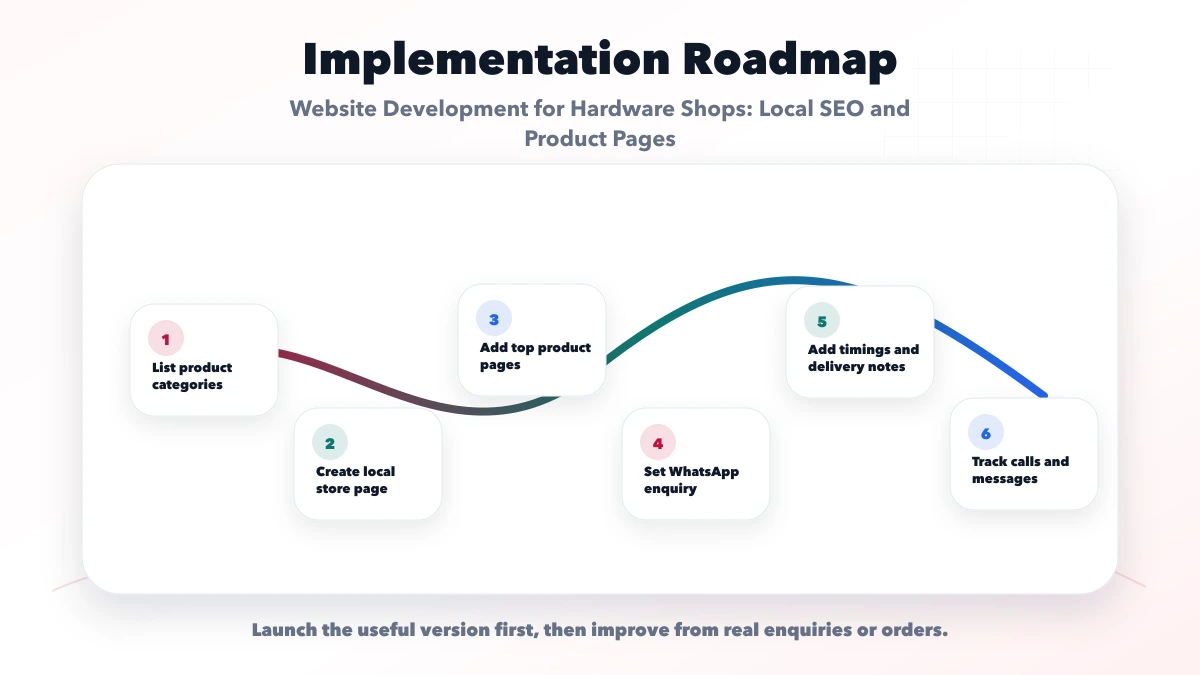
Test the site with a photographed replacement part, a five-line contractor list, and a bulk brand-specific request. Each path should reach the correct team with enough context for a useful response.
Build a controlled category tree before writing pages. A mixed shop might use plumbing, sanitary, hand tools, power tools, fasteners, adhesives, safety products, paints, electrical accessories, and building consumables. Subcategories should use terms customers and staff both understand.
Within a category, maintain fields such as brand, model or SKU, material, size, unit, pack quantity, application, compatible part, and availability method. Do not show purchase price, private dealer rates, or internal stock data on the public page unless the system has explicit access control.
Create product pages only where there is meaningful demand and useful detail. Similar washers or screws may belong in a range page with a size table. A high-demand power tool may justify its own page with specifications, included accessories, warranty route, and availability enquiry. This prevents hundreds of thin pages.
If frequent inventory changes, dealer price lists, or protected catalogs are required, compare a public site with a product catalog web app. The application scope should define who updates stock, which figures are public, and how stale data is handled.
A practical hardware enquiry can capture:
| Requirement | Useful input |
|---|---|
| Single replacement | Photo, approximate size, use, brand if known |
| Product availability | Category, model or size, quantity, pickup branch |
| Contractor list | Typed items or attachment, units, quantities, site city |
| Bulk procurement | Business name, GST need, brands, schedule, delivery PIN |
State whether the submission is an availability check or quote request. Final price may depend on quantity, brand, current supply, tax, freight, and credit terms. Do not label a WhatsApp conversation as a confirmed order without an agreed confirmation and payment process.
Prefill the source category or product in WhatsApp. For systematic assignment, acknowledgements, or CRM records, use integrations and automation and preserve the buyer's consent and non-sensitive context.
Use one accurate store or branch page with business name, address, phone, hours, map, landmarks, parking or loading context, supported categories, pickup process, and delivery coverage. Keep these details consistent with the Google Business Profile. Update special hours and closures promptly.
Original shopfront, aisle, team, delivery, and category photographs help a buyer verify that the business is real. Publish authorized dealership or brand claims only when current and verifiable. Reviews should be genuine and never tied to incentives that violate platform rules.
Avoid creating a page for every neighborhood unless the shop has distinct evidence, coverage, and content for it. The local SEO hub explains how to build service-area relevance without duplicate city pages.
The VASUYASHII Business Suite shows product records, SKU or barcode thinking, stock movement, purchases, invoices, payments, and company-scoped operations. This is relevant product context, not a claim that the product already provides a public hardware ecommerce storefront or every industry-specific catalog field.
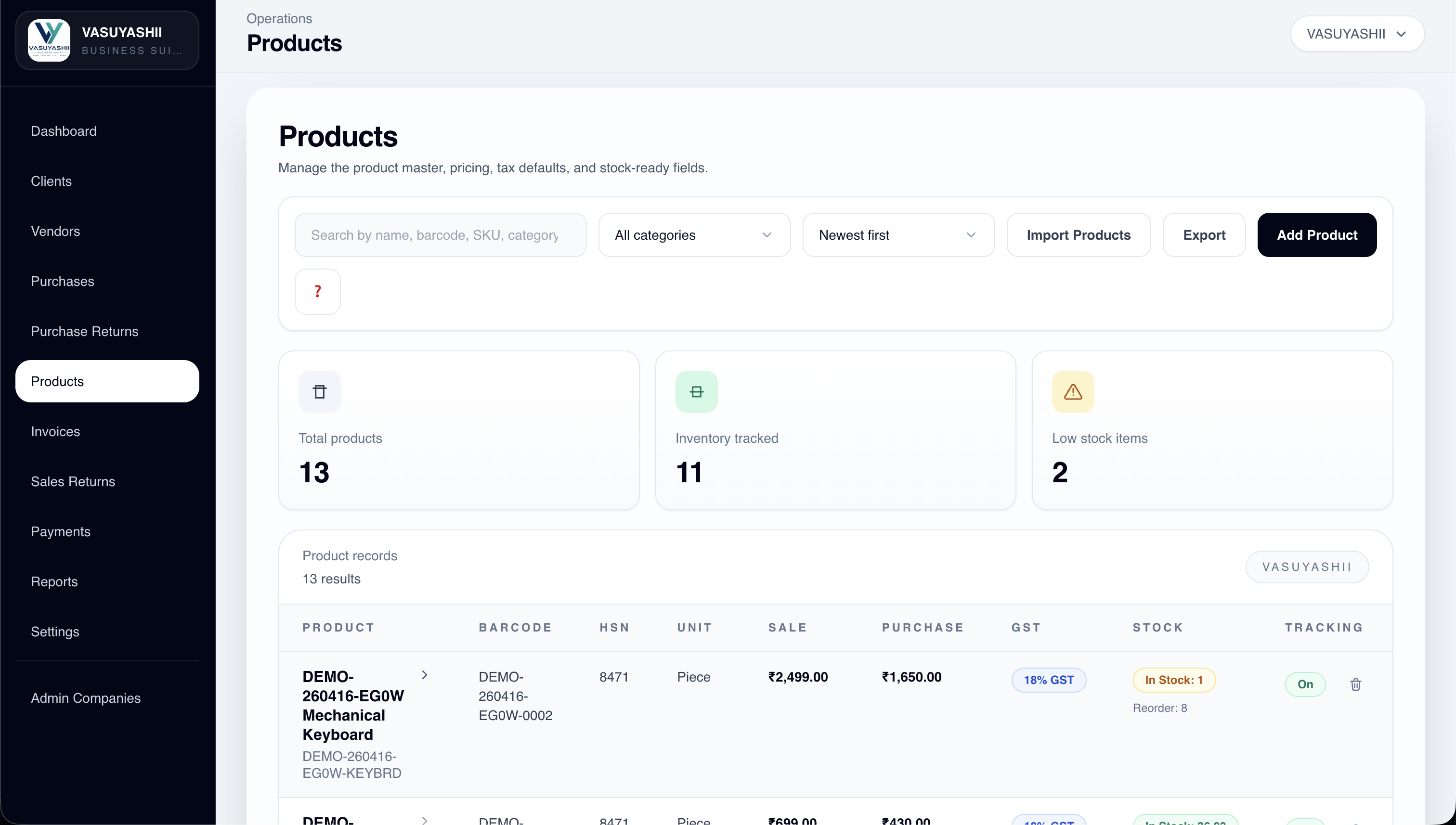
For a hardware business, VASUYASHII can separate the public discovery layer from internal billing and stock operations. A lead-first catalog belongs under website development services. Live stock, protected dealer rates, purchase history, or quotation workflows require custom software scope and acceptance tests.
| Public field | Example purpose | Maintenance owner |
|---|---|---|
| Product/category name | Match buyer terminology | Sales or catalogue owner |
| Brand and model | Distinguish compatible alternatives | Product owner |
| Unit or pack size | Prevent quote ambiguity | Store operations |
| Key specifications | Support selection | Technical sales |
| Availability language | Set honest expectation | Branch/store owner |
| Enquiry action | Capture quantity and delivery location | Sales team |
| Related products | Help compatible buying | Catalogue owner |
Do not expose internal purchase price, dealer pricing or exact live stock unless authentication, permissions and update reliability are in scope. Public “in stock” claims become risky when the website and store records are not synchronised.
Track category visits, internal searches, call clicks, direction clicks, WhatsApp clicks, availability requests, quote submissions, and source pages. Sales should mark whether the enquiry included a valid item, quantity, location, and buying timeline. That is more meaningful than raw click volume.
Assign an owner for hours, brands, category availability, offer expiry, delivery notes, and archived products. Review the catalog monthly with sales or counter staff because they know which names customers use and which questions indicate missing content.
VASUYASHII would map the real category tree, maintained fields, buyer types, branch details, quote path, and update owner before design. We would test a single-item availability request and a bulk list on mobile. Inspect services and contact VASUYASHII with a category list, current stock process, and service area.
A catalog is ready only when store staff can identify the item or ask the next precise question. Attractive cards without units, variants, or availability rules create more confusion.
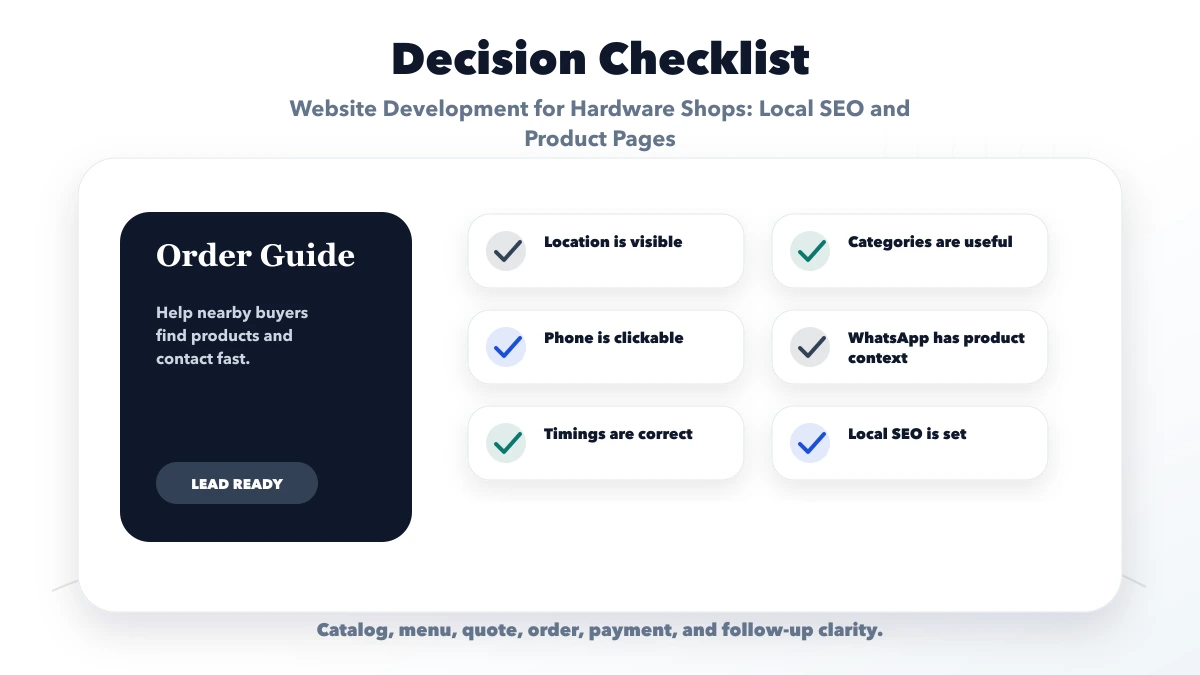
Include a maintained category tree, useful variant fields, real branch information, pickup and delivery rules, contextual call or WhatsApp actions, and quote-ready forms.
Not always. Catalog plus availability or quotation enquiry is often safer when prices and stock move frequently. Ecommerce requires dependable stock, tax, payment, fulfilment, cancellation, and return operations.
Start with categories that create repeat questions, local search demand, or meaningful revenue and that the team can maintain accurately.
Yes. Accurate branch data, genuine category content, consistent business details, and useful local evidence support calls, directions, and store visits.
Yes. VASUYASHII can build the public catalog and local enquiry route; connected stock, dealer pricing, and procurement workflows need separate application scope.
If you want a practical plan for website development for hardware shops, VASUYASHII can help with scope, design, development, SEO setup, lead flow, launch, and maintenance.
Related Articles
June 9, 2026
Website development for electronics shops with catalog pages, service pages, warranty notes, WhatsApp enquiry, local SEO, and checklist.
Read article
June 9, 2026
Plan a cafe website with an updateable menu, dated offers, table and event enquiries, genuine local proof, map accuracy, and measurable contact actions.
Read article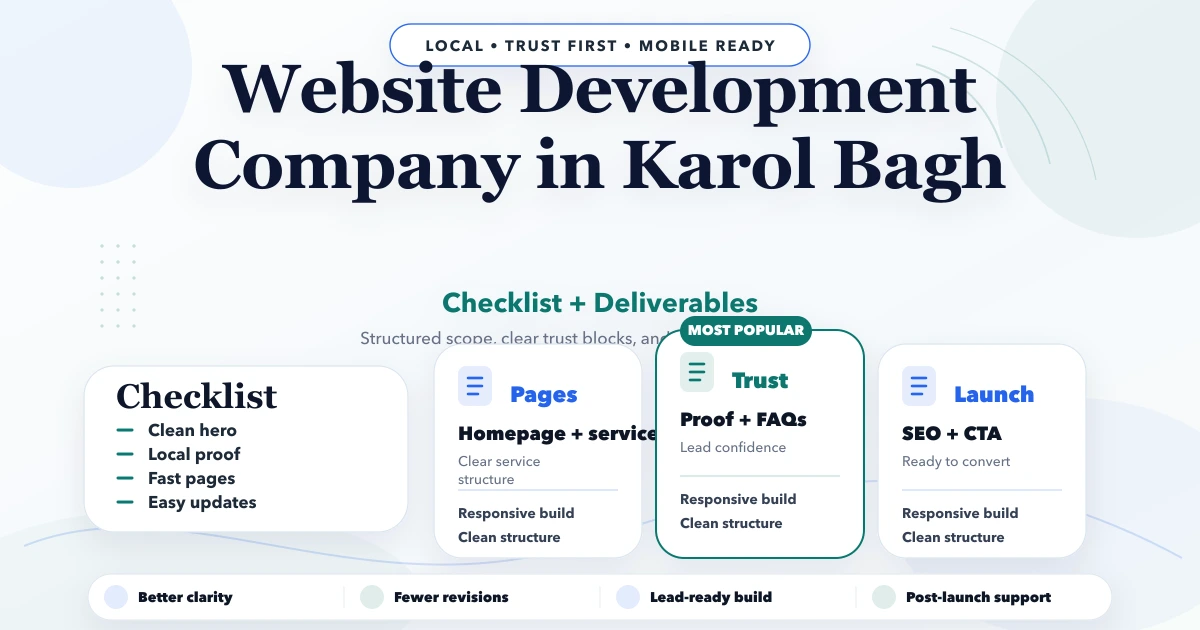
April 21, 2026
Plan a Karol Bagh retail website with a manageable product catalogue, store enquiries, WhatsApp qualification, stock boundaries, analytics, and ownership.
Read article
May 18, 2026
Diagnose whether ecommerce conversion needs better product photography, product-page UI, offer clarity, trust, performance, or checkout before investing.
Read article