
May 15, 2026
Best Wholesaler Website: Catalog, RFQ and Cost
Plan a wholesaler website with a searchable B2B catalog, pack and MOQ data, RFQ and dealer enquiries, pricing controls, lead routing, costs, and launch checks.
Read articlePublished Updated
Build a wholesaler website with searchable catalogs, MOQ and price rules, dealer qualification, repeat-order flow, WhatsApp, and lead tracking.
A wholesale buyer usually cares less about a decorative homepage and more about range, pack size, minimum order, price validity, dispatch location, and repeat availability. The website should organize those decisions without exposing confidential margins or turning every catalogue update into a developer task.
This guide focuses on a wholesaler that carries multiple categories or brands and sells in bulk to retailers, resellers, institutions, contractors, or other businesses. That search intent is different from a distributor representing a principal in a defined territory. The wholesaler page therefore emphasizes assortment, quantity tiers, dealer qualification, and repeat ordering.
By Tushar C. (Founder, VASUYASHII). Prices, discounts, stock, delivery, credit, and returns shown on a wholesale website must come from the business's approved policy. This article provides implementation guidance, not a universal trade-pricing formula.
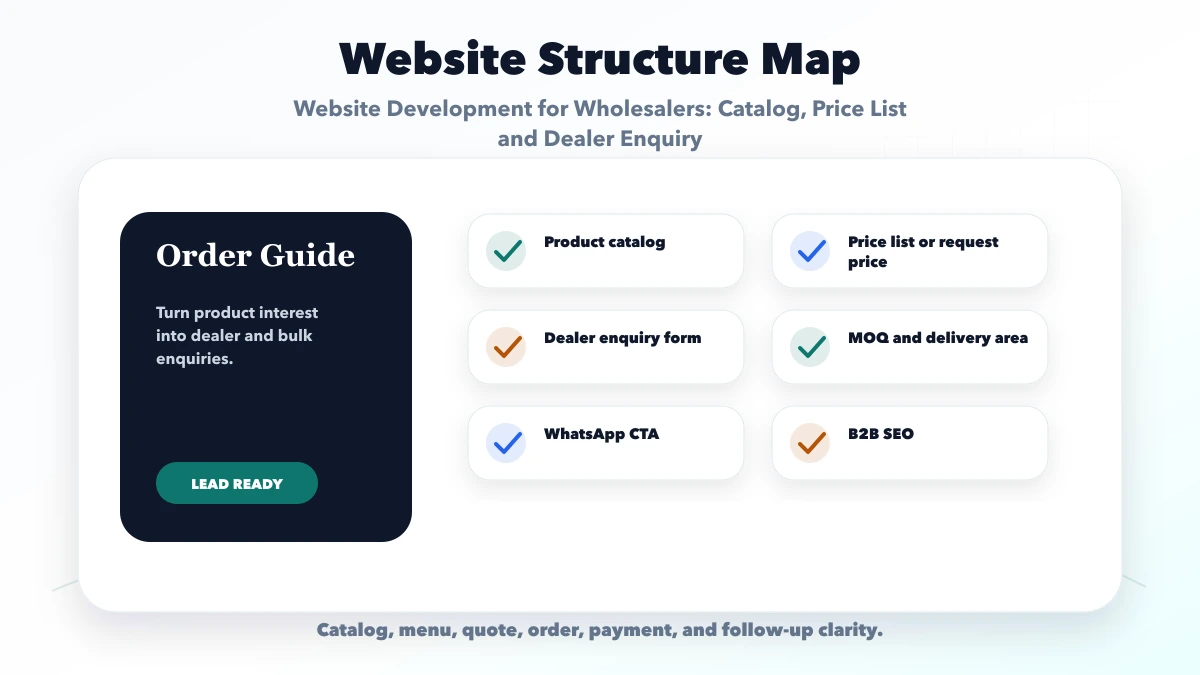
A practical wholesaler website needs a searchable category structure, pack and MOQ context, a controlled price or quote flow, dealer qualification, delivery-area guidance, WhatsApp with product context, and follow-up ownership. For repeat buyers, add a secure reorder or account area only after product codes, customer-specific terms, and stock processes are stable.
Imagine a stationery wholesaler supplying offices and local retailers. A first-time buyer wants a mixed order across paper, files, writing instruments, and printer supplies. A returning dealer already knows the SKUs and wants to upload a list. An institution needs a formal quotation and tax details.
One generic contact form forces all three buyers into free text. A better website offers category browsing for discovery, a structured bulk-enquiry basket for new buyers, and a separate SKU or file-based repeat-order path for approved customers. The sales team receives quantity and delivery context before discussing a rate.
| Catalog level | Useful information | Avoid publishing by default |
|---|---|---|
| Category | Buyer use case, included product families | Long lists with no filters |
| Product | SKU, unit, pack size, variant, GST note | Purchase cost or supplier terms |
| Availability | Enquiry, ready stock, made to order, discontinued | Unverified real-time quantity |
| Commercial | MOQ, price-on-request, validity note | Permanent price promises |
| Logistics | Dispatch city, freight basis, serviceable area | Guaranteed delivery without confirmation |
Use consistent units such as piece, box, carton, set, kilogram, metre, or case. If buyers order in cartons but the internal system stores pieces, define the conversion once. Ambiguous units create quotation and dispatch errors.
Large catalogs should support filters that buyers actually use: category, brand, material, size, pack, application, and availability status. Do not add filters merely because a competitor has them. Empty or inconsistent filters make the catalog harder to trust.
Choose the model based on how often prices change and whether customers have different terms.
Useful when the price is stable, applies broadly, and can be maintained. State tax inclusion, unit, MOQ, validity, and freight basis. A “starting from” number must represent a real purchasable configuration.
Useful for volatile markets, mixed orders, project quantities, or negotiated terms. Ask enough information to prepare a response: products, quantities, location, business type, and required date.
Useful when each buyer has an assigned price list, credit limit, or repeat-order history. This is a web application, not merely a hidden page. It needs authentication, authorization, audit logs, price-version rules, and a safe fallback when data sync fails.
The first enquiry should not feel like vendor onboarding. Ask business name, buyer name, phone, email, city/PIN code, buyer type, main categories, estimated order size, and GSTIN only if needed. Collect certificates or credit documents later through a secure process.
Show what happens next: catalogue review, price confirmation, MOQ check, freight discussion, account approval, or quotation. A vague “we will contact you soon” message leaves the buyer unsure whether the request was received.
For WhatsApp, prefill the selected category or SKU and quantity prompt. Use automation and integration services when routing enquiries to different product teams, but keep personal information out of analytics and public query strings.
Repeat buyers value speed. Options include:
Do not label an enquiry as a confirmed order unless allocation, credit, payment, and dispatch rules are complete. A clear “order request submitted for confirmation” state is safer than false certainty.
VASUYASHII Business Suite is positioned for GST billing, products, inventory, clients, vendors, purchases, payments, expenses, and reports. Those modules show the operational data a wholesaler may need after a digital enquiry arrives.
The public website should expose only approved fields. Customer-specific rates, supplier dues, purchase cost, stock valuation, and private documents remain authenticated and company-scoped. If a wholesaler needs a custom dealer portal, compare the required workflow with the custom software, CRM and ERP hub before choosing a plugin or a bespoke build.
Build pages around genuine product families and buyer questions, not every keyword variation. A useful category page can answer pack size, buyer type, MOQ, dispatch location, and enquiry process. Link it from the main catalog, relevant application guides, and related products.
PDF price lists can support sales, but they should not be the only indexable information. Keep a crawlable category summary on the page and date every downloadable list. Remove expired documents or redirect them to the current resource where appropriate.
Review internal search terms and enquiry notes monthly. If buyers repeatedly search for a grade, pack size, or trade name that the catalog does not recognise, improve the controlled synonym list instead of creating another duplicate page. If a category receives visits but no qualified enquiry, check MOQ clarity, delivery limits, price context, and the next action. This turns search behaviour into catalog maintenance without exposing private dealer pricing or creating hundreds of low-value URLs.
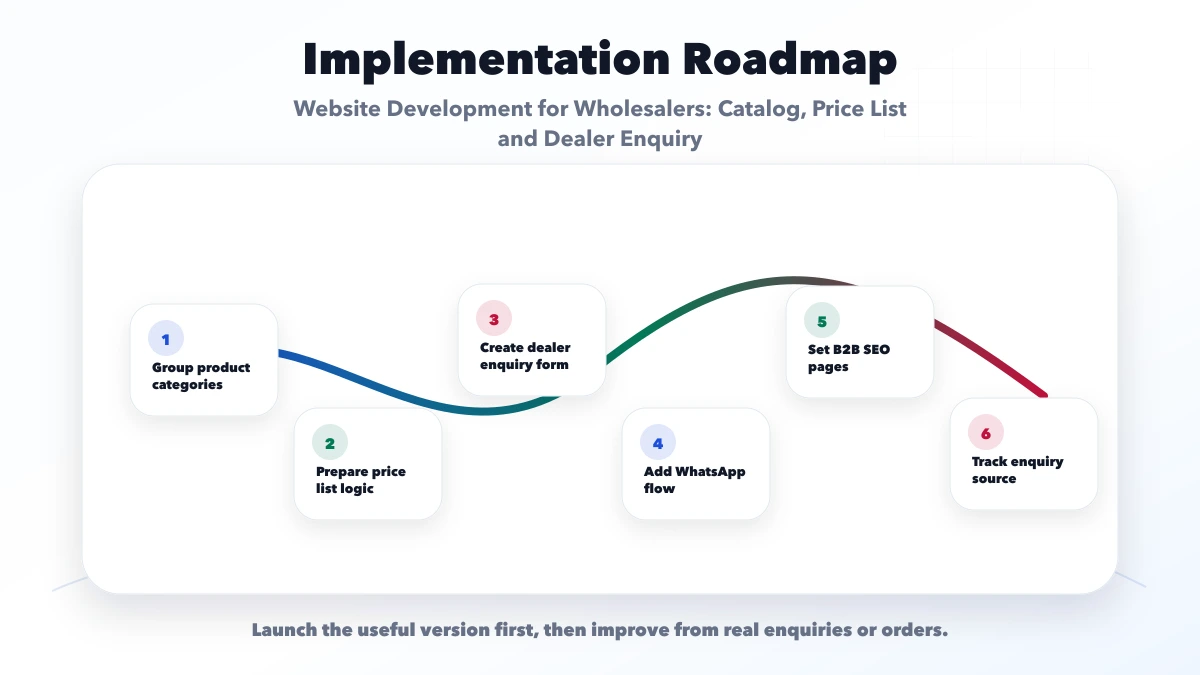
A catalog-and-enquiry site costs less than a connected dealer portal because it does not need account-specific pricing, stock sync, credit rules, approvals, or order history. Begin with reliable product data and qualified enquiries. Add authenticated ordering only when staff can maintain the underlying records.
The quote should state number of products, migration format, filters, account roles, pricing model, integrations, reports, testing, training, and support. “Wholesale ecommerce website” is too broad to compare proposals fairly.
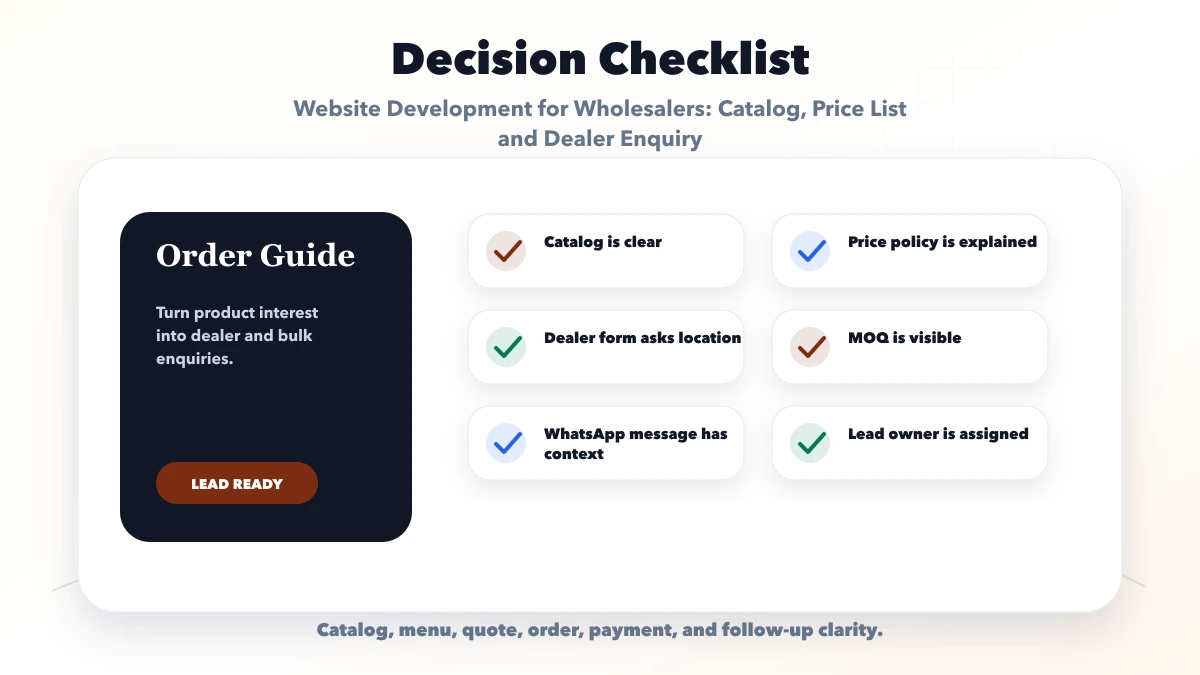
Use the wholesaler website catalog, RFQ and cost guide to decide between a public catalog, enquiry workflow, verified dealer portal, protected price list, and full B2B ordering.
Only if it can be dated, maintained, and accompanied by unit, tax, MOQ, freight, and validity notes. Otherwise use a current-price request or approved-dealer login.
Not always. A searchable catalog and structured bulk enquiry often solves the first problem. Ecommerce becomes useful when pricing, availability, customer terms, payment, and dispatch are system-ready.
Use an enquiry basket that accepts several products and quantities, then asks buyer and delivery context once. The submission should remain a request until commercial confirmation.
Yes. Validate SKU, unit, quantity, duplicate lines, file type, and size. Return clear errors rather than silently accepting unusable rows.
A distributor website often emphasizes principal brands and territory rights. A wholesaler website usually emphasizes broad assortment, quantity tiers, dealer terms, and repeat bulk ordering.
Review no-result searches, most-enquired categories, qualified dealer leads, response time, quotation turnaround, stale price files, and products that repeatedly need clarification.
Prepare a sample of 30 SKUs, current unit/pack rules, one real dealer enquiry, and the approved price-visibility policy. That is enough to scope a useful first release.
Suppliers handling cement, pipes, sanitaryware, electrical goods, or construction chemicals can use the focused building material supplier website plan to define specification fields, BOQ uploads, delivery context, and contractor RFQs.
For counter-led product discovery and local store enquiries, compare the hardware-shop catalog and local SEO guide before adding live pricing or stock claims.
Related Articles
May 15, 2026
Plan a wholesaler website with a searchable B2B catalog, pack and MOQ data, RFQ and dealer enquiries, pricing controls, lead routing, costs, and launch checks.
Read article
June 9, 2026
Plan a building material supplier website with a searchable catalog, contractor RFQs, dealer enquiries, WhatsApp context, local SEO, and lead tracking.
Read article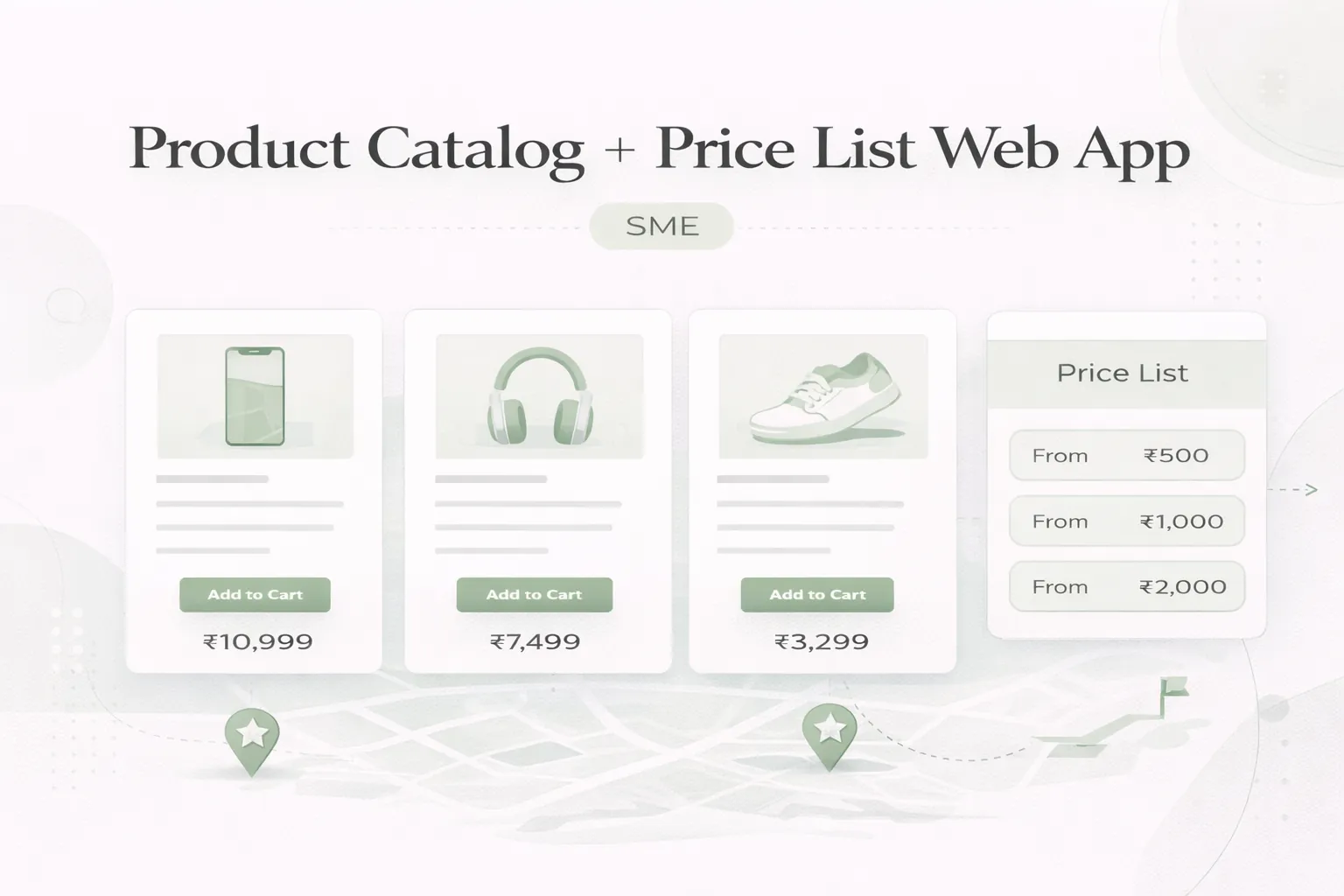
April 8, 2026
Product catalog and price list web app guide for SMEs: features, pricing, workflow, and when it beats PDFs and spreadsheets.
Read article
June 9, 2026
Plan a distributor website with brand catalogs, territory rules, retailer enquiries, stock context, WhatsApp handoff, and B2B lead tracking.
Read article