
May 31, 2026
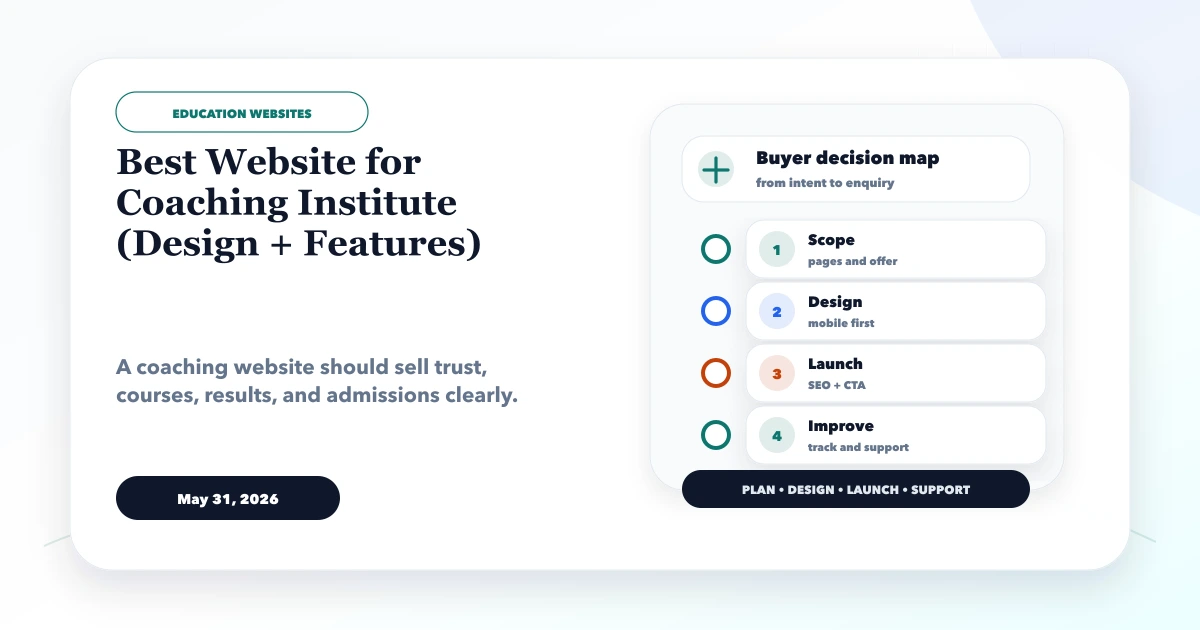
Best Website for Coaching Institute (Design + Features)
Best website for coaching institute guide with design sections, admission leads, course pages, fees, results, WhatsApp, CRM, and features.
Read articlePublished Updated
Plan a coaching institute website with exam-focused course pages, evidence-safe results, counselling leads, batch updates, and admission follow-up.
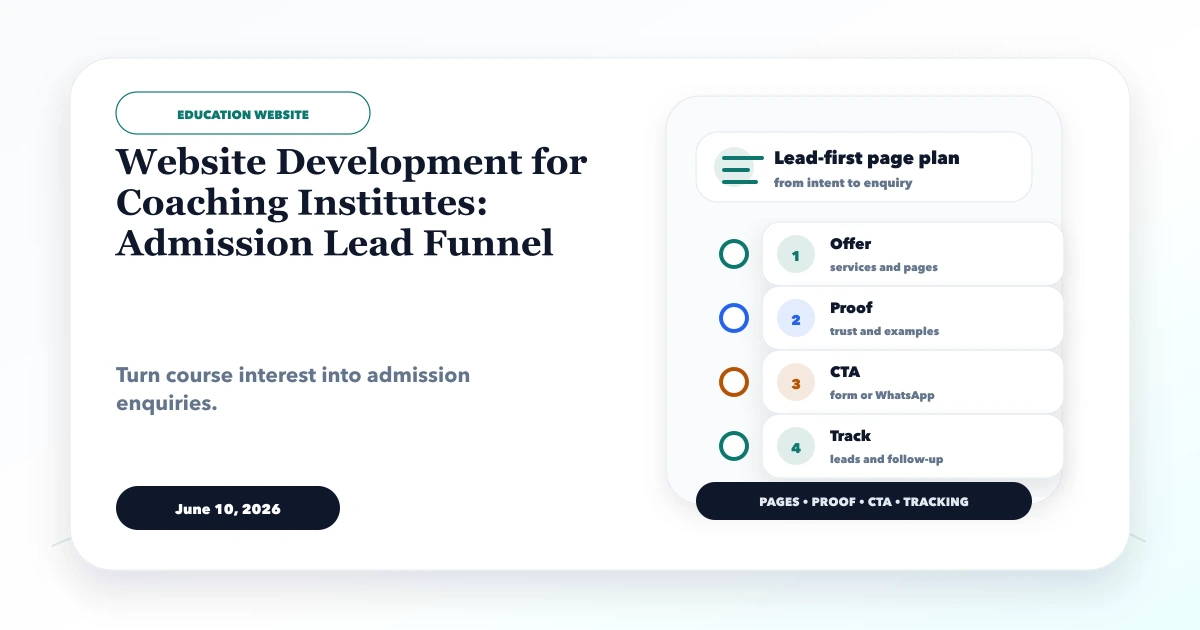
Website development for coaching institutes should support the complete admission decision, not just collect phone numbers. A student or parent moves from exam awareness to course comparison, counselling, batch selection, and enrolment. The website must provide the right information at each stage and preserve the course context when the lead reaches staff.
This guide focuses on exam-oriented coaching businesses, where dates, batches, faculty, results, and eligibility change regularly. It is deliberately different from a tuition-center site or a general training-course landing page.
By Tushar C. (Founder, VASUYASHII). Reviewed for admission-funnel design, evidence-safe result presentation, lead operations, privacy, SEO architecture, and realistic implementation boundaries.
A coaching institute website needs:
The objective is not maximum lead volume. It is to generate enquiries that the counselling team can understand and act on quickly.
An exam-preparation lead can enter at several stages:
| Stage | Student question | Website response |
|---|---|---|
| Exploration | Which exam or stream fits me? | Exam overview and eligibility guidance |
| Comparison | Why this course, mode, or institute? | Course plan, faculty, process, and proof |
| Timing | Is a batch available for my attempt? | Current batch and start-date information |
| Confidence | Can I see how teaching works? | Counselling, demo class, sample lesson, or visit |
| Decision | What are fees, inclusions, and policies? | Transparent fee context and admission steps |
| Enrolment | What happens after payment? | Confirmation, documents, orientation, and support |
A homepage cannot carry every detail. It should route students to the right exam, course, and attempt-year page.
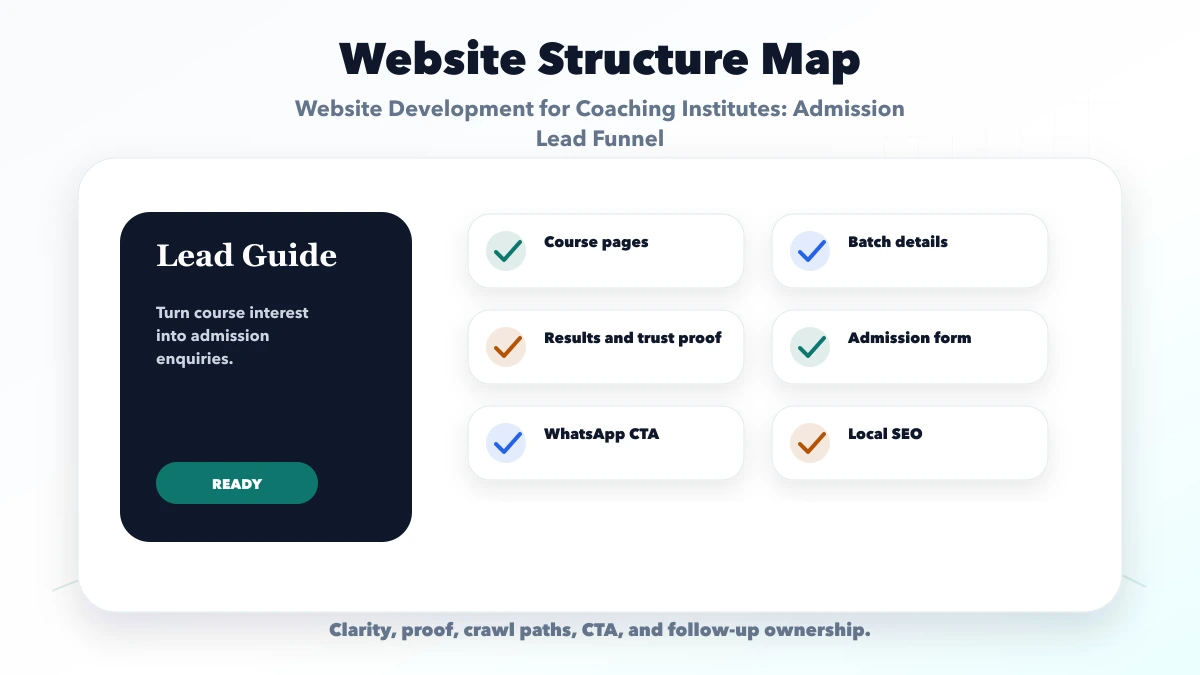
Create one strong parent page for each genuine program family, such as board preparation, entrance examination, government exam, or foundation course. Explain the audience and link to distinct course options.
Each course page should identify exam, level, target attempt, eligibility, duration, mode, schedule, subjects, tests, study material, doubt support, and next step.
Batches are operational data. Keep batch name, start date, days, timing, mode, capacity policy, and status in one maintained source. If live data is unavailable, show “confirm current batch” and avoid stale seats-left counters.
Use branch pages only for real staffed locations. Include original photos, directions, supported programs, counselling hours, facilities, and branch-specific contacts. Do not publish dozens of copied neighborhood pages.
Results are high-trust information and need governance. Before publishing a rank, score, selection, or improvement claim, record:
Do not use one topper image across unrelated programs. Avoid “best results” or “highest selection rate” unless there is a clear comparison basis.
Faculty profiles should use real names, subjects, qualifications, roles, and approved photos. If guest or visiting faculty availability changes, say so. Trust decreases when a public profile promises a teacher who does not handle the advertised batch.
Different students need different actions. A useful coaching website can offer:
Every CTA should carry exam, course, attempt year, page source, and preferred mode into the lead. A generic WhatsApp message loses this context.
Keep the first form short:
Do not ask for identity documents, marksheets, detailed addresses, or payment information before they are required. For minors, define the parent/guardian communication process.
The website should feed a simple, visible process:
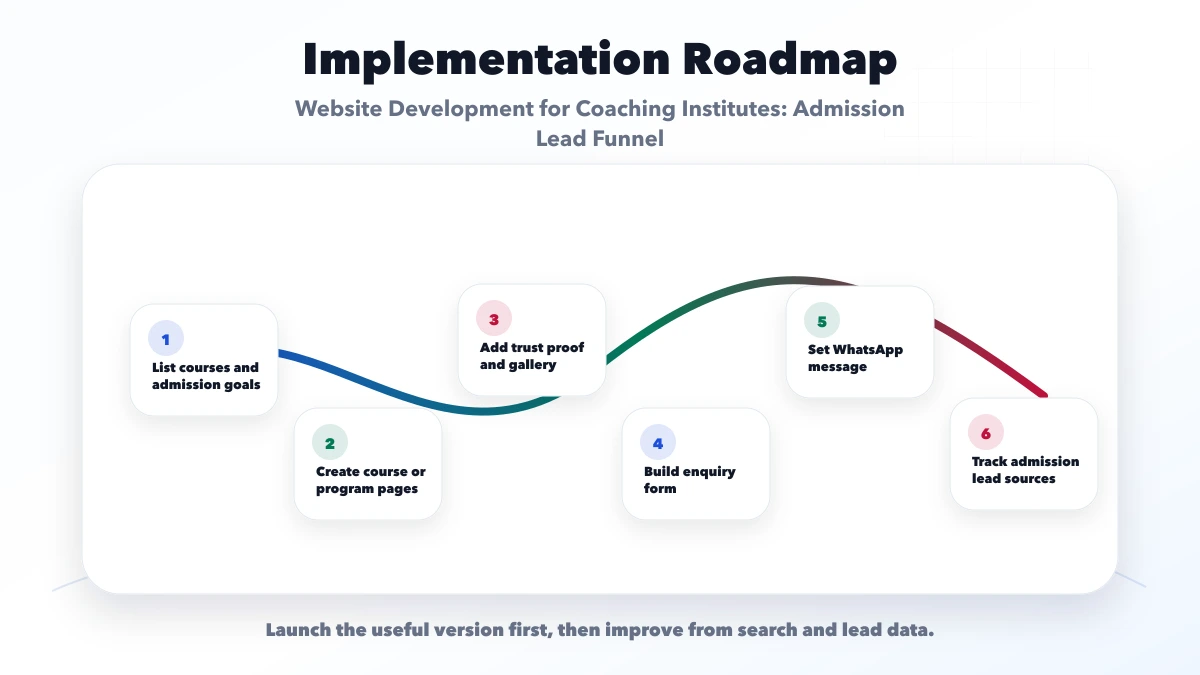
Assign an owner and next-action date. Track the originating course page and CTA. This helps distinguish a page that gets clicks from a page that produces qualified admissions.
WhatsApp automation can acknowledge an enquiry, but repeated promotional messaging requires consent and careful controls. Review integration services when routing leads across WhatsApp, forms, sheets, or a CRM.
Coaching demand changes around exams and admissions. Plan updates for:
Each time-sensitive page needs an owner and review date. Update the existing URL where intent remains the same instead of launching a new year page automatically.
The program hub should link to course pages. Course pages should link back to the hub, relevant faculty or result evidence, branch information, FAQs, and contact. Supporting blogs should answer real pre-admission questions and link to the most relevant course page.
Avoid separate pages for every combination of exam, city, “best,” “near me,” and year. That creates maintenance burden and cannibalization unless each page offers unique intent and evidence.
For local architecture, use the local service URL structure guide and duplicate location-page checklist.
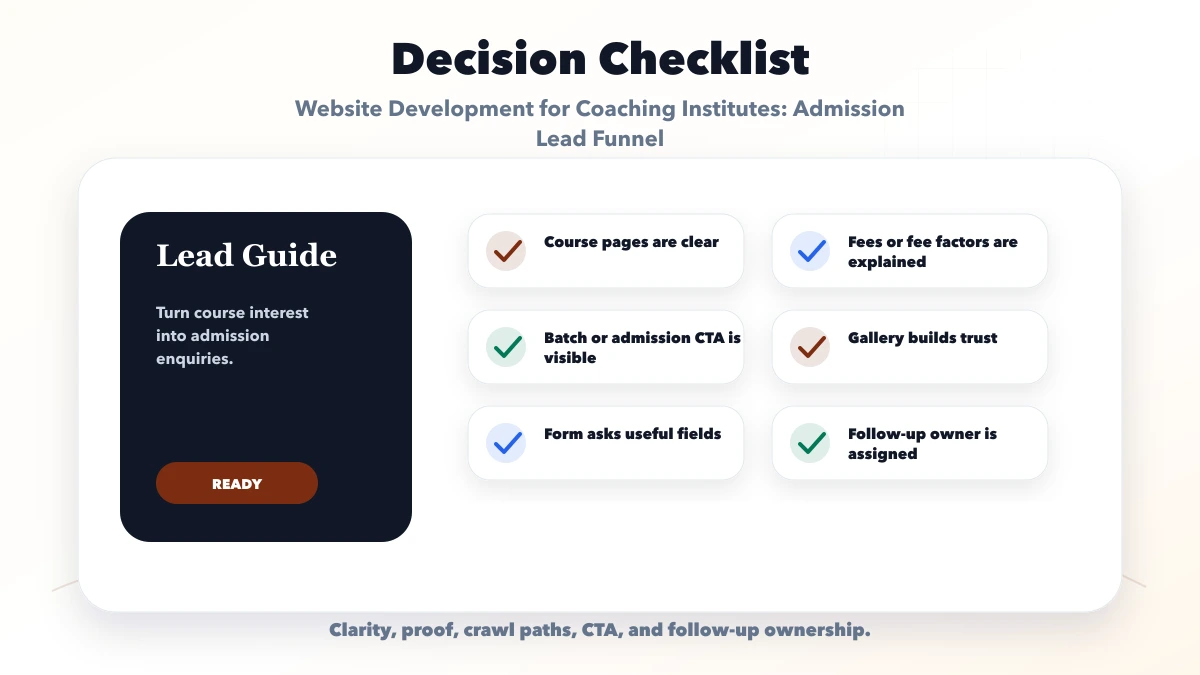
Students at the research stage need eligibility and course-fit content before a fee CTA. Offer counselling as a lower-friction step.
A score image is not enough. State exam, year, association, consent, and verification basis.
Stale pages waste counselling time. Update batch status or route visitors to the next available option.
If staff receive only a name and phone number, they repeat questions the website could have captured. Preserve exam and course context.
A public site does not automatically include attendance, fees, tests, student access, or reporting. Scope those modules separately.
Use a public website for discovery, proof, course comparison, and enquiries. Use a CRM or lead system when multiple counsellors need status and ownership. Consider custom web application development for admissions, student records, attendance, fee workflows, tests, or role-based reporting.
The coaching institute CRM guide covers enquiry ownership, counselling, demo classes, follow-up and admission handover. The coaching institute ERP guide explains the operational layer. A phased project is usually safer than combining every module into the first launch.
It is the path from course discovery through qualification, counselling, batch selection, and enrolment. The website should preserve the student’s context at every step.
Show fixed fees when stable. Otherwise publish a realistic range or factors, inclusions, and confirmation process. Avoid misleading starting prices.
Verifiable and relevant results can build trust. Unclear or exaggerated claims can damage it. Publish evidence with consent, year, exam, and context.
Usually not when the core search intent is unchanged. Update the stable course URL and preserve historical clarity. Create a new page only for a genuinely distinct event or program.
Yes. Preserve course, attempt year, mode, source, and consent in the handoff. Define failure and manual follow-up handling before launch.
VASUYASHII can build the website and scoped lead flow. Attendance, fees, tests, portals, and reporting require separate discovery and software-development scope.
Prepare current courses, attempt years, batches, fee rules, approved faculty/results, and counsellor ownership before requesting a website quote. The strongest design follows a controlled admission process.
Related Articles
May 31, 2026
Best website for coaching institute guide with design sections, admission leads, course pages, fees, results, WhatsApp, CRM, and features.
Read article
June 10, 2026
Website development for training institutes with batch pages, fee details, course enquiries, WhatsApp CTA, CRM lead system, and checklist.
Read article
June 10, 2026
Plan a tuition center website with class and subject pages, batch details, parent-friendly enquiry forms, local proof, and a clear follow-up flow.
Read article
June 8, 2026
Plan an event planner website with permission-approved work, clear services, qualified enquiries, WhatsApp follow-up, package context, SEO and launch checks.
Read article