
June 4, 2026
Lead Funnel for Website Development Companies (2026)
Build a website-development lead funnel from search intent and proof to qualification, discovery, proposal, follow-up, conversion tracking, and reporting.
Read articlePublished Updated
Plan an event planner website with permission-approved work, clear services, qualified enquiries, WhatsApp follow-up, package context, SEO and launch checks.
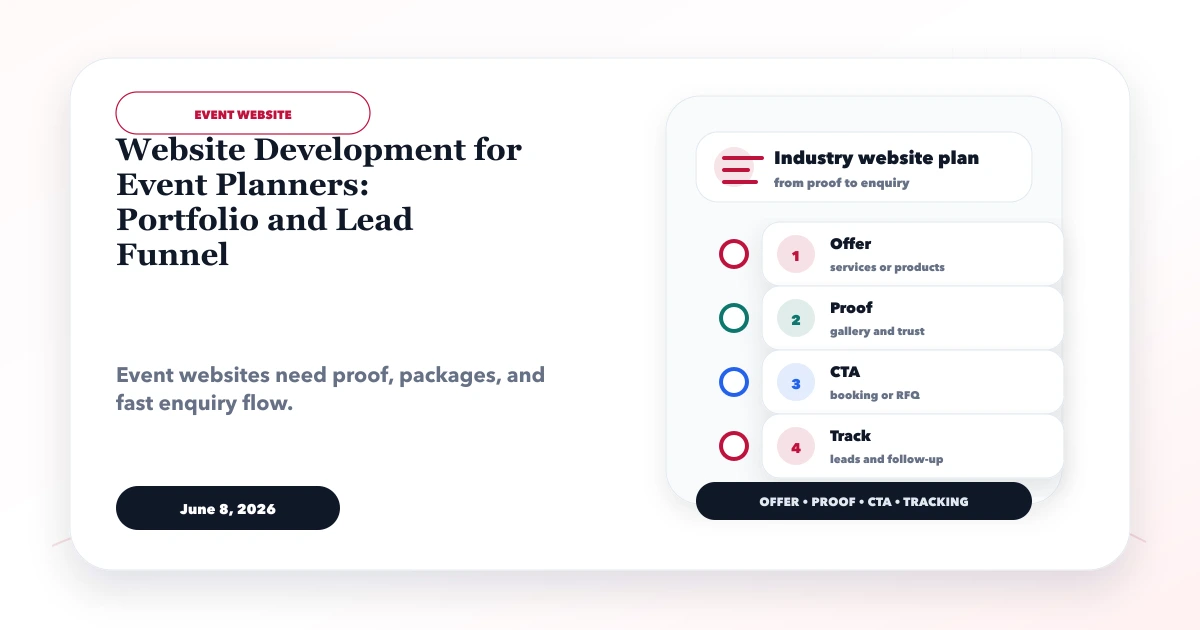
Website development for event planners should turn visual interest into a qualified brief. Visitors need to understand the type of events you handle, the scale and locations you can support, the work you actually delivered, and what information to share for a useful quotation. A gallery alone may create attention, but it rarely tells the planner whether an enquiry is a good fit.
This guide explains how wedding planners, corporate event agencies, social-event teams, decorators, production partners, and independent coordinators can structure a website around evidence, qualification, follow-up, and measurable leads.
By Tushar C. (Founder, VASUYASHII). Reviewed by VASUYASHII Editorial for service-site architecture, media performance, enquiry design, WhatsApp handoff, technical SEO, and small-business website delivery. Event credits, client names, venues, photographs, budgets, testimonials, and results should be published only when the business has permission and accurate records.
An effective event planner website needs distinct service pages, a curated work library, project stories with clear responsibilities, a qualification form, a visible response process, package or budget context, mobile WhatsApp and call actions, and accurate service-area information. It should help serious buyers submit the details required for an initial feasibility check without forcing them through a long proposal form.
The primary conversion is not simply a WhatsApp open. It is a usable event brief that contains event type, tentative date, location, expected guest range, required services, and a realistic budget indication.
Event businesses often list every possible service: weddings, birthdays, corporate conferences, exhibitions, launches, decor, catering, photography, entertainment, logistics, and destination events. This creates a broad-looking website but weak buyer clarity.
Define the operating scope first:
The website should not imply ownership of catering, production, photography, or venue inventory when these are third-party services. Explain the coordination model so clients understand responsibility before a quotation.
Imagine a company planning a 250-person dealer conference in Delhi NCR. The buyer has a tentative month, no final venue, and needs stage production, registrations, branding, food coordination, and photography. A generic "we create unforgettable experiences" page gives the procurement team nothing measurable.
A useful website routes that visitor to a corporate-events page showing:
The team can then respond with relevant questions instead of starting every WhatsApp conversation from zero.
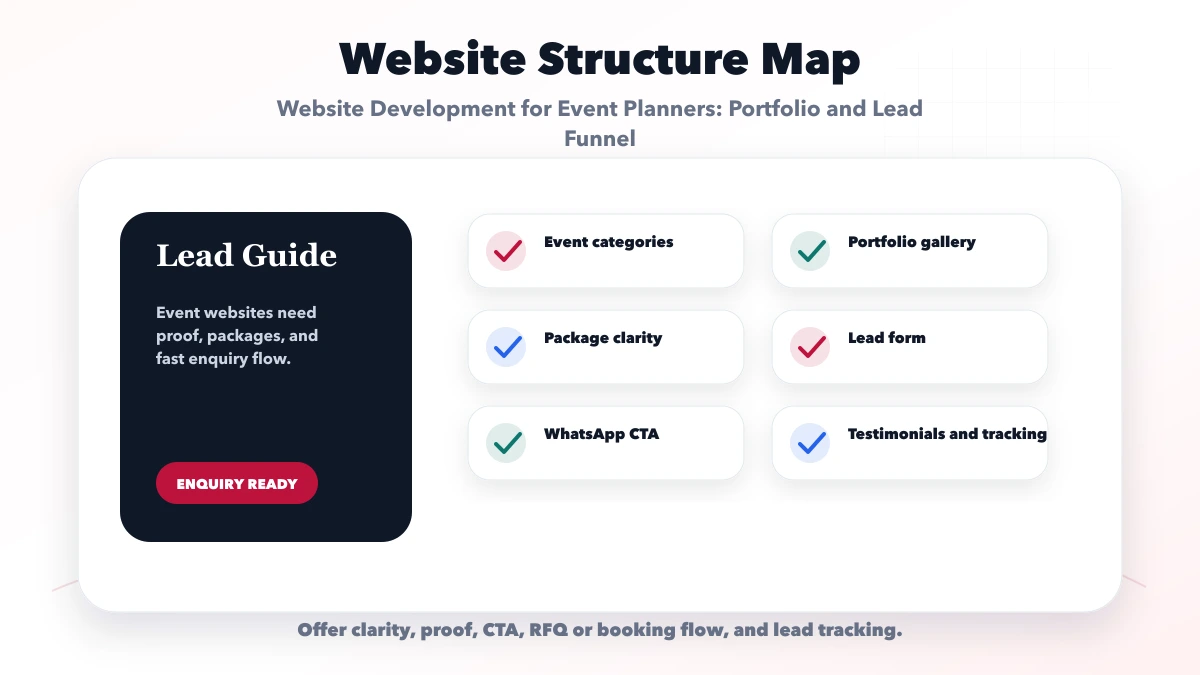
| Page or module | What it should explain | Why the buyer needs it |
|---|---|---|
| Homepage | Event categories, operating region, proof, process, main enquiry CTA | Fast relevance check |
| Service pages | Wedding, corporate, social, production, decor, or other real capabilities | Match a specific event need |
| Work library | Curated projects with permissions and filters | Visual and operational evidence |
| Project story | Brief, scope, role, constraints, delivery, approved media | Understand what the planner actually did |
| Process | Discovery, concept, estimate, approvals, execution, closure | Set engagement expectations |
| Package context | Starting scope, inclusions, exclusions, custom factors | Reduce unsuitable enquiries |
| Enquiry page | Event facts, required services, contact preference, consent | Create a usable lead |
| About and contact | Team, operating model, address, communication routes | Verify the business |
Use descriptive page names and crawlable links. Do not hide every service inside a visual carousel or PDF brochure. Buyers and search engines should be able to reach important services through normal HTML navigation.
An event work library should prove decisions, not only show decoration. For each selected project, record:
Avoid presenting supplier work as your own. Do not use client logos, guest images, children, private ceremonies, or venue media without appropriate permission. If a confidential corporate event cannot be named, publish an anonymized operational story only when it remains accurate and does not reveal protected information.
Large photo sets can damage mobile speed. Use a small number of well-compressed images, descriptive alt text, fixed dimensions, and a strong cover image for each story. Keep original high-resolution archives outside the page delivery path.
The initial form should ask only what is necessary for the next commercial step:
| Field | Reason |
|---|---|
| Event type | Routes the lead to the right service owner |
| Tentative date or month | Helps check lead time and availability |
| City or venue status | Identifies travel and venue dependencies |
| Expected guest range | Influences production and logistics |
| Services required | Clarifies whether the enquiry matches scope |
| Budget band | Prevents mismatched proposals |
| Contact details | Enables follow-up |
| Additional context | Captures constraints not covered above |
Do not make every field mandatory. A buyer early in planning may not know the venue or final guest count. Let them mark a detail as undecided. After submission, show what happens next and the normal response window.
WhatsApp can be offered as a faster conversation route, but prefill a useful message and ask the same core questions during follow-up. Track the click separately from a qualified lead. For more complex routing, reminders, CRM updates, or proposal status, consider integration and automation services.
Event scope changes significantly by venue, guest count, date, city, production level, vendors, permissions, and creative requirements. A website should not publish a fixed all-inclusive price unless the business can honour the stated conditions.
Safer options include:
State exclusions such as venue, catering, artist fees, travel, permissions, taxes, or third-party rentals when relevant. Transparent boundaries build more trust than a low headline price followed by hidden additions.
The website budget depends on the number of service pages, work stories, media preparation, copywriting, lead logic, languages, CRM or WhatsApp integrations, and ongoing update needs.
| Website scope | Suitable for | Main work involved |
|---|---|---|
| Focused service website | Independent planner or specialist | Core services, selected work, enquiry, local foundations |
| Lead-focused agency website | Multi-service event company | Service clusters, project stories, qualification, analytics |
| Enquiry operations system | Team managing high lead volume | Assignment, status, reminders, files, proposal workflow, reporting |
A focused site can often be planned and built in four to seven weeks once approved content and media are ready. A custom operations system needs workflow discovery, permission rules, migration, testing, and staff adoption. Treat those as separate scopes rather than hiding application work inside a website package.
Create service pages around real buyer intent, not keyword variations. A corporate-event page should discuss formats, procurement information, production responsibilities, and delivery process. A wedding-planning page should explain planning stages, family coordination, venue dependencies, vendor model, and decision timelines. These pages should not be copies with only the event label changed.
For genuine local visibility:
Support pages can address topics such as event-brief preparation, vendor coordination, venue evaluation, or budget planning. Link each guide back to the relevant commercial service rather than leaving it isolated.
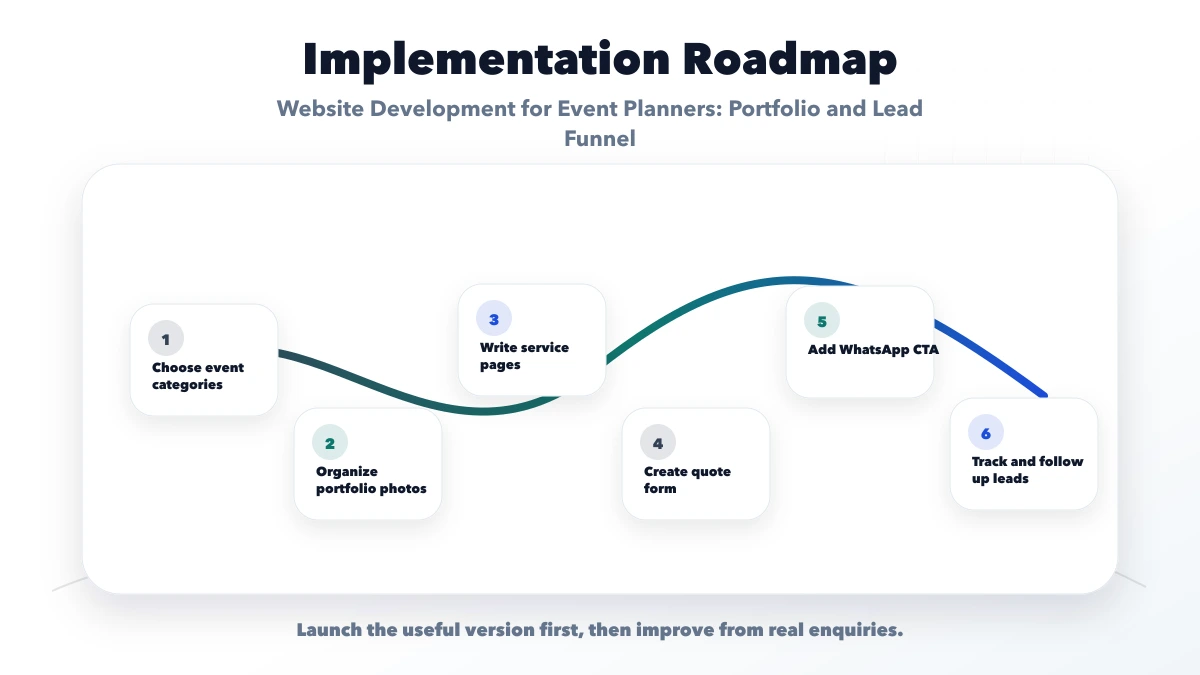
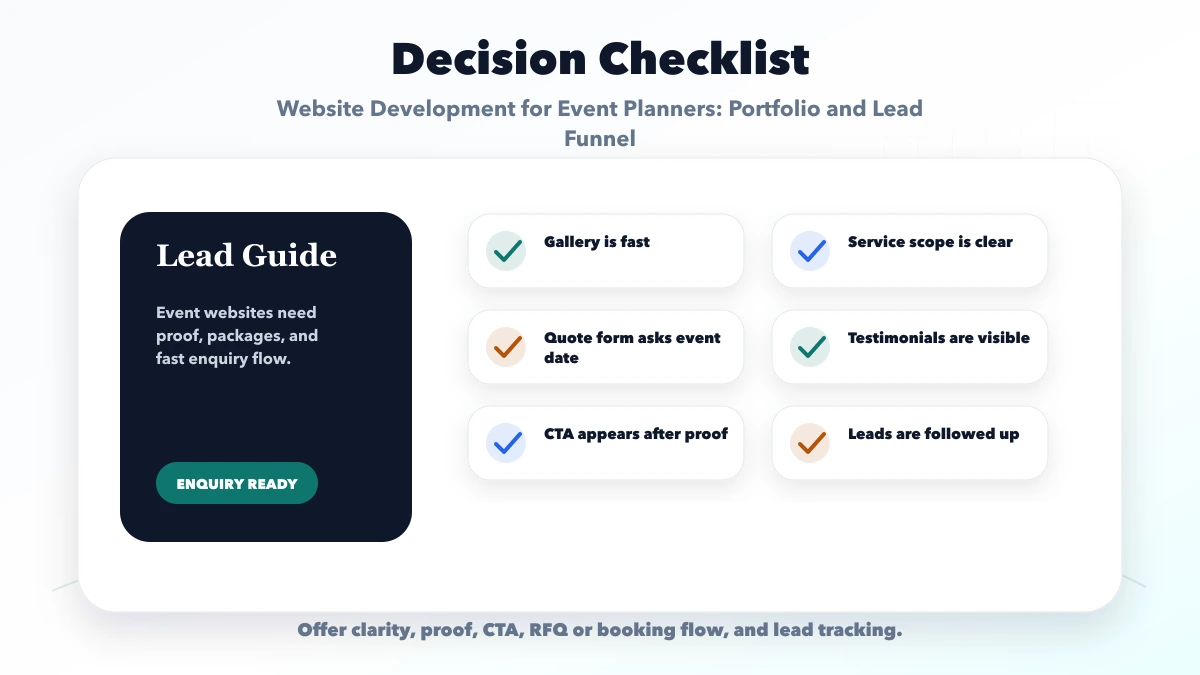
Current VASUYASHII service scoping first separates event categories, delivery ownership, approved evidence, buyer questions, and lead qualification. The first release would prioritize clear services, selected work, fast mobile media, a tested enquiry path, and handover documentation. CRM assignment, automated follow-up, proposal generation, or custom dashboards would be scoped only when the team has a repeatable workflow.
Review web application development for a lead or operations system, software development for a custom workflow, integrations for WhatsApp or CRM handoff, and website maintenance guidance for ongoing ownership. Current options are available on the services page, and project discovery starts through contact.
Start with a homepage, separate pages for genuine event categories, selected work, process, about, enquiry, and contact. Add package context, FAQs, and resources when they answer recurring buyer questions.
Use enough projects to demonstrate the services and scale you want to sell. Six accurate, well-explained stories are usually more persuasive than fifty unexplained photos. Quality, permission, and role clarity matter more than quantity.
They can be public when the package has stable inclusions, exclusions, location, guest assumptions, and validity. Otherwise show starting scope or cost drivers and collect the details required for a custom estimate.
WhatsApp is useful for conversation, but it does not automatically create a complete brief or reporting system. Use a short qualification flow and assign follow-up ownership so important details are not lost.
A custom web app can manage leads, tasks, vendors, approvals, files, reminders, and status reporting. Build it only after the team documents its real process, roles, and exceptions.
Follow the client agreement. If disclosure is restricted, avoid names, logos, guest identities, and confidential metrics. An anonymized story may be possible when it remains accurate and permission allows publication.
Measure qualified form submissions, WhatsApp starts, response time, service interest, budget fit, confirmed discovery calls, proposal rate, and lead source. These signals show whether the website is attracting useful enquiries, not merely traffic.
Prepare a list of event categories, service ownership, approved work, qualification questions, and follow-up responsibilities. VASUYASHII can use that information to recommend a focused event website, a lead-focused agency site, or a custom enquiry operations system.
Related Articles
June 4, 2026
Build a website-development lead funnel from search intent and proof to qualification, discovery, proposal, follow-up, conversion tracking, and reporting.
Read article
June 7, 2026
Plan an interior designer website with approved project stories, service and budget clarity, qualified consultation leads, local SEO and handover checks.
Read article
June 10, 2026
Plan a coaching institute website with exam-focused course pages, evidence-safe results, counselling leads, batch updates, and admission follow-up.
Read article
June 2, 2026
Build a portfolio website that earns calls with clear positioning, honest project proof, case studies, lead qualification, tracking, and fast contact paths.
Read article