
June 8, 2026
Event Planner Website: Portfolio and Lead Funnel
Plan an event planner website with permission-approved work, clear services, qualified enquiries, WhatsApp follow-up, package context, SEO and launch checks.
Read articlePublished Updated
Build a website-development lead funnel from search intent and proof to qualification, discovery, proposal, follow-up, conversion tracking, and reporting.
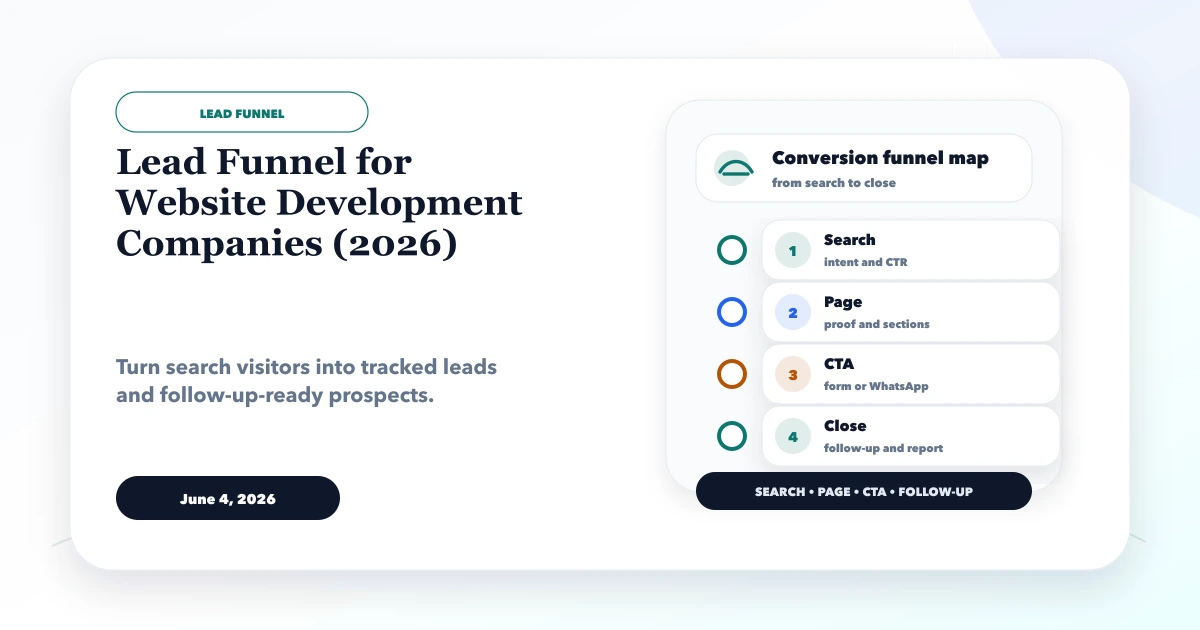
A lead funnel for a website development company should move a buyer from a specific problem to a useful conversation, not push every visitor into the same “Get Quote” form. The funnel must connect search intent, service clarity, proof, qualification, discovery, proposal, follow-up, and outcome reporting.
This guide is designed for small software and web-development companies serving Indian SMEs. It focuses on a funnel a founder or compact sales team can operate without pretending that every click is a lead.
By Tushar C. (Founder, VASUYASHII). The current VASUYASHII lead process uses the website, content, demo, requirement, event-tracking, and follow-up structure documented here. It does not claim a guaranteed conversion rate or lead volume.
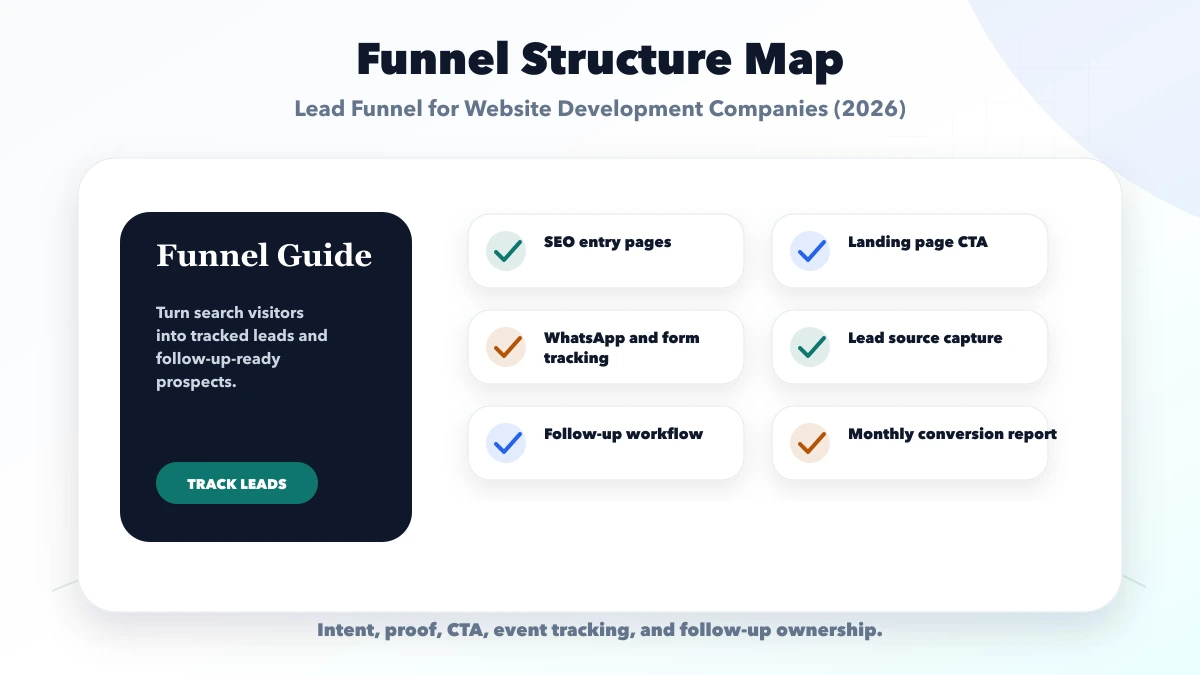
A practical funnel has eight stages:
Optimize the transitions and operational ownership between stages, not only landing-page design.
Website-development companies waste time when every enquiry enters one bucket. Define stages before tracking.
| Stage | Minimum evidence |
|---|---|
| Visitor | Page or session viewed |
| Intent action | Form, WhatsApp, call, demo, or resource action occurred |
| Enquiry received | A real message or submission reached the business |
| Qualified lead | Need, business fit, decision context, and viable next step are known |
| Discovery completed | Workflow, pages, content, timeline, ownership, and constraints were discussed |
| Proposal sent | Written scope, assumptions, exclusions, timeline, and commercial terms sent |
| Won | Agreement and agreed starting condition completed |
| Lost/deferred | Reason and potential future action recorded |
A WhatsApp click is not automatically an enquiry. A form submission may be spam. A genuine enquiry may still be unsuitable.
Different searches require different pages:
Do not create several pages that all target “best website development company” with interchangeable text. One strong parent page and distinct supporting questions are easier to maintain and connect.
The website-development Delhi NCR hub and web-app development hub should serve different buyer needs.
A buyer should understand within the page:
This clarity may reduce raw enquiries while improving fit. That is usually healthier for a small delivery team.
Relevant proof can include:
Avoid fake testimonials, unsupported client logos, invented team size, guaranteed rankings, or project metrics without a source and baseline.
VASUYASHII currently uses industry demos, the Business Suite product page, an author identity, service pages, and a software requirement template as inspectable decision support. Each asset should be labelled according to what it actually proves.
| Page intent | Primary CTA | Context to carry |
|---|---|---|
| Service page | Discuss requirement | Service, business type, priority workflow |
| Cost guide | Request scoped estimate | Required pages/modules, timeline, current setup |
| Demo | Discuss adaptation | Demo type and desired changes |
| Product page | Try live demo | Product interest and setup need |
| Technical guide | Request audit or implementation help | Page topic and observed issue |
| Requirement resource | Use/download template | Optional next consultation after preparation |
Use descriptive text. “Submit” and “Click Here” do not explain the next step.
Offer alternatives when reasonable: a short form for structured requests, WhatsApp for conversational questions, and a call or meeting after qualification. Review the website-to-WhatsApp funnel before automating follow-up.
Collect only what is needed for the first response:
Optional high-intent fields may include current website, user count, required modules, timeline, or budget range. Too many mandatory fields can suppress valid enquiries; too few may create repetitive qualification work.
The form must include validation, spam protection, clear errors, success confirmation, recipient routing, backup delivery, and privacy-safe analytics.
Use a short qualification sheet:
Do not force every prospect into a sales call. Some need a resource, paid discovery, later follow-up, or a polite “not a fit.”
A discovery call should produce decisions, not merely repeat the enquiry. Confirm:
The proposal should connect price to scope and assumptions. Use the scope-creep guide and safe payment-terms guide to define delivery controls.
A simple sequence may be:
Record the reason for no response, lost fit, timing delay, price mismatch, internal cancellation, or competitor selection when voluntarily shared. Do not keep messaging indefinitely.
Website events may include:
contact_click;whatsapp_click;phone_click;demo_open;resource_download;generate_lead after valid form success.Never send personal information or requirement text into analytics. Keep commercial stages in a CRM, controlled sheet, or internal system.
Useful funnel ratios include:
Interpret small samples carefully. One project can distort a low-volume month.
| Responsibility | Owner |
|---|---|
| Service and pricing facts | Founder or service owner |
| Page and content updates | Named content owner |
| Form/WhatsApp delivery | Technical owner |
| First response | Sales or founder |
| Qualification and discovery | Accountable consultant |
| Proposal and commercial terms | Authorized decision maker |
| Analytics QA | Technical/marketing owner |
| Lost-reason review | Founder or sales lead |
Without ownership, funnel tools become disconnected dashboards.
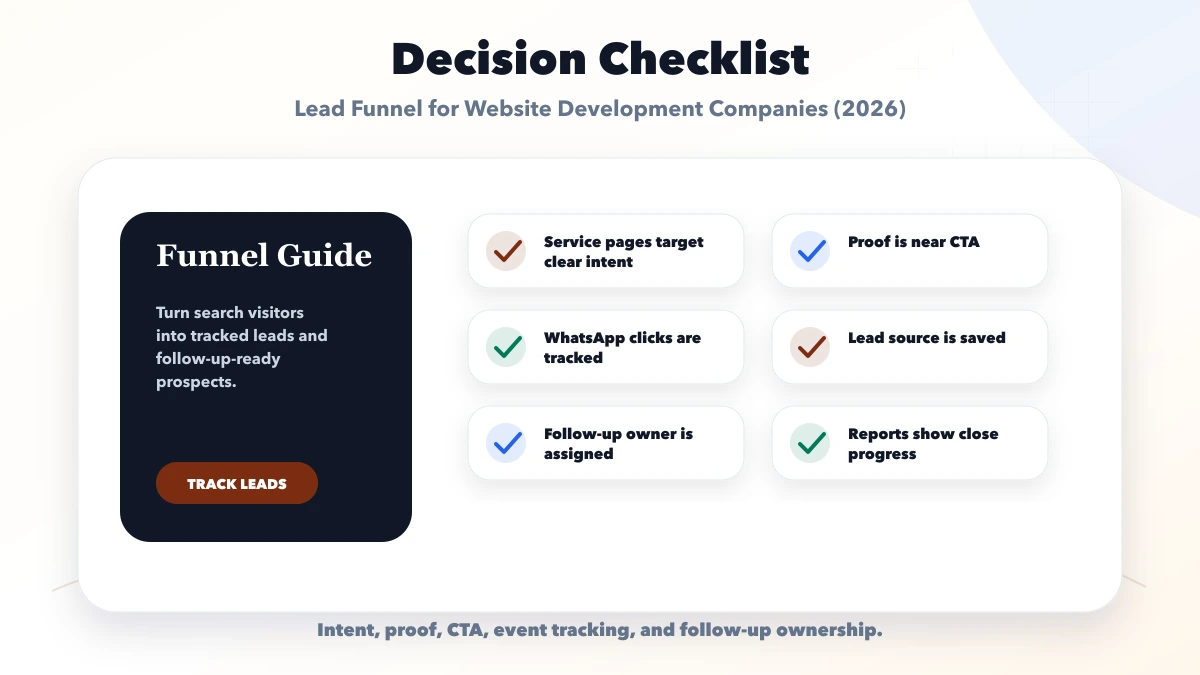
A useful requirement template, audit checklist, or decision guide can work when it helps the target buyer complete a real task. It should connect naturally to the offered service.
Use the software-company lead magnet decision guide to match the asset with buyer stage, qualification fields, privacy controls, and a measurable next action.
Show fixed prices only when inclusions and assumptions are standardized. Otherwise explain cost drivers and use discovery for a scoped estimate.
Neither is universally better. WhatsApp suits quick conversations; forms suit structured requirements. Many businesses should provide both and measure actual qualification outcomes.
Publish an expectation the team can consistently meet. The exact time depends on working hours, service type, and staffing.
A controlled sheet may work at low volume. A CRM becomes useful when ownership, stages, reminders, history, permissions, and reporting need consistency.
Qualified opportunities and profitable outcomes matter more than raw clicks. First-response time and lost reasons are also highly actionable.
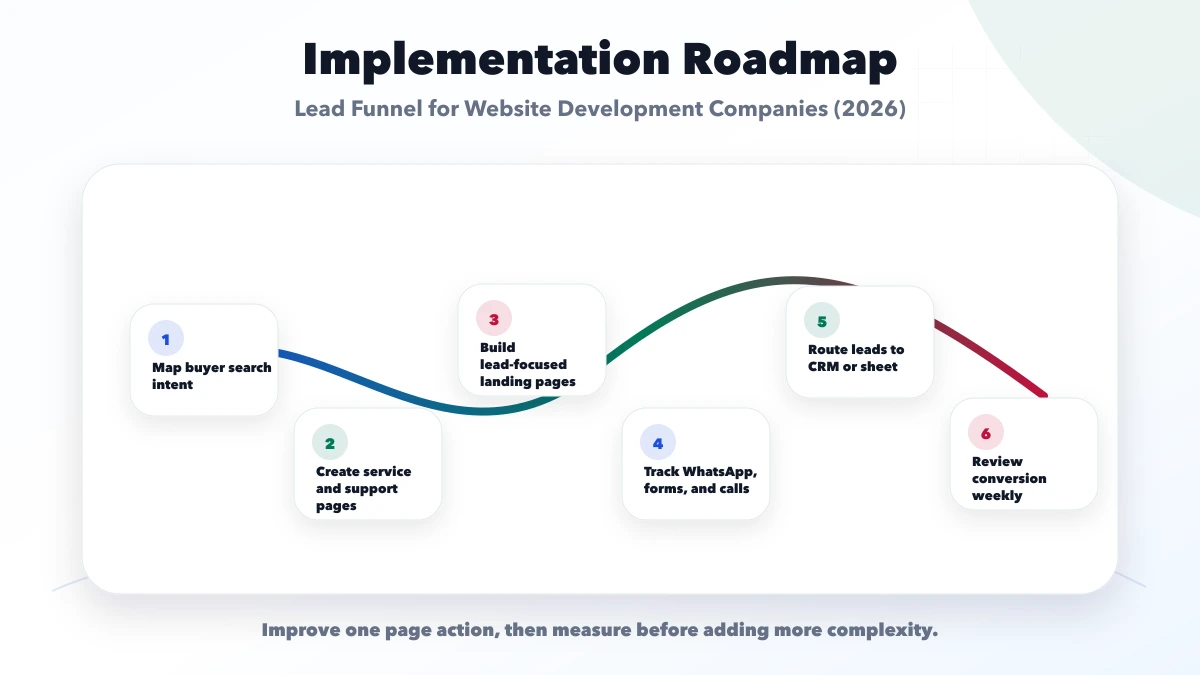
Choose one service and map its complete path from search intent to recorded commercial outcome. Fix that path before adding more landing pages or automation.
Related Articles
June 8, 2026
Plan an event planner website with permission-approved work, clear services, qualified enquiries, WhatsApp follow-up, package context, SEO and launch checks.
Read article
March 29, 2026
Plan a Faridabad industrial AMC website with equipment scope, site-audit requests, maintenance coverage, safety documents, renewals, and lead routing.
Read article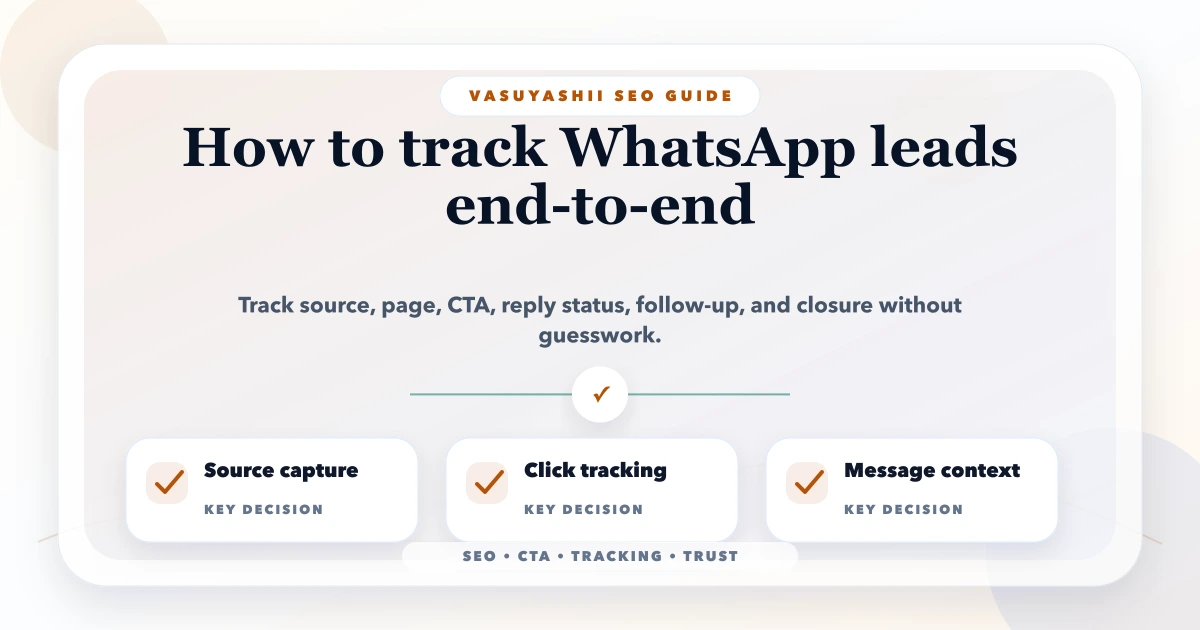
May 11, 2026
track WhatsApp leads end to end: practical 2026 guide with structure, pricing, checklist, mistakes, FAQs, tracking tips, and next steps for Indian SMBs.
Read article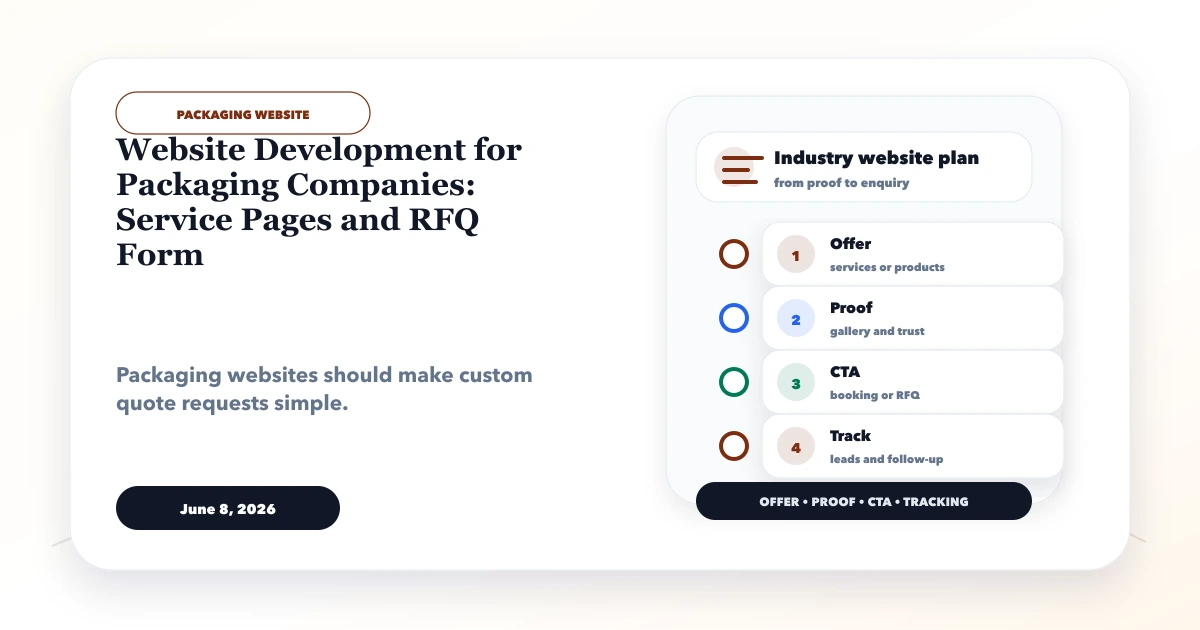
June 8, 2026
Plan a packaging company website with material and print specifications, industry applications, MOQ context, proof, and a quote-ready RFQ form.
Read article