
June 7, 2026
Architect Website: Portfolio and Enquiry Flow
Plan an architect website with approved project stories, clear role and scope, fast portfolios, consultation qualification, SEO, and lead ownership.
Read articlePublished Updated
Plan an interior designer website with approved project stories, service and budget clarity, qualified consultation leads, local SEO and handover checks.
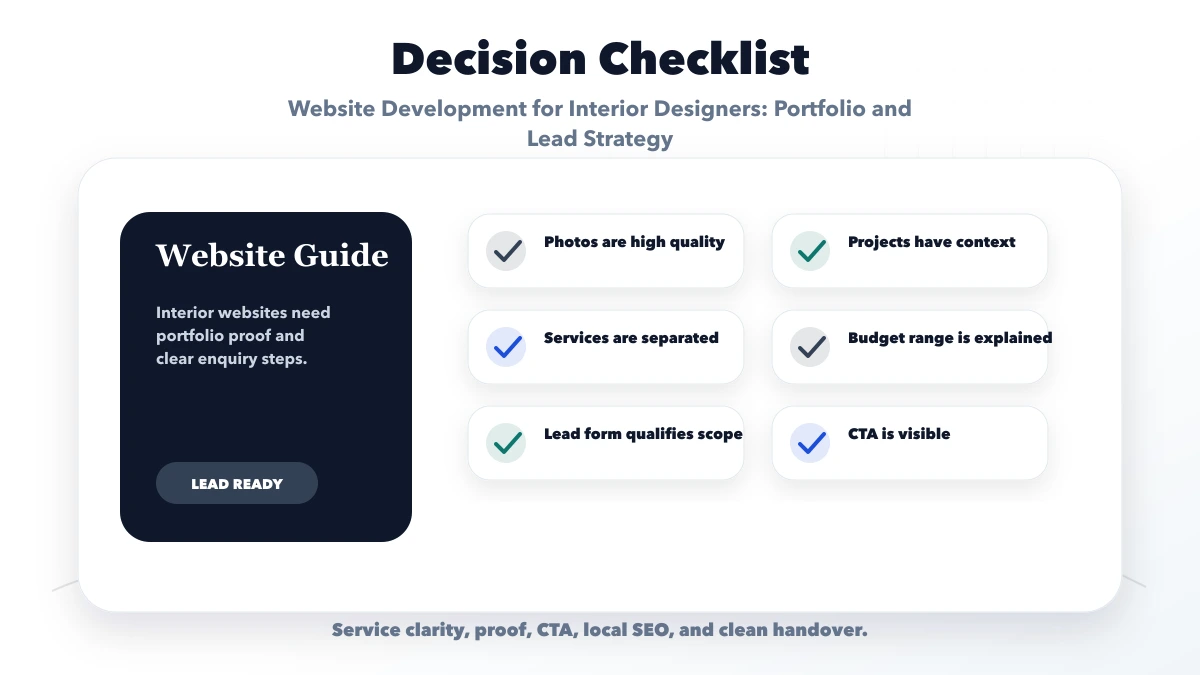
Website development for interior designers should help a prospective client judge style fit, project fit, working process, and the next consultation step. A beautiful image grid can attract attention, but buyers also need to know whether the studio handles residential, retail, office, hospitality, renovation, design-only, or turnkey work; which locations and budgets are practical; and what information is required before a consultation.
This guide explains how to turn approved project evidence into a focused service website and qualified enquiry flow without inventing project roles, hiding budget assumptions, or slowing the site with oversized galleries.
By Tushar C. (Founder, VASUYASHII). Reviewed by VASUYASHII Editorial for service-page architecture, project storytelling, media performance, enquiry design, local SEO, and website handover. Project photographs, client names, addresses, vendors, budgets, drawings, testimonials, and outcomes should be published only with accurate credits and permission.
An effective interior designer website normally needs clear service pages, a curated project library, individual project stories, studio and designer information, process and engagement boundaries, budget or project-size context, a consultation form, location information, and fast mobile media. The primary conversion should be a qualified consultation request, not a generic "send details" message.
Keep each project story honest about the studio's role. Design, execution, styling, procurement, project management, architecture, and contracting are different responsibilities and should not be blended into one claim.
Start with the current commercial focus:
For each service, define target location, typical project size, minimum engagement, deliverables, exclusions, and who executes on site. A studio that provides design drawings and vendor coordination should not imply that it directly employs every contractor.
This positioning decides the homepage, service pages, project filters, form fields, and SEO targets.
A family has purchased a three-bedroom flat in Noida and wants design, wardrobes, kitchen, lighting, furniture coordination, and execution before moving in. They have possession date and floor plan but no final budget. They browse five designer websites and see similar luxury images.
The useful website gives them a decision path:
That information helps both parties identify fit before investing time in a meeting.
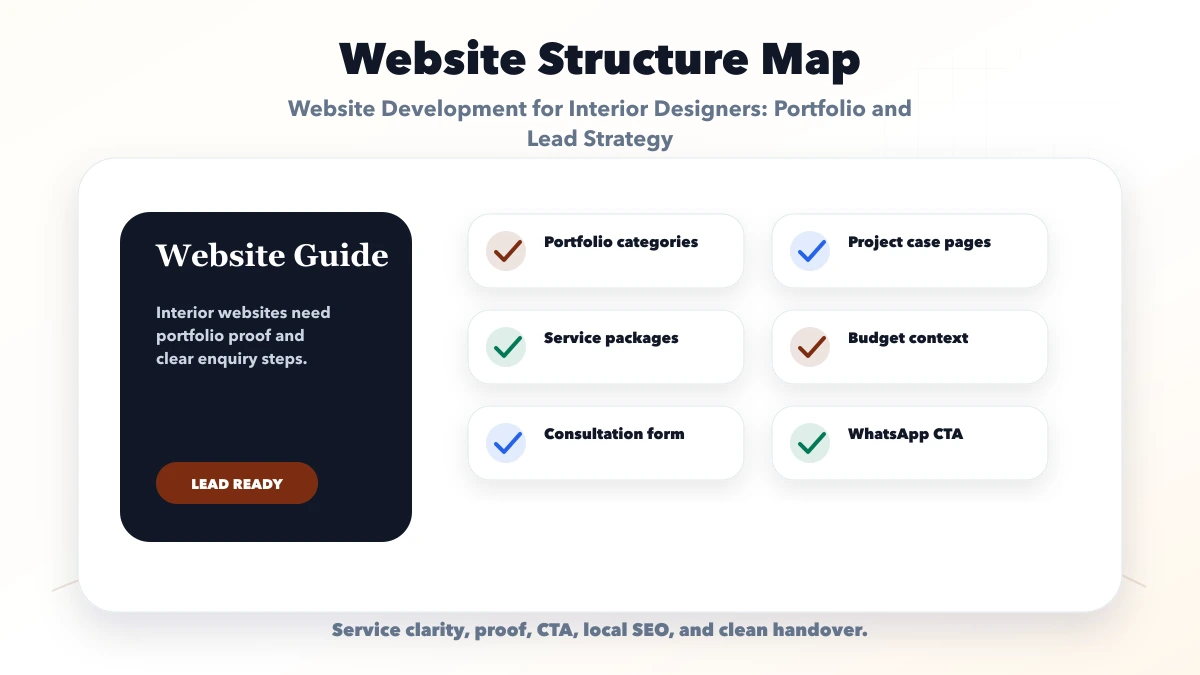
| Page | What to include | Decision supported |
|---|---|---|
| Homepage | Positioning, service categories, selected work, process, location, CTA | Is this studio relevant? |
| Service page | Scope, deliverables, exclusions, process, fit, related projects | Do they handle my requirement? |
| Project library | Filters by space type or service, not dozens of vague tags | Can I find comparable work? |
| Project story | Brief, constraints, studio role, decisions, outcome, approved media | What did the studio actually do? |
| Process | Discovery, concept, design, approvals, procurement, execution, handover | How will we work together? |
| Studio or About | Designers, verified experience, approach, team and partner model | Who is responsible? |
| Consultation | Qualification fields, file rules, response expectation | How do I start? |
| Contact and location | Address, service region, phone, email, hours | Can I verify and reach them? |
Important pages should be reachable through normal HTML links. Do not hide projects behind an animation that fails on mobile or requires visitors to discover an unfamiliar gesture.
A useful project page can follow this structure:
Do not publish a project as completed if it is only a concept render. Label concept, under-execution, completed, styled, or photographed status accurately. Credit architects, photographers, contractors, stylists, and collaborators where agreements require it.
Maintain an evidence register for every project:
Residential interiors can expose personal possessions, family photos, security details, or exact addresses. Review every image before publication. Remove sensitive metadata and avoid showing information that could identify occupants without permission.
For mobile performance, publish a limited sequence that tells the story. Use WebP or AVIF where supported by the project, fixed dimensions, descriptive alt text, responsive sizes, and lazy loading below the fold. Do not deliver full-resolution camera files to every visitor.
A service page should explain more than aesthetic style. Include:
For turnkey work, state which parts are contracted directly and which depend on vendors. For design-only work, clarify whether site visits, BOQ, vendor selection, and execution supervision are included.
| Field | Why it matters |
|---|---|
| Project type | Routes residential, office, retail, or other enquiries |
| City and locality | Confirms serviceability and travel needs |
| Property size | Supports scope estimation |
| Current stage | Distinguishes planning, possession, renovation, and ongoing work |
| Required services | Clarifies design-only, coordination, or execution need |
| Target start or completion | Identifies timeline feasibility |
| Budget band | Helps both parties evaluate fit |
| Floor plan or reference | Provides context through a controlled upload route |
| Contact preference | Supports follow-up |
Do not require every detail. Early buyers may not know the final budget or possession date. Allow "not decided" while still collecting enough for the next step.
Public file upload needs size, type, malware, storage, access, and retention controls. For sensitive architectural drawings, a safer first step may be a short form followed by an approved private sharing process.
WhatsApp can support follow-up, but the website should prefill useful context and assign a lead owner. Track a WhatsApp click separately from a completed consultation request.
Interior project budgets vary by size, scope, site condition, materials, brands, custom work, services, location, contractor model, and timeline. A website can educate without publishing a misleading universal price.
Useful approaches include:
Similarly, separate design timeline from procurement and execution. Mention approval dependencies, site access, civil changes, vendor lead times, and client decisions. Do not guarantee a completion date before discovery and site review.
An interior studio should maintain accurate business identity, address or service-area information, phone, hours, and location context. Publish location pages only for real offices or genuinely supported service areas with distinct evidence and useful operational detail.
The strongest search pages usually combine:
Avoid generating many near-identical "interior designer in area" pages. A strong regional service page with verified local work is more defensible than dozens of thin swaps.
| Website scope | Suitable for | Main work |
|---|---|---|
| Focused studio website | Small studio with selected services and projects | Pages, project stories, form, local foundations |
| Lead-focused multi-service site | Studio serving several project types | Service architecture, filters, qualification, analytics |
| Project and lead web app | Team needs admin, assignment, files, stages, reporting | Authentication, permissions, workflow and support |
A focused site may take four to eight weeks after approved content and photography are available. Project curation and permission often take longer than design. A custom system needs discovery, data modelling, file security, role testing, training, and a separate implementation timeline.
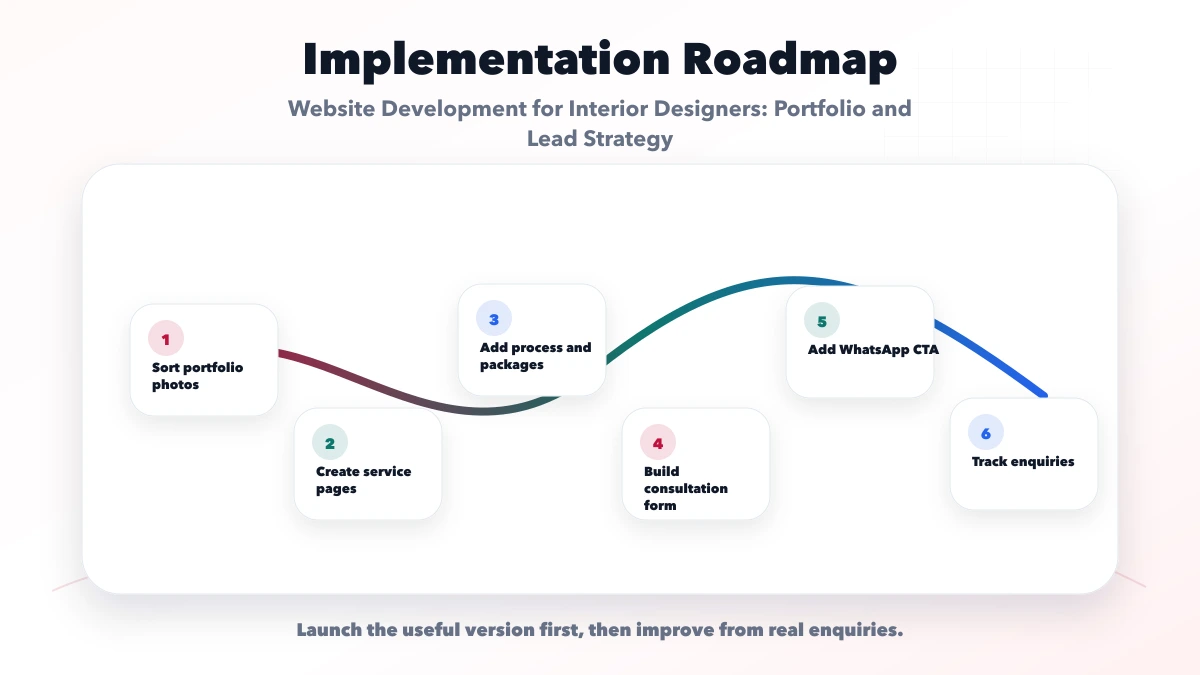
VASUYASHII would start with positioning, service boundaries, a project evidence register, permission-approved media, consultation fields, and update ownership. The first release would focus on a fast service website with selected stories and a tested lead path. Project admin, CRM stages, automated follow-up, secure files, or dashboards would be proposed separately when the studio has a repeatable workflow.
Relevant options include web application development, custom software development, integrations and automation, the website content checklist, and lead tracking from SEO. Review all current services at services or begin through contact.
Use a homepage, distinct service pages, selected project stories, process, studio or About page, consultation, contact, and location information. Add guides only when they answer real buyer questions.
Show enough approved projects to demonstrate the services and project types you want to sell. A smaller set of complete, accurate stories is stronger than a large unexplained gallery.
Publish budget context only with permission and clear assumptions. If exact values are confidential or not comparable, explain cost drivers, minimum engagement, or scope bands instead.
Yes, when the deliverables, responsibilities, pricing, and buyer decisions differ. Clear separation prevents clients from assuming execution is included in a design-only engagement.
Yes, through a controlled file workflow. Define file types, size, storage, access, retention, and deletion. Sensitive plans should not receive public URLs.
It can improve visibility and qualification when services, location, proof, technical foundations, and content are strong. It cannot guarantee lead volume or ranking, and follow-up remains a business responsibility.
Measure service-page engagement, project-story views, consultation submissions, WhatsApp starts, response time, project fit, discovery calls, proposal rate, and source. Do not treat page views as qualified leads.
Create a service list and project evidence register before requesting design concepts. Include project status, studio role, permission, media owner, location disclosure, service fit, and the consultation information your team needs.
Related Articles
June 7, 2026
Plan an architect website with approved project stories, clear role and scope, fast portfolios, consultation qualification, SEO, and lead ownership.
Read article
June 8, 2026
Plan an event planner website with permission-approved work, clear services, qualified enquiries, WhatsApp follow-up, package context, SEO and launch checks.
Read article
June 2, 2026
Build a portfolio website that earns calls with clear positioning, honest project proof, case studies, lead qualification, tracking, and fast contact paths.
Read article
June 10, 2026
Build computer institute course pages with syllabus, tools, batch and fee details, honest certificate proof, demo-class leads, and clear follow-up.
Read article