
June 10, 2026
Coaching Institute Website: Admission Lead Funnel
Plan a coaching institute website with exam-focused course pages, evidence-safe results, counselling leads, batch updates, and admission follow-up.
Read articlePublished Updated
Website development for training institutes with batch pages, fee details, course enquiries, WhatsApp CTA, CRM lead system, and checklist.
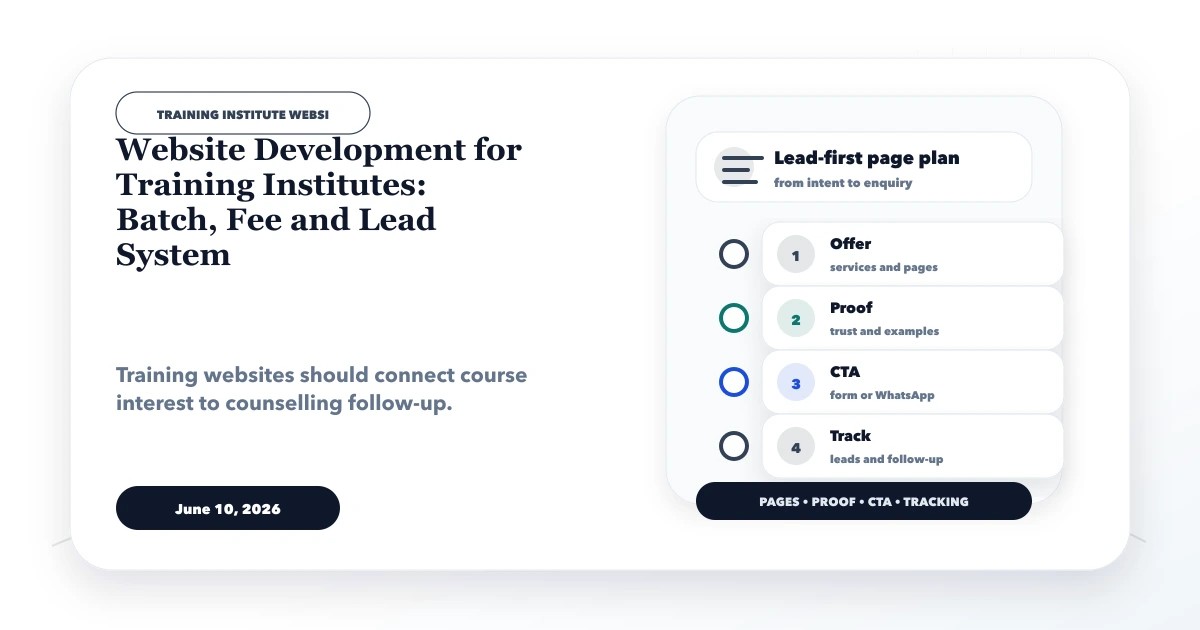
Website development for training institutes should connect course discovery with a real batch and counselling process. A student comparing a weekend data course, a working professional seeking an evening certification, and a company requesting team training need different schedule, fee, eligibility, and follow-up information.
This guide covers course-page architecture, batch data, fee transparency, trainer and outcome proof, counselling forms, WhatsApp context, lead ownership, local SEO, and the boundary between a public website and a student-management application.
By Tushar C. (Founder, VASUYASHII). Editorial review covers course and batch information, education-claim boundaries, lead routing, fee clarity, and maintainable admission content.
A training institute website should include course pages, batch schedule, fee context, trainer proof, lead form, WhatsApp CTA, counselling flow, and CRM or sheet tracking.
A visitor may ask "fees?" because the page does not say what the course includes, when the next batch starts, or which schedule fits. If the institute receives the same message for every course, counsellors spend time rediscovering intent and leads are assigned inconsistently.
The practical target is a course-specific enquiry containing program, preferred batch, learner profile, and next action. Submission should request counselling or a demo class, not imply enrollment or job placement.
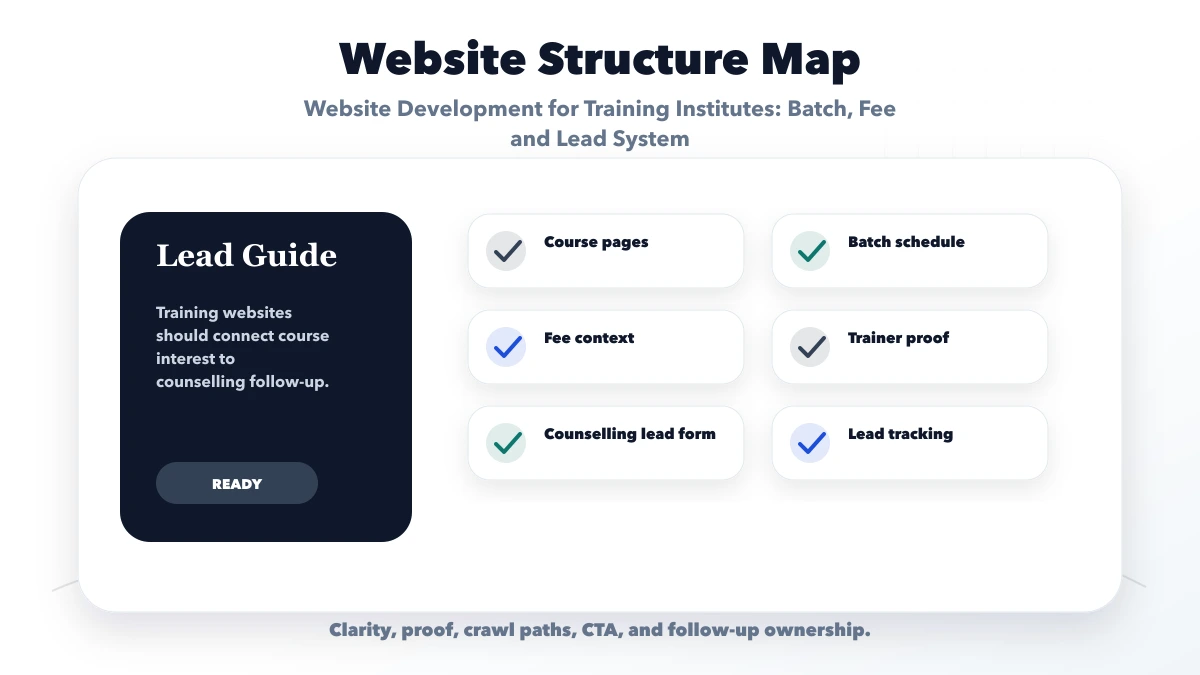
Connect each check to a learner decision: curriculum explains scope; prerequisites prevent mismatch; batch data supports availability; fee components set expectations; trainer and outcome evidence reduce uncertainty; routing keeps follow-up accountable.
| Website area | What to include | Why it matters |
|---|---|---|
| Admission layer | Course pages, fees, batch info | Helps parents and students decide |
| Trust layer | Gallery, results, teachers, reviews | Builds confidence |
| Lead layer | Form, WhatsApp, callback | Captures enquiries |
Organize pages around maintained courses and learner intent. Do not copy the same training template across every technology or create city pages where the institute has no trainer, centre, or delivery evidence.
Launch the highest-priority courses only after curriculum, trainer, schedule, fee, and enquiry ownership are verified. Improve pages using counselling questions, no-show reasons, search terms, and batch-fill data rather than publishing more generic course pages.
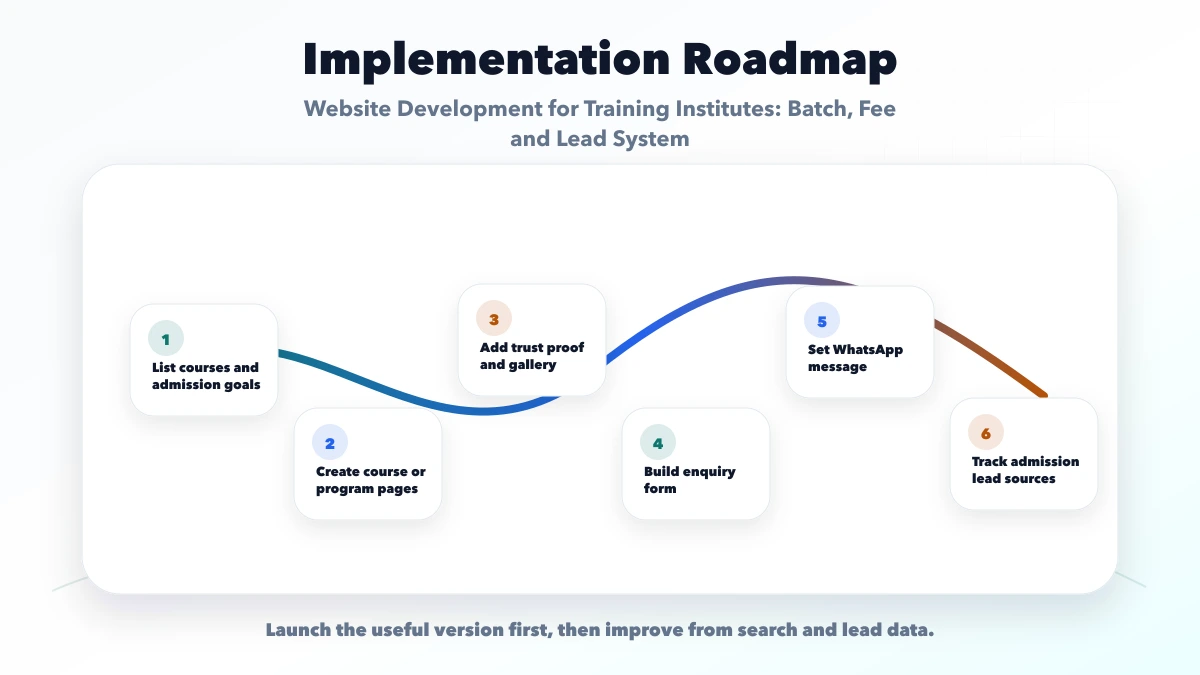
Test an enquiry for a student, working professional, and company team. Each record should carry the course and schedule context, reach the correct owner, and receive an agreed next step.
Each course page should answer:
Avoid promising jobs, salary outcomes, certifications, or placement rates without verifiable conditions and evidence. Explain the support actually included, such as interview practice, portfolio review, doubt sessions, or employer introductions. If data is from a past cohort, state the period and sample rather than presenting it as a guaranteed result.
Course pages need distinct content. A spoken-English course, Tally course, Python program, digital-marketing class, and corporate Excel workshop should not reuse the same curriculum or career claims.
Batch information changes more often than general course copy. Keep a defined owner and update process for:
| Batch field | Why it matters |
|---|---|
| Start date/status | Prevents enquiries for an expired batch |
| Days and time | Helps learners check schedule fit |
| Mode and venue | Separates online, classroom, and hybrid delivery |
| Language | Sets the teaching expectation |
| Capacity/status | Supports waitlist or availability wording |
| Trainer | Avoids incorrect faculty claims |
| Fee and inclusions | Makes the comparison fair |
Do not display "limited seats" unless capacity and current enrollment support it. Archive past batches without deleting the core course page. If schedules change frequently, use a simple managed collection rather than editing hard-coded cards across several pages.
Fee content should state what is included: registration, classes, assessment, material, certification fee, tax, installment charge, or refundable deposit. A "starting from" amount needs a defined course or batch basis.
A first enquiry can collect name, contact, course, current background, preferred mode, preferred time, city, and one short goal. Avoid collecting identity documents or payment details through a public lead form.
Route leads by course or centre and assign a visible owner. Record source page, campaign, enquiry time, first response, counselling status, demo status, and final outcome. If WhatsApp is used, prefill the course and batch context. A message opening should not be counted as a completed lead until the visitor provides a valid requirement.
For automated assignment, reminders, or CRM updates, review integrations and the lead follow-up system guide. Define consent and stop rules before sending automated messages.
Use trainer profiles with real qualifications and subject experience. Show original classroom, lab, assignment, or project evidence with participant permission. Student reviews should be genuine and should not disclose personal data unnecessarily.
Portfolio or project examples need context: course, learner starting point, assignment brief, support provided, and what the result demonstrates. Do not present a template project as paid client work. Keep placement partner logos and certificate affiliations current and authorized.
A demo class page should state topic, duration, mode, date, intended level, and whether attendance is free or requires registration. Confirmation and reminders should use the same schedule source to prevent conflicting messages.
Use one strong page per maintained course or distinct intent. Link from a subject hub to related course pages, fee guidance, batch schedule, trainer proof, FAQs, and contact. Build location pages only for real centres or genuinely distinct delivery areas. The website development hub and local SEO hub provide the broader architecture.
Track course views, batch views, demo requests, valid counselling leads, call and WhatsApp clicks, and source page. The admissions team should mark fit, demo attendance, follow-up status, enrollment, and reason lost. Conversion quality matters more than the total number of CTA clicks.
A fictional design reference for responsive education pages is not a training-institute customer result. The services directory demonstrates current workflow implementation in other domains without proving course enrollment outcomes.
VASUYASHII can build the public course, batch, proof, and counselling experience. If the institute needs student login, fee records, attendance, tests, certificates, or role-based staff dashboards, that becomes a separately secured web application with data and permission requirements.
VASUYASHII would map courses, batch ownership, counselling stages, proof permissions, fee rules, and measurement before design. We would test one course enquiry through assignment and follow-up. Review software development for the internal system layer and contact VASUYASHII with the current course sheet and admissions process.
Judge the site by whether a learner can select the right course and whether a counsellor receives enough context to continue. A modern hero cannot fix expired batches or unowned leads.
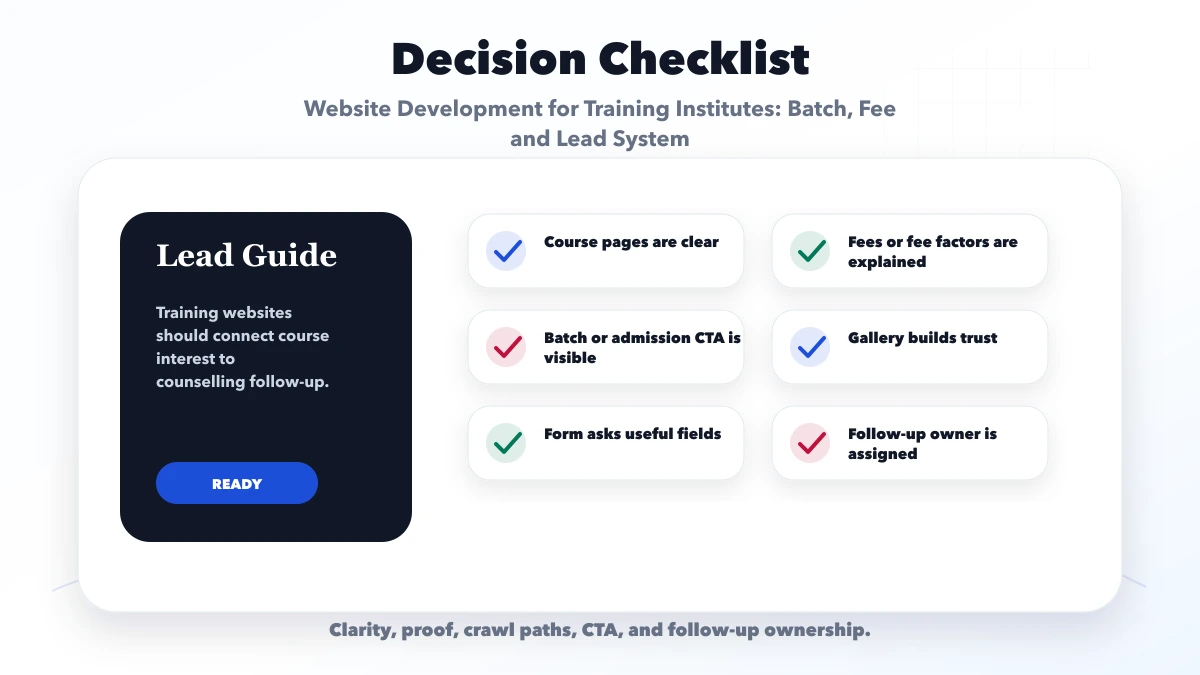
Include distinct course pages, current batches, fee components, prerequisites, trainer and outcome proof, demo or counselling steps, and traceable lead ownership.
Yes, but prefill course and schedule context, record consent, and route the conversation to an accountable counsellor.
Show the current course fee or clearly explain components, tax, installments, material, certification, and the process for obtaining a verified quote.
Yes. Define course-based ownership, statuses, consent, reminders, duplicate handling, and reporting before connecting the form or WhatsApp flow.
Yes. VASUYASHII can build the public website and lead flow; student management, attendance, fees, tests, and certificates require separate application scope.
If you want a practical plan for website development for training institutes, VASUYASHII can help with scope, design, development, SEO setup, lead flow, launch, and maintenance.
Related Articles
June 10, 2026
Plan a coaching institute website with exam-focused course pages, evidence-safe results, counselling leads, batch updates, and admission follow-up.
Read article
June 2, 2026
Plan a local service business website with focused service pages, genuine area proof, calls, WhatsApp, forms, qualification, tracking, and follow-up ownership.
Read article
June 10, 2026
Plan a property dealer website with verified listings, buyer and owner forms, WhatsApp qualification, CRM ownership, privacy, and listing expiry controls.
Read article
June 10, 2026
Website development for real estate agents with property leads, listing pages, WhatsApp CTA, CRM flow, lead source tracking, and local SEO.
Read article