
May 10, 2026
Software Project SRS Template for SMEs
A practical software SRS template for SMEs covering roles, workflows, data, business rules, integrations, acceptance criteria, migration, and change control.
Read articlePublished Updated
Follow an eight-phase software development process for SMEs covering discovery, scope, UX, build, testing, migration, training, launch, and support.
This guide on software development process for SMEs is for Indian SME owners, operations heads, and founders who want custom software without confusion, scope gaps, or surprise cost. If you run an SME in Delhi NCR, Ghaziabad, Noida, Delhi, Gurugram, Faridabad, or anywhere in India, the aim is simple: plan software with less confusion, fewer surprises, and better business control.
SME software projects usually lose control through accumulated ambiguity: verbal requirements become screens, exceptions appear during testing, migration is underestimated, and staff first see the system near launch. An eight-phase process places a decision and exit rule between each of those risks.
By Tushar C. (Founder, VASUYASHII). Reviewed by VASUYASHII Editorial for real-world SME implementation experience, pricing clarity, and practical usefulness.
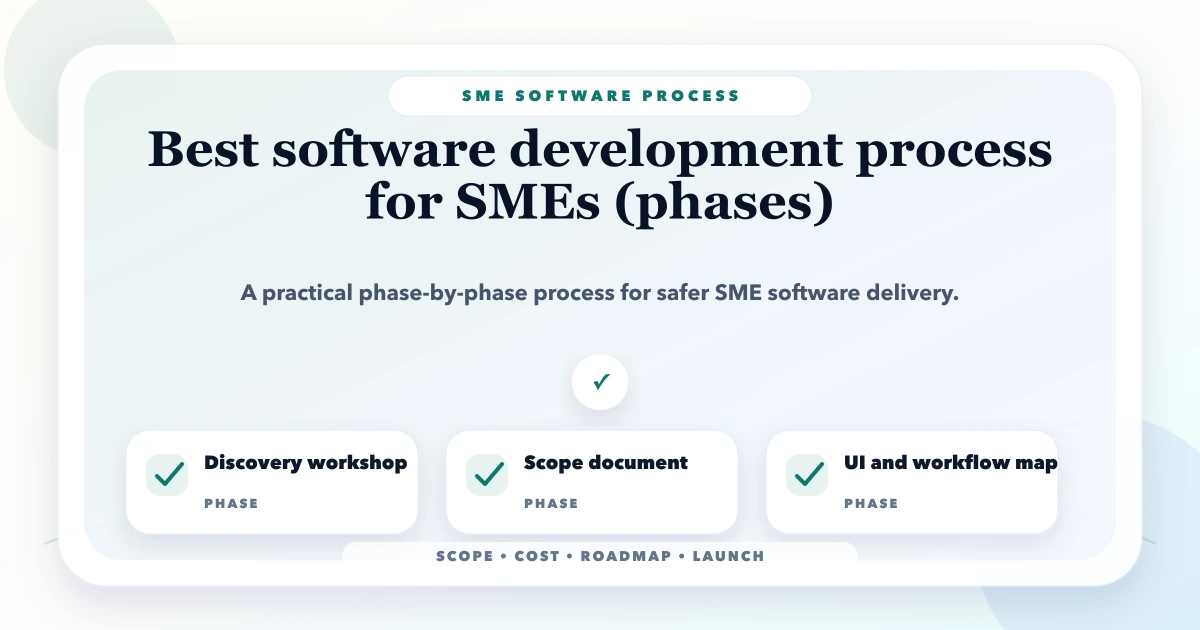
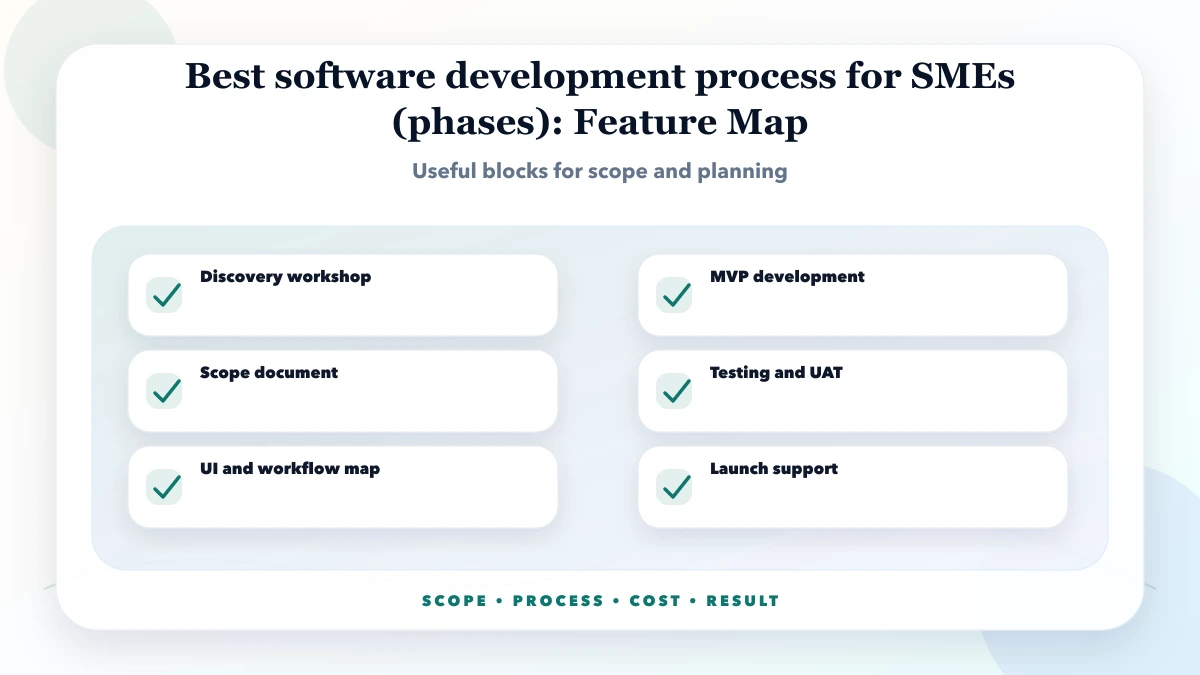
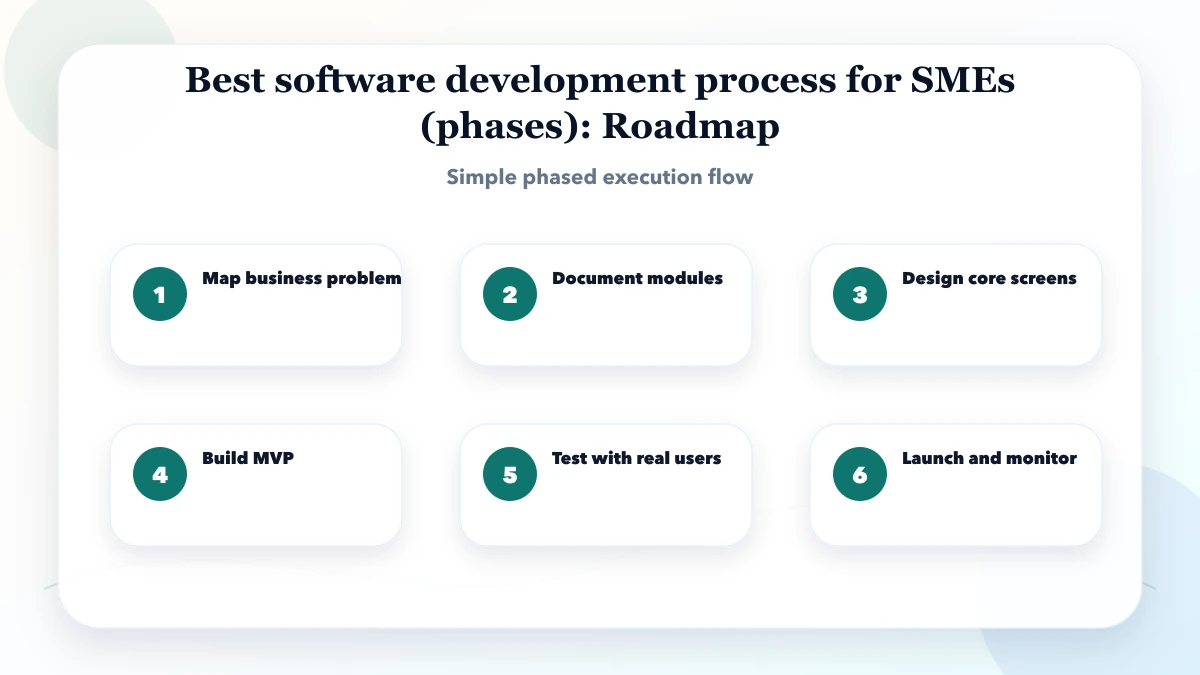
The best software development process for SMEs is discovery, scope, UI planning, MVP build, testing, data migration, staff training, launch, and post-launch monitoring.
The first release should solve one measurable operational problem end to end. Later modules remain visible in the roadmap, but they do not enter build until the current workflow, data, permissions, and acceptance criteria are stable.
The owner often understands the pain while daily users understand the exceptions. Discovery must include both. A sales head may request a pipeline dashboard, while sales staff reveal that duplicate leads, reassignment, and missing next dates are the actual blockers.
Name the approver beside every output. “Dashboard complete” is vague; “operations owner can filter branch stock, open a product ledger, and export the approved columns within two seconds on the agreed dataset” is testable.
| Scope | Practical price range | Typical timeline |
|---|---|---|
| Discovery + scope | ₹20,000 to ₹75,000 | 1 to 2 weeks |
| MVP build | ₹1.5 lakh to ₹6 lakh | 4 to 12 weeks |
| Full business system | ₹6 lakh to ₹20 lakh+ | 3 to 8 months |
These ranges are useful only after the first-release boundary is visible. Approval chains, record ownership, offline needs, statutory documents, external APIs, migration volume, concurrency, reports, and support response expectations can change the estimate materially.
A smaller release can be economical without cutting safeguards. Remove optional modules before removing authorization, backups, validation, error handling, UAT, or handover. Those controls protect the investment rather than decorate it.
The phases can overlap slightly, but their decisions cannot be skipped. Developers may prepare the environment during design, yet production migration should still wait for tested mapping and reconciliation. Training material can begin during UAT, but users should train on the accepted workflow.
Choose technology after clarifying users, devices, connectivity, transaction volume, integrations, hosting ownership, and maintenance capability. The deliverable should include environments, deployment, monitoring, backup, restore, access control, and dependency ownership, not only framework names.
Business rules drive more effort than menu labels. Billing includes tax, rounding, returns, credits, partial payments, numbering, PDFs, and permissions. CRM includes duplicate detection, assignment, stage transitions, next actions, consent, communication history, and source reporting. List those rules before comparing quotes.
Classify scope by operational consequence. Release-one items are necessary to complete the chosen workflow safely. Deferred items have a business owner and reason but do not block that outcome. Rejected items duplicate another capability or lack evidence.
For each accepted feature, document actor, starting state, inputs, allowed actions, output, permissions, exceptions, and acceptance example. Missing exception and permission rules are a sign that discovery is unfinished.
If replacing spreadsheets, select one authoritative dataset and reconcile its totals before import. If building CRM, prove capture-to-outcome for one lead source. If building inventory, prove opening stock, purchases, sales, returns, adjustments, and ledger balance for a sample product before expanding the catalog.
Adoption needs explicit ownership. Define which old tools stop being authoritative, when users switch, who answers first-line questions, and how errors are reported. Train each role on its own daily tasks using realistic examples and verify completion.
| Phase | Main output | Exit rule |
|---|---|---|
| 1. Discovery | Problem, users, current workflow, success metric | Sponsor confirms the problem and priority |
| 2. Scope | Modules, boundaries, assumptions, later list | Phase-one scope is signed off |
| 3. UX and data design | Key screens, fields, states, permissions | Users can walk through core tasks |
| 4. Build | Working increments in a test environment | Agreed acceptance criteria pass internally |
| 5. UAT | Real business scenarios and defect record | Business owner accepts critical workflows |
| 6. Migration | Cleaned, mapped, reconciled data | Sample and final totals are approved |
| 7. Training and launch | SOPs, access, backup, support route | Each role can complete its daily tasks |
| 8. Stabilization | Monitoring, fixes, adoption review | Critical issues close and ownership transfers |
Do not close a phase because a meeting happened. Close it when its output and acceptance rule are complete. This makes change requests visible and prevents unfinished discovery from returning as expensive development rework.
Software development is a shared delivery responsibility, but each decision needs one accountable owner. A developer should not invent business rules, and a business sponsor should not approve technical controls they have not seen tested.
| Responsibility | Primary owner | Evidence to review |
|---|---|---|
| business outcome and priority | SME sponsor or product owner | approved problem, success metric, release boundary |
| workflow and exception rules | process owner with daily users | process map, sample records, acceptance scenarios |
| architecture and data design | technical lead | data model, integration plan, security decisions |
| implementation and code review | development team | working increments, review record, automated checks |
| business acceptance | named UAT owner | passed scenarios, accepted limitations, defect status |
| release and recovery | engineering or DevOps owner | deployment, monitoring, backup, rollback evidence |
| adoption and support | business owner plus support team | training, SOPs, usage review, escalation route |
A freelancer, internal team, or software company can perform development when the required roles are covered and ownership is explicit. The buyer should evaluate evidence, communication, handover, and support capability rather than relying only on a technology list.
DevOps connects build, test, release, monitoring, incident response, and recovery so software can move from a developer's machine into a controlled operating environment. It is not only hosting setup at the end of the project.
For an SME release, practical DevOps work includes separate environments, controlled secrets, repeatable deployment, logs, alerts, backup and restore, rollback instructions, dependency updates, and a named response route. Security should remain part of every phase; the official NIST Secure Software Development Framework provides a useful lifecycle reference.
Small projects may combine roles, but they should not omit the responsibilities. Before commissioning a build, compare the full lifecycle in the custom business software use-cases and cost guide.
Keep one decision log with request, business reason, impact on timeline and cost, approver, and release phase. Small changes can combine into a major scope increase, especially around reports, permissions, and integrations. A visible “later” list lets the team preserve useful ideas without interrupting the current release.
Use a weekly demo with working software and real examples. Screenshots and percentage-complete reports hide integration and data problems. The business owner should see the main workflow move from input to report or document output.
This evidence makes handover safer if the vendor, employee, or infrastructure changes later. It also gives the SME a factual baseline for maintenance instead of relying on verbal memory.
Before development, assemble a problem brief, current workflow, sample data, required outputs, user roles, and one success metric. VASUYASHII can convert those inputs into process maps, first-release scope, acceptance examples, wireframes, and an implementation estimate.
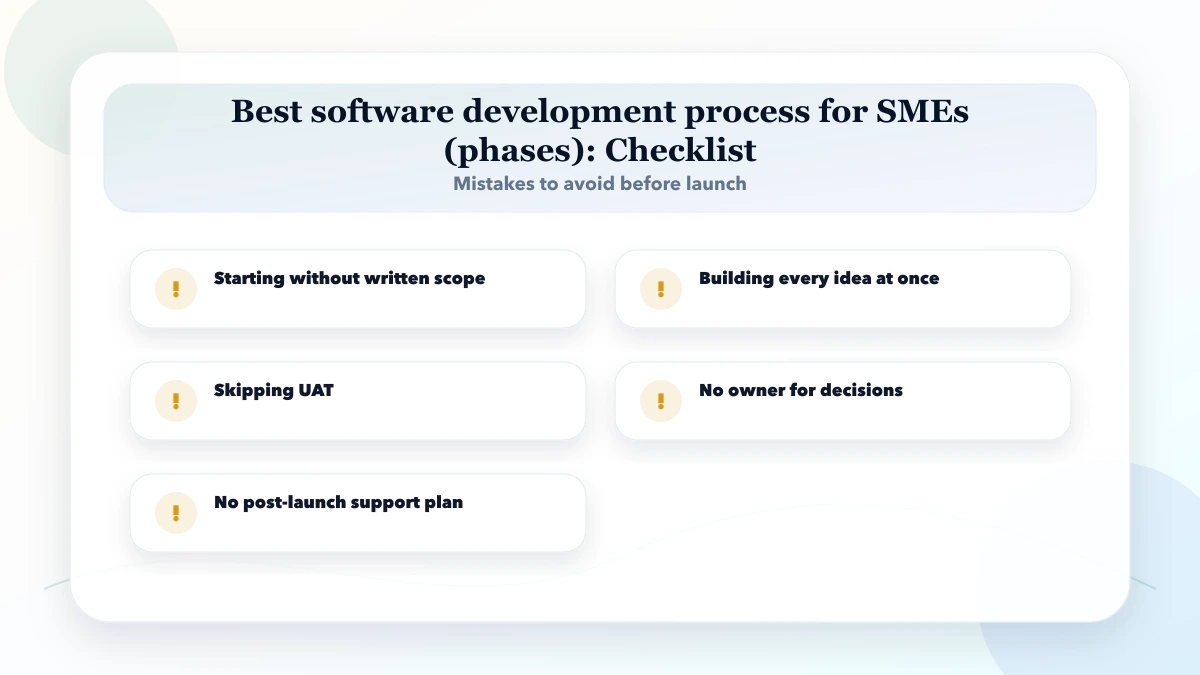
Avoid defining completion as “deployed.” Completion also needs accepted workflows, reconciled data, trained users, credentials under business control, backup and rollback, monitoring, known limitations, and support ownership.
It is for Indian SME owners, operations heads, and founders who want custom software without confusion, scope gaps, or surprise cost. The goal is to make decisions practical for Indian SMB budgets, staff, and timelines.
Start with map business problem. This keeps the project grounded in the real business problem instead of random feature requests.
Treat the table as an early range. A quote becomes reliable after workflows, rules, integrations, roles, migration samples, acceptance tests, deployment ownership, and support expectations are written.
Yes. Each phase should still produce a usable, supported outcome rather than half of several modules. Later releases should respond to adoption evidence and operational priority.
Document the problem, current and target workflow, users, permissions, records, validation, reports, exceptions, migration, acceptance scenarios, change decisions, credentials, deployment, backup, training, and support.
The biggest risk is starting without written scope. It creates delays, unclear ownership, and avoidable rework.
Yes. VASUYASHII can facilitate discovery, prepare PRD or SRS artifacts, design the workflow, build the approved release, validate migration, support UAT and training, and document handover.
After defining phases, convert them into a measurable six-month software roadmap, prepare role-based staff training, and use the SME software handover checklist before final acceptance.
If you are planning SME software, share the current process, sample sheets or forms, user roles, required outputs, known exceptions, and release constraint. VASUYASHII can shape them into a phased delivery and acceptance plan.
Related Articles
May 10, 2026
A practical software SRS template for SMEs covering roles, workflows, data, business rules, integrations, acceptance criteria, migration, and change control.
Read article
March 21, 2026
Website development process explained for 2026 with discovery, sitemap, wireframes, UI design, SEO setup, speed, QA, launch, and maintenance.
Read article
May 19, 2026
Prevent software scope creep with a practical change-control process, acceptance criteria, decision owners, impact estimates, and phased delivery rules.
Read article
May 10, 2026
NDA ownership clause: practical checklist, template, pricing, timeline, mistakes, FAQs, clear owner-safe guidance, and next steps for Indian SMBs today.
Read article