
May 21, 2026
Website Project Timeline: Milestones and Approvals
Plan a website project timeline with discovery, content, design, development, testing, approval milestones, launch responsibilities, and delay controls.
Read articlePublished Updated
Compare Agile, Waterfall and hybrid delivery for SMB software projects using requirement stability, budget, review capacity, risk and acceptance needs.
Agile and Waterfall are delivery methods, not guarantees of speed or quality. An Indian small business can fail with either method if requirements have no owner, decisions are delayed, acceptance is vague, or every new request is treated as part of the original price.
The practical question is not "Which method is modern?" It is: How stable is the workflow, how often can the business review working software, and which risks must be resolved first?
For many custom CRM, booking, inventory, dashboard, and automation projects, a hybrid model works best: define business rules, boundaries, data, integrations, and acceptance upfront; deliver the confirmed scope in short reviewable increments.
| Project condition | Better starting model | Reason |
|---|---|---|
| Requirements are regulated, contractual, or highly stable | Waterfall or milestone-led | Approval and traceability matter more than frequent reprioritisation |
| Users cannot explain the workflow until they see it | Agile | Working increments expose misunderstandings early |
| Budget is capped but priorities can change | Time-boxed Agile | The team protects time and changes the priority list, not the budget silently |
| Fixed launch date and fixed essential scope | Hybrid | Freeze the release baseline, then review implementation in short cycles |
| Legacy migration or risky integration is central | Discovery plus technical spike | Resolve unknowns before promising a full plan |
| Owner can review only once every few weeks | Milestone-led hybrid | Pure sprint delivery will stall without frequent decisions |
Waterfall organises work into sequential stages: discovery, specification, design, development, testing, acceptance, and launch. A stage is substantially approved before the next begins.
It is useful when the business can describe the expected result in detail. Examples include reproducing an approved invoice format, implementing a known approval chain, or replacing an existing workflow without changing policy.
A good Waterfall project still needs demonstrations. "Waterfall" should not mean disappearing for four months and revealing the complete system at the end. Visual design, data samples, and risky rules should be validated before full implementation.
The website project agreement guide explains how scope, acceptance, dependencies, and change handling should appear in a practical agreement.
Agile delivers small usable increments, reviews them with stakeholders, and adjusts the next priorities using what was learned. It is valuable when the solution is clearer than the exact interaction.
For example, a service company may know it needs lead assignment and follow-up control but may not know which pipeline stages, reminder rules, or manager reports staff will actually use. A short cycle can validate one lead flow before the team builds every dashboard.
Agile does not mean unlimited changes for a fixed fee. A responsible Agile engagement still defines:
Use a fixed discovery and release baseline, followed by incremental delivery.
This protects the commercial baseline while allowing the interface and operational details to improve with evidence.
Ask three employees to describe the same workflow separately. If their answers conflict, the workflow is not stable enough for a detailed fixed specification. Begin with discovery and a prototype.
If the policy, document, and approval steps are already written and consistently followed, milestone-led delivery is easier.
Agile requires a product owner who can answer questions, inspect a build, provide data, and accept or reject work every week. If the owner is unavailable, short sprints do not create agility; they create waiting time.
Assign one accountable decision-maker and named reviewers for finance, sales, operations, or compliance. Reviewers advise; the owner resolves conflicts.
There are three honest commercial choices:
"Fixed everything with unlimited flexibility" is not a real model. Before comparing quotes, use a module-level estimate such as the software cost module method.
Unknown API behaviour, damaged legacy data, offline requirements, complex calculations, or unusual performance targets should be tested through a small technical spike. The output is evidence: a working connection, migration sample, benchmark, or confirmed limitation.
Do not hide uncertainty inside a large optimistic estimate.
Define acceptance for every deliverable. A useful criterion is observable: "A manager can approve a discount above 10%, the action is logged, and staff cannot bypass the rule." "Discount module complete" is not testable.
The software handover checklist should also be agreed before launch, not negotiated after final payment.
Consider a service business replacing spreadsheet lead tracking.
| Week | Delivery focus | Business responsibility |
|---|---|---|
| 1 | Discovery, data sample, role matrix | Confirm owners, sources, stages, reports |
| 2 | Prototype and release baseline | Approve flow and exclusions |
| 3 | Lead capture, duplicate rule, assignment | Test real lead examples |
| 4 | Pipeline, notes, tasks, reminders | Review daily staff workflow |
| 5 | Manager visibility and reports | Validate filters and definitions |
| 6 | Website or WhatsApp integration | Test failure and retry cases |
| 7 | Migration trial and user acceptance | Reconcile sample totals and ownership |
| 8 | Training, controlled launch, support | Approve go-live and issue ownership |
This is illustrative, not a universal timeline. Data condition, integrations, number of roles, and response time from stakeholders can change it substantially.
Every requested change should record:
Small changes can have broad effects. Adding "branch" to a customer record may also affect permissions, duplicate rules, assignment, reporting, migration, and exports.
A useful 30-minute review answers:
Do not spend the review reading status slides that could have been sent earlier. Use the time to inspect software and make decisions.
Our project scoping process separates fixed business rules from uncertain interaction details before recommending a delivery method.
For a custom software development project, we first separate stable business rules from uncertain interaction details. High-risk data and integration work is identified before the delivery forecast. The resulting plan can use fixed milestones, time-boxed iterations, or a hybrid based on the actual risk rather than a fashionable label.
To discuss a specific workflow, share the current process, sample records, user roles, required reports, and target launch through the contact page.
No. Agile can reduce the time to a useful first increment, but total delivery depends on scope, decisions, data, integrations, and quality. Slow feedback can make an Agile project slower than a well-defined milestone project.
Yes, when time and team capacity are capped and priorities can move. The business must accept that newly added work may replace lower-priority work or move to a later release.
Yes. Early prototypes and milestone demonstrations reduce misunderstanding. Sequential governance does not require delaying all user feedback until the end.
Usually hybrid. Data model, roles, core transactions, migration, and release boundary need upfront clarity. Screen details, reports, and lower-priority automation benefit from incremental review.
One or two weeks is common, but the right duration is the shortest period in which the team can complete and demonstrate an accepted increment. A sprint has little value if stakeholders cannot review that often.
Record the impact, estimate it, and decide whether cost, timeline, or another priority changes. The decision should be explicit instead of silently expanding the original commitment.
Related Articles
May 21, 2026
Plan a website project timeline with discovery, content, design, development, testing, approval milestones, launch responsibilities, and delay controls.
Read article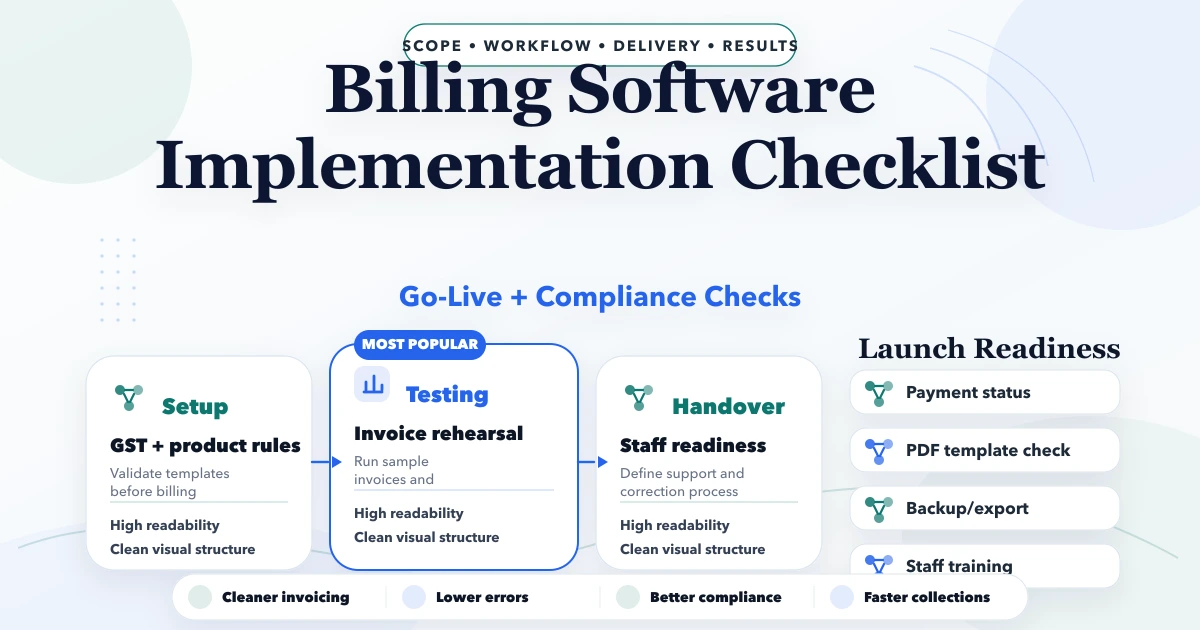
April 26, 2026
Billing software implementation checklist with GST setup, rollout phases, cost, timeline, training, and practical launch steps for Indian SMBs.
Read article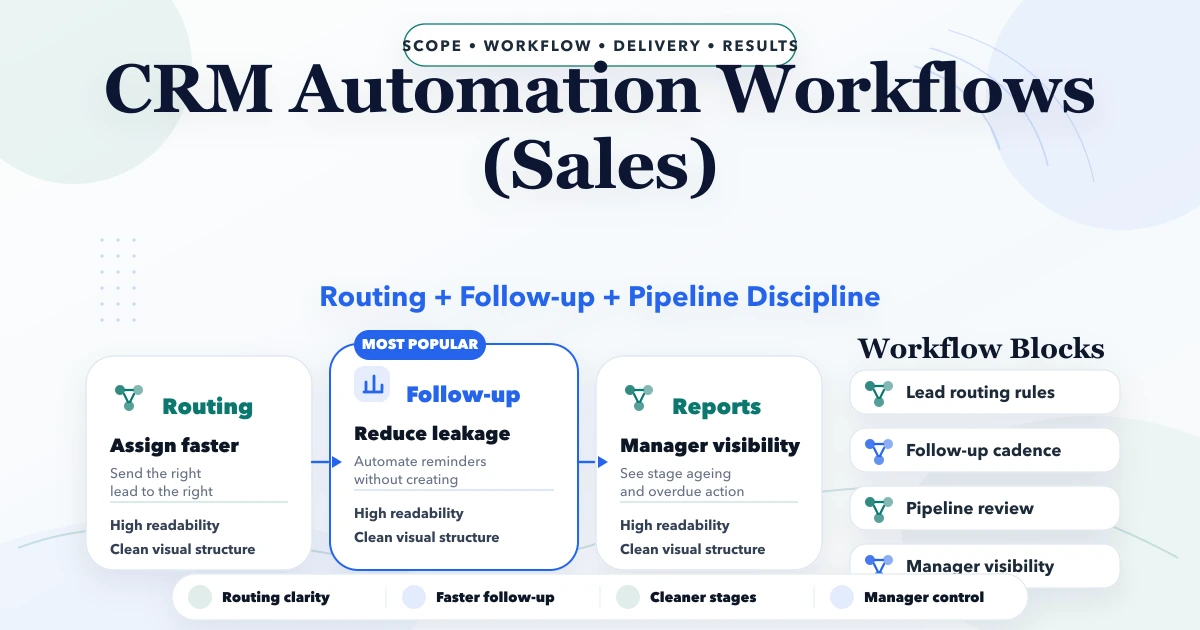
April 29, 2026
CRM automation workflows for sales with lead routing, follow-up rules, task logic, reporting, pricing, and implementation guidance for SMBs.
Read article
May 19, 2026
Prevent software scope creep with a practical change-control process, acceptance criteria, decision owners, impact estimates, and phased delivery rules.
Read article