
March 28, 2026
Software Development Company in Delhi NCR
Software development company in Delhi NCR: pricing, process, deliverables, timelines, and how businesses choose the right partner in 2026.
Read articlePublished Updated
Compare fixed, modular, time-and-material, and hybrid custom software pricing with scope rules, cost drivers, change control, payment milestones, and examples.
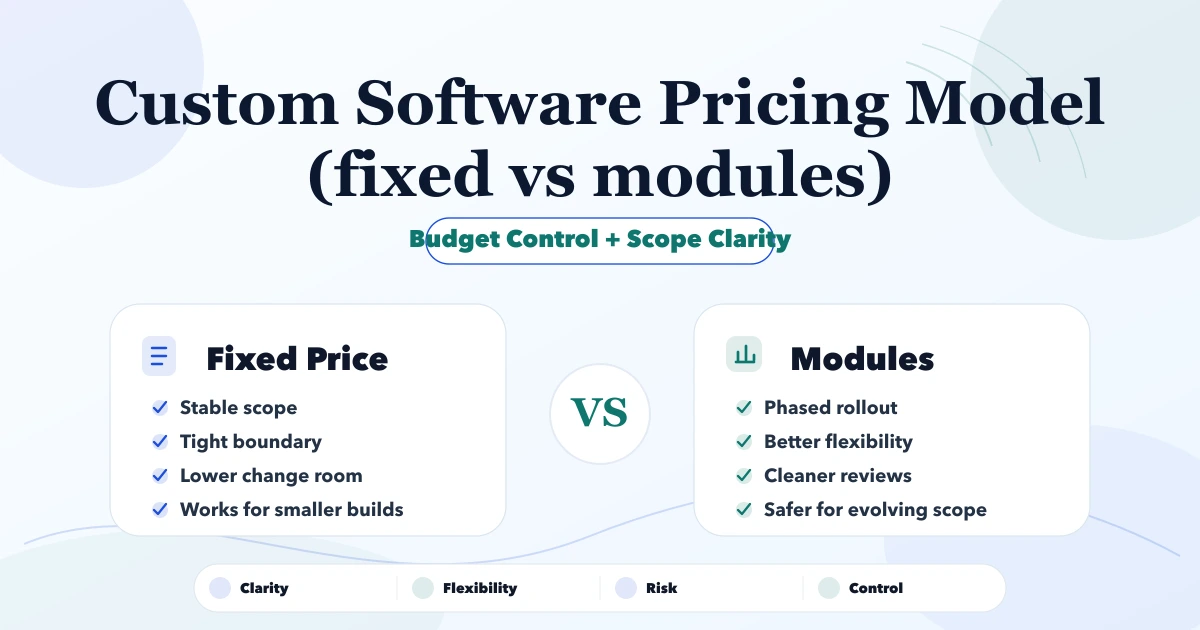
Custom software pricing is a way to allocate uncertainty. A fixed quote moves defined-scope risk to the vendor, modular pricing isolates work into business capabilities, and time-and-material pricing keeps discovery open while the buyer controls priorities and budget.
The right model depends on how stable the workflow is, how many external dependencies exist, and whether acceptance can be written before development. This guide shows how to compare commercial models without treating the lowest initial number as the lowest total cost.
By Tushar C. (Founder, VASUYASHII). Reviewed by VASUYASHII Editorial for scope clarity, delivery practicality, SEO usefulness, and buyer relevance for 2026.
Serving Delhi NCR: Ghaziabad, Noida, Delhi, Gurugram, Faridabad, and nearby growth markets.
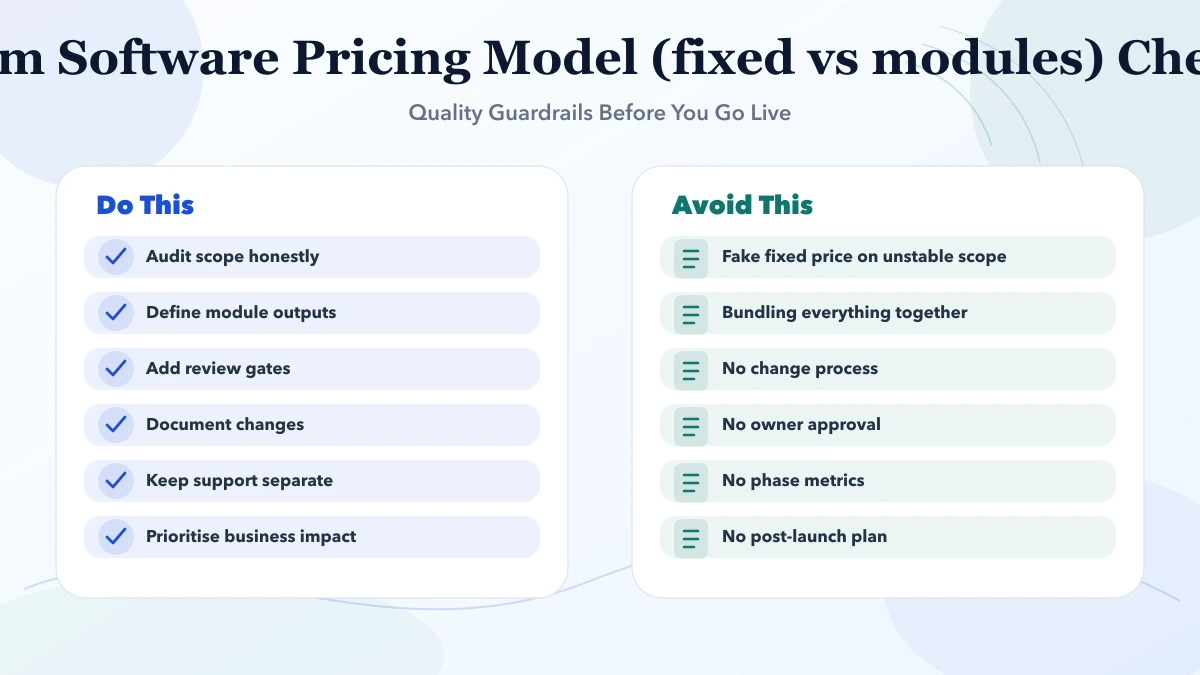
Fixed-price custom software works when scope is genuinely stable and small. Module-based pricing works better when the workflow is evolving, integrations are unclear, or the team needs a safer phased rollout. For most SMB projects, modular pricing reduces risk better than pretending scope is fully locked when it is not.
Current VASUYASHII evidence includes scoped workflow applications and the VASUYASHII Business Suite, where billing, inventory, purchases, payments, expenses, reports, and company boundaries depend on shared foundations. This experience shows why pricing individual screens without pricing data rules, permissions, reports, deployment, and support creates a weak estimate. It is not a claim that one budget or delivery model fits every client.
Custom software can look expensive when it is compared only with one monthly subscription. A fair comparison includes the cost of workarounds, duplicate entry, disconnected tools, reporting effort, training, migration, hosting, maintenance, and future change. The pricing model should expose those obligations instead of hiding uncertainty inside a low opening quote.
This guide is for business owners comparing custom software quotations, founders defining an MVP, and operations teams planning a phased internal system. It is especially useful when vendors have quoted different scopes or used “fixed price” without matching acceptance criteria and exclusions.
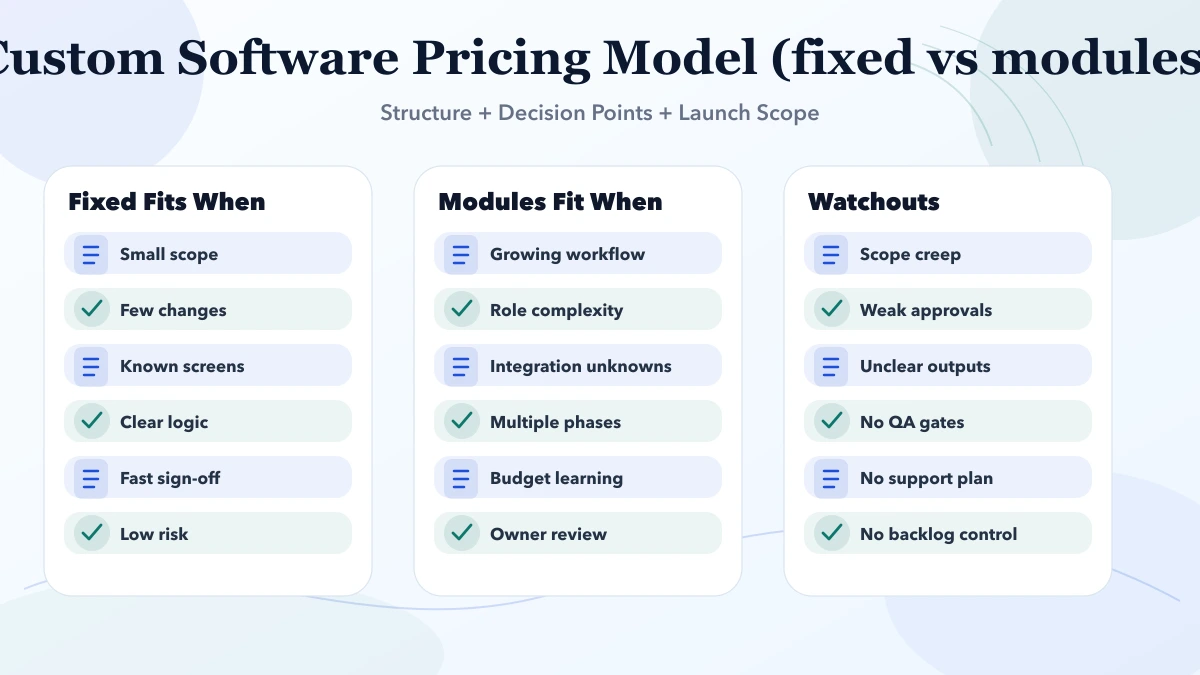
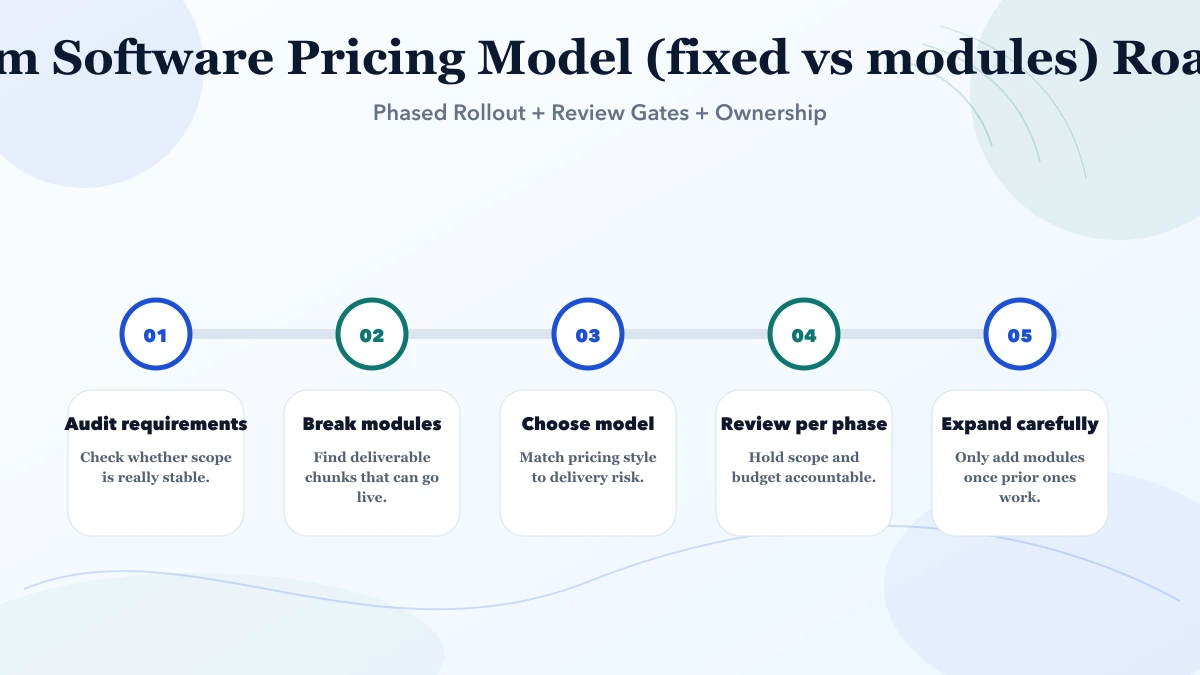
Good execution begins with a signed commercial baseline and ends each milestone with reviewable evidence. The buyer can see which workflow is usable, which assumptions remain open, which changes affect cost, and what must pass before payment or expansion.
There is no universal price for custom software. A focused workflow may require tens of thousands of rupees, while a multi-module system with migration, integrations, roles, reports, and support can require several lakhs. Use the illustrative bands below only for early planning; a reliable quotation requires workflow, data, exceptions, acceptance, deployment, and support details.
Choose one measurable workflow, include the minimum controls needed to operate it safely, and defer unrelated modules. Do not save money by removing permissions, validation, backup, error handling, acceptance testing, or handover. Those are lifecycle controls, not optional polish.
| Situation | Safer model | Why |
|---|---|---|
| stable workflow and testable acceptance | fixed scope | price and delivery boundary can be defined |
| known platform with optional capabilities | modular | buyer can activate value in controlled phases |
| uncertain workflow or new integration | paid discovery or time-and-material | learning is expected and visible |
| fixed launch objective with uncertain details | hybrid | discovery reduces risk before a fixed implementation phase |
| ongoing product backlog | capped monthly capacity | priorities can change without rewriting the whole contract |
Fixed scope is not the same as unlimited revisions. It requires explicit screens, roles, data rules, integrations, migration assumptions, non-functional requirements, and acceptance tests. Modular pricing is not simply charging for every menu item; shared foundations such as authentication, company scope, audit, deployment, and design components must be allocated transparently.
A safer payment schedule attaches money to reviewable outcomes: approved discovery, accepted prototype, working staging workflow, migration rehearsal, production release, and handover. “Fifty percent complete” is difficult to verify. “Customer, product, invoice, payment, and report acceptance tests passed on staging” is specific.
For the buyer, keep a decision log and a change register. For the vendor, record assumptions and dependencies. When a requested change affects data structure, permissions, integration behavior, migration, or reports, estimate its schedule and cost impact before implementation.
For planning only, a lean internal tool or focused workflow may begin around ₹35,000 to ₹1.5 lakh. A multi-module business phase may fall around ₹1.5 lakh to ₹4 lakh. A custom platform with several roles, integrations, migration, reports, and operational support can reach ₹4 lakh to ₹12 lakh or more. These are not VASUYASHII quotations; an actual quote depends on verified scope, risks, quality requirements, and support.
Compare total ownership cost, not only build cost. Include hosting, third-party subscriptions, messaging, payment charges, backups, monitoring, maintenance, security updates, content/data ownership, training, and future change capacity.
It is expensive when the build duplicates a standard product, tries to replace every process at once, or begins without stable requirements. It can be commercially reasonable when one focused system removes recurring operational loss and the business can support it over time.
Compare at least three numbers: first-release cost, annual operating cost, and the measured cost of the current process. Do not claim ROI from assumed time savings. Establish a baseline before launch, then compare the same metric after adoption.
Current VASUYASHII capability includes scoped web applications, business workflow software, integrations, and the live Business Suite. The product demonstrates billing, inventory, purchases, payments, expenses, reports, secure PDF sharing, and multi-company architecture. It should not be read as evidence that every custom requirement or advanced accounting feature already exists.
Use the accurate software quote checklist before comparing proposals. For broader use cases and planning bands, read the custom business software cost guide.
The commercial baseline should describe users, roles, workflows, data entities, calculations, approvals, notifications, reports, integrations, migration, environments, testing, deployment, training, support, and explicit exclusions. Screenshots alone are insufficient because the expensive work often sits behind them.
Write assumptions beside the price. Examples include one company versus multiple companies, one warehouse versus many, a fixed CSV format, a provider with documented APIs, a named number of report templates, or one approval cycle. When an assumption changes, both parties can see why the estimate changes.
A good module owns a coherent business capability. Customer management, product master, purchasing, invoicing, payment collection, expense recording, and reporting can be phased, but they share identity, permissions, company scope, audit, document numbering, and deployment foundations.
Avoid creating artificial modules around individual buttons. The price should expose shared platform work separately so buyers understand why adding the first module can cost more than adding a later one.
| Module question | Decision to document |
|---|---|
| data ownership | which records the module creates and controls |
| dependency | which foundation or previous module is required |
| permissions | who can view, create, approve, cancel, and export |
| acceptance | complete workflow and edge cases to test |
| migration | source format, cleaning owner, rehearsal, cut-off |
| reporting | definitions, filters, timing, and reconciliation |
| integration | provider, credentials, limits, failures, retries |
| support | warranty, incident severity, response, and change process |
Phase zero can be a paid discovery engagement producing process maps, data definitions, risk register, prototype, integration check, and implementation estimate. Phase one can then become fixed scope because the uncertainty has been reduced. Later improvements can use modular estimates or capped monthly capacity.
This model is useful when the buyer needs budget control but cannot define the workflow confidently at the start. Discovery should produce reusable artifacts and a clear stop decision, not merely a sales presentation.
Score each proposal from one to five for workflow understanding, scope specificity, acceptance tests, technical risk, data migration, permission design, integration handling, ownership, support, and price transparency. A cheap proposal with undefined migration or acceptance should not automatically outrank a higher proposal that exposes the real work.
Ask vendors to demonstrate comparable capability accurately. Separate live products, client work with permission, internal prototypes, and fictional demos. Do not accept invented client results or assume a module exists because it appears in a mockup.
The strongest cost control is evidence-based scope. Negotiating a lower rate cannot compensate for unclear responsibilities or rework.
Before signing, confirm the quotation version, tax treatment, payment dates, acceptance owner, warranty, support hours, hosting responsibility, source access, data export, third-party charges, cancellation terms, and treatment of unfinished work. Store these with the approved scope and change register.
The buyer and vendor should both be able to explain what becomes usable at each milestone. If that explanation depends on “we will decide later,” price the uncertainty through discovery or flexible capacity instead of hiding it inside a fixed promise.
No. It works well for smaller, stable scope builds. The risk starts when teams pretend unstable requirements are fixed.
Because they create clearer review checkpoints, better phase-wise budget control, and less pressure to predict every detail upfront.
Yes. Discovery and one small module can be fixed, while later modules can be estimated separately.
Weak scope documentation, unclear ownership, and informal change requests usually cause the biggest disputes.
Basic stabilisation can be included, but ongoing SLA support should usually be defined separately.
Yes. We can review the workflow and recommend a safer pricing and delivery structure.
Related Articles
March 28, 2026
Software development company in Delhi NCR: pricing, process, deliverables, timelines, and how businesses choose the right partner in 2026.
Read article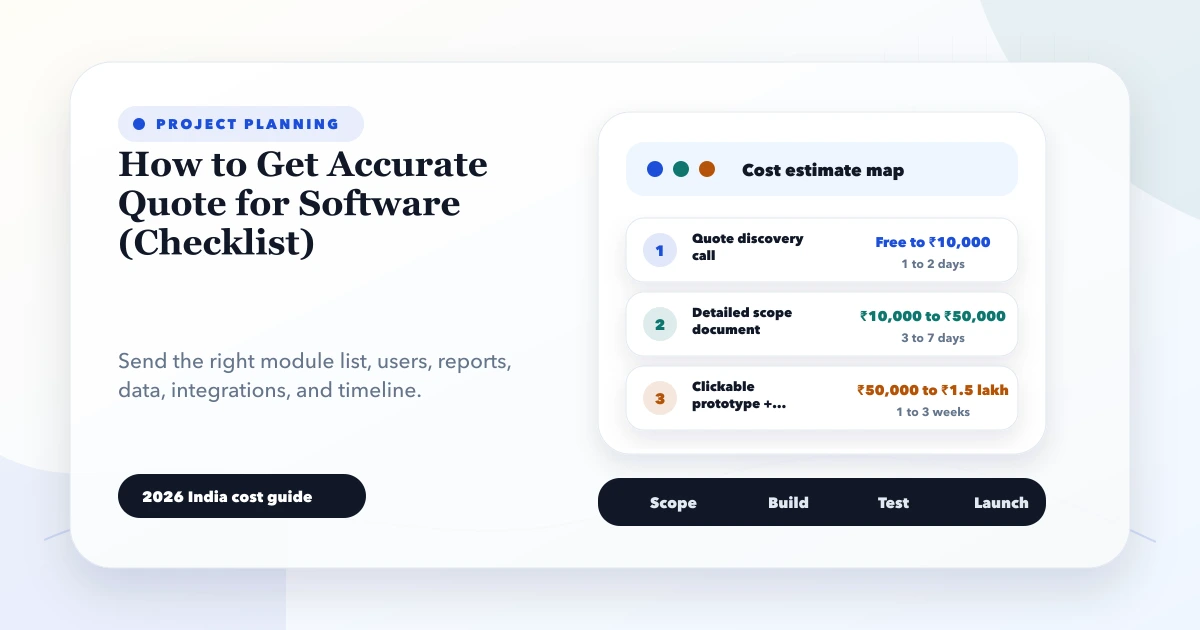
May 28, 2026
accurate software quote checklist: 2026 India pricing guide with modules, timeline, cost drivers, mistakes, quote checklist, and practical planning ranges.
Read article
May 10, 2026
website project scope document template: practical checklist, template, pricing, timeline, mistakes, FAQs, and clear owner-safe guidance for Indian SMBs.
Read article
May 24, 2026
Use a phased small-business ERP implementation roadmap covering process ownership, master data, migration, pilots, controls, training, and go-live support.
Read article