
April 23, 2026
How to Write an SEO-Friendly Portfolio Case Study
Write an SEO-friendly portfolio case study with approved evidence, clear decisions, honest outcomes, useful visuals, internal links and buyer-focused structure.
Read articlePublished Updated
Copy a software development agency portfolio case study template with a filled example, evidence checklist, client approvals and conversion-ready CTA.
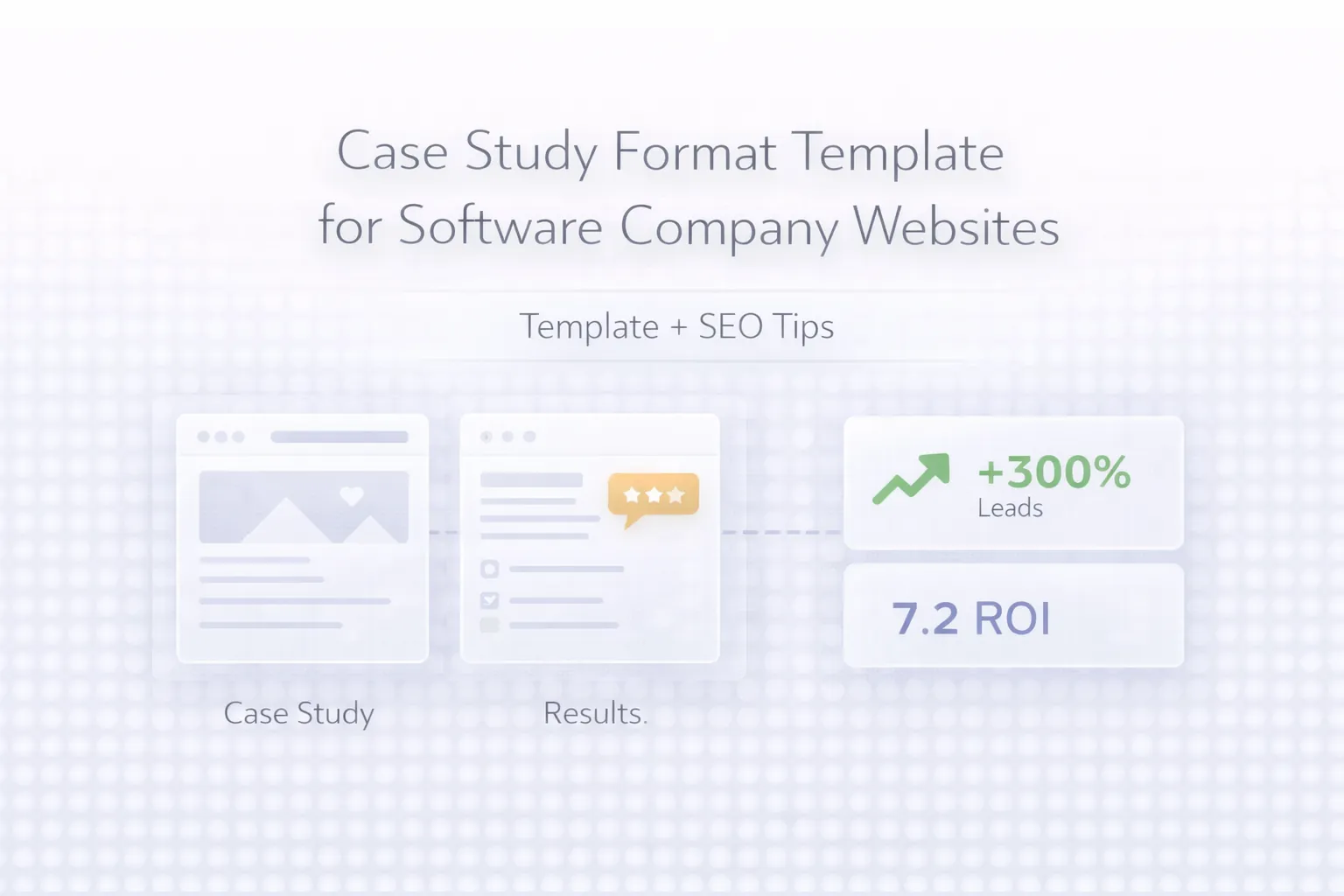
A useful software development agency portfolio case study template must do more than display a screenshot, technology list, and short testimonial. It should explain the starting problem, the agency's exact role, the workflow delivered, the evidence available, and what changed after launch.
If you need the format immediately, jump to the copy-ready portfolio case study template. If you want to evaluate finished examples first, review the VASUYASHII implementation case-study portfolio, where each study separates verifiable evidence from claims that cannot be supported publicly.
This guide includes the copy-ready format, three first-party portfolio examples, an approval workflow, an anonymized writing example, proof rules, SEO guidance, and a structure that avoids unsupported outcome claims.
A strong software case study usually includes:
The goal is not to write a brag post. The goal is to let a future buyer verify three things quickly: the agency understood a similar workflow, delivered a defined scope, and can separate proven outcomes from unverified assumptions.
| If you need | Start here | What you will get |
|---|---|---|
| A reusable writing format | Copy-ready template | A section-by-section brief for client context, problem, scope, evidence, outcome, and CTA |
| Real software-company examples | Implementation case-study portfolio | Published examples with screenshots, dated evidence, validation, and explicit claim boundaries |
| One worked writing example | Anonymized operations-dashboard example | A safe example that demonstrates the format without pretending to be a client result |
| Help creating a proof page | Send your project requirement | A route to discuss content, design, screenshots, approvals, and page development |
Case studies reduce buyer uncertainty. In software projects, uncertainty is usually high because the buyer cannot fully judge quality from visuals alone.
Many teams finish projects and move on. They do not pause to structure the story, capture proof, and publish it in a way that future clients can understand quickly.
Related reading:
Here is a practical template that works for most software company websites.
Start with a clear headline. Example:
How We Built a CRM Dashboard for a Service Business That Reduced Follow-up Delays
This instantly makes the page more useful than a vague title like "CRM Project."
Explain who the client is without oversharing sensitive details. Mention industry, team size, or business type if possible.
What was broken, slow, manual, or confusing before the project started? This is where future buyers start seeing themselves in the story.
List what the project needed to achieve. Better reporting, faster order handling, cleaner approvals, improved lead tracking, and so on.
Explain what was actually built. Modules, roles, dashboards, integrations, customer portal, mobile flow, or admin system.
Describe discovery, wireframes, development, testing, and rollout in a concise way. This shows maturity.
Good case studies do not pretend the project was magically easy. Mention real implementation challenges and how they were handled.
Use clear outcomes where possible: time saved, reporting clarity, reduced manual work, better lead response, improved user adoption, or fewer errors.
Include screenshots, workflow diagrams, or section visuals. Visual proof improves trust quickly.
Finish with a CTA that connects the reader to a relevant service or contact step.
Use the following structure as a writing brief. Replace every bracketed instruction with a verified fact; do not publish the instructions themselves.
Title: How [client type] improved [verified workflow or outcome]

Client context
[Industry, operating model, team or branch context, and whether the name is approved.]

Starting problem
[What was manual, delayed, duplicated, risky, or difficult to measure before the project?]

Success definition
[What observable change would make the project useful? Include the measurement owner.]

Agency role and scope
[Discovery, UX, frontend, backend, integration, migration, QA, deployment, or support actually delivered.]

Solution and workflow
[Explain the user roles, records, decisions, integrations, and failure states.]

Constraints and trade-offs
[Budget, timeline, data quality, legacy systems, phased exclusions, or compliance boundaries.]

Evidence
[Approved screenshots, acceptance-test results, analytics, operational records, or attributed client feedback.]

Outcome
[Use a measured number only when its source, period, and owner are known. Otherwise state the observed operational change.]

Next phase
[What remains outside the delivered scope or is planned later?]

CTA
[Link the reader to the relevant service or a context-preserving contact form.]
This format is intentionally different from a gallery item. A portfolio card can help discovery, but the case study page must explain delivery and evidence in enough detail for a buyer to evaluate relevance.
Client context: a multi-user service business needed one place to review enquiries, task ownership, and overdue follow-ups. The client name and commercial data were not approved for public use.
Starting problem: staff updated separate sheets, managers could not see ownership consistently, and weekly reporting required manual reconciliation.
Phase-one scope: role-based login, lead records, assignment, status history, filters, overdue queues, exports, and an owner summary. Marketing automation and advanced forecasting were explicitly excluded.
Evidence that can be published: approved interface screens with private data removed, the signed-off module list, role/permission matrix, acceptance-test scenarios, and an attributed statement about the previous reporting process. A percentage improvement should appear only if baseline and post-launch records were measured consistently.
CTA: connect the proof to web application development or custom software development, not to an unrelated generic enquiry.
The example is a template, not a claim that VASUYASHII delivered this exact anonymous project. That distinction protects trust while showing how a real software case study should be structured.
The strongest portfolio pages show real delivery decisions and also state what their evidence does not prove. These VASUYASHII examples use that standard:
| Case study | What it demonstrates | Evidence boundary |
|---|---|---|
| Business Suite ERP-lite product build | Product modules, architecture decisions, current interface screens, and rollout boundaries | Demonstrates VASUYASHII's product work; it does not claim a customer's revenue or adoption result |
| 616-post SEO content-library recovery | Repository inventory, editorial decisions, validation layers, and preserved public URLs | Reports source-library changes; it does not promise rankings, traffic, or lead growth |
| Confirmed website lead tracking | Form acknowledgement, service context, analytics boundaries, and failure handling | Confirms implementation and validation steps; it does not claim every enquiry became a sale |
Together, the case-study portfolio and the template on this page serve two different buyer needs: examples show whether an agency documents real work, while the template helps a team create its own proof page consistently.
Before publication, create a small evidence register:
| Claim or asset | Evidence owner | Publication permission | Safe wording |
|---|---|---|---|
| Client name and logo | Client sponsor | Written approval required | Use only the approved legal or brand name |
| Screenshot | Product owner | Confirm data is safe to display | Blur or replace personal and confidential data |
| Time or cost saving | Operations/finance owner | Confirm period and method | State baseline, comparison period, and limitations |
| Testimonial | Named speaker | Approve exact quotation and attribution | Do not rewrite praise into a stronger claim |
| Technology list | Delivery lead | Confirm production use | Separate evaluated tools from tools actually shipped |
If the client cannot be named, anonymize the business while preserving useful workflow detail. If outcomes were not measured, report delivered capabilities and acceptance evidence instead of inventing a percentage. This follows the people-first principle in Google Search Central's helpful content guidance: give readers original, useful information and make expertise and sourcing clear.
Case studies can also become valuable search assets if written properly.
Buyers often search by outcome or problem, not only by technology.
Link to the service that delivered the work, related implementation guides, and a context-preserving contact route. This helps discovery without reviving outdated portfolio claims.
Clear headings improve readability and help search engines understand the structure.
Most buyers will scan. Use sections, bullets, short paragraphs, and proof blocks.
Screenshots without business explanation do not carry enough value.
These are the mistakes that make software case studies weak:
If you hire someone to convert completed projects into polished case studies, typical pricing depends on research depth and asset quality.
₹6,000 to ₹15,000₹15,000 to ₹40,000₹40,000 to ₹1 lakh+If the project also requires design, screenshots, layout updates, and page development, total cost goes beyond content alone.
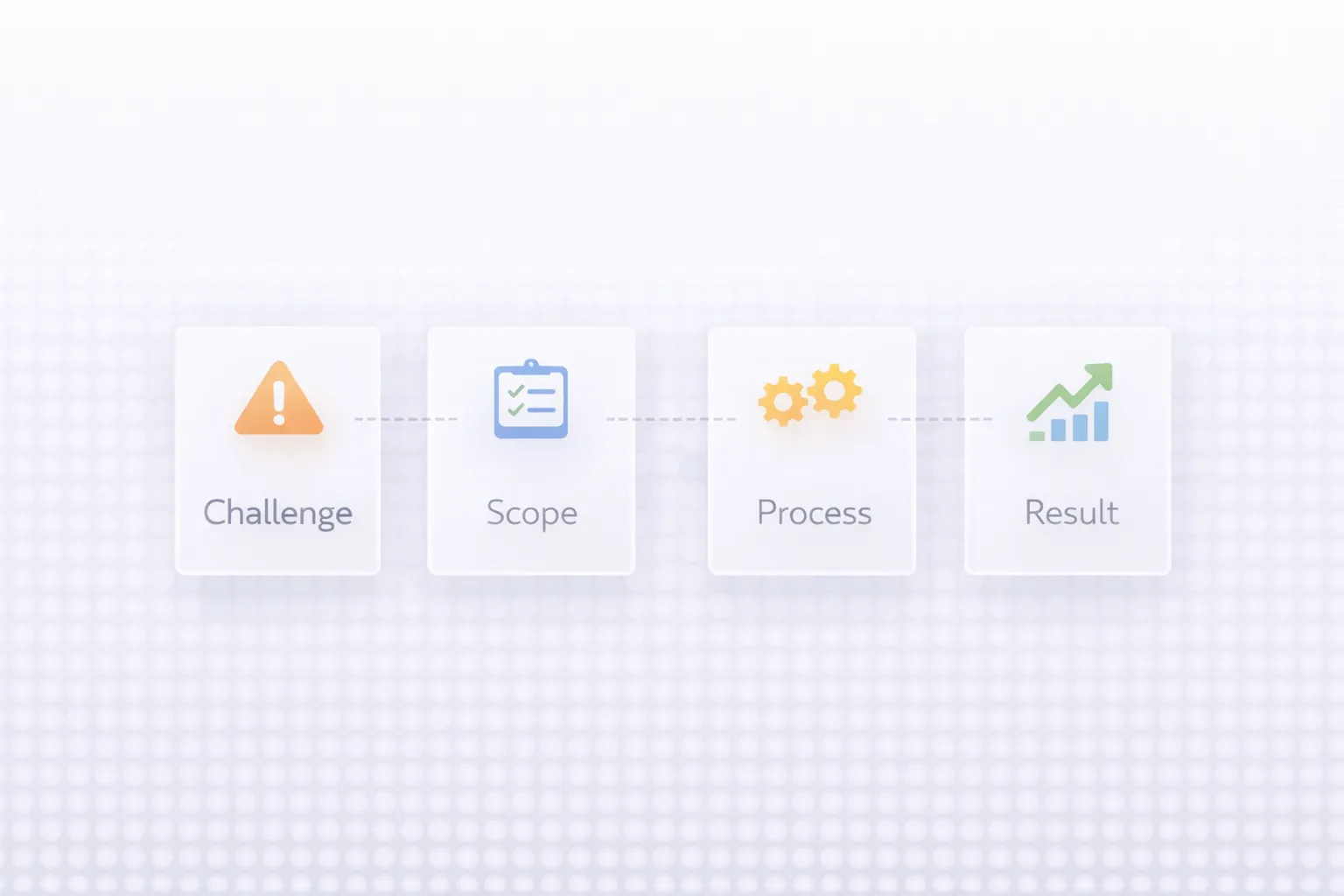
The publishing setup matters more than many teams think.
A good case study can usually be built in a few days if the project details are available.
The biggest delay is often not writing. It is collecting accurate proof and approvals.
Case study production cost depends on:
The biggest blocker is often weak documentation after project delivery. Good projects become great case studies only if proof is captured properly.
Because case studies show real proof of problem-solving, which builds trust faster than generic service claims.
Even 3 to 5 strong case studies can add major credibility if they cover different use cases well.
Usually business outcome first, with technology supporting the story where relevant.
Yes, especially when they target problem-driven queries and are internally linked properly.
You can still publish anonymized case studies with industry context and proof structure.
No. Choose the ones that are strongest in relevance, clarity, or business impact.
Writing a vague success story with no real challenge, scope, or outcome.
Yes. That is one of its biggest strengths. Good case studies help both website conversion and sales trust-building.
If you want your completed projects to work harder for sales and trust, the next step is to turn them into structured case studies with clearer story, proof, and CTA flow.
Related Articles
April 23, 2026
Write an SEO-friendly portfolio case study with approved evidence, clear decisions, honest outcomes, useful visuals, internal links and buyer-focused structure.
Read article
May 14, 2026
Practical lead magnet ideas for software companies, with qualification flows, measurement rules, Indian B2B examples, mistakes, and launch checklists.
Read article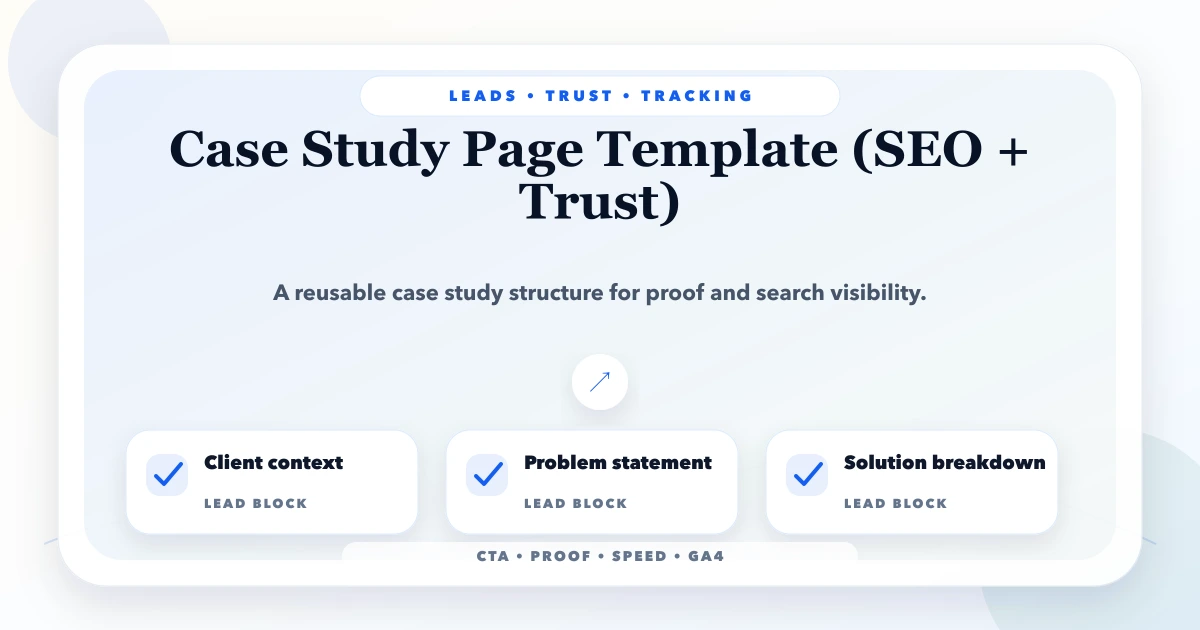
May 20, 2026
Write credible case studies with context, constraints, decisions, delivery evidence, attribution and privacy. Use this template without inventing claims.
Read article
May 14, 2026
portfolio SEO plan case studies: practical 2026 SEO plan with cluster map, pricing, roadmap, mistakes, FAQs, proof, and next steps for Indian SMBs today.
Read article