
First-party SEO implementation
How We Rebuilt a 616-Post SEO Content Library
VASUYASHII used its own website as the working system: inventory every post, separate real content debt from monitoring labels, improve one evidence-led batch at a time, and preserve public URLs while Google recrawls the changes.
- Evidence date
- 3 August 2026
- Useful for
- Content teams and service businesses with large article libraries
616
Posts inventoried
One file-based MDX library reviewed with reproducible rules.
107 to 0
Posts under 1,000 words
Baseline audit on 23 July versus the 3 August source scan.
210 to 50
Posts under 1,500 words
Depth was improved only where intent and usefulness justified it.
592
Current KEEP decisions
The remaining labels are monitoring or manual review signals.
Context
What was being solved
The 23 July 2026 audit found a technically clean website but a content library that had grown faster than its editorial controls. The 616-post inventory included 107 posts below 1,000 words, 210 below 1,500 words, 95 high-similarity pairs, reused paragraph patterns, weak contextual links, and uneven first-party proof.
The goal was not to make every article longer. The goal was to preserve useful URLs while giving each retained page a distinct job, a clear search intent, enough implementation detail, accurate metadata, and evidence boundaries that did not turn sample workflows into customer claims.
This was an internal VASUYASHII implementation. It is published because the source files, dated reports, sitemap, and current rendered pages can be checked. No client result or guaranteed Google outcome is attached to it.
Constraints
The implementation had to solve more than the visible screen.
01
A flat blog library made important commercial and support content compete with similar city, cost, and implementation pages.
02
Bulk deletion or canonical changes would have created unnecessary URL risk without fresh page and query evidence from Search Console.
03
Word count alone could reward padded content while missing duplicated paragraphs, weak proof, unclear ownership, or poor internal links.
04
Google recrawl and ranking changes happen after deployment, so source quality and search performance had to be measured separately.
Decisions
The choices that controlled the final implementation
01
Freeze public URL decisions
Normal refreshes preserved slug, publication date, cover path, canonical logic, and index controls. Merge, redirect, or noindex remained a manual decision requiring current GSC and business-value evidence.
02
Use a reproducible classifier
Each post was checked for depth, source metadata, author, FAQ and table structure, contextual links, incoming blog links, proof signals, repeated paragraphs, cluster similarity, and historical GSC opportunity data.
03
Work in focused batches
The highest-risk thin and overlapping pages were handled first. Later batches moved to striking-distance and commercial pages, where first folds, official sources, workflows, limitations, and decision guidance mattered more than another generic rewrite.
04
Separate validation layers
Source checks, production builds, generated HTML, sitemap output, live status codes, canonical metadata, and Search Console outcomes were recorded as separate evidence. A green build was never presented as proof of higher rankings.
Delivered scope
What can be verified in the implementation
A 616-post inventory with KEEP, IMPROVE, MERGE_REVIEW, and NOINDEX_REVIEW decision labels.
Dated CSV and Markdown reports that preserve the reason behind each batch selection.
Intent-specific introductions, checklists, workflows, FAQs, decision tables, limitations, and internal links.
Hub-led internal architecture for website development, web apps, custom software, local SEO, and Business Suite topics.
Final-www canonical, Open Graph, schema, sitemap, and indexability validation after material batches.
A rule to stop random rewrites and wait for fresh GSC page/query evidence after deployment.
Validation
What was checked
- The 3 August classifier reported 592 KEEP, 23 IMPROVE, 1 MERGE_REVIEW, and 0 automatic NOINDEX_REVIEW posts.
- The current source scan reports 0 posts below 1,000 words and 50 below 1,500 words.
- All 616 posts have an explicit author and FAQ section; 559 contain a table.
- The source scan finds external references on 377 posts and first-party or implementation-proof signals on 482 posts.
- The pre-authority production build generated 708 of 708 static pages and a 638-URL final-www sitemap.
Claim boundaries
What this evidence does not prove
- The before and after numbers describe the repository content inventory, not traffic, revenue, leads, or ranking improvement.
- The proof-signal and external-source counts are classifier coverage indicators; they are not a substitute for human editorial review.
- Historical GSC labels are retained for monitoring and can keep a strong page in an IMPROVE queue until fresh evidence is reviewed.
- No location page is treated as proof of a physical office, local customer, or completed project in that city.
Evidence sources
Pages and references used
- VASUYASHII blog library
Current public output of the file-based 616-post content library.
- VASUYASHII sitemap
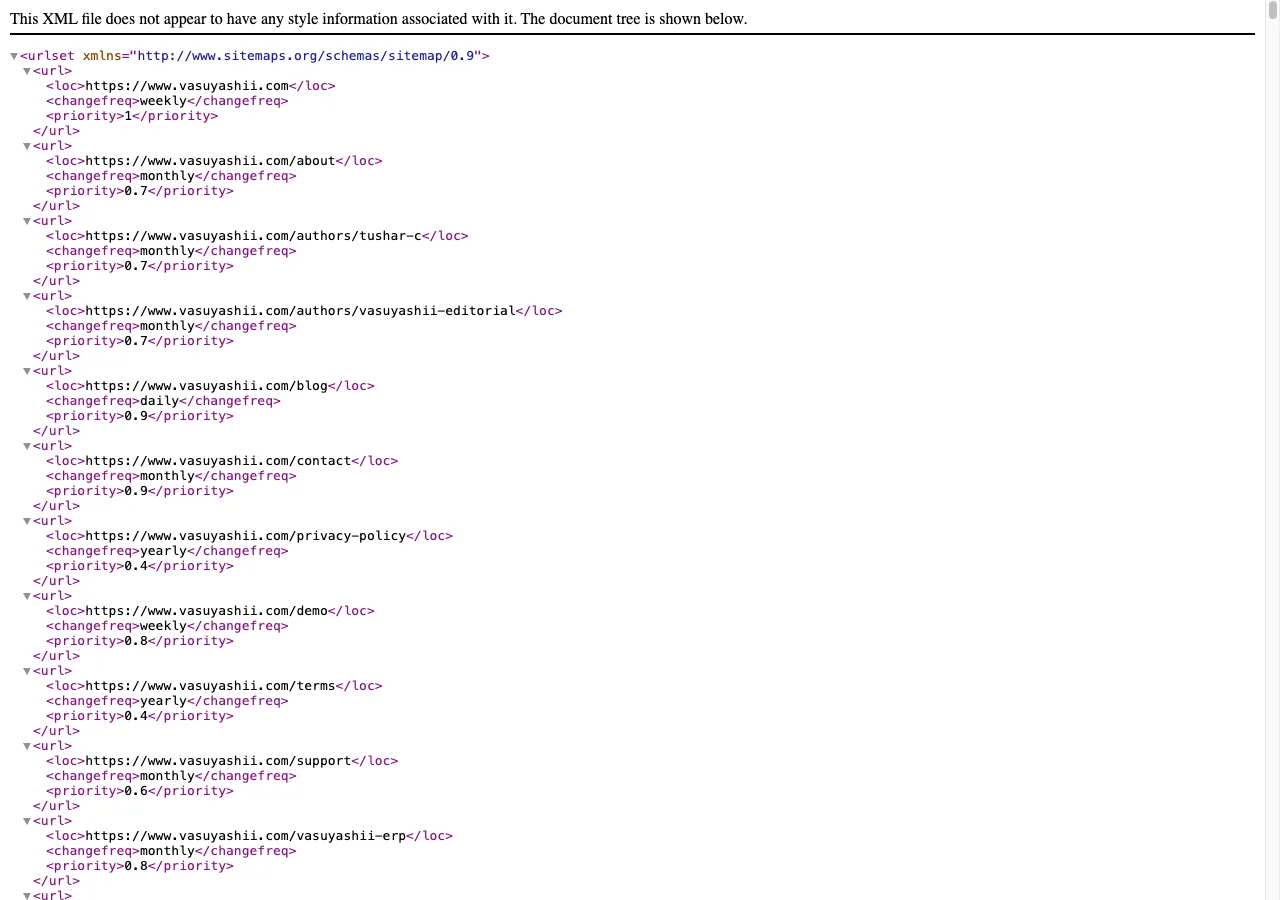
Current canonical discovery file for indexable public pages.
- Google helpful content guidance
Official context for people-first, useful, trustworthy content.
- Google spam policies
Official context for scaled content and doorway-page risk.
Continue the review
Related implementation guidance
- Website Development Delhi NCR hub
Commercial parent page for the website-development cluster.
- Local SEO hub
Editorial rules for local visibility without scaled city-page spam.
- Founder and author profile
Ownership and editorial responsibility for the implementation.
Start with one verifiable workflow.
Share the current records, users, steps, exceptions, and desired decision. VASUYASHII will compare a ready product, integration, website, or focused custom build without assuming unsupported scope.
Discuss a focused first phase