
01
Records and data control
Customer, supplier, product, transaction, document, backup, and recovery discipline.
Original VASUYASHII framework · Version 1.1
Use 18 practical questions to score how your business controls records, workflows, billing and stock, customer continuity, reporting, access, and change. The result gives three operating priorities before you compare software or automation options.
Free self-assessment
Answer for the current process, not the system you plan to buy. No answers leave this browser and no personal information is requested.
Dimension 1 of 6
How consistently the business captures customers, suppliers, products, jobs, invoices, and supporting documents.
Result locked
18 answers remain. Unanswered questions are not treated as zero because that would create a misleading readiness result.
Methodology
The assessment contains six equally weighted dimensions. Each dimension has three questions and each question scores from zero to three. The maximum raw score is 54; the displayed score converts that total to a 0-100 scale. No industry, turnover, city, or company-size adjustment is applied.
Equal weighting keeps the method understandable. It also prevents a polished dashboard from hiding weak records, shared passwords, missing backups, or an ownerless customer handoff. A business may change the weighting during a formal discovery project, but that customised result should not be presented as the same benchmark.
Version 1.0 was published on 3 August 2026. Version 1.1, published on 4 August 2026, adds the methodology record below. The questions, weights, formula, and score bands are unchanged.
01
Customer, supplier, product, transaction, document, backup, and recovery discipline.
02
Written steps, handoffs, approvals, status visibility, exceptions, and decision owners.
03
Quotations, invoices, taxes, payments, dues, purchases, inventory, returns, and review.
04
Enquiry source, follow-up, commitments, delivery, support history, and closure ownership.
05
Metric definitions, trusted source records, review frequency, and action responsibility.
06
Individual access, permissions, recovery, failure procedures, and implementation ownership.
Methodology record
For examples of how VASUYASHII records implementation decisions, validation, and claim limits, review the first-party implementation case studies.
Use the overall band to choose the size of the next change. Use the dimension scores to choose where that change should begin. A low score does not mean the business is failing; it means important work depends on people and workarounds that may become fragile as volume, branches, products, users, or compliance obligations increase.
0-24
Standardise records and one complete workflow before broad automation.
25-49
Connect fragmented tools, remove duplicate records, and assign handoff ownership.
50-74
Improve exceptions, access, recovery, management review, and measured adoption.
75-100
Automate selectively while protecting data quality, controls, and change ownership.
From score to scope
If records score lowest, clean the masters and identifiers first. If workflow ownership scores lowest, map the steps and approvals before selecting automation. If reporting scores lowest, define the decisions and formulas before requesting a dashboard. If resilience scores lowest, correct access and recovery before connecting more systems.
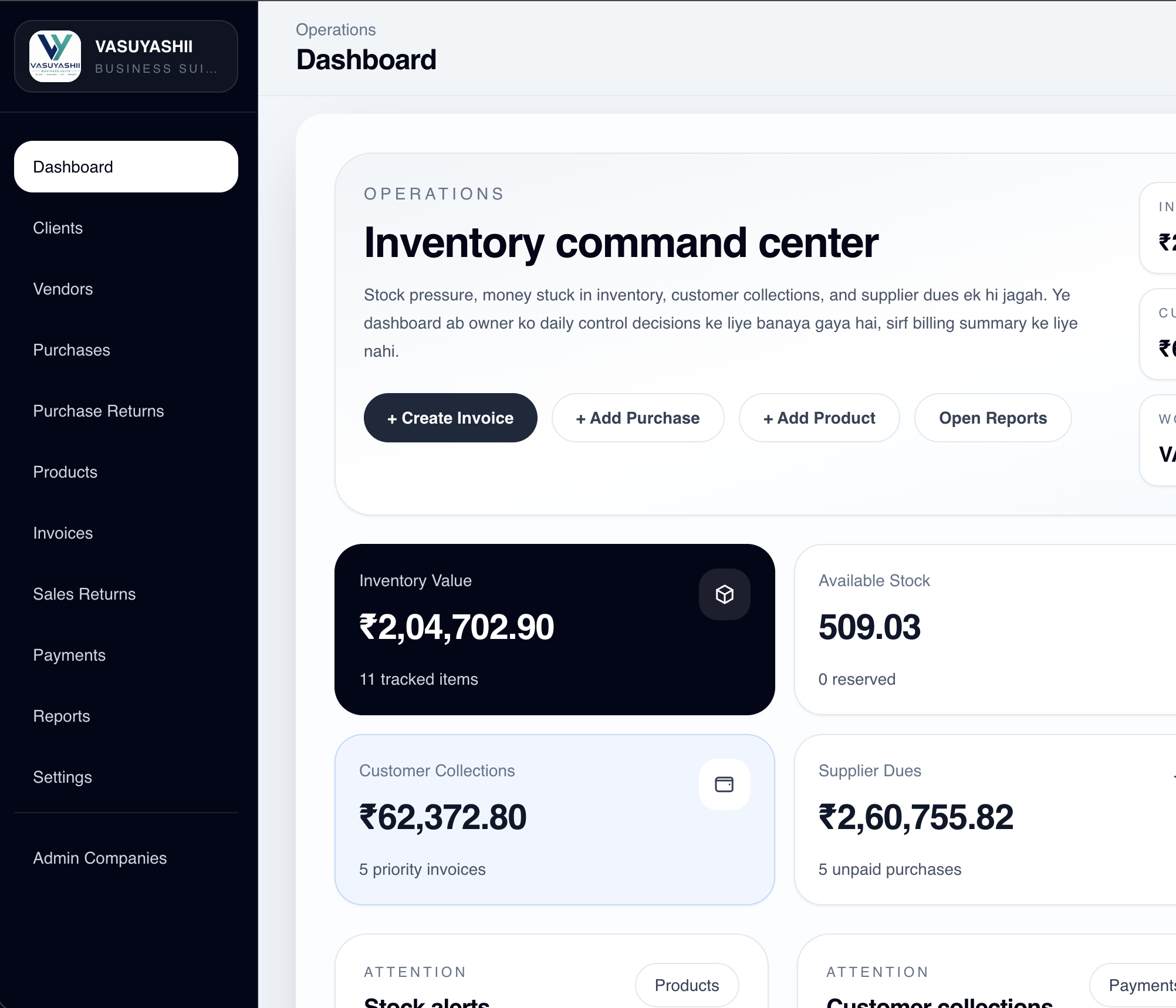
The current VASUYASHII Business Suite demonstrates a connected operating direction across products, customers, vendors, purchases, stock, invoices, payments, expenses, and owner reporting. The screenshot is product evidence, not proof that every SME needs the same modules or configuration.
These sources informed the topics covered, not the numerical score bands. The scoring thresholds remain VASUYASHII editorial methodology and should not be described as government standards.
The Ministry of MSME's Annual Report 2025-26 provides current institutional context for digital governance and the Indian MSME ecosystem.
CERT-In's essential measures for MSMEs support the benchmark's attention to authentication, access, backups, recovery, updates, and incident readiness.
Review current obligations through MeitY's official Digital Personal Data Protection Rules 2025 publication rather than treating this tool as legal advice.
GSTN's official e-invoicing overview is an example of why invoice creation, validation, reporting, and statutory applicability must be separated clearly.
No. It is an original VASUYASHII self-assessment framework. The score compares your answers with a disclosed operating-control model; it is not a market percentile or claim about the average Indian SME.
No. A ready SaaS or ERP-lite product may be the better option when the workflow is standard. Custom software is justified only when proven operating rules, documents, approvals, integrations, or reports cannot be configured safely in an existing product.
The owner should complete it with people responsible for sales, billing, purchase, stock, service delivery, reporting, and system administration. Different answers are useful evidence that the process is not understood consistently.
Answer based on what happens today. A written policy earns little operating value when staff use a parallel spreadsheet, shared password, private WhatsApp thread, or undocumented workaround.
No. It identifies planning questions only. GST, privacy, security, accounting, labour, and sector-specific obligations should be confirmed with qualified professionals and current official guidance.
Share the dimension score, current workflow, users, records, exceptions, and desired decision. VASUYASHII can then compare a ready Business Suite setup, integration, web app, or focused custom-software phase.
Discuss the assessment result