
First-party product implementation
Building VASUYASHII Business Suite for Indian SMEs
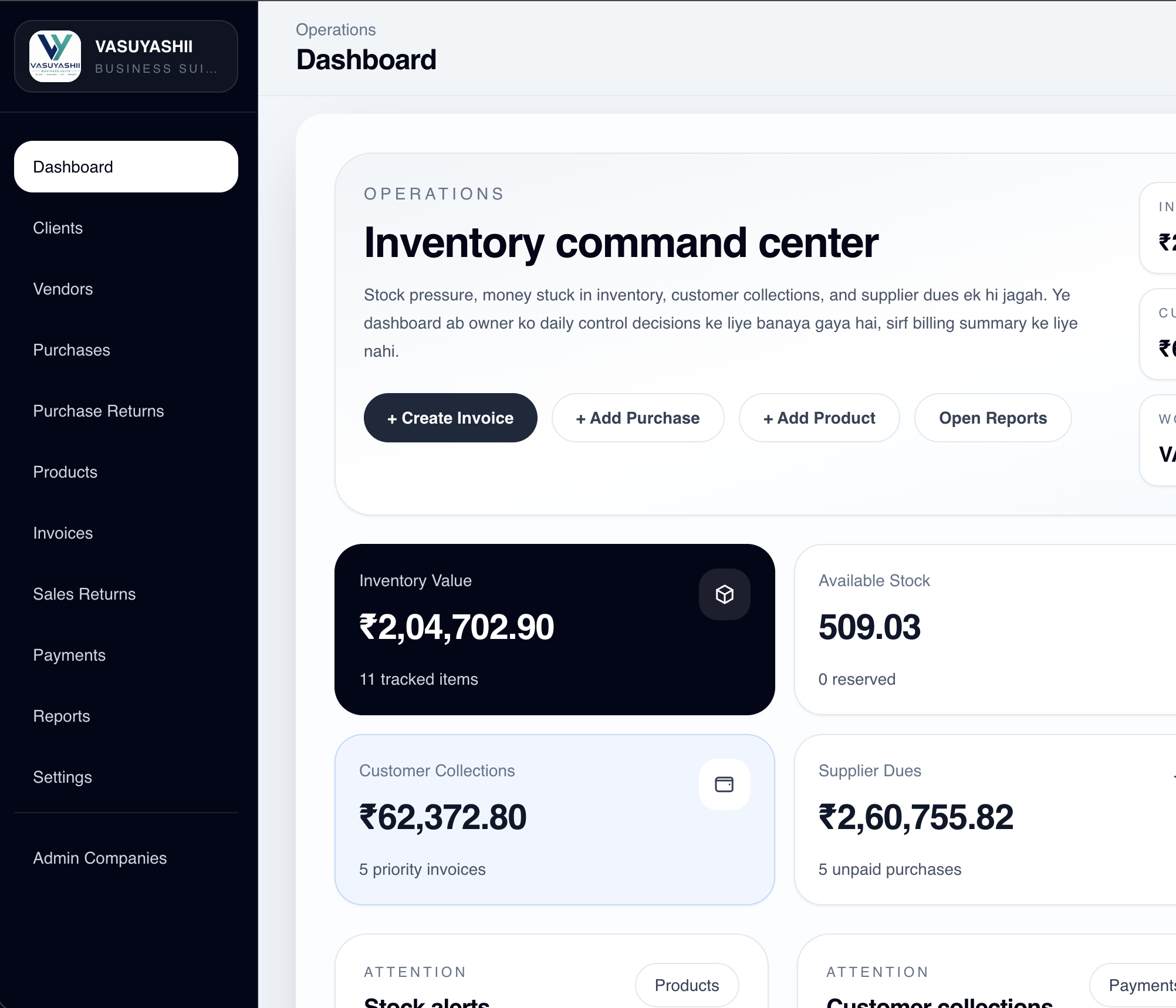
VASUYASHII Business Suite was shaped as a practical ERP-lite operating layer for Indian traders, wholesalers, retailers, distributors, and suppliers that need billing, stock, purchases, payments, expenses, reports, and documents without enterprise ERP complexity.
- Evidence date
- 4 August 2026
- Useful for
- Indian SMEs evaluating billing, inventory, and business software
16
Originally documented modules
Scope recorded for the original product case study; confirm the modules included in your proposed setup.
23
Documented capabilities
Original product scope includes separately confirmed rollout options; this is not a new feature-verification result.
Review
Demonstration scope
Agree a sample-data environment and relevant workflows before arranging a product demonstration.
ERP-lite
Explicit product boundary
Not positioned as a full SAP, Odoo, Tally, or accounting replacement.
Context
What was being solved
Many Indian SMEs need connected billing and inventory control but do not need the implementation weight of a full enterprise ERP. The practical problem is keeping products, customers, vendors, purchases, invoices, payments, dues, expenses, returns, and owner reporting connected without forcing staff through unrelated modules.
The product build therefore started with daily operating records and the transaction links between them. The original product record describes the implementation direction. The case study explains delivery decisions and scope boundaries; it does not claim a customer revenue, margin, stock, or adoption outcome.
The web application is the current primary platform. Mobile, Mac, and Windows delivery are rollout options that require scope confirmation rather than being described as automatically included in every plan.
Constraints
The implementation had to solve more than the visible screen.
01
Billing totals, stock movement, purchases, returns, payments, and owner reports must use consistent source records.
02
Multi-company users need firm-level separation so one company cannot silently read or change another company's transactions.
03
Invoice PDFs and WhatsApp sharing need a customer-safe document flow rather than exposing private authenticated backend URLs.
04
The sales page must distinguish current product scope from future accounting, statutory, mobile, and desktop modules.
Decisions
The choices that controlled the final implementation
01
Position the product as ERP-lite
The product promise stays focused on GST billing, inventory, purchases, payments, expenses, reports, PDFs, and daily business control. Full ledgers, P&L, balance sheet, payroll, manufacturing BOM, TDS/TCS, reconciliation, and statutory integrations remain separate or future scope.
02
Keep companies as a hard data boundary
Users can switch between authorised firms, while invoices, purchases, payments, dues, stock history, and operating records remain company-specific. Shared masters can be copied deliberately instead of merging transaction histories.
03
Connect the commercial lifecycle
Product, party, purchase, invoice, return, payment, expense, and report screens are treated as one operating chain. The owner dashboard reads from those records instead of becoming a disconnected presentation layer.
04
Generate and share documents safely
Invoice PDFs are generated with business, GST, total, and payment details. Public WhatsApp sharing uses a controlled share-link direction instead of sending a private authenticated file URL.
Delivered scope
What can be verified in the implementation
Dashboard, customers, vendors, products, stock, GST invoices, purchases, and sales and purchase returns.
Payments, dues, expenses, sales and purchase reporting, and stock-related owner views.
Backend-generated PDF invoice templates with preview and regeneration actions.
Secure public PDF sharing direction for WhatsApp and customer document access.
Backup and restore, import/export, multi-company switching, and company-scoped team access where configured.
A product overview that separates the documented web scope from roadmap and separately agreed rollout options.
Validation
What was checked
- The original case study recorded 16 main modules and 23 capabilities or rollout options. These historical counts do not establish the scope of a new quotation.
- The public-reference review on 29 September 2026 did not run a product session or repeat functional acceptance tests. Request a demonstration using agreed synthetic records.
- Previously withdrawn screenshots are not current evidence. Retained public images illustrate the product record and do not verify every module or workflow.
- Use the product overview to discuss fit, exclusions and separately quoted add-ons. Confirm current access arrangements and included modules before a demonstration or purchase.
- A published product page or application link confirms availability of that reference; it does not establish successful product testing or customer results.
Claim boundaries
What this evidence does not prove
- Use agreed synthetic records for any new demonstration. This case study does not certify every record in a connected product workspace as safe for public viewing.
- No customer adoption, revenue, time-saving, accuracy, or profitability result is claimed in this case study.
- The product is not presented as a full accounting, payroll, manufacturing, statutory filing, or enterprise ERP system.
- E-invoice, e-way bill, advanced accounting, WhatsApp API automation, data migration, mobile, Mac, and Windows rollout require separate confirmation.
Evidence sources
Pages and references used
- VASUYASHII Business Suite product page
Current modules, fit, plan, screenshots, setup flow, and exclusions.
- Business Suite application entry point
Arrange access and an appropriate sample-data environment before reviewing workflows; the application was not tested in this public-reference review.
- GST e-invoice overview
Official context for separating invoice operations from statutory applicability.
Continue the review
Related implementation guidance
- Custom Software, CRM and ERP hub
Decision hub for ready products, integrations, and custom workflows.
- Indian SME readiness benchmark
Assess operating controls before choosing modules.
- Software project requirement template
Prepare users, records, workflows, integrations, and acceptance scope.
Start with one verifiable workflow.
Share the current records, users, steps, exceptions, and desired decision. VASUYASHII will compare a ready product, integration, website, or focused custom build without assuming unsupported scope.
Discuss a focused first phase