
June 3, 2026
Website Project Agreement Template: Scope & Timeline
Use this website project agreement template to define deliverables, exclusions, timeline, revisions, payments, ownership, acceptance, support and termination.
Read articlePublished Updated
Plan a website project timeline with discovery, content, design, development, testing, approval milestones, launch responsibilities, and delay controls.
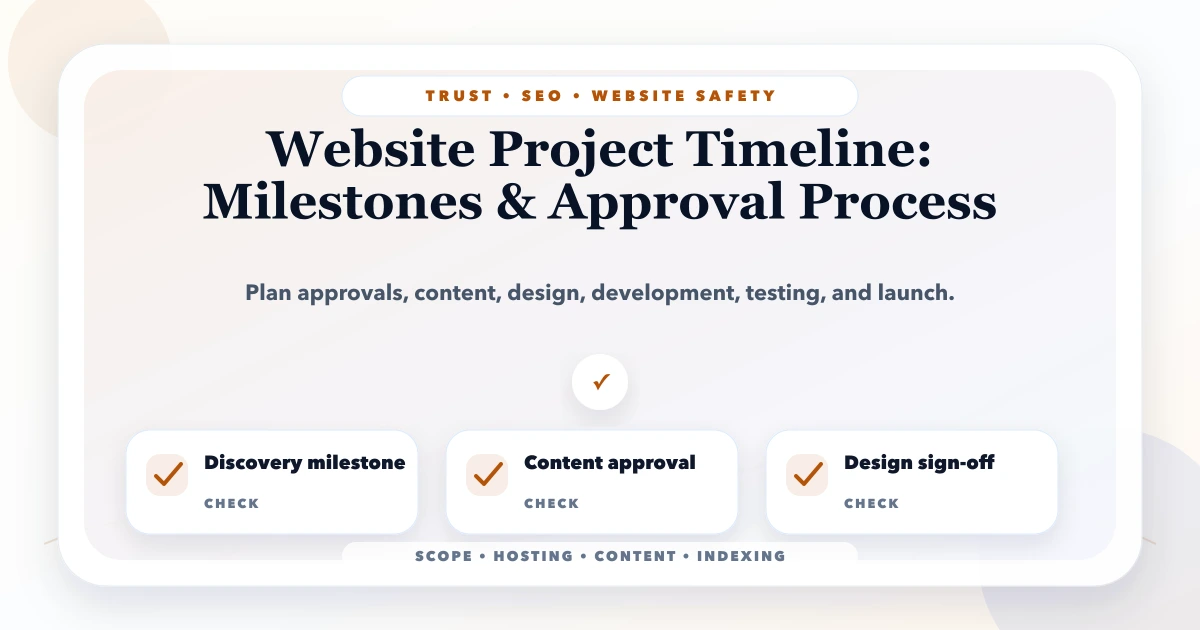
A website timeline is a sequence of approval gates, not a single delivery date. Each gate should name the artifact being reviewed, the person who can approve it, the acceptance criteria, and the consequence of requesting a change after approval.
This guide gives business owners and delivery teams a practical operating model for moving from discovery to launch. It focuses on the dependencies that usually create delays: late content, scattered feedback, unclear decision rights, unrecorded scope changes, and a launch checklist that begins too late.
By Tushar C. (Founder, VASUYASHII). Reviewed by VASUYASHII Editorial for real-world web development, SEO, hosting, content, security, and project planning experience.
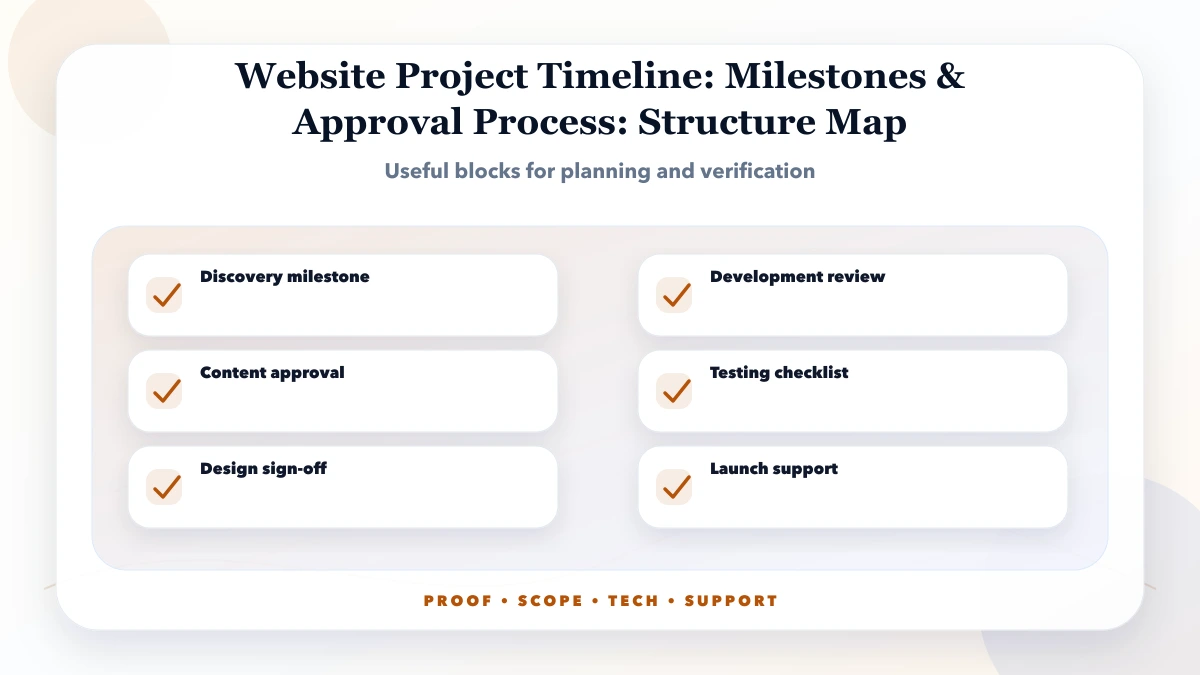
A website project timeline should include discovery, scope approval, content collection, wireframe/design approval, development, testing, revision, launch, and post-launch support.
| Scope | Practical price range | Typical timeline |
|---|---|---|
| Small website timeline | ₹25,000 to ₹75,000 | 1 to 3 weeks |
| Business website timeline | ₹75,000 to ₹2.5 lakh | 3 to 6 weeks |
| Custom website timeline | ₹2.5 lakh to ₹8 lakh+ | 6 to 12 weeks |
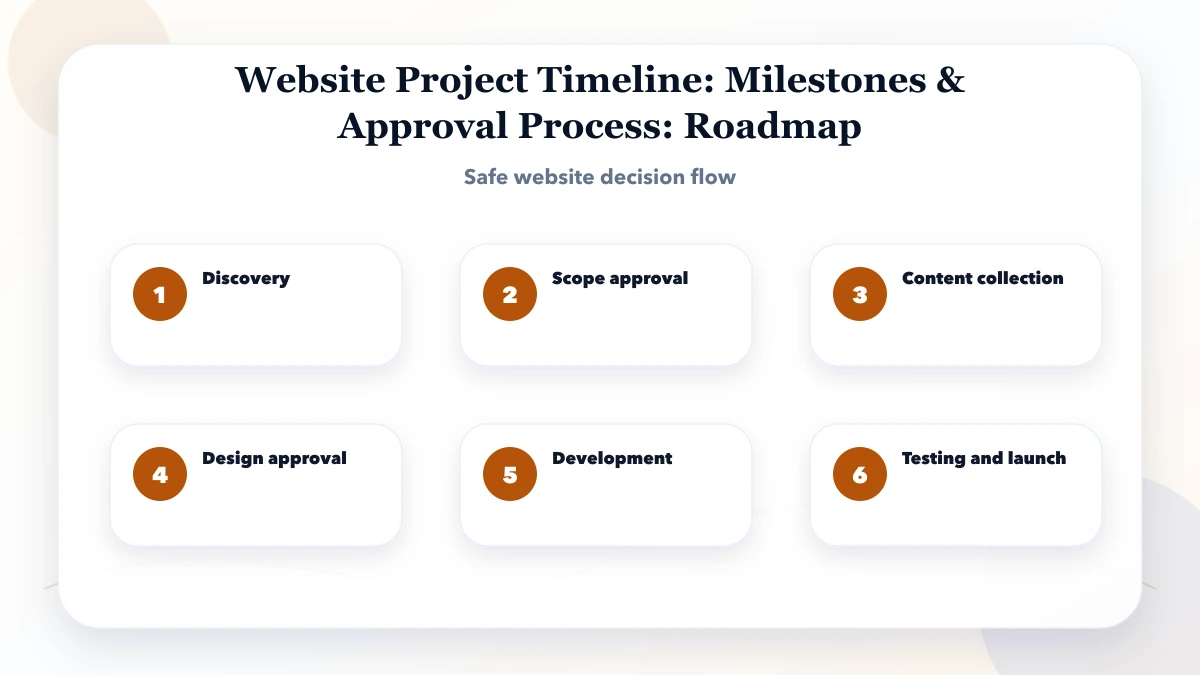
It is for SMB owners who want to understand how a website project should move from scope to launch without delays. The goal is to make the decision safer and easier for Indian SMB owners.
Start with discovery. This gives you a clear first signal before you spend money or make major changes.
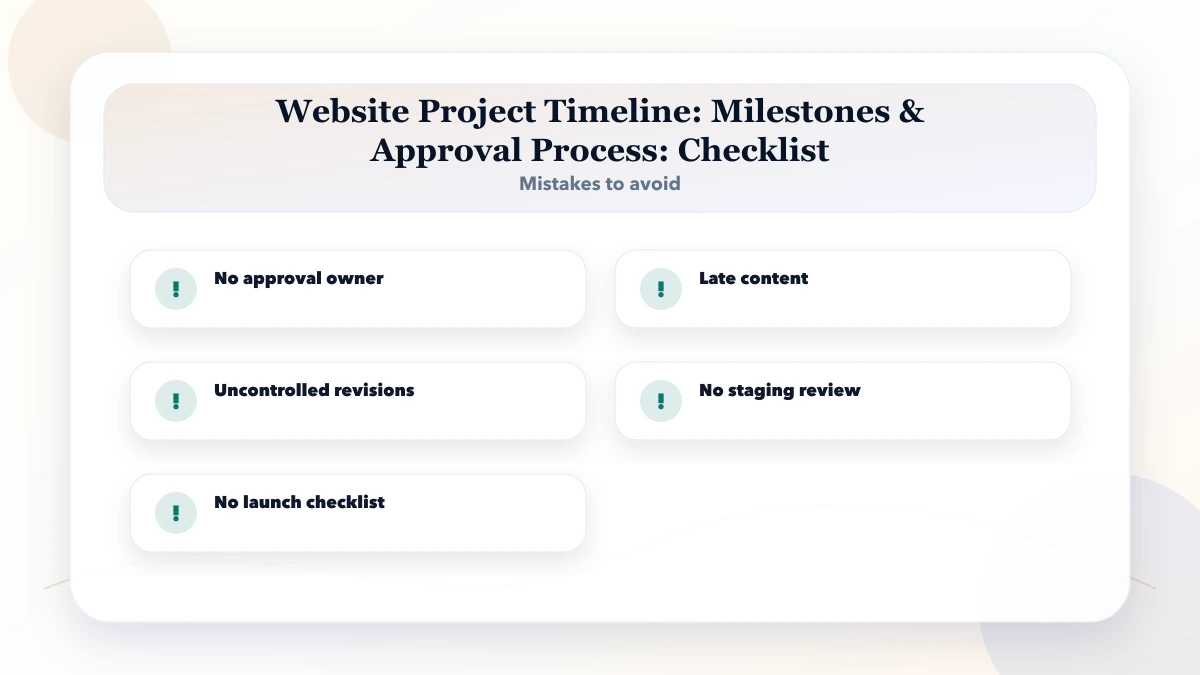
The biggest mistake is no approval owner. It usually creates avoidable cost, delay, or SEO loss.
Use the following table as a delivery contract appendix. Dates can change, but the evidence required at each gate should remain clear.
| Gate | Review artifact | Primary approver | Exit condition |
|---|---|---|---|
| 1. Discovery | goals, audiences, constraints, success measures | business owner | one approved problem statement |
| 2. Scope | page list, features, exclusions, dependencies | owner and delivery lead | signed scope and change process |
| 3. Content | content inventory and missing-input register | content owner | approved copy or named placeholders |
| 4. Structure | sitemap and key wireframes | marketing or product owner | journeys and CTA hierarchy approved |
| 5. Visual design | responsive representative screens | brand owner | components and visual direction approved |
| 6. Development | staging build with functional checklist | delivery lead | scoped behavior implemented |
| 7. QA | issue log, browser/device checks, form tests | nominated acceptance owner | no launch-blocking issues |
| 8. Launch | redirects, analytics, backup, access list | business and technical owners | production verification complete |
An approval is not “looks fine.” It should refer to a version, date, and acceptance checklist. Feedback should be consolidated into one document so the team does not receive conflicting instructions from email, chat, and calls.
A focused landing page may take roughly one to two weeks when the offer, copy, brand assets, form destination, and decision-maker are ready. A small service website commonly needs three to six weeks. A content-heavy or custom website may need six to twelve weeks or more. These are planning bands, not delivery promises; integrations, migration, content production, legal review, and slow approvals change them.
Do not compress the calendar by removing QA. Reduce the phase-one scope instead. Launching fewer complete pages is safer than launching many pages with broken forms, unfinished copy, missing redirects, or uncertain ownership.
When a milestone slips, classify the cause before changing the launch date:
Each category needs a different response. Input blocks need an owner and due date. Scope changes need impact on price and schedule. Quality failures need correction and retest, not silent acceptance.
Current VASUYASHII website work uses scoped phases, responsive review, production build validation, final URL checks, and analytics-event verification where included. Exact artifacts depend on the signed scope. Public demo websites are design concepts, not evidence of a client result, and performance or ranking outcomes are not guaranteed.
Before requesting a quote, prepare the business website planning checklist and the website project agreement guide. These reduce approval ambiguity before development starts.
Content should run as a parallel workstream, not arrive after development. Create an inventory for every page with headline, service facts, proof, images, CTA, legal copy, SEO intent, owner, and status. Mark each item as approved, draft, blocked, or intentionally deferred.
Use real placeholders only when the launch plan names who will replace them and by when. Never hide missing client input by publishing generic claims, borrowed images, fabricated metrics, or unapproved testimonials.
| Content dependency | Responsible owner | Deadline relative to build |
|---|---|---|
| service facts and exclusions | business owner | before wireframe approval |
| brand assets and image rights | brand owner | before visual design |
| case-study permission | client relationship owner | before staging review |
| privacy and legal text | authorized reviewer | before QA |
| form recipient and response process | sales owner | before functional testing |
| metadata and redirect map | SEO or delivery owner | before launch rehearsal |
One nominated approver should combine stakeholder comments. Each comment should identify the page or component, current problem, requested outcome, and priority. “Make it better” or screenshots without context are not actionable acceptance feedback.
Separate defects from preference changes. A defect fails an agreed requirement. A preference change alters an approved artifact. A scope addition introduces new output or behavior. Tracking these categories prevents the team from treating every comment as either free revision or unreasonable change.
Set a response window for each gate. If approval is delayed, record whether downstream work can continue safely. Silence should not automatically become approval for brand, legal, payment, security, or data decisions.
Run the launch checklist on staging before the production date. Test navigation, forms, phone and WhatsApp actions, emails, analytics events, responsive layouts, browser behavior, accessibility basics, metadata, canonical URLs, sitemap, redirects, robots directives, structured data, image loading, error states, and access ownership.
Prepare a rollback or correction path. Record the previous deployment, backup state, DNS ownership, launch operator, monitoring window, and escalation contact. After release, verify the final domain rather than assuming the deployment preview represents production.
The project is not complete at the first 200 response. During the agreed warranty window, verify real submissions, lead destinations, analytics, search-console access, key redirects, page indexing eligibility, and known third-party services.
Handover should include domain and hosting access, source location, deployment method, analytics/search accounts, form configuration, third-party subscriptions, image/licence records, backup/restore notes, and the support boundary. The owner should know which changes are included in warranty and which require maintenance or a new scope.
Use the website delivery checklist before final payment. It converts “the site is live” into a verifiable operating handover.
A useful project review can stay under thirty minutes when evidence is ready:
Do not use the meeting to discover the current version. Staging links, decision logs, issue lists, and approval artifacts should be shared beforehand. Record decisions immediately so later chat messages do not reverse them accidentally.
Track approved gates, overdue client inputs, unresolved launch blockers, open defects by severity, scope changes awaiting decision, and days spent waiting for approval. These indicators show whether the schedule problem is delivery capacity, decision latency, quality, or changing scope.
A project can be “on time” while quality is being deferred. Keep unresolved accessibility, form, security, redirect, analytics, and ownership issues visible until accepted or explicitly removed from scope by an authorized decision.
The final schedule should leave room for DNS propagation, production verification, correction, and business-owner acceptance. Launching late in the day without an available reviewer or rollback owner creates avoidable operational risk.
Large stakeholder teams should also apply the governance and migration checks in the corporate website development guide when assigning milestone approvers and launch ownership.
Related Articles
June 3, 2026
Use this website project agreement template to define deliverables, exclusions, timeline, revisions, payments, ownership, acceptance, support and termination.
Read article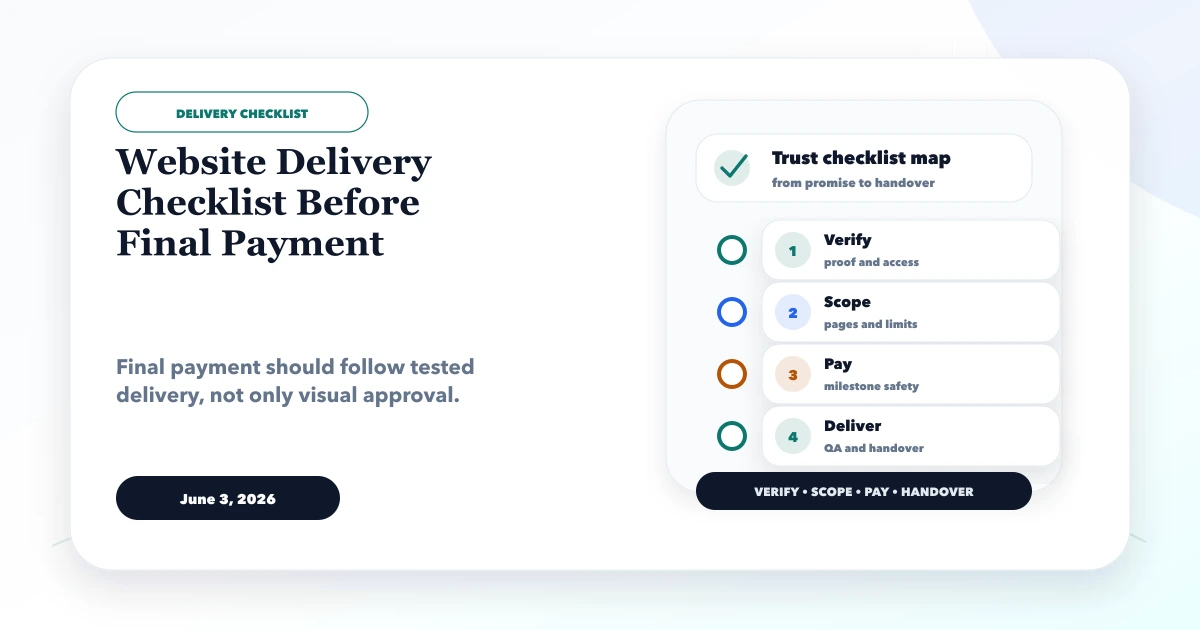
June 3, 2026
Website delivery checklist before final payment with pages, forms, SEO, speed, mobile, access handover, backups, and launch QA.
Read article
May 19, 2026
Compare Agile, Waterfall and hybrid delivery for SMB software projects using requirement stability, budget, review capacity, risk and acceptance needs.
Read article
May 22, 2026
Compare workflow automation with hiring staff using workload, exception rate, service risk, costs, controls, payback, and a practical Indian SME decision model.
Read article