
April 29, 2026
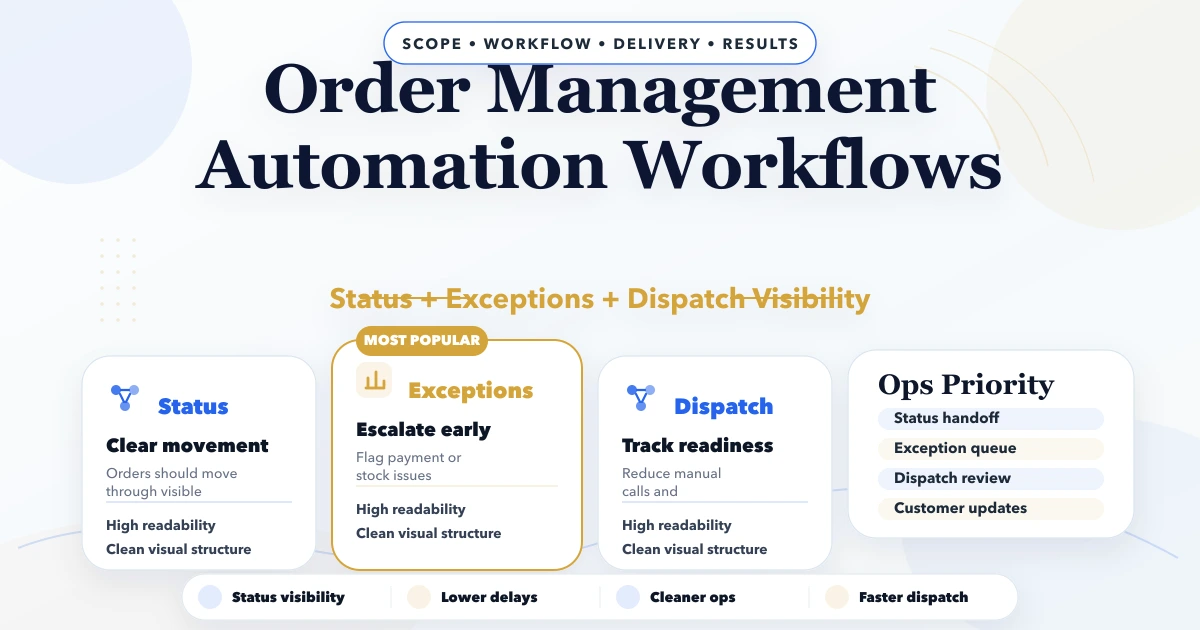
Order Management Automation Workflows
Order management automation workflows with status control, billing, stock sync, routing, pricing, and rollout guidance for SMB operations.
Read articlePublished
Order management system development guide with OMS features, pricing in India, tech stack, timeline, and cost drivers for growing SMB operations today.
Many businesses outgrow manual order tracking before they realize it. Orders come from website forms, WhatsApp, sales calls, distributors, or repeat customers, but status is managed through spreadsheets, chat, and memory. That works until dispatch gets delayed, payment status becomes unclear, or customer communication starts breaking down.
An order management system is the layer that brings order capture, status flow, stock coordination, dispatch updates, and reporting into one operational view. For Indian SMBs, the best OMS is not an enterprise monster. It is a practical system that shows where each order stands and what needs to happen next.
This guide explains what a lean OMS should include, how much development usually costs in India, which tech stack works well, and how to scope phase one without creating unnecessary bloat.
If your team struggles to answer "What is the latest status of this order?" quickly and confidently, you probably need an OMS. The right system should centralize order details, payment state, fulfilment steps, dispatch readiness, and customer-facing status updates in one place.
A useful SMB OMS usually covers:
If dispatch and physical movement are major pain points, this topic connects closely with warehouse management systems and billing software.
OMS is a strong fit for B2B sellers, distributors, ecommerce-support teams, project supply businesses, and any SMB where orders move through multiple internal checkpoints before completion. If the sales team, warehouse team, and billing team are constantly checking status manually, OMS usually creates fast value. It is also highly relevant when customers expect quick updates but your team still depends on repeated internal calls to confirm readiness, payment state, or dispatch progress.
Businesses also benefit early when order volume is increasing but the internal team still has no clean daily view of overdue, blocked, or exception orders. That visibility alone can reduce customer frustration and internal follow-up time.
This matters a lot for businesses scaling from a manageable order count to a much higher daily load. Without an OMS, the usual response is to add more coordination calls and more follow-up people instead of fixing the flow itself. A good OMS lets the same team handle more volume with better clarity and cleaner handover.
That is usually where the ROI becomes obvious.
Small teams feel that improvement very quickly.
Orders sit at the intersection of sales, stock, billing, customer communication, and dispatch. When those parts are disconnected, order handling becomes fragile.
Good OMS design gives operational clarity. It makes the order lifecycle visible from the first confirmation to the last dispatch update. That reduces internal coordination effort, improves customer response time, and gives management a more accurate picture of fulfilment performance.
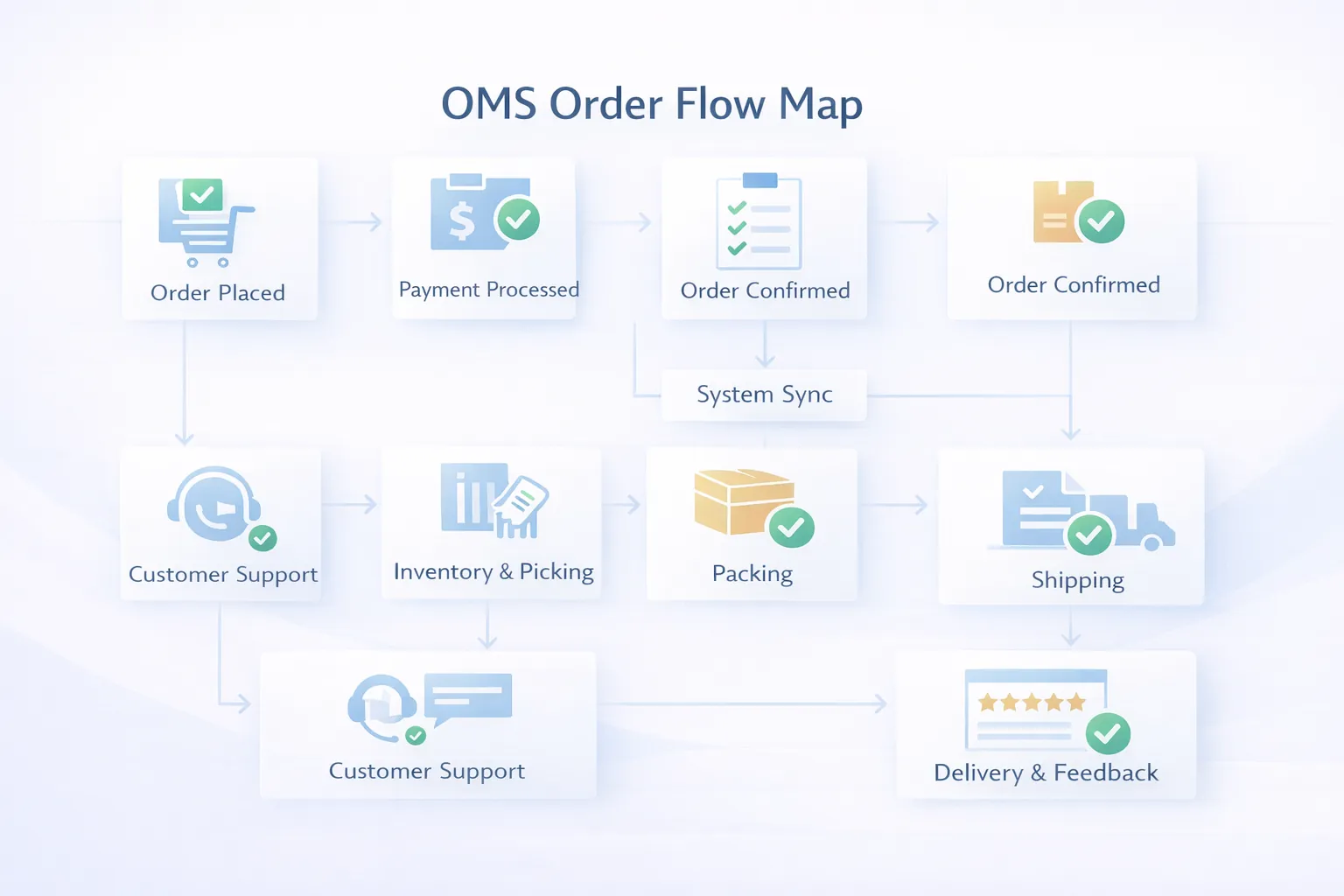
Before building an OMS, define the exact order lifecycle.
The software should know where the order came from and what confirms it. That may be manual approval, payment receipt, customer PO, or sales confirmation.
The system should show whether stock is ready, whether packing has started, or whether procurement or production is still pending. This prevents the team from treating all confirmed orders as equally ready.
Dispatch should not be a vague final step. There should be a visible handoff from packed to dispatched to delivered or closed, with exception notes where needed.
Not every order ends neatly. Returns, damage, short shipment, or replacement requests should remain linked to the original order record so the team does not lose context.
For businesses selling across multiple channels or fast-moving dispatch, OMS often becomes the backbone that connects sales, warehouse, and billing.
These features usually matter most in an SMB-friendly OMS.
Businesses often add automated notifications, channel sync, courier APIs, RTO views, SLA tracking, or customer self-service after the core order flow becomes stable.
If your team is still asking three people to know one order status, a proper OMS usually pays for itself in saved time and fewer fulfilment mistakes.
OMS pricing depends on order volume, dispatch workflow, stock linkage, and integration requirements.
₹1.8 lakh to ₹3 lakhIncludes order records, status flow, dashboards, and basic fulfilment visibility.
₹3.2 lakh to ₹5.5 lakhIncludes payment state, packing and dispatch handoff, returns tracking, and role-based dashboards.
₹5.75 lakh to ₹9 lakhIncludes channel sync, warehouse integration, customer notifications, and deeper reporting.
For many SMBs, the most effective scope sits in the ₹3.2 lakh to ₹5.5 lakh band because it brings real operational clarity without becoming an oversized platform.
Costs rise when the OMS is expected to replace inventory, WMS, shipping, finance, and CRM completely in phase one. That is rarely the best first move.
An OMS needs good status integrity, fast filters, and clean integrations.
Next.js for order tables, status boards, detail pages, and responsive role-based dashboards.Node.js for order workflow, validation, status transitions, and notification logic.PostgreSQL for order master, line items, payments, dispatch records, and activity logs.If order updates depend on payment or messaging tools, API integration services becomes important early. When orders reserve stock across stores or marketplaces, use the ecommerce inventory sync workflow to define stock ownership, cancellations and reconciliation.
OMS projects usually take 5 to 9 weeks for an SMB-ready launch.
Timelines stretch when the business does not yet agree on what counts as confirmed, ready, dispatched, or closed. These status definitions should be finalized early.
These are the biggest budget variables in OMS development:
The right OMS should reduce uncertainty. If order status still needs manual confirmation every time, the workflow design is incomplete.
To keep rollout practical:
That sequence gives cleaner adoption and better reporting. Once the team trusts the status flow, you can expand into automation, courier sync, or customer portal features.
An order can be paid but not packed, or packed but payment-pending in some models. If the system mixes those concepts, reporting becomes confusing.
Returns, partial fulfilment, customer hold, and stock shortage are normal. If phase one ignores them completely, teams go back to chat and side spreadsheets.
Automation is useful, but only after the team agrees on manual flow first. Otherwise, the wrong status changes get automated and create new confusion.
Sales, finance, support, and warehouse teams use the same order differently. A one-screen-fits-all approach usually slows everyone down.
If the software stores orders but cannot show fulfilment readiness, it becomes an incomplete record system rather than an operational tool.
It is software that manages order capture, status flow, payment visibility, fulfilment, dispatch, and related reporting in one place.
For SMB-focused builds, it usually starts around ₹1.8 lakh and often lands between ₹3.2 lakh and ₹5.5 lakh for a practical system.
No. Ecommerce software is customer-facing storefront logic. OMS is the internal operational layer for processing and tracking orders.
Yes. In fact, that is one of the most valuable integrations when dispatch is a daily operational pain point.
Most SMB OMS projects take around 5 to 9 weeks depending on exception handling and integration needs.
Usually yes in at least a basic form, because returns and cancellations are common realities that affect reporting.
Yes. Many businesses add approved WhatsApp or email updates once the status flow is stable.
Not agreeing on status meanings before development starts. Most confusion later traces back to that.
If your team still checks order status through repeated calls, chat pings, and Excel filters, the process is ready for a proper OMS.
Related Articles
April 29, 2026
Order management automation workflows with status control, billing, stock sync, routing, pricing, and rollout guidance for SMB operations.
Read article
March 26, 2026
Warehouse management system guide for small businesses with WMS features, pricing in India, tech stack, timeline, and cost drivers for lean operations.
Read article
May 26, 2026
Plan a distributor order portal with dealer access, price lists, credit controls, approval, allocation, dispatch, returns, payments, and ERP sync.
Read article
May 26, 2026
transport logistics booking tracking portal: practical 2026 guide with features, INR pricing, roadmap, tech stack, mistakes, FAQs, and Indian SMB tips.
Read article