
May 27, 2026
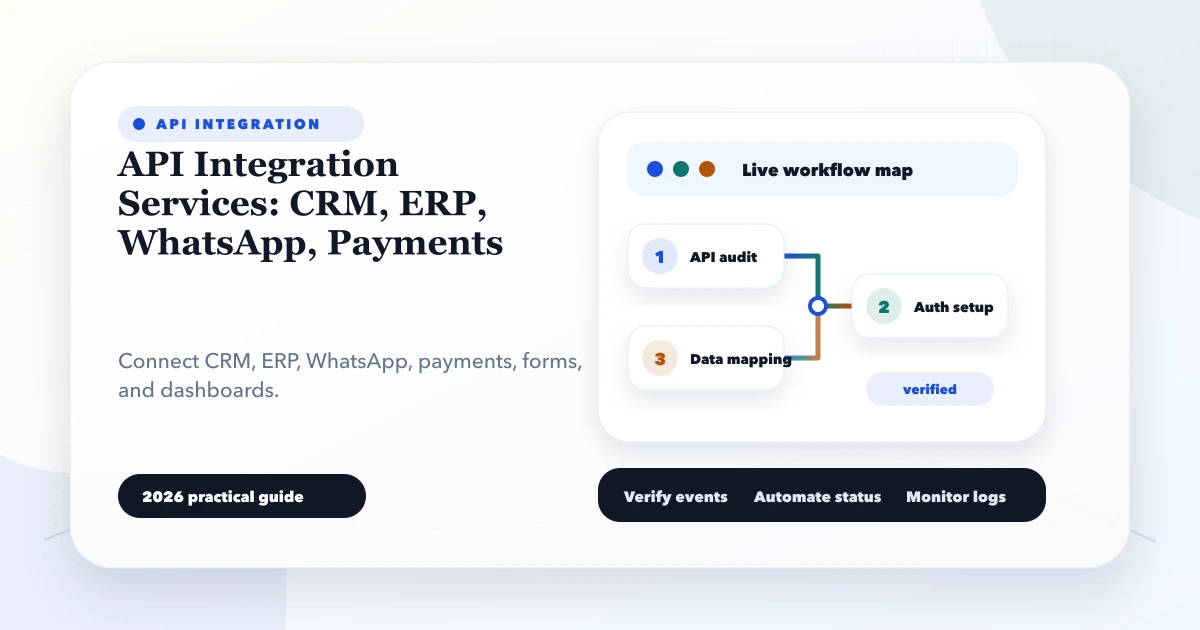
API Integration Services: CRM, ERP, WhatsApp, Payments
Plan CRM, ERP, WhatsApp and payment API integrations with clear data ownership, webhooks, retries, security, monitoring, cost and rollout guidance.
Read articlePublished Updated
API integration services for businesses in 2026: payments, WhatsApp, CRM, data sync, webhooks, reliability, and the key scope and delivery considerations.
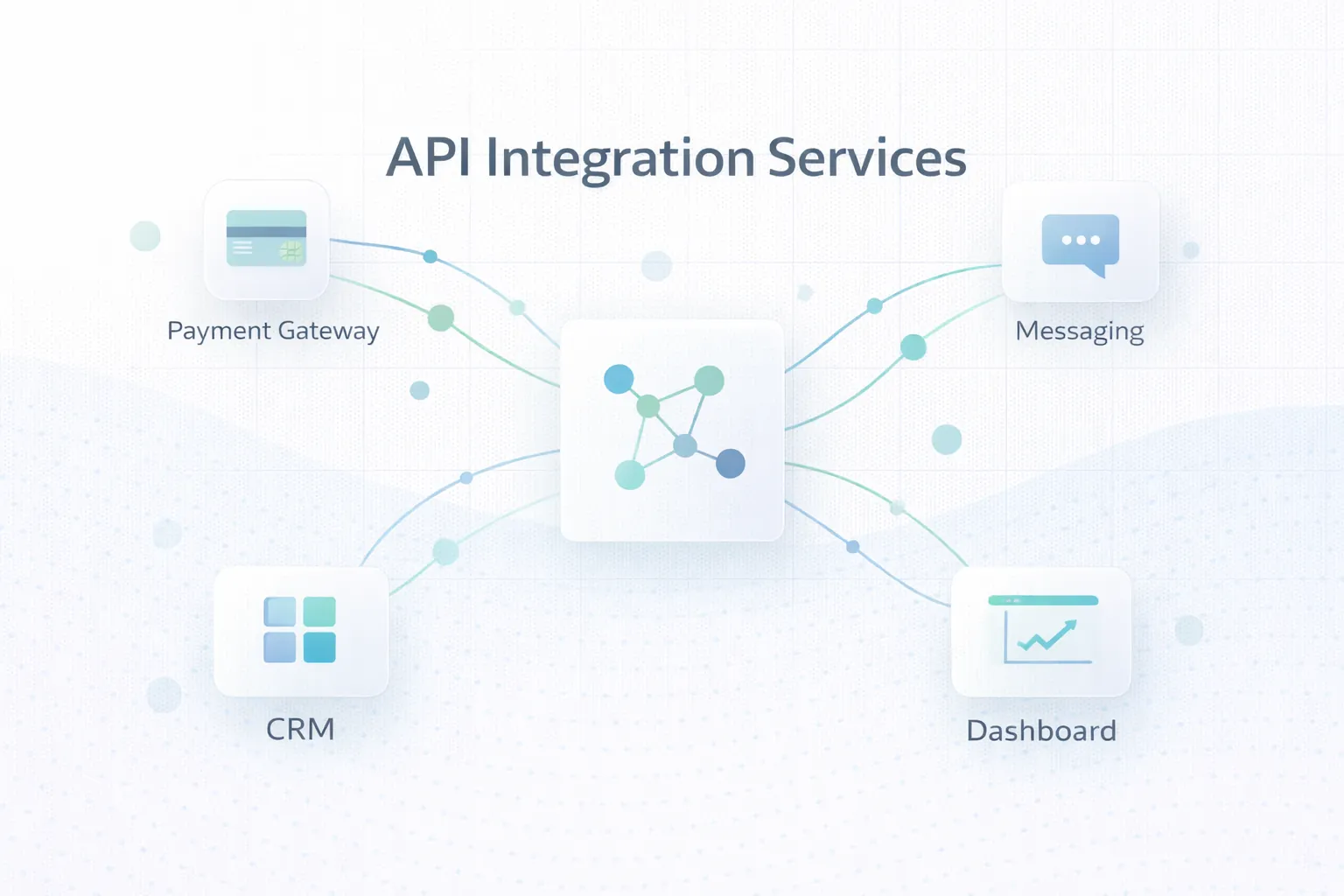
Businesses often feel integration pain before they describe it in technical terms. Someone enters the same data twice, payment updates do not reach the CRM, customer messages go out late, or reports are stitched together manually every week. Those are integration problems disguised as routine admin issues.
In 2026, companies expect their tools to work together. Customers do not care whether their update came from a CRM, billing system, or custom dashboard; they only experience whether the business looks organized and responsive.
This guide covers:
API integration services connect systems so data and actions move automatically between payment gateways, CRM platforms, messaging channels, dashboards, and custom software. The real job is not just connection. It is reliable business flow.
Start by naming one event, its authoritative source, the required destination state, and the person who owns failures. That produces a testable integration brief before anyone chooses libraries or automation tools.
API integration services matter because they align system behavior with business operations. When integration is done well, information moves reliably, teams trust the data, and automation becomes practical instead of fragile.
Some APIs are mature and predictable, while others have limited documentation, restrictive endpoints, or inconsistent webhook behavior. This changes the outcome because API quality directly affects integration speed, stability, and support effort.
Tokens, secrets, signature verification, access scopes, and secure storage all need to be managed correctly before any sync becomes trustworthy. This changes the outcome because weak auth handling creates real business risk, not just technical inconvenience.
Field names rarely match business meaning cleanly between systems, so integrations need logic for status mapping, validation, and fallback behavior. This changes the outcome because data mapping is often where the real complexity of the project lives.
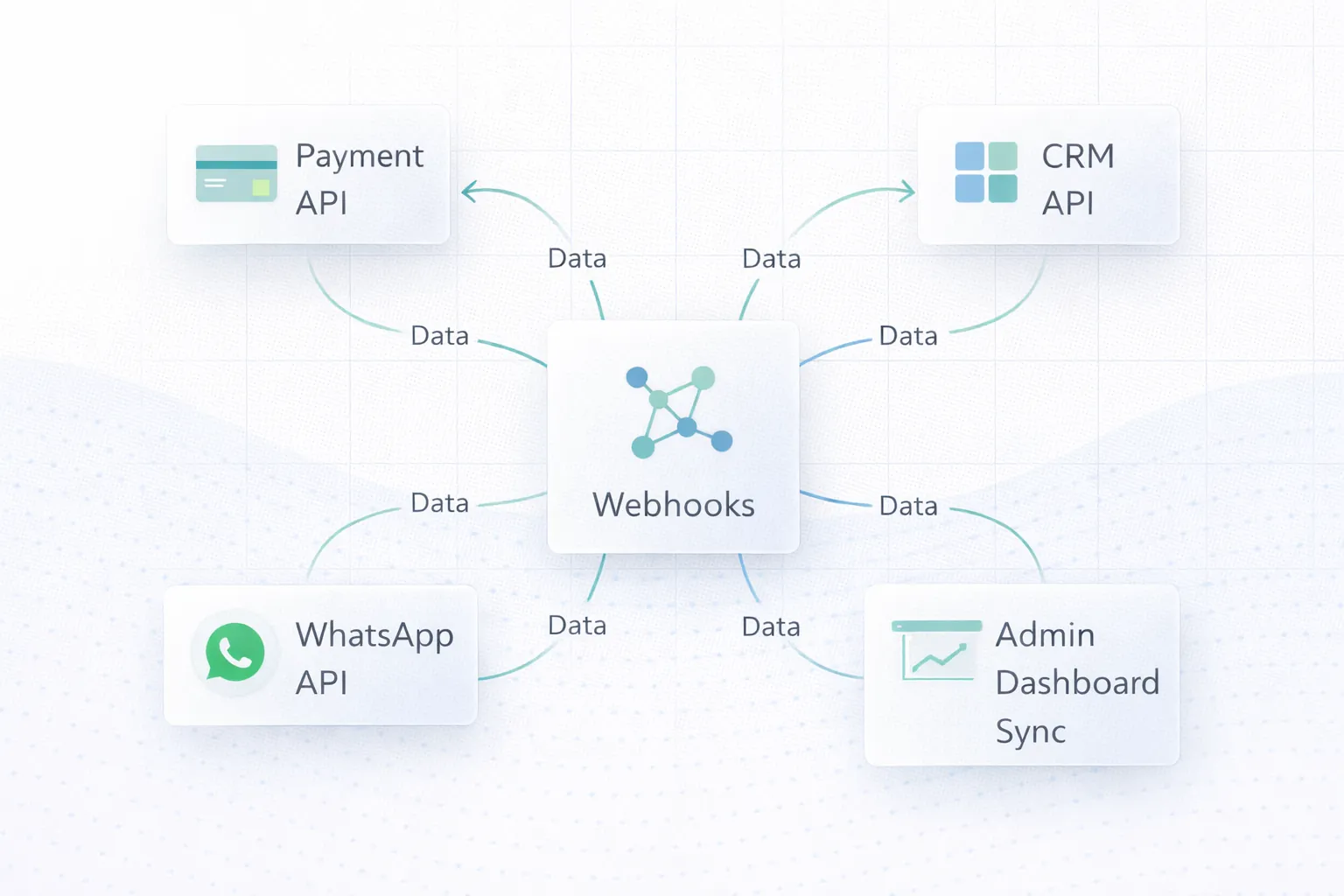
Many integrations depend on webhook events for real-time updates, which means retries, duplicate protection, and logging need to be handled carefully. This changes the outcome because event reliability is what keeps sync accurate under real traffic.
Teams need to know what synced, what failed, and what needs attention without reverse-engineering logs every time an issue occurs. This changes the outcome because observability keeps integrations manageable after launch.
Third-party APIs change over time, so the integration should be built with enough structure that updates do not break the whole workflow unexpectedly. This changes the outcome because maintainability matters because integrations are living dependencies, not one-time code snippets.
A production integration needs an operating model, not only a successful sandbox request. The implementation should make duplicate delivery, delayed events, rejected payloads, credential rotation, and provider downtime visible and recoverable.
The project should begin by defining what business event starts the sync, which systems are involved, and what the successful outcome looks like.
That prevents integrations from becoming technical bridges without business clarity. When this layer is done properly, the product becomes easier to onboard, easier to support, and easier to improve later.
API keys, OAuth flows, webhook signatures, and environment configuration all need controlled implementation and storage.
Security is foundational because integrations usually carry sensitive operational data. When this layer is done properly, the product becomes easier to onboard, easier to support, and easier to improve later.
Data often needs cleaning, field mapping, or status translation before another system can use it safely.
Validation protects downstream tools from bad or partial data. When this layer is done properly, the product becomes easier to onboard, easier to support, and easier to improve later.
Live event handling should account for duplicate events, delayed deliveries, and temporary failures without creating inconsistent records.
Reliable event processing is what makes integrations feel dependable in production. When this layer is done properly, the product becomes easier to onboard, easier to support, and easier to improve later.
Teams should be able to inspect sync state, failed runs, and retried events without needing low-level developer access for routine checks.
This reduces support friction and improves confidence in the system. When this layer is done properly, the product becomes easier to onboard, easier to support, and easier to improve later.
Serious integrations need controlled testing with representative scenarios before real customers or transactions depend on them.
A safer rollout reduces the chance of production surprises around money, communication, or records. When this layer is done properly, the product becomes easier to onboard, easier to support, and easier to improve later.
| Contract field | Example question | Required decision |
|---|---|---|
| Source event | Did the gateway report payment success or did staff mark an invoice paid? | Choose one authoritative event for each state change |
| Identity | Which order, customer, invoice, or message does the event belong to? | Define stable external and internal identifiers |
| Idempotency | What happens when the same event arrives again? | Repeat processing must not duplicate money, messages, or records |
| Ordering | Can refunded arrive before a delayed paid event? | Define valid transitions instead of trusting arrival order |
| Retry | Which failures are temporary and how often can they be retried? | Use bounded retry and a reviewable failed state |
| Owner | Who reviews a failed payment, CRM write, or message? | Assign an operational owner and escalation path |
Stripe's official webhook guidance covers signature verification, retries, duplicate events, and the fact that event ordering is not guaranteed. These are useful design constraints even when another gateway is used. Review the current Stripe webhook documentation and the OWASP API Security Top 10 when defining the integration threat model.
Use sample payment records to review operational status and reconciliation. A payment-record interface alone does not prove a particular gateway integration, webhook success rate, automated reconciliation result or customer outcome.
When a verified payment event is accepted, the system can update order state, notify the team, log the transition, and trigger the next workflow.
The acceptance test should prove duplicate delivery does not create a second payment or fulfilment action.
CRM changes can trigger approved WhatsApp templates, reminder logic, or support updates when consent and messaging-policy requirements are satisfied.
Record provider message IDs and delivery states so a sent request is not confused with confirmed delivery.
Accepted enquiries can be assigned and pushed into the right CRM pipeline after server validation and duplicate checks.
Failed CRM writes need a retryable queue or visible manual action; silently dropping the lead is not an acceptable state.
Custom dashboards often need data from external business systems for reporting, approvals, or status updates.
Define refresh timing and source-of-truth rules so the dashboard cannot present stale data as current.
Bring one event sample, API documentation, sandbox access, destination fields, and known failure cases. That is enough to define a focused integration phase and its acceptance tests.
Real business integration also involves state changes, failures, timing, and exception handling. Simple mapping alone rarely survives production complexity.
Webhooks and external APIs can deliver late, duplicate, or partial events. Systems must know how to handle that safely or duplicate records and broken sync become likely.
Storing keys loosely or mixing environments carelessly increases security risk and debugging pain. Use scoped credentials, controlled secrets, and a rotation procedure.
If every sync issue requires developer intervention to diagnose, the business loses confidence quickly. Provide an inspection view without exposing secrets or sensitive payloads.
Third-party platforms update versions, scopes, and data formats over time. Record version assumptions, provider notices, and a regression-test path.
An API connection does not guarantee end-to-end business success. Provider uptime, rate limits, account approvals, consent rules, data quality, and downstream availability remain external dependencies. A successful HTTP response may also mean “accepted for processing,” not “business action completed.”
Do not claim real-time behavior unless latency is measured and the fallback state is defined. Payment, messaging, and customer-data integrations also require stricter access, logging, retention, and incident handling than a low-risk content sync.
Integration cost depends on the number of systems involved, the quality of their APIs, the amount of transformation logic required, and how much failure visibility the business needs. A simple one-way sync is far smaller than a real-time, event-driven workflow with retries and monitoring.
If your integrations are feeding a larger custom product, Full Stack Web Development Guide and Web Application Development Guide are useful related reads because integration quality depends on the surrounding system architecture too.
The smartest way to control cost is to define the business event clearly, map the minimum useful sync, and add secondary automations only after the core flow is stable.
It is a service that connects software systems so data and actions move automatically between them in a reliable, secure, and traceable way.
Common reasons include weak data mapping, no retry logic, poor webhook handling, hidden API limits, or lack of visibility when something goes wrong.
Yes, many do through webhooks or event-driven sync. Real-time behavior still needs safeguards for duplicates, delays, and failed processing.
It means handling the same event safely more than once without creating duplicate results. It is important because APIs and webhooks can repeat events.
Often yes. Even lightweight inspection views or sync logs make support much easier and help businesses trust the workflow.
List the systems involved, define the business event, identify required fields, note failure scenarios, and clarify who should act when something does not sync correctly.
Usually yes, because mistakes can affect money, customer communication, and trust. They deserve extra attention around testing, logging, and rollback behavior.
Send the source system, destination system, event samples, API documents, expected states, and failure owner. We can turn that evidence into a bounded integration plan.
Related Articles
May 27, 2026
Plan CRM, ERP, WhatsApp and payment API integrations with clear data ownership, webhooks, retries, security, monitoring, cost and rollout guidance.
Read article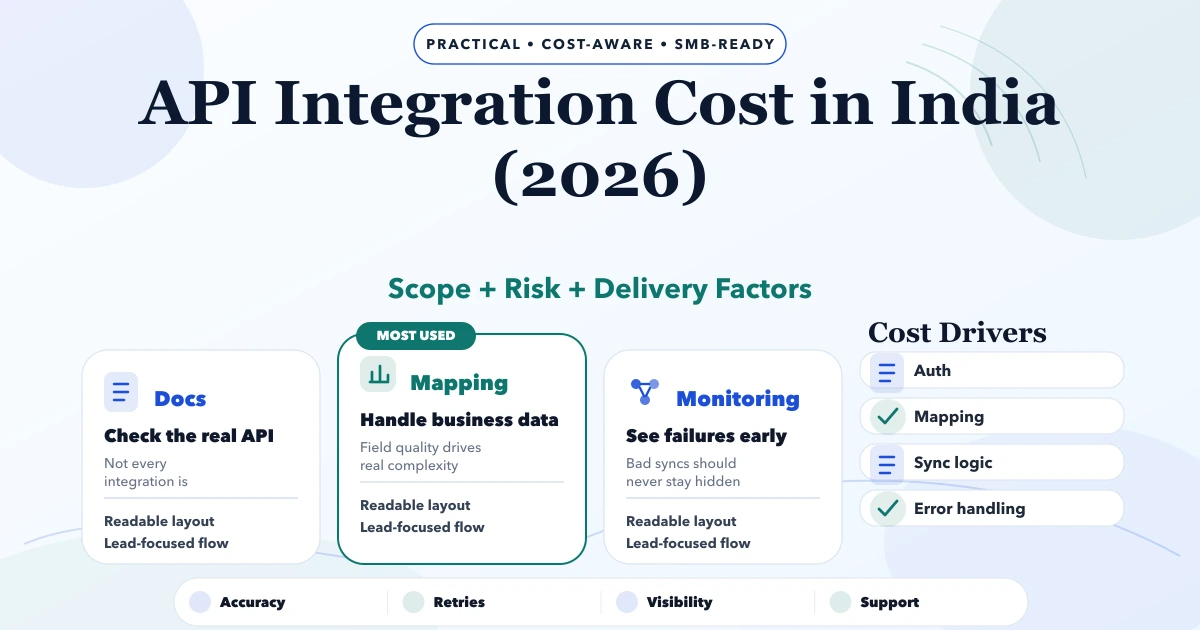
May 6, 2026
Estimate API integration cost in India using endpoint scope, authentication, data mapping, retries, reconciliation, testing, monitoring, and support needs.
Read article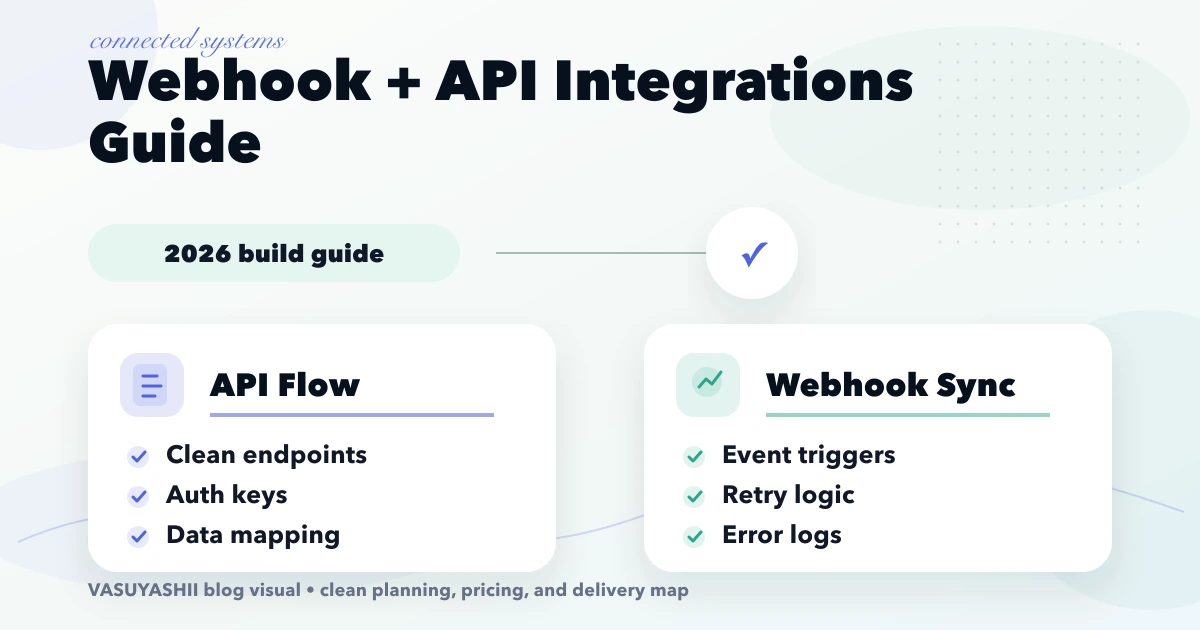
April 20, 2026
Build reliable webhook integrations with event contracts, signatures, idempotency, retries, replay, reconciliation, monitoring, testing, and ownership.
Read article
May 27, 2026
Learn when cloud functions fit automation and how triggers, retries, idempotency, logs, security, testing, and operating costs should be planned.
Read article