
March 25, 2026
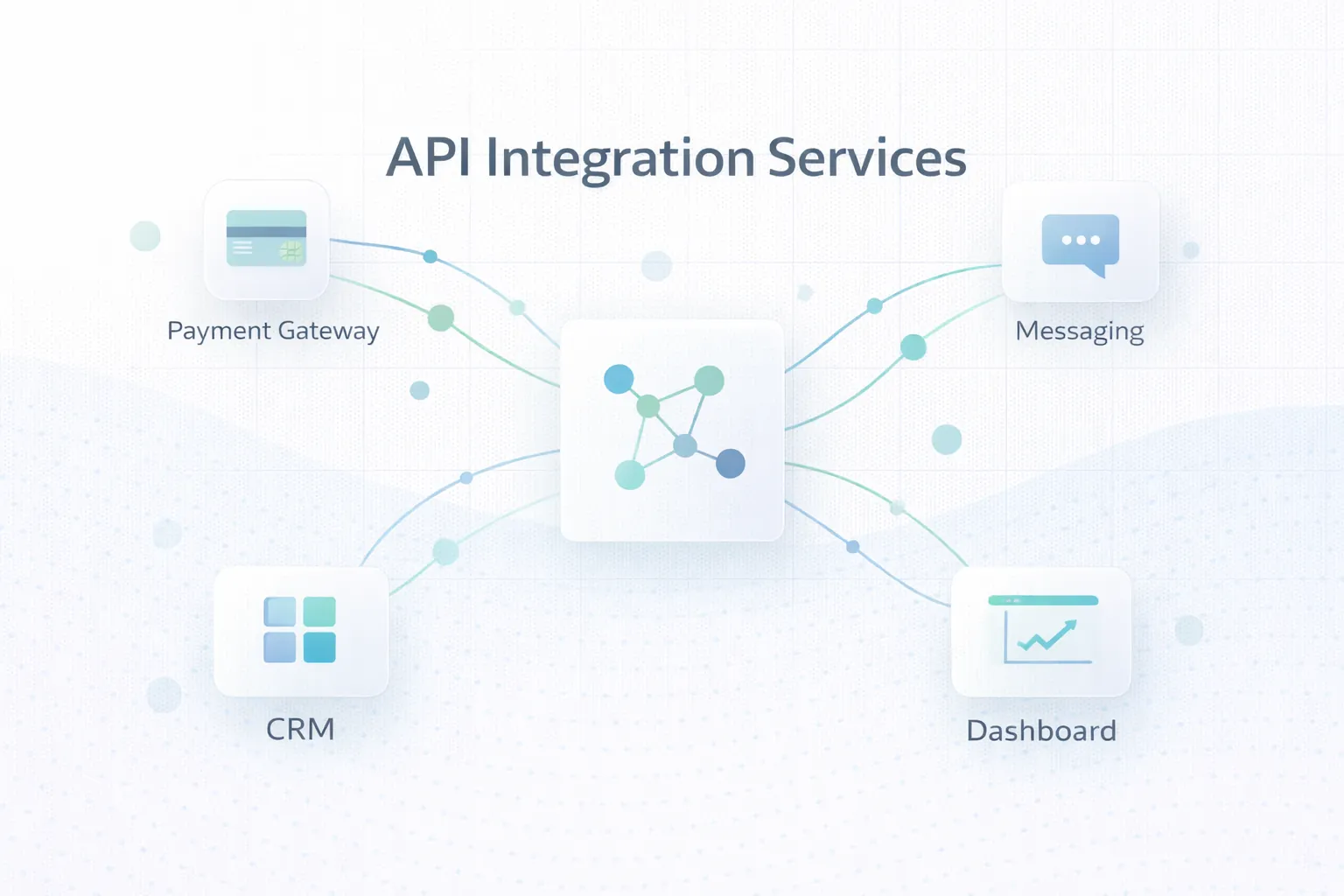
API Integration Services for Businesses (2026)
API integration services for businesses in 2026: payments, WhatsApp, CRM, data sync, webhooks, reliability, and the key scope and delivery considerations.
Read articlePublished Updated
Estimate API integration cost in India using endpoint scope, authentication, data mapping, retries, reconciliation, testing, monitoring, and support needs.
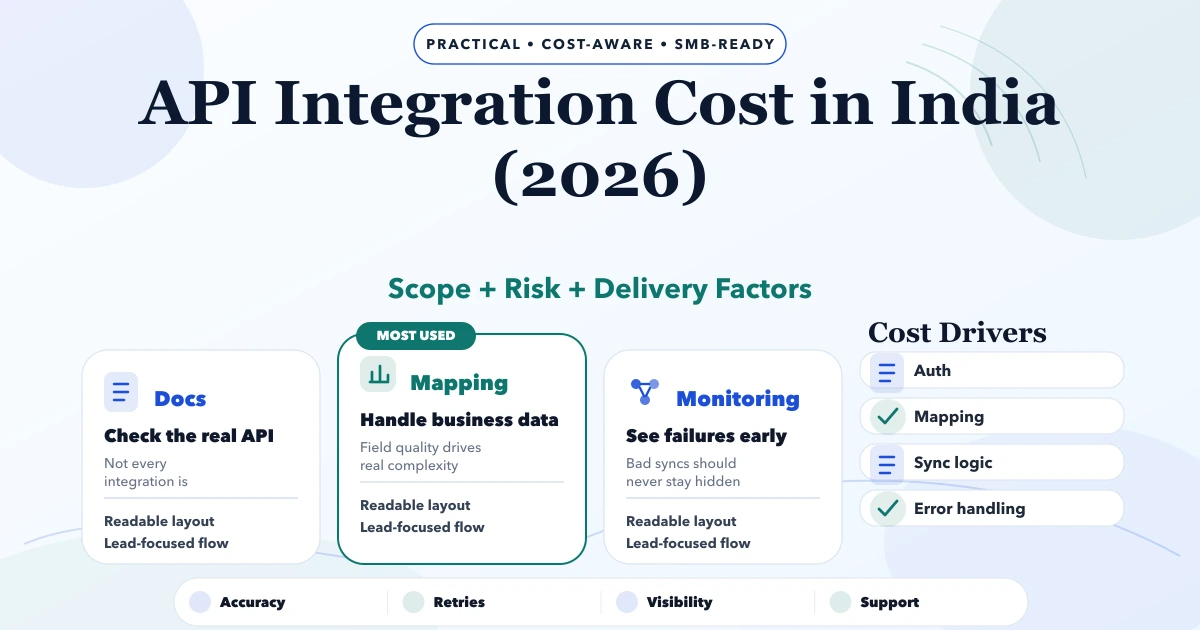
API integration cost in India depends on what the connection is allowed to change, how the two systems identify the same record, and what happens after timeouts, duplicates, partial success, or provider outages. Endpoint count alone is not a safe estimate.
This guide is for SMB founders and operations teams comparing lead, payment, inventory, CRM, ERP, WhatsApp, or document integrations. It separates connector work from business rules, reliability controls, reconciliation, rollout, and ongoing support.
API integration cost in India depends on more than endpoint count. The real pricing drivers are auth complexity, data mapping, webhook or sync behaviour, rate limits, retries, testing, and how much business risk sits inside the connection.
| Scope | Price range | Timeline |
|---|---|---|
| Single straightforward integration | ₹25,000 to ₹90,000 | 3 to 10 days |
| Multi-endpoint business integration | ₹90,000 to ₹3 lakh | 2 to 6 weeks |
| Complex sync + webhook layer | ₹3 lakh to ₹8 lakh+ | 1 to 3 months |
Because auth quality, data complexity, sync behaviour, and operational risk can be completely different even if both say integration on paper.
Sometimes. They can reduce polling load, but they add their own reliability and monitoring requirements.
Yes for important business processes. Blind trust in automation creates operational risk.
Data cleanup and mapping usually cause more real effort than teams expect.
Use logs, alerts, retry views, and some owner-visible status so failures do not stay invisible.
Yes. That is usually the right first step before scoping implementation.
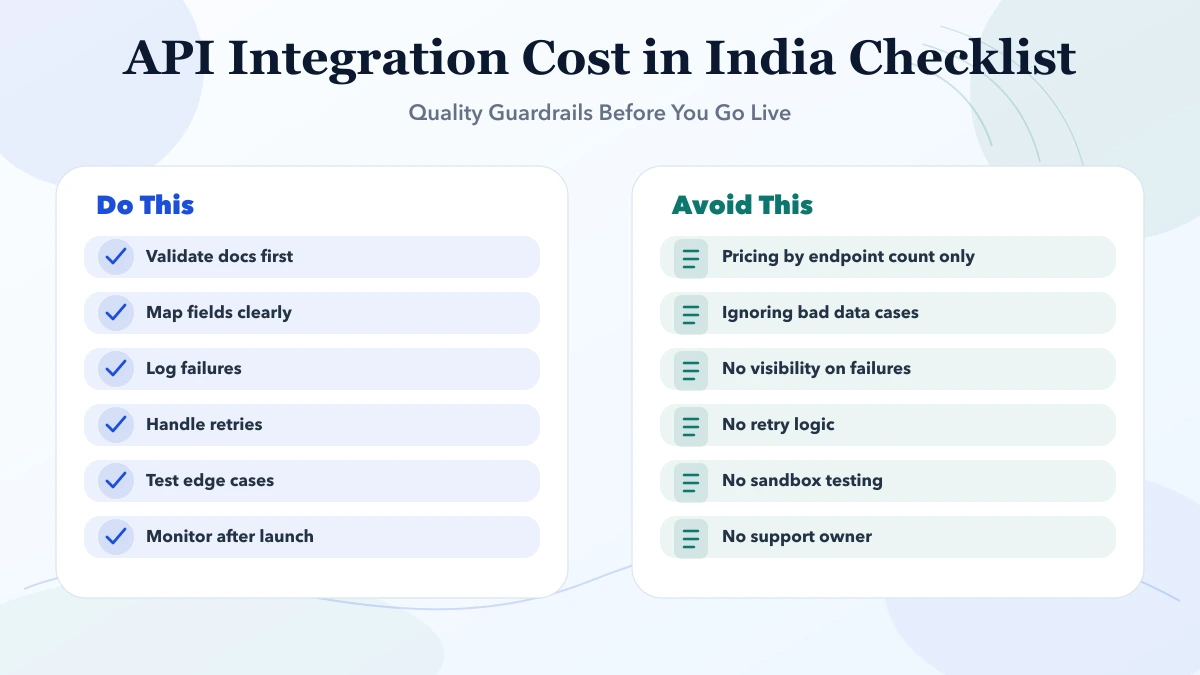
An API integration connects two systems with different data models, permissions, limits, and failure behaviour. One endpoint can be expensive when it controls money or requires reconciliation. Ten read-only endpoints can be straightforward when documentation and test data are complete.
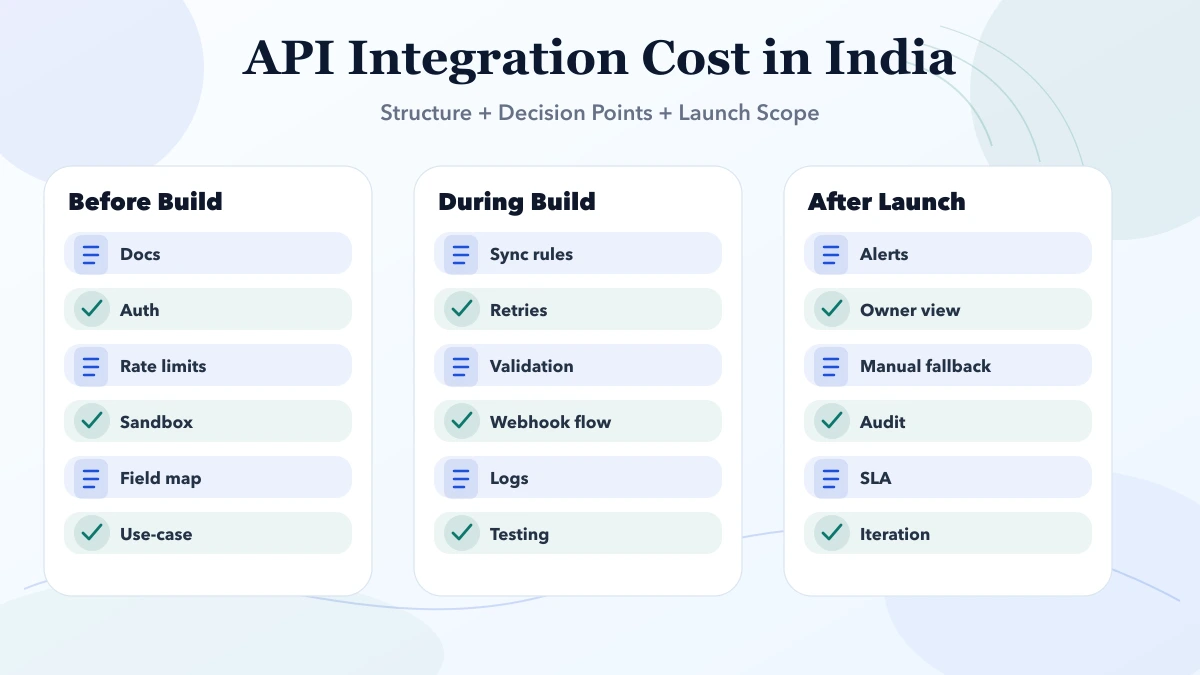
Before estimating, document:
If a provider does not offer stable documentation, sandbox credentials, or support, include discovery risk rather than hiding it in a fixed quote.
| Workstream | Lower effort | Higher effort |
|---|---|---|
| Authentication | One documented API key | OAuth, token refresh, tenant consent, rotating certificates |
| Data mapping | Matching fields and formats | Codes, taxes, units, identities, or historical cleanup |
| Direction | One-way read or send | Two-way synchronization with conflict rules |
| Trigger | Scheduled batch | Real-time webhooks plus replay and ordering |
| Reliability | Non-critical reporting | Payment, inventory, billing, or compliance state |
| Environment | Complete sandbox and fixtures | Production-only provider with limited test data |
| Operations | Basic error alert | Queue dashboard, reconciliation, replay, and support SLA |
| Governance | One company | Multi-company credentials, permissions, and audit retention |
The quotation should price discovery, implementation, testing, rollout, and ongoing operation separately where possible.
A website sends validated enquiries to a CRM. Complexity includes authentication, field mapping, consent fields, duplicate handling, spam rules, error visibility, and a fallback when the CRM is unavailable. "Send form to CRM" is not only an HTTP request.
The CRM and ERP both contain customer records. The team must decide which system owns name, tax ID, address, credit limit, and status. It also needs identity matching, conflict rules, deletion behaviour, and a reconciliation report. This is significantly more complex than one-way delivery.
The payment provider sends asynchronous events. The backend verifies signatures, stores event IDs, applies allowed order-state changes, prevents duplicates, and separates payment truth from browser redirects. Stripe's official idempotent request documentation describes idempotency keys for safely retrying API operations. Internal order and webhook processing still need their own state and deduplication rules.
A legacy system may expose files, database views, or a limited API. Mapping, network access, scheduling, encoding, historical data, and vendor coordination can dominate cost. A small proof using representative records should precede a full fixed estimate.
An integration should expose at least these states:
received → validated → processing → succeeded
and failure paths such as:
validation_failed, retry_scheduled, blocked, manual_review, and dead_letter.
Store a correlation ID, business reference, provider request/event ID, attempt count, last error category, timestamps, and next action. Do not store sensitive credentials or unnecessary personal data in logs.
Retry only failures that may recover. Invalid payloads and permission errors usually need correction, not endless retry. Use bounded exponential backoff where appropriate and ensure the business operation is idempotent.
Retries answer "did we try again?" Reconciliation answers "do both systems now agree?" For orders, compare status and amount. For inventory, compare movement totals or controlled snapshots. For CRM sync, report records missing or conflicting by stable external ID.
A daily exception report may be more valuable than a complex attempt to auto-resolve every conflict. Assign an owner and define how a corrected record is replayed.
For company-scoped systems, tenant identity must be derived from trusted configuration or verified claims, not accepted blindly from a payload. Review the multi-tenant SaaS architecture guide and web app security guide.
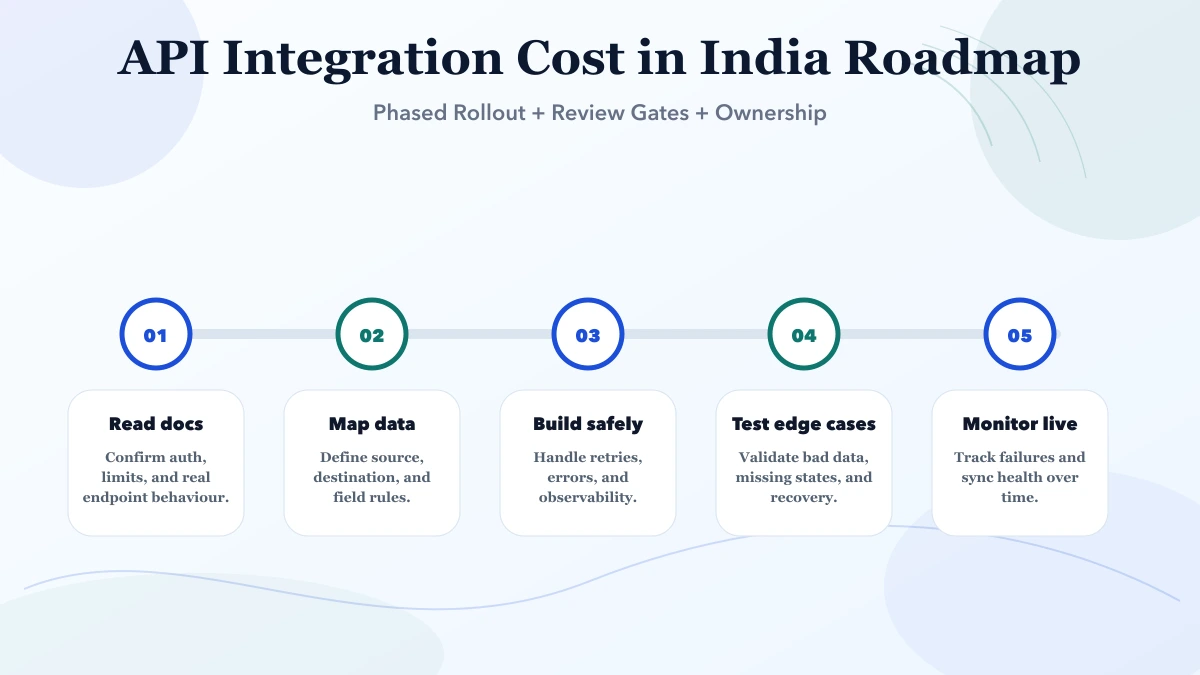
Instead of promising one market price, calculate:
discovery + connector build + business rules + test fixtures + reliability controls + rollout + operating support
A narrow, well-documented connector may fit a small fixed milestone. Payment, inventory, multi-company, or two-way integrations usually need a discovery phase and staged rollout. Provider subscriptions, per-message charges, WhatsApp conversation fees, payment fees, cloud usage, and vendor support are external recurring costs unless the proposal states otherwise.
Ask every quote to include assumptions for volume, endpoints, environments, fields, event types, retention, availability, and support. Changing these assumptions changes the price.
Test:
The handover should include credential ownership, environment variables, mapping document, runbook, alert destinations, replay procedure, and known provider limits.
VASUYASHII publicly offers API integrations and automation, custom software development, and web applications. The Business Suite also demonstrates business workflows where company-scoped records, documents, and operational data matter. These are relevant capability signals, not proof of compatibility with an unreviewed third-party API.
Send documentation links, sample payloads with private data removed, desired workflow, expected volume, and recovery requirement through the contact page. A responsible estimate should state unknowns and may recommend a paid or limited proof before the complete rollout.
Related Articles
March 25, 2026
API integration services for businesses in 2026: payments, WhatsApp, CRM, data sync, webhooks, reliability, and the key scope and delivery considerations.
Read article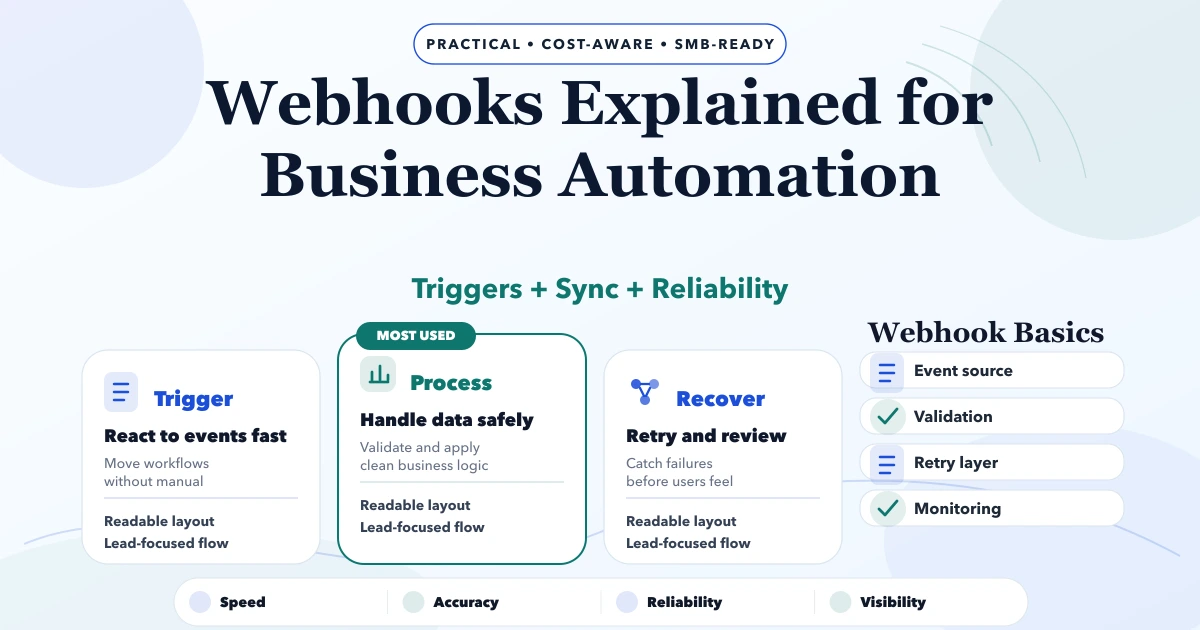
May 6, 2026
Understand business webhooks with event contracts, signature checks, idempotency, retries, logs, failure ownership, pricing, and rollout decisions.
Read article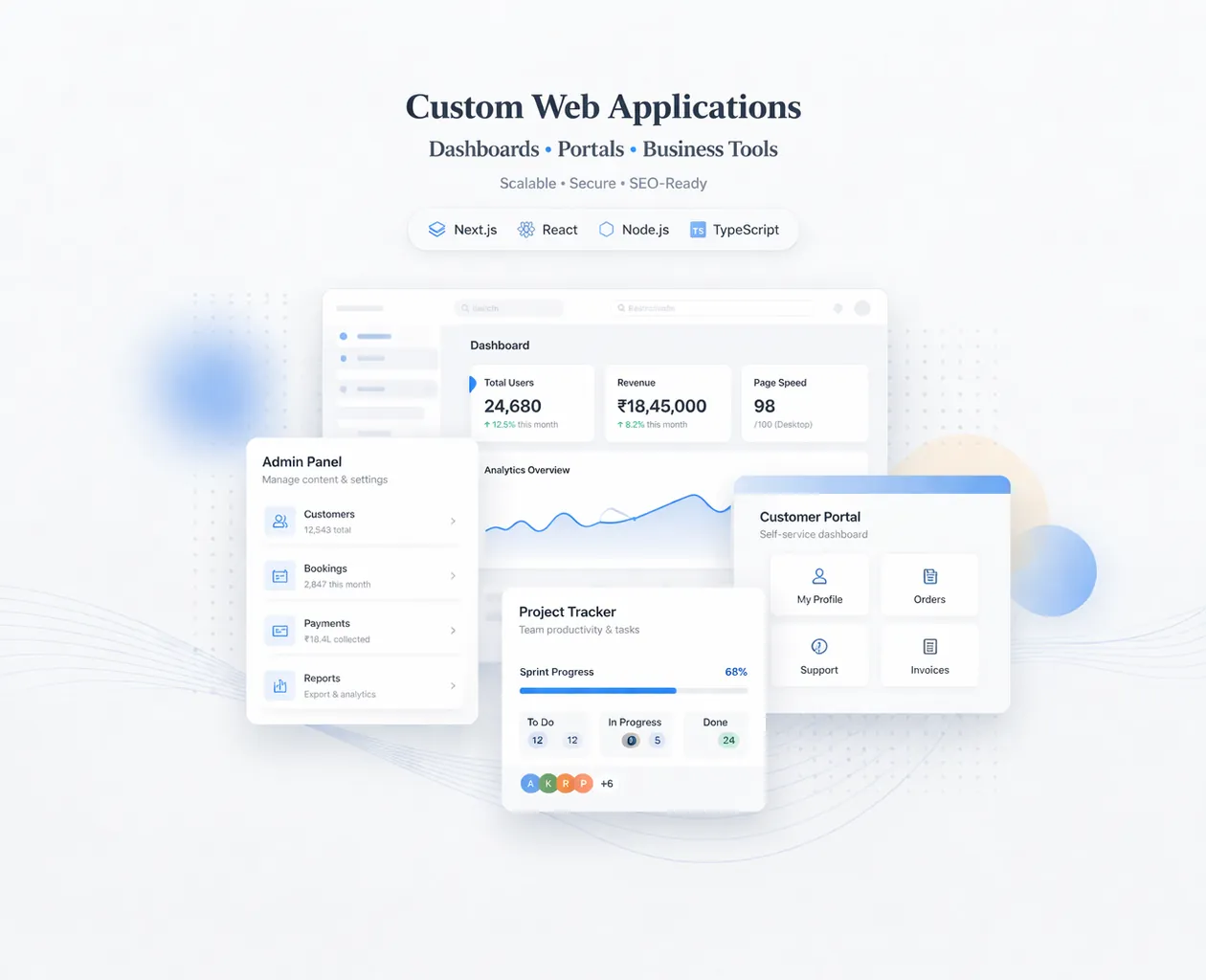
March 25, 2026
Explore web application development services in 2026: modules, workflows, real examples, process, timelines, integrations, and the main business cost drivers.
Read article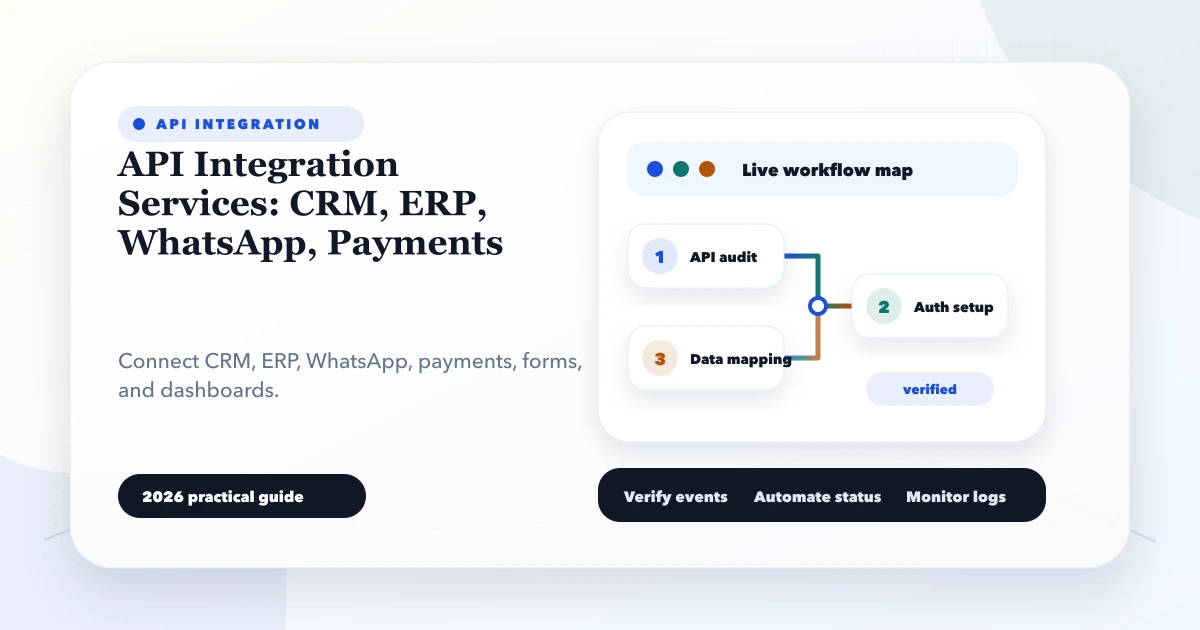
May 27, 2026
Plan CRM, ERP, WhatsApp and payment API integrations with clear data ownership, webhooks, retries, security, monitoring, cost and rollout guidance.
Read article