
March 25, 2026
Web Application Development Services Guide
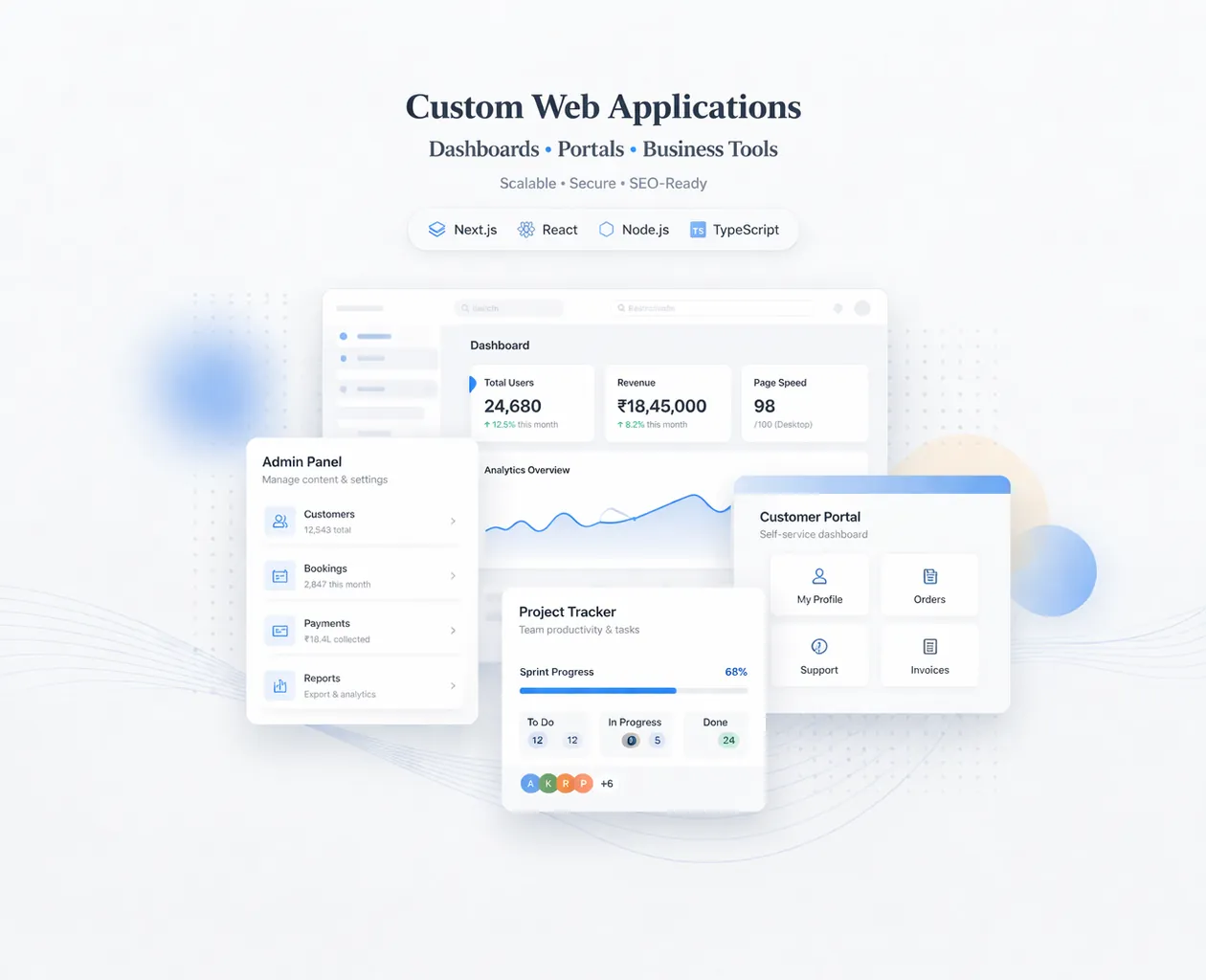
Explore web application development services in 2026: modules, workflows, real examples, process, timelines, integrations, and the main business cost drivers.
Read articlePublished Updated
Estimate web application development cost in India using modules, roles, workflows, integrations, reports, migration, QA, support and phased delivery.
Web application development cost in India should be estimated from business rules, modules, user roles, data and delivery risk, not from the number of screens.
Two apps may both have twenty screens. One stores simple enquiries; the other enforces approvals, calculates tax, generates PDFs, integrates payments and separates data between companies. Their cost cannot be comparable.
This guide provides indicative planning bands and a repeatable scope method for Indian SMEs, founders and operations teams. The figures are not fixed quotations or a market guarantee.
| Scope | Indicative build band | Typical delivery shape |
|---|---|---|
| Focused internal MVP | ₹2–₹5 lakh | One workflow, limited roles, core reports |
| Connected business web app | ₹5–₹12 lakh | Several modules, approvals, PDFs, integrations |
| Multi-company SaaS MVP | ₹8–₹18 lakh+ | Tenant isolation, billing, roles, onboarding, operations |
| Complex platform | Scope after discovery | Heavy integrations, compliance, migration or scale |
These bands assume a custom production system with discovery, development, QA and deployment. A prototype, no-code workflow or ready-made product may cost less and may be the better choice.
A website primarily presents content and captures enquiries. A web application lets users sign in, create records and perform controlled work.
| Website | Web application |
|---|---|
| Service pages and content | Operational modules and records |
| Public navigation | Authentication and permissions |
| Contact forms | Business validation and state changes |
| Limited stored data | Database, audit and reports |
| Mostly publishing workflow | Ongoing product/support lifecycle |
If visitors only need to understand services and contact the business, do not buy a custom web app. Review business website planning first.
A useful estimate can be expressed as:
discovery + modules + shared platform + integrations + migration + QA + launch + support
Each part should appear in the proposal.
Discovery converts business language into:
Skipping discovery does not remove its cost. It moves decisions into development, where changes are slower and more expensive.
Most apps need foundation work before the first business module:
Do not compare a quote that includes these controls with a quote for only visible screens.
Classify every module.
| Level | Example | Main effort |
|---|---|---|
| Simple | Client master | CRUD, validation, search |
| Moderate | Purchase workflow | Items, totals, status, permissions |
| Complex | Inventory | movements, locations, reservations, reconciliation |
| High-risk | Payment or tenant access | callbacks, security, idempotency, isolation |
A “reports module” can mean one downloadable table or a full analytics layer with filters, calculations and scheduled delivery. Name each report.
Cost grows when actions differ by role.
Questions:
A role matrix should list view, create, edit, approve, export and delete permissions for every sensitive module. Use the permission-matrix guide before estimating.
State transitions create more work than static forms.
Example purchase states:
draft → submitted → approved → partially received → completed → cancelled
For each transition, define:
The quote should include exception paths, not only the happy path.
An integration estimate depends on:
“WhatsApp integration” can mean a simple click link or approved template messaging with delivery status and consent. They are different projects. Review integration services for the distinction.
Reports require calculation rules, permissions, filters and performance work.
Define:
PDF invoices or documents also need template design, page breaks, tax rules, numbering, storage and regeneration rules.
Migration cost depends more on data quality than row count.
Scope:
Do not promise migration from a sample sheet without checking the actual data.
A responsive web app is not automatically an offline mobile app.
Cost rises for:
Keep these as separate deliverables unless included explicitly.
Possible scope:
Suitable when one manual workflow is the primary problem.
Possible scope:
Suitable for billing, inventory, CRM, booking or order workflows that share data.
Possible scope:
Use the SaaS MVP cost guide when the business model includes plans and multiple customer organizations.
| Phase | Typical range | Output |
|---|---|---|
| Discovery and scope | 1–3 weeks | process map, module list, acceptance plan |
| UX and prototype | 1–4 weeks | approved flows and key screens |
| MVP development | 6–14 weeks | working modules and integrations |
| QA and UAT | 2–4 weeks | verified scenarios and corrections |
| Launch and stabilization | 1–3 weeks | production, training, monitored fixes |
Phases can overlap, but approval delays, unclear data and provider access can extend delivery.
Plan for:
The maintenance contract should distinguish defect correction, routine care and new features. The website and web-app maintenance guide explains that boundary.
Do not save money by removing authorization, backups, validation or reconciliation from a system that handles sensitive operations.
Normalize every vendor quote.
| Scope item | Vendor A | Vendor B | Decision |
|---|---|---|---|
| Discovery | |||
| Modules | |||
| Roles | |||
| Reports/PDFs | |||
| Integrations | |||
| Migration | |||
| QA/UAT | |||
| Deployment | |||
| Support | |||
| Source ownership |
Compare accepted outcomes, not one total number.
VASUYASHII provides scoped web application and custom software development. VASUYASHII Business Suite is an existing ERP-lite billing and inventory product; it should not be confused with a quote for arbitrary custom modules.
Use the web app development hub to connect this cost model with phase-one planning, dashboard, portal, and SaaS resources.
Live demo access, mobile or desktop delivery, advanced accounting, statutory integrations and custom automation must match the specific product or proposal.
A focused custom MVP may fall around ₹2–₹5 lakh, while connected or SaaS systems can require much more. The final estimate depends on roles, workflows, integrations, migration and risk.
A prototype or very limited tool may be possible. Confirm whether production authentication, permissions, QA, deployment, support and source ownership are included.
A focused MVP often needs discovery plus several development and QA weeks. A reliable estimate requires an accepted module and workflow map.
It can accelerate suitable products, but cost and architecture depend on access rules, queries, offline needs, integrations and future scale.
Reports contain calculation, filtering, authorization, export and performance rules. Their complexity is not visible from the number of screens.
Launch stabilization should be defined. Ongoing care, provider changes and new features need a separate support scope.
Use the software project requirement template and provide modules, roles, examples, integrations, data and acceptance criteria.
Write a phase-one brief with one outcome, users, modules, states, reports, integrations and sample data. Then contact VASUYASHII for a scoped estimate through web application development services.
Related Articles
March 25, 2026
Explore web application development services in 2026: modules, workflows, real examples, process, timelines, integrations, and the main business cost drivers.
Read article
March 19, 2026
Plan a business web app with roles, modules, data models, security, testing, deployment, Indian costs, implementation guidance, and a practical checklist.
Read article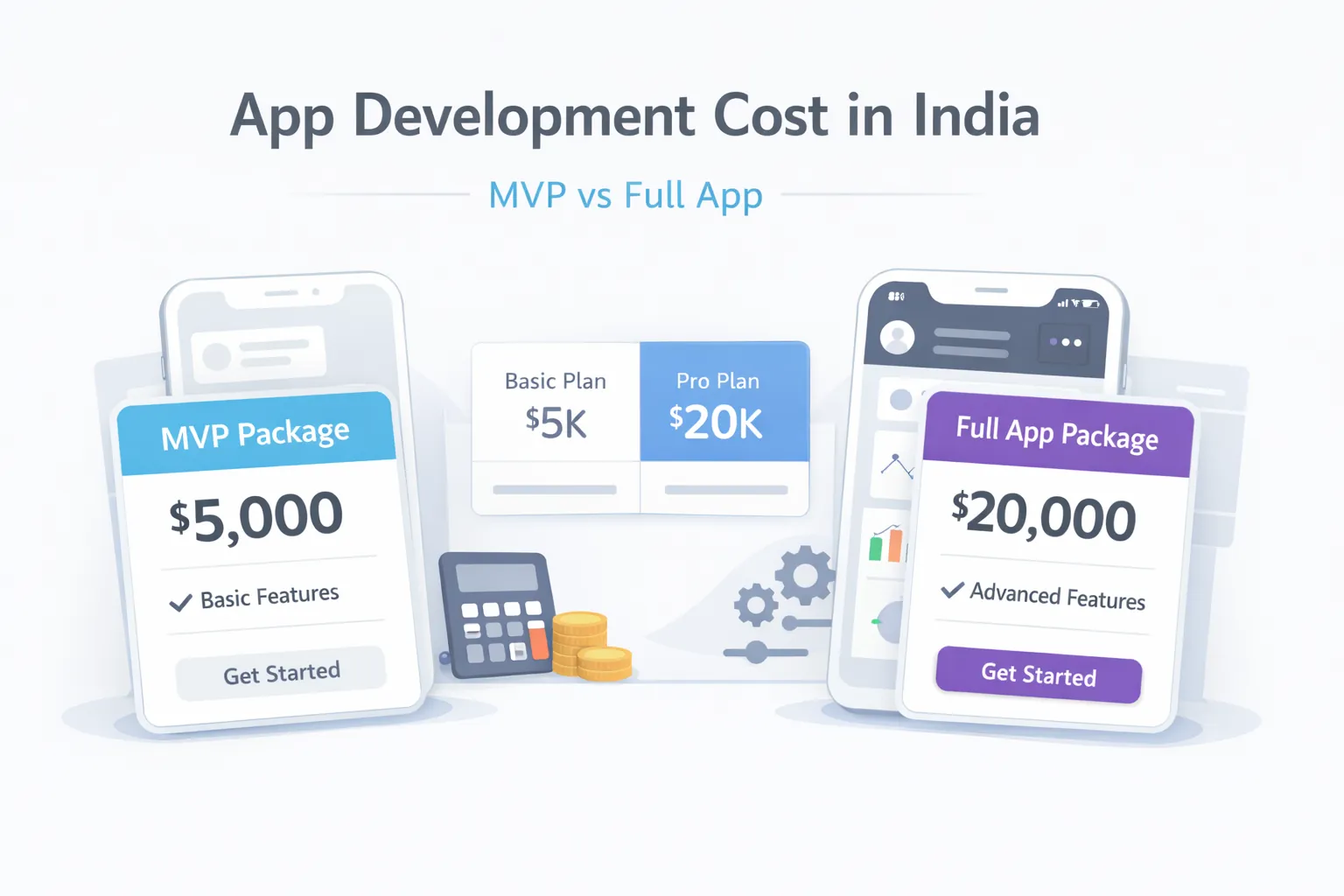
March 29, 2026
Estimate app development cost in India by comparing prototype, focused MVP, and full product scope across platforms, backend, integrations, QA, and support.
Read article
May 22, 2026
Automate business reports with validated data, scheduled snapshots, WhatsApp or email delivery, failure alerts, access controls, and audit logs.
Read article