
March 28, 2026
Google Search Console Indexing Guide 2026
Google Search Console indexing guide for 2026: how to get pages indexed faster without spam, common issues, checks, and practical workflow.
Read articlePublished Updated
Improve Google indexing by fixing crawl access, canonical signals, sitemap dates, internal links, rendering and content quality before requesting recrawl.
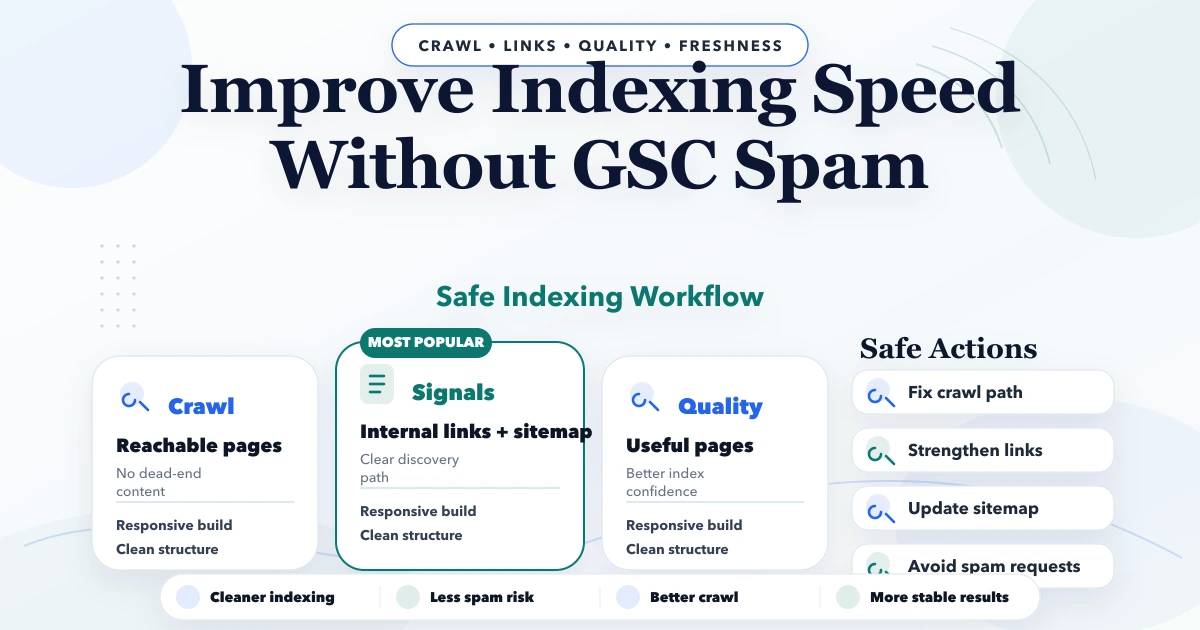
You cannot force Google to index a normal web page, but you can remove the reasons that make crawling, understanding, and selecting it difficult. Repeatedly clicking "Request indexing" does not repair a wrong canonical, thin duplicate content, weak internal discovery, blocked rendering, or a low-value page. Google explicitly says repeated recrawl requests do not make crawling faster and that inclusion is not guaranteed.
This guide provides a safe workflow for improving indexing speed without Google Search Console submission spam. It is intended for business websites, service pages, and blog libraries, including static Next.js sites.
By Tushar C. (Founder, VASUYASHII). Reviewed by VASUYASHII Editorial against current site-audit practice and official Google Search Central documentation available on July 20, 2026. Google controls crawling, indexing, and serving; no developer or SEO provider can guarantee inclusion or a ranking position.
Use this order:
200 and is publicly renderable;noindex rules;Google's recrawl documentation says crawling may take from a few days to a few weeks. It also states that submitting the same URL repeatedly will not accelerate crawling. Treat the request as a notification, not a repair tool.
Teams often use "not indexed" for three different stages:
| Stage | Question | Typical evidence |
|---|---|---|
| Discovery | Does Google know the URL exists? | Sitemap, internal links, discovered status |
| Crawling | Can Google fetch the final page and resources? | URL Inspection, response, robots, rendering |
| Index selection | Does Google choose this page for its index? | Canonical selection, duplicate and quality signals |
A sitemap can support discovery, but Google's crawling and indexing FAQ states that a sitemap does not guarantee indexing or improve ranking. A successful crawl also does not guarantee selection. Diagnose the stage before changing anything.
Test the exact canonical URL, not an old HTTP or non-www variation. The final URL should:
200 after expected domain redirects;404 responses;If the inspected URL redirects, Google may correctly classify it as "Page with redirect." Request indexing for the final destination, not the redirecting variation.
For a static export, inspect the generated HTML as well as the browser view. Confirm that the title, description, H1, body content, links, canonical, and JSON-LD are present in the delivered document. If critical content appears only after a fragile client-side request, rendering can become a separate risk.
Review robots.txt, page-level robots metadata, and HTTP headers. A page intended for indexing should not carry noindex. Important assets should not be blocked if Google needs them to understand the page.
Remember that robots and index control are different. Google's noindex documentation explains that Google must be able to crawl a page to see its noindex instruction. Do not try to place a noindex rule inside robots.txt; that is not a supported implementation.
Check inherited metadata in shared layouts. A route can accidentally inherit a noindex rule intended for demos, staging pages, search results, or private utility routes.
The following should all identify the same final HTTPS URL:
<link rel="canonical">;og:url;url and mainEntityOfPage;Self-canonical is appropriate for a unique page that should be indexed. Do not point every similar article to a parent page merely because Google has not indexed it. A canonical is a duplicate-content signal, not a request to rank a weaker page.
If Google-selected canonical differs from the user-declared canonical, compare content, internal links, redirects, domain variants, and sitemap history. Remove mixed signals before submitting another request.
Technical correctness is not enough when many pages answer the same query with the same structure. Compare the affected page with its closest siblings:
If only the city, industry, or keyword changes, improve the page with real local or operational value. If two pages have the same purpose, decide whether to differentiate, consolidate, or retain one based on Search Console, backlinks, leads, and business relevance. Do not mass-delete based on word count alone.
For VASUYASHII, priority content refreshes use distinct Indian SME workflows, transparent capability boundaries, explicit authorship, current update dates, useful tables, and contextual links. That improves the page itself; it does not create an indexing guarantee.
Important pages should be reachable through crawlable HTML links from relevant hubs and articles. A URL buried on page 20 of an archive is technically discoverable but receives weak context.
Build a simple hierarchy:
Use descriptive anchors that explain why the destination matters. Avoid adding the same list of links to every article. Three contextually strong links from relevant pages are better than dozens of unrelated footer links.
Useful VASUYASHII parent routes include website development services for Delhi NCR, web application development, custom software, CRM and ERP, and the local SEO hub.
The sitemap should contain indexable final URLs only. Remove redirecting, non-www, HTTP, duplicate, or intentionally noindexed pages. Use a real lastmod value only when the page's significant content changed; do not rewrite every sitemap date on each build.
After deployment:
lastmod with the meaningful content update; andSubmitting a sitemap is the scalable discovery method for many URLs. URL Inspection is better for a small set of priority changes.
Inspect the final canonical URL after deployment. Review:
If the live test is correct and the page changed meaningfully, request indexing once. Record the date and wait. Do not repeat the request every day. Monitor the Page Indexing report, URL Inspection result, impressions, and crawl date over the following days or weeks.
The Google Search overview says Google does not guarantee that it will crawl, index, or serve every eligible page. A responsible status report should acknowledge that uncertainty.
Google's Indexing API documentation limits the API to pages with JobPosting or BroadcastEvent embedded in VideoObject. It is not a general-purpose fast-indexing API for blog posts, service pages, or ecommerce pages.
Avoid third-party services that promise instant indexing by submitting normal URLs through unsupported methods, multiple accounts, artificial traffic, or automated request loops. These methods do not fix page quality and may create unnecessary account or spam risk.
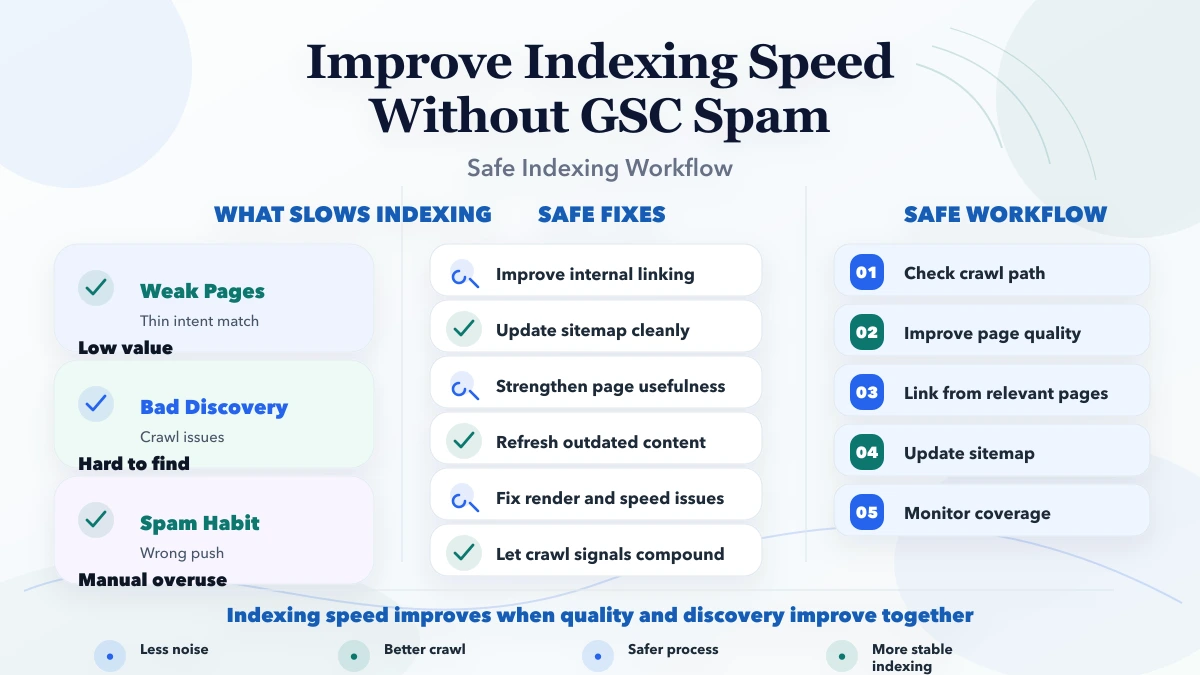
| Finding | Likely action | Do not do |
|---|---|---|
| Redirecting URL in GSC | Validate redirect and work on final destination | Request indexing for source URL |
Final page has noindex | Confirm intent and remove only if accidental | Override without checking route purpose |
| Canonical points elsewhere | Fix mismatch if page should be unique | Add more sitemap submissions |
| Crawled, not indexed | Compare quality, duplication, intent and internal links | Assume a crawl-budget problem immediately |
| Discovered, not indexed | Improve discovery, importance and page value | Submit the same URL daily |
| Duplicate, Google chose another canonical | Review competing signals and page overlap | Force self-canonical without differentiation |
| Rendered HTML is incomplete | Fix delivery or rendering | Blame content length alone |
| Sitemap missing final URL | Fix sitemap generation and deploy | Manually resubmit every post |
lastUpdated only after meaningful improvement.Current VASUYASHII indexing reviews separate technical eligibility from content selection. We first verify status, final URL, directives, canonical consistency, static HTML, sitemap, and internal links. We then compare the page against its closest content cluster and improve only when the page has a legitimate distinct purpose. Redirects, canonical overrides, noindex, or deletions require stronger evidence than a single GSC label.
Related guides include how to fix discovered currently not indexed, the Google Search Console indexing guide, content cannibalization fixes, automatic sitemap updates, and service city pages without spam.
Request once after a meaningful deployment for a small number of priority URLs. Repeating the same request does not make crawling faster. Use a sitemap for broader discovery and monitor the result.
There is no guaranteed time. Google says recrawling can take from days to weeks, and indexing is not guaranteed. Site importance, crawl access, page quality, duplication, links, and demand can all affect the process.
Not by itself. Update the visible and structured modification date only when the content changed meaningfully. Artificial freshness creates a misleading signal and does not add page value.
Include canonical, indexable posts that the site wants search engines to discover. Exclude redirects, duplicates represented by another canonical, noindexed pages, and low-value utility routes.
Relevant crawlable links improve discovery and context. They cannot rescue a duplicate or unhelpful page on their own. Link from topic hubs and closely related content where the destination adds value.
Not necessarily. It means Google crawled the URL but did not currently include it. Check technical signals, but also compare content purpose, uniqueness, evidence, and internal importance.
No. A provider can improve eligibility, discoverability, consistency, and usefulness, but Google decides whether and when a page is indexed and shown.
Export the affected final URLs from Search Console and classify each by redirect, canonical, crawl, rendering, content overlap, and internal linking. Fix one confirmed cause at a time, deploy, then use URL Inspection on the final canonical page.
Related Articles
March 28, 2026
Google Search Console indexing guide for 2026: how to get pages indexed faster without spam, common issues, checks, and practical workflow.
Read article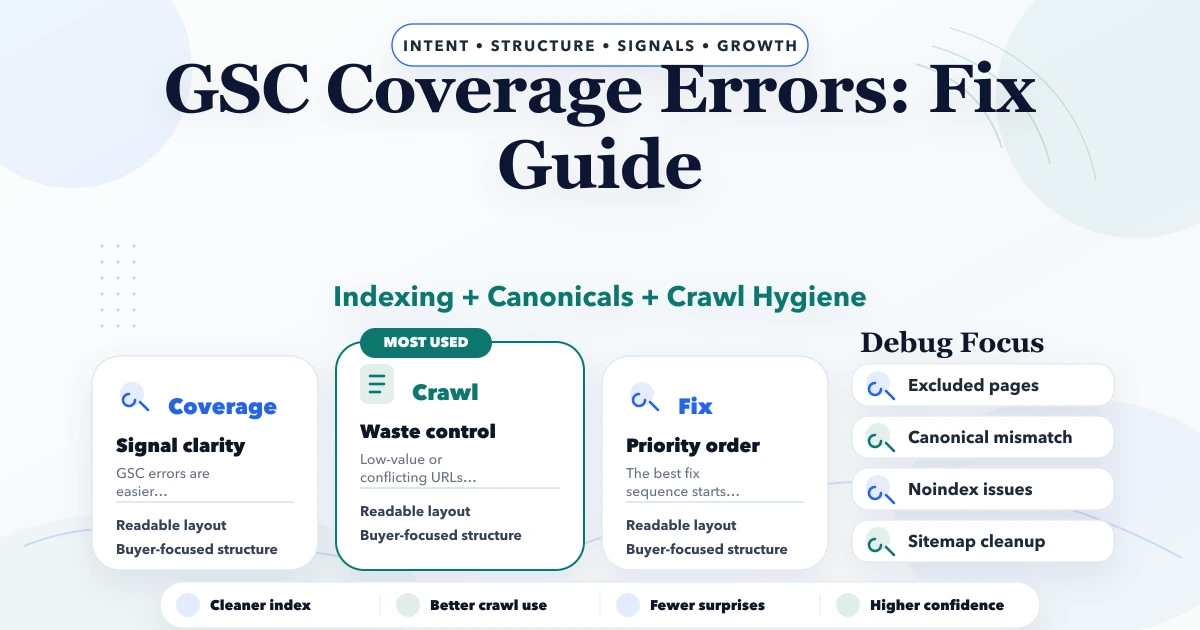
May 3, 2026
GSC Coverage errors fix guide: excluded pages, crawl issues, canonicals, noindex, sitemap fixes, and practical troubleshooting steps for 2026.
Read article
May 12, 2026
Avoid scaled content, weak city pages, canonical noise, sitemap clutter, spam links, poor intent matching, and measurement gaps with this practical SEO review.
Read article
April 8, 2026
Read Google Search Console clicks, impressions, CTR and position correctly, then diagnose query intent, snippets and page opportunities before editing.
Read article