
March 26, 2026
Vendor and Client Management Software Guide
Vendor and client management software guide with CRM-lite features, pricing in India, tech stack, timeline, and rollout advice for growing SMB teams today.
Read articlePublished
Staff management system guide for SMBs covering attendance, roles, reports, pricing in India, tech stack, timeline, and rollout tips for lean HR ops today.
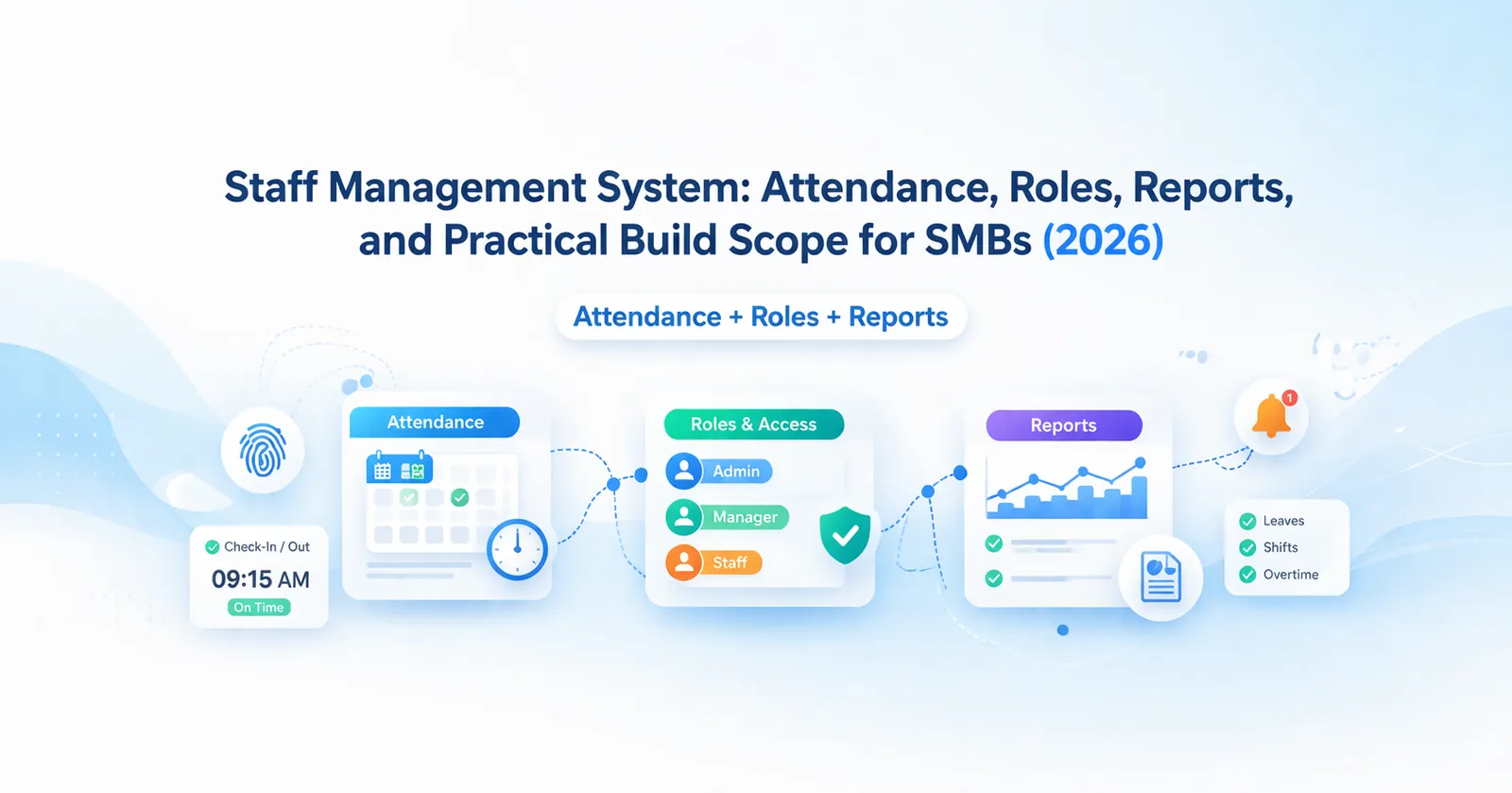
Many small and mid-sized businesses do not need a giant HR suite. They need a practical staff management system that can record attendance, define roles, manage leaves, show who belongs to which branch or department, and generate reports without manual juggling.
The problem usually starts small. Attendance comes from a register, leave requests come on WhatsApp, employee documents sit in folders, and role clarity exists only in someone's head. As the team grows, that setup stops scaling. Reporting becomes weak, managers lose visibility, and payroll or compliance preparation becomes more time-consuming than it should be.
This guide explains how a staff management system should be scoped for Indian SMBs, what features matter, what development cost usually looks like, and how to keep the first release useful instead of overloaded.
If your business is handling attendance, leaves, roles, and employee reporting through spreadsheets, chat approvals, and manual follow-up, a staff management system can reduce confusion and save a lot of admin time. For most SMBs, the best version is not a full corporate HRMS. It is a lean operations-focused system that centralizes staff data and gives managers clearer daily visibility.
The most useful phase-one scope usually includes:
If your business also needs internal approvals and dashboard-heavy operations, admin dashboard development and internal tools development for companies are relevant companion reads.
Staff management systems work best for businesses with 10 or more employees, multiple managers, attendance-heavy operations, or more than one branch. Retail groups, clinics, agencies, training centers, service teams, and admin-led companies usually feel the value early because attendance, leave, and role visibility become much easier to manage. If your HR work is still small but messy, a lean staff system often gives more value than jumping straight into a heavyweight HR platform.
It becomes even more useful when monthly payroll preparation still depends on last-minute attendance corrections, leave confirmations, and repeated manager follow-up.
That alone can justify the first release for many admin-heavy SMBs.
People management becomes messy much faster than founders expect. It is not only about who joined and who left. It is also about attendance consistency, exception handling, role clarity, late approvals, and report accuracy.
A good staff management system gives structure to the daily admin of people operations. It reduces dependency on memory, makes manager approvals cleaner, and creates a trusted source for attendance and staff reporting.
This matters even more for growing businesses where owners want visibility but do not want to micromanage every leave request or attendance exception.
Before development starts, decide how broad you want the system to be.
This is suitable for businesses that mainly want employee master, branch mapping, attendance, leave, and reports. It works well for offices, retail chains, clinics, training centers, agencies, and service companies.
This adds leave approval hierarchy, role-based access, branch manager views, attendance exceptions, and stronger admin reporting. It is useful where multiple managers handle different departments or branches.
This can include shift planning, task assignment, document expiry reminders, onboarding checklists, payroll export support, and workflow integrations. Not every SMB needs this on day one, but many grow into it once the attendance base becomes stable.
If the system later needs to connect with payroll, operations, or ERP modules, it is better to prepare the data structure early rather than rebuilding later.
These are the staff management features that usually deliver the most practical value.
After launch, businesses often add geolocation attendance, selfie verification, onboarding checklists, asset allocation, or payroll export integrations. These should come after the base attendance and reporting process is working properly.
If your team is already doing attendance or leave tracking manually, the real question is not whether software is needed. The real question is how lean phase one can be while still solving the daily mess.
Staff management software pricing depends on employee count, attendance method, role complexity, and reporting requirements.
₹1.4 lakh to ₹2.5 lakhIncludes employee master, attendance, leave requests, and basic reports.
₹2.6 lakh to ₹4.5 lakhIncludes role-based access, branch views, exception handling, and stronger dashboards.
₹4.75 lakh to ₹7.5 lakhIncludes shift planning, geo attendance, document workflows, exports, and integration support.
For most SMBs, yearly support and improvements usually fall around ₹20,000 to ₹70,000 depending on employee count, hosting, and change frequency.
The best lead-oriented budget is usually the middle tier if your business already has multiple managers or branches. A very small build works for one office. A more structured build pays off when reporting and approvals are already eating team time.
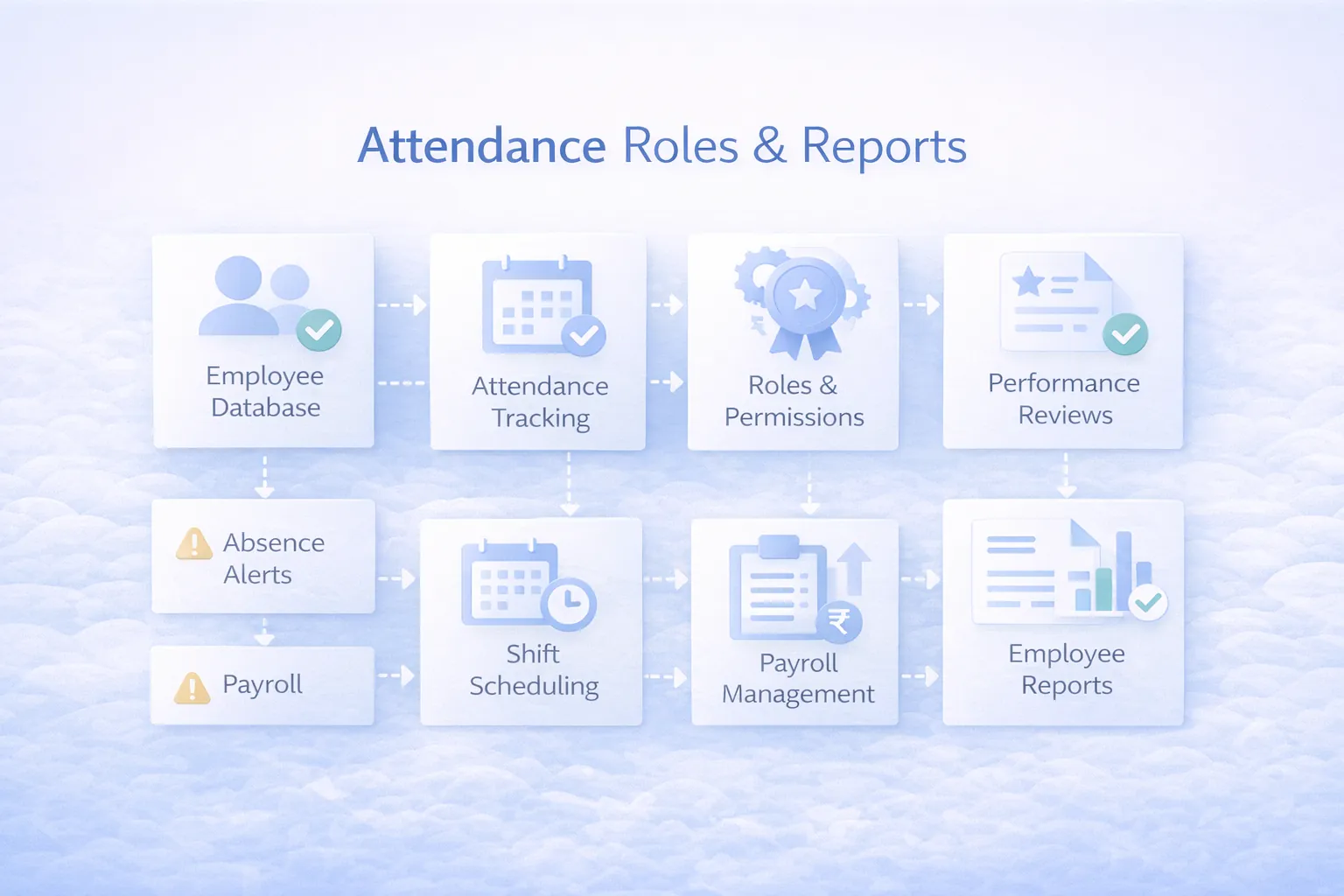
Staff software needs reliable forms, clean approvals, and fast report access.
Next.js for employee records, attendance panels, leave screens, and admin dashboards.Node.js or equivalent server logic for attendance rules, approval flows, and report processing.PostgreSQL for employee master, attendance logs, leave records, documents, and audit entries.If this system will later connect to payroll, ERP, or broader admin tools, planning those integrations early helps avoid rework.
Staff management system projects usually take 4 to 8 weeks for an SMB-ready rollout.
Projects often slow down when the business has unclear leave policy or attendance exception rules. That is a process problem first, then a software problem.
These factors usually decide the actual project size:
The right build should make staff management calmer, not heavier. If approvals and records still feel confusing after launch, the scope needs rethinking.
To keep the first release practical:
This keeps the software easy to adopt. Once usage becomes consistent, you can expand into task workflows, onboarding checklists, or broader ERP and admin modules.
Many SMBs ask for payroll, recruitment, appraisal, onboarding, and attendance all at once. That usually slows down launch and reduces clarity. Start with the operational basics first.
If late marks, grace time, half days, and holidays are not defined clearly, software cannot magically create consistency. Business rules must be written down before rollout.
Staff software often contains sensitive data. Not every manager should see every document or report. Role design is part of trust.
Attendance processes can differ between office staff, field staff, and branch teams. If phase one ignores that difference, adoption becomes messy fast.
Someone from the company should define what "monthly attendance report" or "leave summary" really means. Without that ownership, reporting keeps changing late in the project.
For most SMBs, a lean custom build starts around ₹1.4 lakh and grows toward ₹4.5 lakh or more as roles, branches, and reporting become more detailed.
Not necessarily. A staff management system can be much leaner and more operations-focused than a full HRMS.
Yes. In fact, that combination is one of the most common and useful first-phase scopes.
Not always. Many SMBs do well with a responsive browser system first. Mobile app investment should be based on actual usage pattern, not assumption.
Yes. Branch-wise records, managers, and reports are common requirements and should be planned early if the business already works that way.
Yes. Many businesses first launch attendance and leave, then add payroll exports or integrations once the data becomes reliable.
Launching without clear attendance rules and approval ownership. Users get confused, and the software starts taking blame for process gaps.
Usually 4 to 8 weeks for a practical SMB scope, depending on branch logic and report depth.
If attendance and leave are still managed through chat, register, and repeated follow-up, there is a clear process gap worth fixing now.
Related Articles
March 26, 2026
Vendor and client management software guide with CRM-lite features, pricing in India, tech stack, timeline, and rollout advice for growing SMB teams today.
Read article
April 2, 2026
HRMS for small business: attendance, payroll, leave modules, cost, and rollout timeline for a practical SME system in 2026.
Read article
March 27, 2026
Restaurant admin dashboard features guide with owner-panel reports, pricing in India, tech stack, timeline, and cost drivers for restaurant software today.
Read article
May 23, 2026
document management system portal: practical 2026 guide with features, INR pricing, roadmap, tech stack, mistakes, FAQs, and Indian SME tips today safely.
Read article