
May 24, 2026
Retail Inventory Management System Guide
Plan retail inventory software around products, barcodes, stock movements, purchases, sales, returns, transfers, counts and reorder controls.
Read articlePublished Updated
Inventory software for retail shops: features, real use cases, pricing, rollout plan, and what retailers should digitize first in 2026.
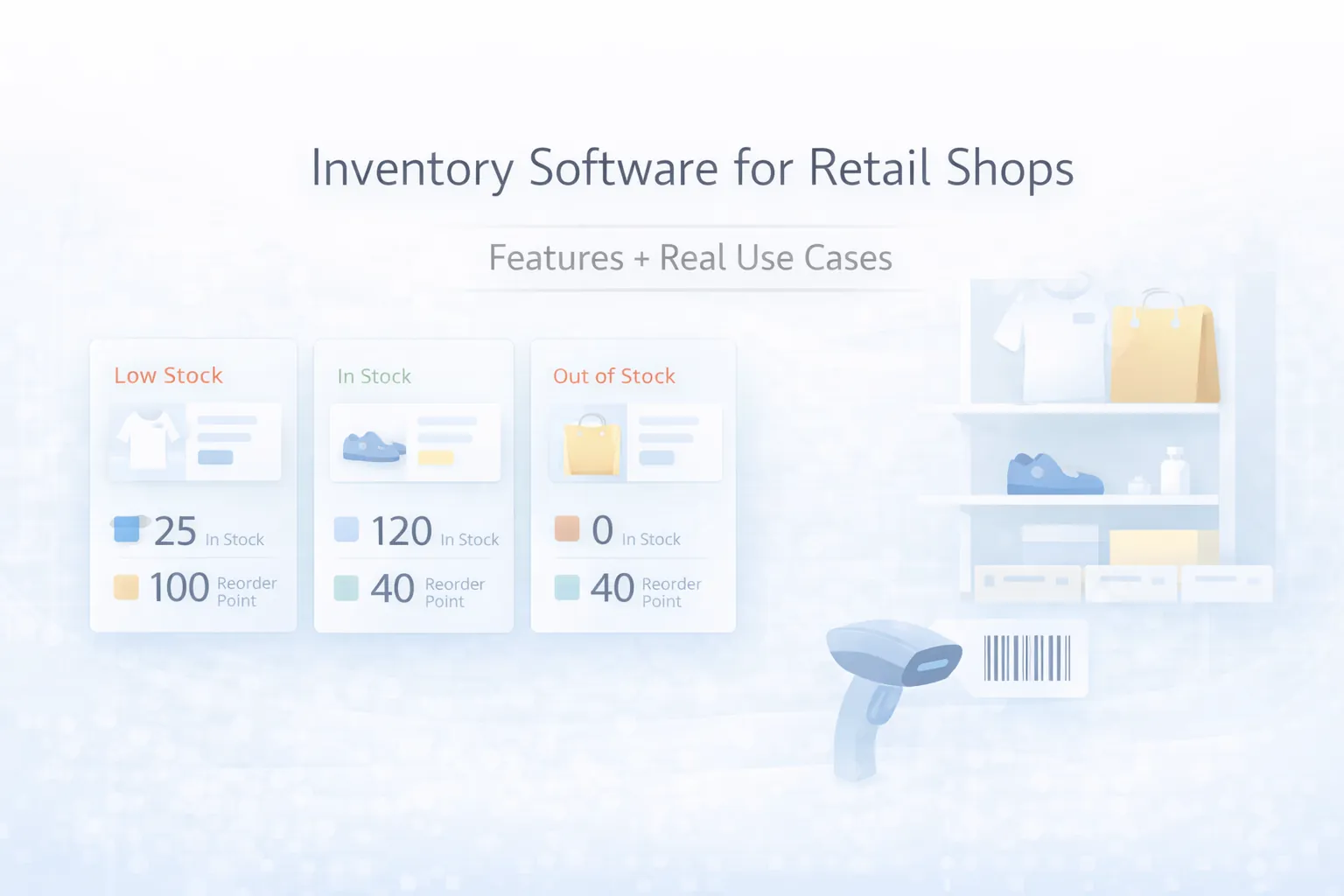
Retail shops often think inventory problems start when business becomes "big." In reality, stock confusion begins much earlier. One item shows available in the register but is missing on the shelf. Another item gets reordered late. Staff updates stock manually in one place and sales happen somewhere else. Slowly, stock mistakes become a daily tax on the business.
That is why inventory software matters even for small and mid-sized retail shops. Good inventory software is not only a stock counter. It becomes the system that helps the owner understand item movement, purchase planning, dead stock, fast-moving items, and day-to-day control.
This guide explains what inventory software for retail shops should include, what real use cases justify the investment, how much it costs in India, and what to build first if you do not want to overcomplicate operations.
The Business Suite inventory workflow is a useful starting point when product records, stock visibility, purchases, sales, returns and reports cover the main need. Evaluate it with a small sample product set: receive an item, sell it, return it and compare the resulting records with a physical count. Let the staff member who normally does this work participate in the walkthrough.
Write down any gap involving variants, expiry dates, branch transfers, hardware or external POS connections. Do not treat multi-company support as proof of every multi-branch workflow. Configuration and a new feature are different costs, and your proposal should make that distinction clear.
Discuss an inventory-management requirement with the product count, locations, current billing system and main stock problem. If the existing product does not fit, compare a separately scoped custom software implementation before deciding to migrate.
Retail inventory software becomes valuable the moment a shop starts facing repeated stock mismatch, purchase delay, slow counting, or unclear product movement. Even a small shop can benefit if the right phase-one scope is chosen.
For most retail businesses, the best first version includes:
Typical pricing ranges:
₹1 lakh to ₹2.2 lakh₹2.2 lakh to ₹4.5 lakh₹4.5 lakh to ₹10 lakh+Inventory software matters because retail mistakes multiply quietly. They may not look dramatic in one day, but they hurt margin and customer trust over time.
Once stock movement becomes visible, owners make better decisions. Reordering becomes calmer. Staff accountability improves. Product-level reporting starts making sense. This is especially useful for apparel, grocery, cosmetics, hardware, stationery, electronics, and multi-category stores.
Related reading:
These are the features that matter most for retail inventory control.
Barcode printing, supplier reorder suggestions, expiry alerts, margin reports, transfer between branches, and deeper POS integration can be added after the base system works well.
Retail owners often understand software better through use cases than through feature lists.
The store needs size and color visibility, stock movement by variant, and confidence that popular products are not oversold or under-ordered.
The owner needs quick reordering, item count discipline, and clarity on fast-moving essentials. Low-stock alerts create immediate value here.
The team needs traceable product entry, price updates, and better visibility into product categories that move slower but have higher value.
Here inventory software becomes even more important because one branch may have dead stock while another is understocked. Central visibility saves real money.
Retail software cost depends on product complexity, branch count, and whether billing or POS integration is included.
₹1 lakh to ₹2.2 lakhBest for one outlet and core stock tracking.
₹2.2 lakh to ₹4.5 lakhBest for stronger reporting, low-stock logic, roles, and better admin usability.
₹4.5 lakh to ₹10 lakh+Best for POS sync, multi-branch control, richer reports, and workflow automation.
Start with stock visibility and reporting. Do not try to rebuild the entire shop operation at once unless the team is ready for that change.
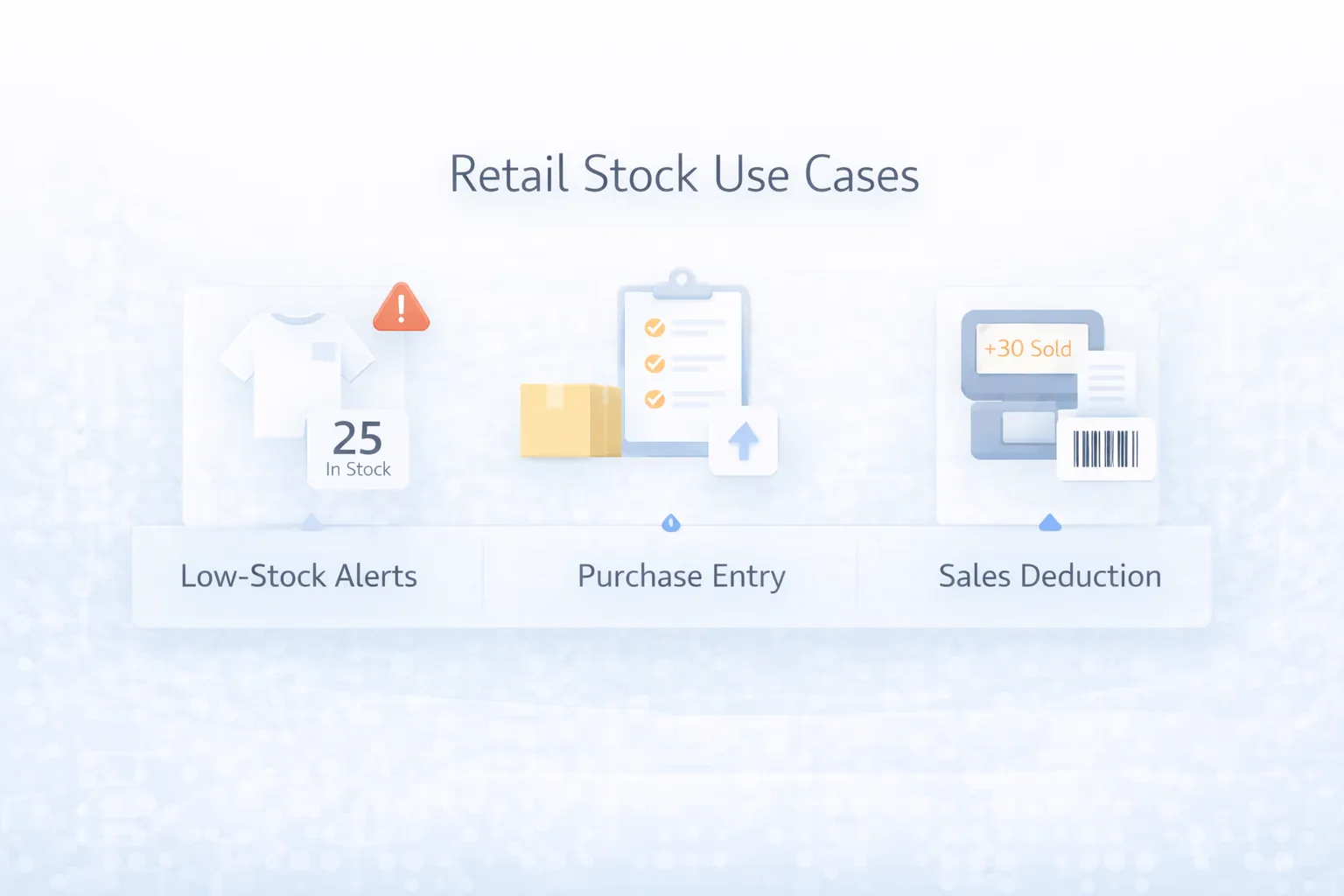
Retail inventory systems need dependable data, search speed, and easy admin access.
Next.js for admin panels, stock screens, and reportsNode.js for stock logic, adjustments, alerts, and integrationsPostgreSQL for products, branches, stock history, and reportsMost focused retail inventory projects take 4 to 8 weeks.
Timeline improves when the shop already has clean product records.
If stock mismatch is already affecting sales decisions or staff time, the right software project usually starts with SKU discipline and stock visibility, not with a huge feature list.
The biggest pricing factors in retail inventory software are:
The biggest process mistake is trying to digitize messy product data without standardizing it first.
The current VASUYASHII Business Suite product screen shows product records, SKU or barcode fields, HSN/SAC, units, GST rates, sale and purchase prices, and stock visibility used in its ERP-lite workflow.
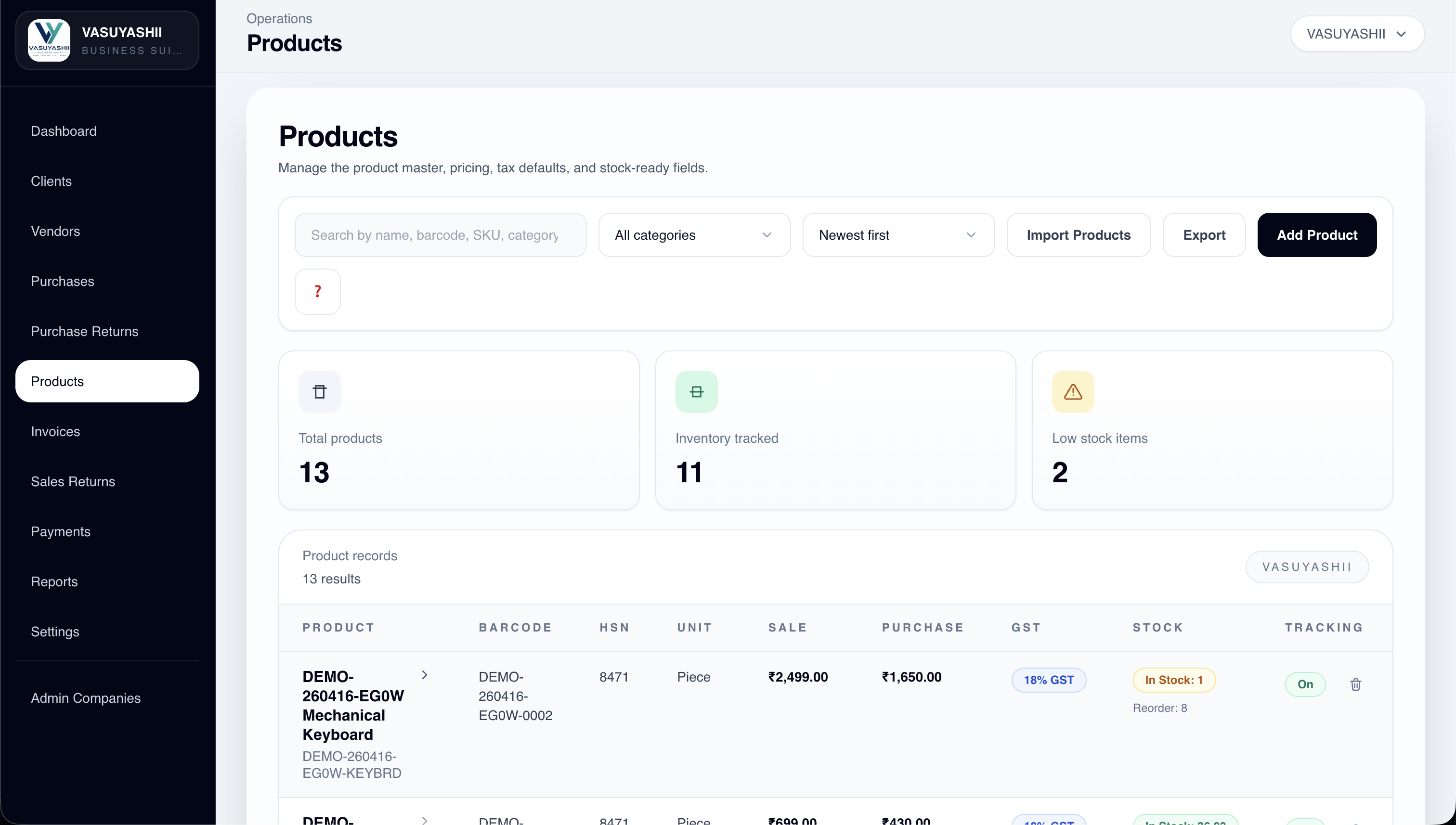
This screenshot is evidence of the current product surface. It is not a customer result and does not prove that every retailer should replace existing software. Retail fit depends on item volume, variants, billing, returns, hardware, branches and operating discipline.
Do not store only one editable quantity. Define how stock changes and which document creates each movement.
| Movement | Quantity effect | Required reference |
|---|---|---|
| Opening stock | Increase | Approved opening import |
| Purchase receipt | Increase | Supplier purchase record |
| Retail sale | Decrease | Completed bill or invoice |
| Sales return | Increase after approval | Original sale and return reason |
| Purchase return | Decrease | Supplier return record |
| Damage or loss | Decrease | Adjustment approval |
| Stock transfer | Decrease/increase by location | Transfer-out and transfer-in record |
| Count correction | Either | Physical count and authorised reason |
The owner should be able to trace current quantity back to movements. Direct quantity edits without actor, time and reason make shrinkage and reconciliation difficult.
Agree SKU uniqueness, barcode ownership, unit, category, brand, GST rate, HSN/SAC, variants, reorder level and active/inactive status. Apparel may need size and colour variants; hardware may need unit packs and brand alternatives; FMCG may need batch or expiry scope.
Use recognised identifiers when the business sells through organised retail or marketplaces. GS1's GTIN guidance explains the global identifier standard. A locally generated internal barcode can still be useful for private operations, but it should not be presented as a GS1-issued GTIN.
If stock mismatch, delayed purchase, or unclear product movement is already causing problems, then yes, even a small shop can benefit.
A focused project can start near ₹1 lakh, while more useful retail builds usually sit between ₹2.2 lakh and ₹4.5 lakh.
In many retail setups, yes. That reduces manual stock updates and improves reliability.
Yes, though multi-branch logic increases scope and should be planned carefully.
Product master, stock movement, low-stock alerts, purchase entry, and simple reports are usually enough.
Yes. Many shops start with admin software and add barcode workflows after adoption improves.
Trying to automate everything before product records and daily stock rules are clear.
Apparel, grocery, cosmetics, hardware, electronics, and other SKU-heavy retail businesses usually benefit quickly.
If you want stock control that actually improves ordering, visibility, and reporting, the next step is to define your product structure, branch rules, and reporting needs clearly before build starts.
Related Articles
May 24, 2026
Plan retail inventory software around products, barcodes, stock movements, purchases, sales, returns, transfers, counts and reorder controls.
Read article
May 9, 2026
inventory system developer near me: pricing, checklist, FAQs, trust signals, and practical SEO steps for Indian SMB owners.
Read article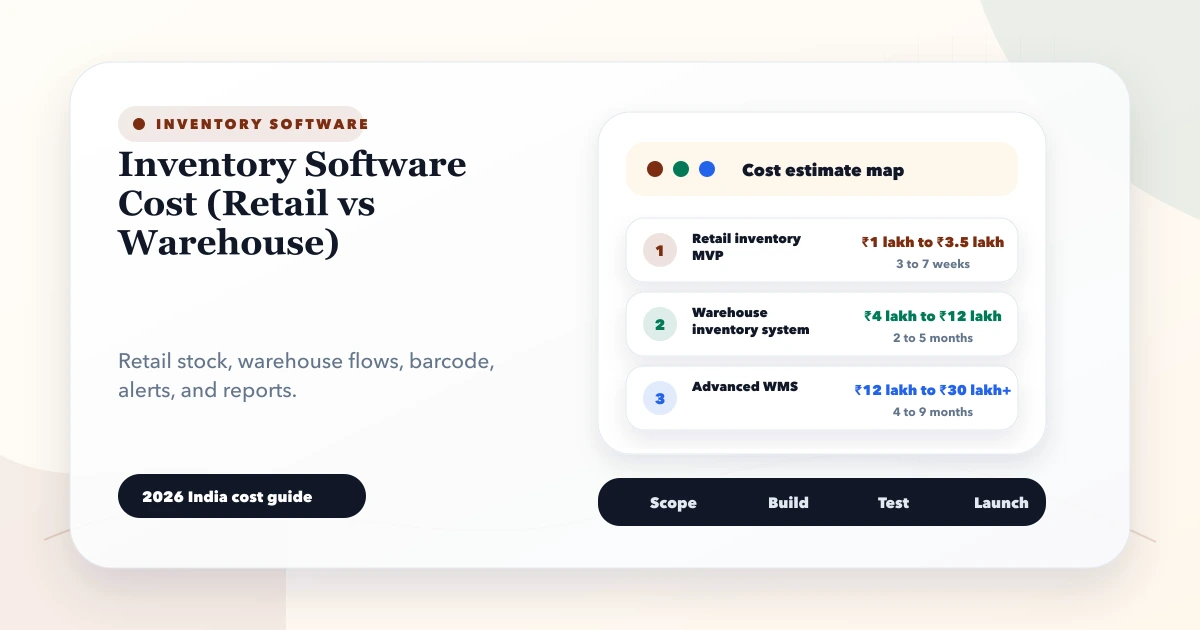
May 28, 2026
Compare inventory software cost for retail and warehouse operations, including modules, barcode workflows, locations, integrations, rollout, and hidden effort.
Read article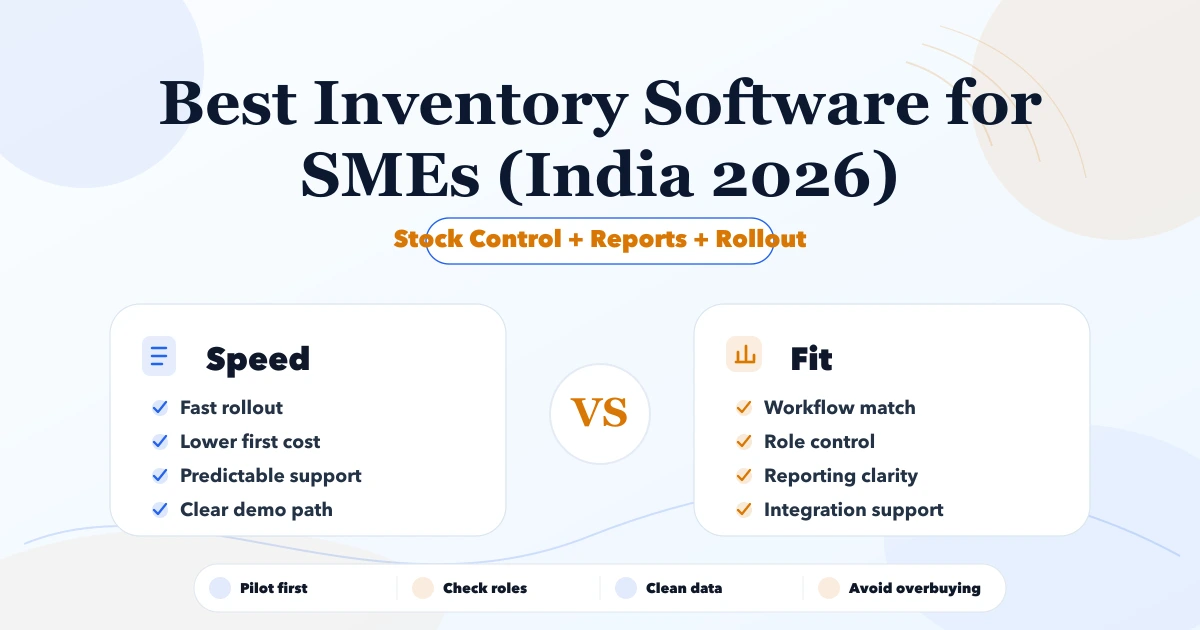
May 7, 2026
Compare inventory software for Indian SMEs by stock workflow, billing, purchases, reports, rollout cost, and when ERP-lite or custom software fits.
Read article