
May 24, 2026
Barcode-Based Inventory System (Mobile + Scanner)
Plan a barcode inventory system for receiving, putaway, picking, stock counts, returns, and transfers using mobile cameras or dedicated scanners.
Read articlePublished
inventory keyword topic cluster: practical 2026 SEO plan with cluster map, pricing, roadmap, mistakes, FAQs, proof, and next steps for Indian SMBs today.
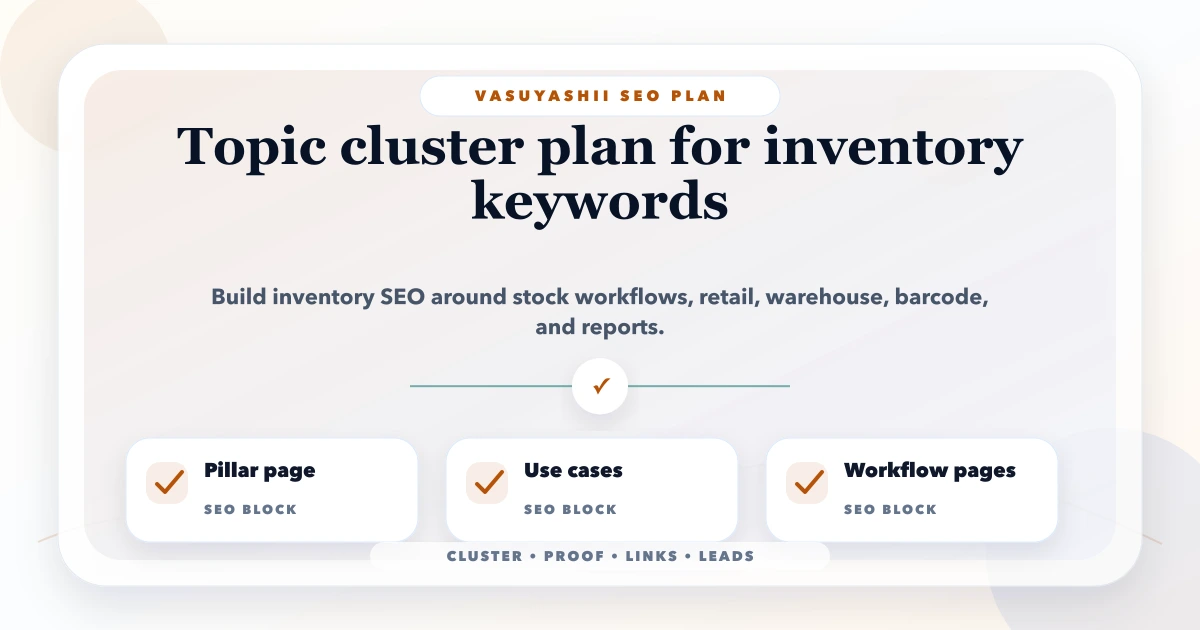
This guide on inventory keyword topic cluster is for software companies targeting inventory system leads from retailers, warehouses, restaurants, distributors, manufacturers, and SMEs. It is written for Indian SMB owners and software-company teams who want organic growth without fake ranking promises. You will learn how to structure pages, build topic clusters, add proof, use internal links, estimate cost, avoid spam risk, and track real leads.
Ranking is not a one-click activity. It comes from useful pages, clean technical setup, topical depth, internal links, trust signals, and consistent measurement. The aim is to make your website easier for users and search engines to understand while keeping the lead path clear.
By Tushar C. (Founder, VASUYASHII). Reviewed by VASUYASHII Editorial for field experience, SEO usefulness, buyer clarity, and practical implementation relevance.
Serving Delhi NCR and nearby business markets: Ghaziabad, Noida, Delhi, Gurugram, Faridabad, Meerut, Hapur, and remote clients across India.
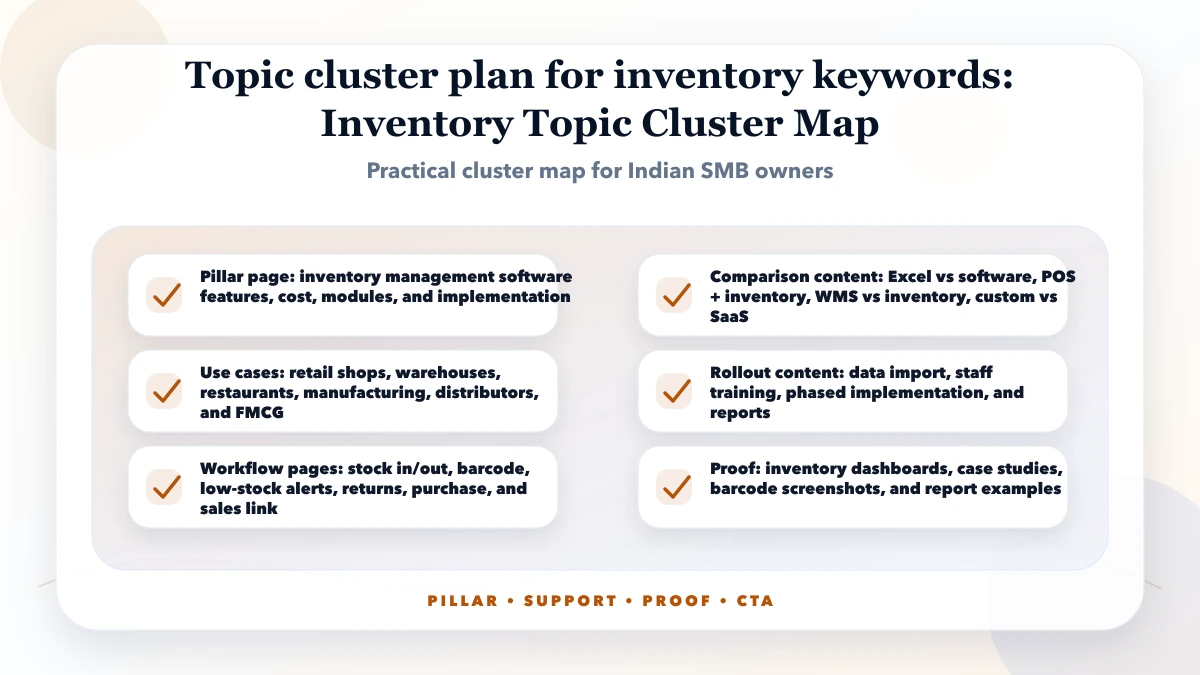
An inventory keyword topic cluster should include an inventory software pillar page, retail inventory guide, warehouse management guide, barcode system guide, stock reports, cost guide, integrations, and rollout plan.
If you want a practical starting point, choose one primary page as the pillar, then create supporting pages that answer real buyer questions. Link everything clearly. Add proof near the CTA. Track leads, not only rankings.
We have also seen one repeated pattern: websites improve faster when content, proof, technical SEO, and conversion tracking are planned together. Publishing more pages without proof or follow-up usually creates traffic confusion instead of sales clarity.
Use this framework as a working content and SEO plan. It can be converted into a page brief, blog calendar, internal-link map, or implementation sprint.
For Indian SMB and B2B software searches, the content should not sound like a copied textbook. Add real workflows, pricing context, screenshots, examples, local service clarity, and clear next steps. This makes the page more useful and helps sales teams qualify enquiries.
Good execution starts with search intent. A pricing query needs cost drivers. A comparison query needs balanced tradeoffs. A local-service query needs location proof and service clarity. A topic-cluster page needs a clear relationship between pillar and support pages.
The next layer is proof. Buyers looking for software, websites, CRM, inventory, billing, or ERP need confidence that the provider understands real business operations. Screenshots, case studies, project notes, templates, demos, and practical checklists make the content more believable.
The final layer is conversion. Every important SEO page should have a clear lead path: WhatsApp, form, call, demo, scope document, audit, or consultation. Traffic without lead tracking can look successful in reports while failing commercially.
| Scope | Practical price range | Typical timeline |
|---|---|---|
| Inventory cluster strategy | ₹15,000 to ₹45,000 | 3 to 7 days |
| 10-page inventory cluster | ₹60,000 to ₹2 lakh | 1 to 2 months |
| Inventory SEO + demo funnel | ₹2 lakh to ₹6 lakh+ | 3 to 6 months |
These are practical planning ranges, not guaranteed SEO outcomes. Real cost depends on competition, existing domain strength, number of pages, content quality, design requirements, proof assets, technical fixes, and whether implementation is included.
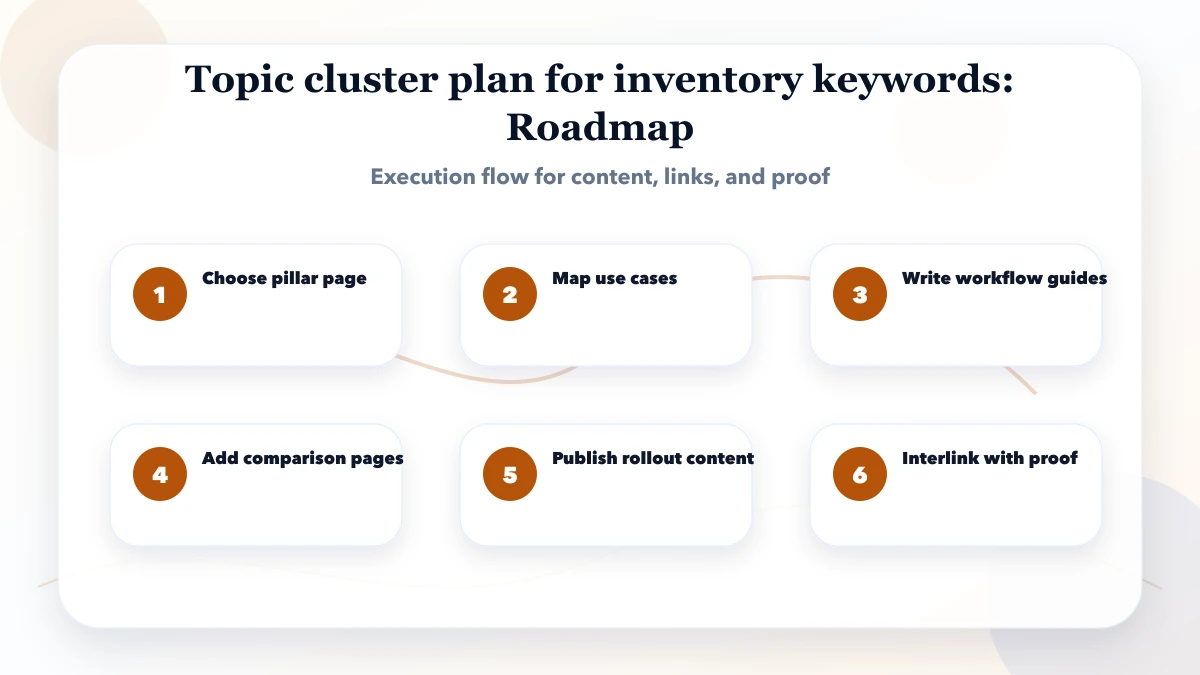
Treat the roadmap as an operating plan. Publish pages in a logical order, then refresh them using Search Console data. A page that starts ranking for unexpected queries may need a new FAQ, stronger internal link, better title, or a supporting blog.
The setup can stay lightweight at first. For most teams, a content calendar, Search Console, GA4 events, internal link tracker, and lead source sheet are enough to make better decisions. Larger teams can add CRM attribution, dashboards, and automated content QA.
Review these drivers every month. A page may need stronger proof, clearer headings, better internal links, improved CTA placement, or a more specific angle. Do not judge success only by publishing count.
The biggest mistake is chasing keywords without building page usefulness. A page should help a real buyer decide what to do next. If the content is thin, duplicated, or written only for search engines, it can create long-term quality risk.
If you want to implement this without overbuilding, start with one pillar page and two support pages. Improve proof, internal links, and tracking first. Then expand the cluster after you see which queries and leads are moving.
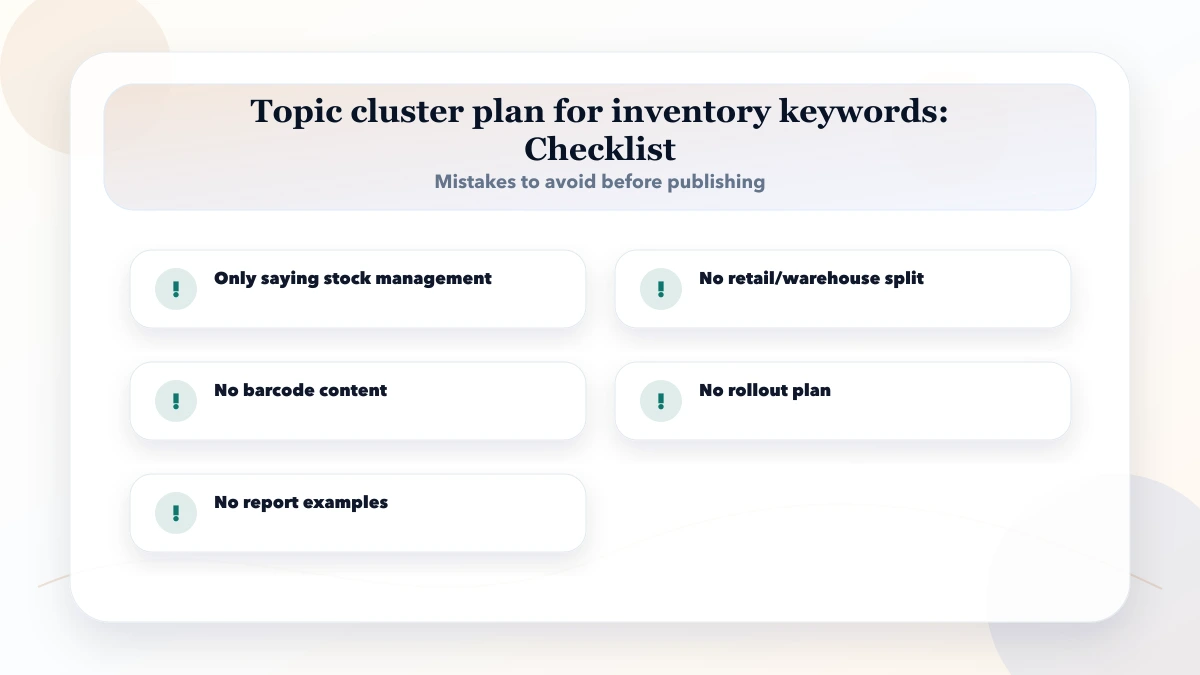
Start with revenue-adjacent topics. If your company sells CRM, do not only publish broad CRM definitions. Publish CRM cost, custom vs SaaS, implementation timeline, lead follow-up workflow, and sales pipeline reporting. If you sell inventory systems, cover barcode, retail, warehouse, stock reports, and rollout.
For Delhi NCR local SEO, use city and service language naturally. Mention service areas, proof, and process, but avoid stuffing every city name into every paragraph. Local usefulness is more valuable than repetitive location lists.
For software-company SEO, connect content to demos or proof. A buyer who reads an ERP roadmap article should be able to see related ERP modules, portfolio proof, and a clear way to request a consultation.
Measure this page like a business asset, not only like a blog post. For inventory keyword topic cluster, check Search Console queries after indexing, then group them into three buckets: direct-fit queries, nearby queries, and irrelevant queries. Direct-fit queries tell you whether the page matches the main intent. Nearby queries show which support pages or FAQs should be created next. Irrelevant queries show where headings or copy may be too broad.
Refresh the page every 30 to 60 days during the first few months. Add answers from real sales calls, improve examples, update pricing ranges if scope changes, and strengthen links to the most relevant service or portfolio pages. If a page gets impressions but low clicks, test the title and meta description. If it gets clicks but no leads, improve the CTA, proof block, form fields, WhatsApp message, and above-the-fold clarity.
Keep a simple scorecard: target keyword, current clicks, qualified leads, related pages published, internal links added, proof assets added, and next action. This prevents random publishing and makes SEO execution accountable. Over time, the best-performing pages should become cluster hubs that link to newer support articles, case studies, templates, and service pages.
It is a connected set of pages covering inventory software, use cases, workflows, pricing, comparisons, and rollout.
Yes, if both are important markets because their workflows and search intent differ.
Include inventory software, retail inventory, WMS, barcode system, stock reports, POS inventory, and cost topics.
Yes. Inventory buyers need to see how stock, reports, and alerts work.
Yes. Pricing and cost-driver content attracts high-intent buyers.
Link workflow blogs to the inventory pillar and relevant demos, case studies, and contact page.
If you want a practical SEO and topic-cluster plan for website development, web apps, software development, CRM, inventory, billing, ERP, portfolio, or lead magnets, VASUYASHII can help you plan and implement it cleanly.
Connect overlapping invoice, stock, purchase, and payment intent through the GST billing keyword cluster plan instead of publishing duplicate module pages.
Related Articles
May 24, 2026
Plan a barcode inventory system for receiving, putaway, picking, stock counts, returns, and transfers using mobile cameras or dedicated scanners.
Read article
May 14, 2026
CRM keyword topic cluster: practical 2026 SEO plan with cluster map, pricing, roadmap, mistakes, FAQs, proof, and next steps for Indian SMBs today safely.
Read article
May 14, 2026
Plan an ERP keyword cluster with one pillar, distinct module and industry intent, phased implementation guides, internal-link rules, proof boundaries, and lead tracking.
Read article
May 18, 2026
Plan ecommerce inventory sync across stores, warehouses and marketplaces using stock states, reservations, webhooks, idempotency and reconciliation.
Read article